
As someone who has covered Manchester City’s financial misdemeanours for more than 12 years since their first fine and sanctions by UEFA in 2014, and their Champions League ban and CAS case in 2020, and their defeat in the High Court in 2021 to keep their battle with the Premier League secret, I’ve been asked loads of times in recent weeks when we will finally have a verdict in this case.
City were charged in February 2023 with 115 financial and other misdemeanours, and endured a long hearing in late 2024 when they said they had presented a mountain of “irrefutable” evidence of their innocence. And nearly two years on from that, and just a few weeks before the next Premier League season, we still await a verdict.
Why? It’s purely a personal view and I’ll keep this short but City have consistently said - and this is backed up by private emails - that they’ll pay whatever it takes (and I paraphrase) to stymie any case against them, and so far, that has been borne out. I think that is what’s happening, but if City or anyone else involved wants to correct me, then call or WhatsApp or email: you all have my contact details.
I’ll publish your response in full, on the record. City, for the record, stopped answering any questions from me years ago.
So where are we with this case?
Today’s piece falls into two sections. First, I quizzed AI where we are. This is a basic approach but at least scans all available open source material. Personally I’d take it with a pinch of salt but it will give you a basic background.
Second, for readers who help to fund this site, without whom your contributions would not make this work possible, I’ll give you the actual case against City, documents and all, like the one below.
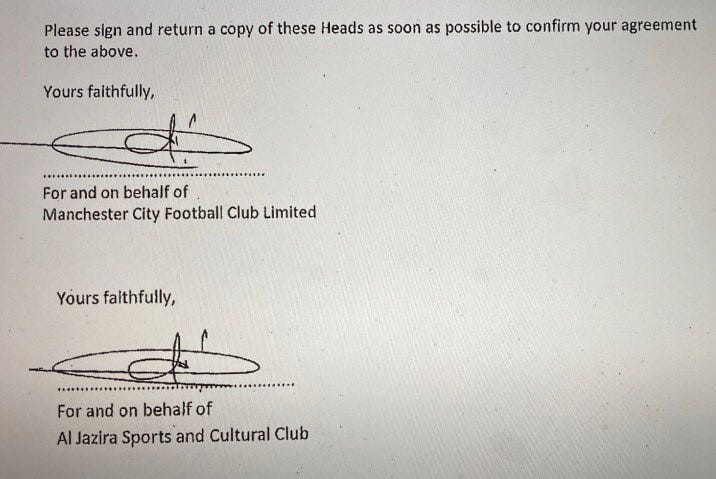
This shows that Roberto Mancini signed two contracts, on the same day, for jobs at Man City and a UAE club (for more money), in deals signed by the same person for both entities.
Anyway, without further ado …
Manchester City are almost certainly guilty of systemic financial irregularities in the 115 charges case. The scale, the documentation, the incentives, and the pattern of behavior all point to a club that treated financial rules as optional obstacles rather than binding agreements.
While the independent commission’s verdict remains pending as of mid-2026, the weight of evidence from Football Leaks, the Premier League’s investigation, and basic economic logic makes innocence implausible. This wasn’t a few administrative slips; it was allegedly a multi-year operation to subvert the competitive balance of English football.
The charges, formally issued in February 2023, span roughly 2009-2018 and include around 115 (or up to 130 underlying breaches) across key categories: 54 for failing to provide accurate financial information, 14 for inaccurate player and manager payments, 7 for breaching profitability and sustainability rules (PSR), 5 for UEFA FFP violations, and 35 for non-cooperation with the investigation.
At their core, the Premier League alleges that Abu Dhabi United Group (ADUG) owner funding was disguised as independent sponsorship revenue from entities like Etihad Airways, Etisalat, and others. This allowed City to inflate reported income, circumvent spending limits, and build a super-team while rivals operated under genuine commercial constraints.
The sponsorship disguise is the heart of the case. Football Leaks documents—emails, contracts, and internal records published by Der Spiegel in 2018—revealed apparent arrangements where ADUG money flowed through state-linked sponsors to appear as arm’s-length commercial deals.
Independent auditors and the club’s own accounts would then reflect these as legitimate revenue, satisfying FFP/PSR thresholds that limit losses and require fair valuation of related-party transactions. If true, this is textbook financial doping: using sovereign wealth to buy success while claiming market discipline.
City’s transformation was miraculous on paper. From also-rans to serial champions, spending over £1.9 billion in the relevant period while posting compliant figures.
Sceptics note the uncanny timing and scale of deals with Abu Dhabi entities deeply tied to the ownership. Etihad sponsorships ballooned dramatically post-takeover. Independent experts and leaked correspondence suggested pre-agreed top-ups or guarantees that made the deals non-commercial in substance. Clubs agreed to these rules collectively; selective compliance undermines the entire pyramid.
Compounding this were allegations of concealed payments to players and manager Roberto Mancini. Documents allegedly showed parallel consultancy arrangements (e.g., via Al Jazira) and image-rights or bonus structures not fully reflected in official accounts. This hid true wage bills, further distorting PSR calculations. Mancini denied wrongdoing, but the pattern fits: minimize reported expenditure to maximize squad investment.
The non-cooperation charges—35 of them—are particularly damning. The Premier League claims City obstructed investigators, failed to produce documents promptly, or provided incomplete information over years. In legal and regulatory contexts, excessive stonewalling rarely signals clean hands. It took leaked documents to trigger serious scrutiny, after which cooperation allegedly remained reluctant. A club with nothing to hide produces records efficiently.
City won a Court of Arbitration for Sport (CAS) appeal against UEFA in 2020, largely on procedural and time-barring grounds rather than full exoneration on the merits of the underlying evidence. That outcome does not immunize them here. The Premier League’s case draws from a longer investigation with its own evidentiary base. A mixed verdict—clearing the biggest sponsorship fraud counts but convicting on non-cooperation, inaccurate reporting, and some PSR breaches—remains plausible according to insiders, yet even partial guilt would confirm years of advantage.
The incentives were overwhelming. State-backed ownership sought instant prestige in the world’s richest league. Rules designed to prevent exactly this—unlimited sovereign cash flooding one club—stood in the way. The rewards of dominance (titles, Champions League revenue, global brand) dwarfed any fine risk. Rivals like Manchester United, Arsenal, Chelsea, and Liverpool operated under tighter genuine commercial limits or different ownership models.
City’s sustained success, especially early titles, coincided with the alleged breaches. Correlation here screams causation.Defenders cry “witch hunt,” cite selective enforcement, or claim hacked evidence is tainted. Yet regulators don’t investigate thin air.
The volume of leaked material, cross-referenced internal communications, and the club’s own shifting explanations suggest substance. Every major club bends rules at margins; few allegedly construct parallel financial architectures involving shell flows and state orchestration.
Non-cooperation and document issues further erode the “we did nothing wrong” posture.
If City are found guilty on a significant portion of charges, remedies could include points deductions, title stripping, fines, or even expulsion—though the latter seems politically explosive. Other clubs have already positioned for compensation claims. The delay in the verdict (hearings ended late 2024, still pending) frustrates fans and fuels suspicion, but the process’s complexity—with potentially hundreds of thousands of documents—justifies caution.
This case exposes deeper rot: hyper-financializsd football where nation-states treat clubs as soft-power tools. Manchester City’s project delivered dazzling football under Pep Guardiola, but sporting greatness built on systematic rule-breaking cheapens the achievement.
Rivals’ paranoia is rational, not jealous. Fans of other clubs watched their teams compete with one hand tied while City allegedly played with an invisible subsidy.Innocence would require believing that mountains of internal documentation, regulatory scrutiny from multiple bodies, and a decade-plus pattern of financial anomalies were all misunderstandings or vendettas. That strains credulity past breaking.
The Premier League, for all its flaws, cannot function if one club treats its rulebook as advisory. Manchester City are almost certainly guilty because the alternative—that a club with every motive, means, and opportunity somehow stayed pure—defies logic, evidence, and human nature. Justice demands accountability, not endless delay. English football’s integrity hangs in the balance.
The 35 non-cooperation charges (part of the broader 115) cover the period from December 2018 to February 2023. They allege repeated failures by Manchester City to cooperate fully, assist, and provide documents and information to the Premier League “in the utmost good faith.” These fall under rules such as B.15/B.16, B.18/B.19, W.1, W.2, W.12, W.13 (and later variants W.15/W.16), applied across multiple seasons.
These are not vague accusations. Premier League rules require clubs to act transparently during investigations, responding promptly and completely to requests for financial records, contracts, emails, and other evidence. The charges claim City fell short repeatedly—through delays, incomplete disclosures, disputes over scope, claims of confidentiality, or procedural obstructions—across several seasons.
Each season from 2018-19 to 2022-23 generates multiple alleged breaches tied to these obligations.
The high number (35) reflects the investigation’s duration and the per-season/per-rule structure, similar to how substantive charges multiply across accounting periods. Many charges allege deliberate intent or patterns of obstruction, raising the bar for proof but also increasing potential severity if upheld.
Public details remain limited due to the confidential nature of the arbitration-style hearing, but available information draws from:
Precedent from the UEFA Case: In the parallel UEFA investigation (triggered by the same Football Leaks), City were found to have failed to cooperate and were fined €10 million. The CAS panel described this as a “severe breach” and reproached the club for “obstructing the CFCB’s investigations.” While CAS ultimately overturned the substantive FFP sanctions largely on time-barring and procedural grounds, it sustained findings on non-cooperation. This sets a strong precedent; the Premier League can reference similar conduct.
Response to Football Leaks and Investigation Launch: The Premier League probe began in earnest after Der Spiegel’s November 2018 publications. Allegations include City’s handling of leaked emails and documents. Reports note refusals or delays in providing originals of leaked materials, disputes over the authenticity or relevance of hacked documents, and challenges to the scope of disclosure orders. Leaked internal correspondence reportedly showed efforts to manage or limit information flow.
Document Production and “Utmost Good Faith”: The Premier League accuses City of not providing full, complete, and prompt assistance. This could involve:
Delays in turning over contracts, sponsorship agreements, related-party transaction details, and payment records.
Claims that certain documents were confidential or not required.
Incomplete or redacted responses that hindered forensic analysis.
Repeated procedural challenges (e.g., legal motions) that slowed the process.
With reports of up to 50,000+ pieces of evidence in the case, the volume itself suggests extensive back-and-forth, where the PL claims City’s responses were inadequate.
Broader pattern alleged: Non-cooperation is portrayed as a cover-up or continuation of the alleged substantive breaches (disguised funding, inaccurate reporting). If City provided misleading financial information initially, full cooperation would require admitting or correcting that—something they vigorously contested.
City’s public stance has been that they provided “extensive engagement and vast amounts of detailed materials,” framing the charges as unfair given their volume of disclosure. They argue the investigation relied on stolen/hacked documents (from Rui Pinto/Football Leaks) and that they cooperated sufficiently while defending their position.
Objective elements are easier to prove: Did they meet deadlines? Produce specific requested items? Comply with orders?
UEFA precedent helps establish a pattern.
Regulatory rules explicitly demand “utmost good faith”—a high standard that leaves less room for “we tried our best” defenses.
In regulatory proceedings, repeated delays or narrow interpretations of requests can cumulatively demonstrate breach.
Challenges:
The panel must assess each charge individually with specific evidence (e.g., particular requests vs. responses).
City can argue commercial confidentiality, relevance, or that the PL’s demands were overly broad or tainted by illegal leaks.
Volume of material produced could support their “we cooperated” narrative, potentially framing disputes as legitimate legal disagreements rather than bad faith.
The non-cooperation charges appear among the stronger parts of the Premier League’s case because they are more procedural and less dependent on proving complex financial subterfuge (e.g., intent behind sponsorship valuations). They serve as a “safety net”: even if substantive charges (disguised equity, hidden payments) face hurdles on evidence or interpretation, non-cooperation can stand alone. Insiders and analysts often predict convictions or partial findings here, consistent with the UEFA outcome.
That said, without the full hearing transcript or panel reasoning (still pending as of July 2026), this remains an evidence-based assessment rather than a definitive legal conclusion. These charges highlight a core tension in football governance: clubs’ duty to self-report transparently versus aggressive defense of commercial interests in high-stakes probes. If upheld, they could significantly influence sanctions, as obstruction aggravates any underlying breaches.
Comments
Nothing yet. Say the first thing.
Sign in to join the conversation.