
Happy 250th birthday to the USA for tomorrow! And welcome to the most American Sporting Intelligence newsletter that you will ever read.
Much of this World Cup has been ‘Americanised’ - from the commercial breaks (let’s call them what they are) to the four quarters and the omnipresence of David Beckham, a living billboard, and Sporting Intelligence wants to give you a flavour of what this World Cup on Uncle Sam’s territory has been like so far.
After brief detours to Boston and New York City, this Sporting Intelligence correspondent travelled to Texas, the Lone Star State, to report on the round of 32, in part motivated by Brazil’s match against Japan. Generating global acclaim, the Asian powerhouse however disappointed in a 2-1 defeat.
At least Texas didn’t. On the way to the Dallas Stadium, a car plastered with religious slogans offered some warm words of advice: “The Bible says God will spit lukewarm Christians out of His mouth.”
Religion seemed to be a theme near the venue. Jordan, a Broncos fan, and Eli were canvassing for the ‘Mission Cup’, self-described as “a gospel-centered outreach that takes place alongside the World Cup, using the global passion for soccer to share the message of Jesus Christ”.
When asked if football had replaced religion, Jordan said: “In a way, I can see that. It’s a way of idiolising persons and sports brings people together. It’s easy to strike up a conversation.”
Putting a hand on each of my shoulders, Eli and Jordan then proceeded to pray for this Sporting Intelligence reporter: “I don’t know Sam, but I thank the Lord for meeting him, for bringing him into my life as a nice person. That the Lord may accompany him, that the Lord may arrive in his life and guide him.”
Our blessings were almost short-lived. On the road to Memphis in the great state of Tennessee, we were pulled over by Texan police. In a scene right out of a movie, we sat frozen in our seats. The officer told my Irish colleague, who drove: “Get out of the car, don’t be playing games with me.”
In a cowboy hat and with a deep Southern accent, he admonished: “85mph might be fine in Ireland but that can land you in jail in Texas.” Luckily, the sheriff let us go and we arrived in Memphis in one piece, taking in the last 10 minutes of Mexico - Ecuador on Tuesday, alongside the Mexican diaspora, mainly workers at local restaurants and bars, at the midtown bar Celtic Crossing.
Sporting Intelligence had come on a road trip to the Bible Belt - not to gloat over the many clichés it offered - from the Trump signage to cowboy churches - but to understand if the World Cup was cutting through in the US, away from the host cities.
Memphis, heavy on Elvis Presley history, is where Dr Martin Luther King was shot at the Lorraine Motel on 4 April, 1968. The city does not have much of a ‘soccer’ culture, with the local team ‘Memphis FC’ competing in the USL, the second tier of American football.
The following morning - after a carjacking around the corner from Sporting Intelligence’s accommodation - the scene was very different at the same bar. It was desolate and just seven England fans showed up for the round of 32 clash with DR Congo. Perhaps locals and Americans could have been forgiven - it was an 11am kickoff on a Wednesday and the mercury was hitting 32 degrees already.
A stone’s throw away, at the Young Avenue Deli bar, locals were enjoying brunch. A high-school basketball coach, Tevin Jackson, was just about the only person paying attention to the match. He’d got into the Word Cup because of the low-scoring element of the game. He said: “Basketball is very high-scoring. I like the skill and footwork in soccer. That’s what I work on with my kids as well.”
In the commercial break for the fourth quarter (more on that later), brand Beckham went into overdrive, featuring in Home Depot and Verizon ads. “The FIFA World Cup is here in our backyard. Is David Beckham ready?” a Home Depot manager asks over the intercom. Beckham is then seen shopping, walking through the aisles of Home Depot. In his garden, he turns into a beekeeper and says, from behind a bee veil, in stilted fashion: “You have to try this, this is so relaxing.”
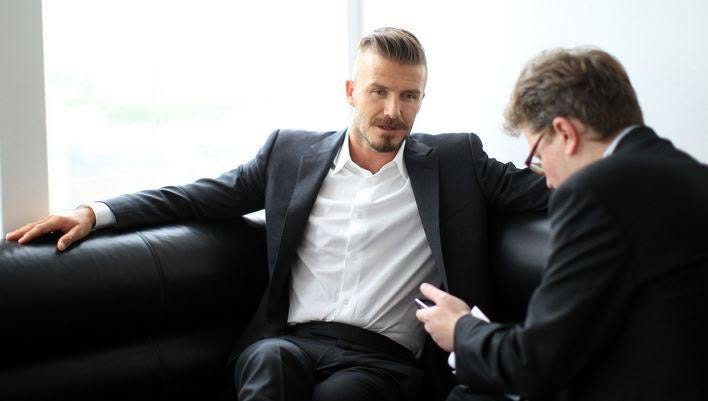
Beckham (below, receiving fashion advice and abdominal workout tips from Sporting Intelligence editor, Nick Harris) is ubiquitous at this World Cup. Everywhere you look, Becks pops up - eating Lay’s crisps or celebrating with a cold Stella Artois beer. He also endorses McDonald’s, Bank of America and Lenovo.
In 2007, the England star moved to MLS franchise, the LA Galaxy, and in a way, legitimised the American top division. He became the face of soccer in the US, embracing the local celebrity culture. Tom Cruise, Katie Holmes, Jennifer Love Hewitt, Eva Longoria and Arnold Schwarzenegger attended his first game in a Galaxy shirt against Chelsea.
Today, Beckham is the owner of Inter Miami where Lionel Messi plies his trade. At England - Panama in New Jersey, he was shown no less than four times on the big screen. It talks to the celebrity culture of the US, where Paris Hilton introduced the match ball at US - Turkey or Cooper Flagg was shown on the Jumbotron in Dallas during Norway - Ivory Coast. Flagg who?
“In the United States, Beckham remains arguably the only footballer who has truly crossed over into mainstream culture,” Ricardo Fort, a marketing expert and previous sponsorship executive at Coca Cola, told Sporting Intelligence.
“Americans may know Messi, but Beckham is more than a former football player, he’s a global celebrity, fashion icon, businessman, MLS pioneer and now co-owner of Inter Miami. He resonates with football fans and non-football fans alike.”
Fort believes that Beckham is making a fortune out of his commercial endorsements during the tournament. “My estimate is that each major World Cup-related endorsement deal is worth between $3 million and $5 million,” explains Fort. “His total commercial earnings associated with the tournament could easily reach $20 million.”
Fort says: “There’s just one Beckham. He is really on a league of his own”.
Yet, when every brand borrows the same celebrity, Fort cautions that his presence across so many ads “limits his value as an ambassador for all of them. When he speaks for so many sponsors, no brand gets the differentiation they hope to have when signing him.”
Beckham has been front and center of this “Americanised” World Cup - the sky-high ticket prices, the commercial breaks, the four quarters, the vast NFL stadiums, the lack of public transport - and, of course, Americans microwaving croissants left and right.
Where to start with all of this? FIFA offered $9,000 tickets for the clash between Lionel Messi’s Argentina and Pico Lopes’ Cape Verde in Miami. Talking to supporters across the US and Canada, they understood that they were getting exploited by FIFA, but attended the matches because it was a once-in-a-lifetime opportunity.
Valentin Schneider, 19 and his friend had travelled from Austria to attend the country’s opening match against Jordan in San Francisco. They paid $400 for a ticket, the equivalent of season ticket in category 1 at Austria Wien, the club they support.
Schneider said: “The ticket price is too much, but it’s the first time Austria are participating since 1998. I wasn’t even born. The match against Argentina is even more unaffordable.”
Sanel Talic, a Bosnian-American from Tampa, Florida, agreed. He flew to Los Angeles for Bosnia - Switzerland. In the rouse - and alcohol - of qualification against Italy, his cousin bought $1,500 tickets for the match. He pays $2,000 for a season ticket at the Tampa Bay Buccaneers. The trip with his son became an easy $4,000 exercise. His father, traveling from Sarajevo, also spent $4,000, four times the average salary in Bosnia.
Talic said: “You know, it’s the World Cup and I expected to pay up, but it was quite a bit. The overall experience was fantastic and something I could not imagine in my dreams. It was worth it. My son’s expression and hearing - it was the best day of his life and that was enough for me.”
They had to add local transport to their bill. Public transport in LA and the United States is very limited, if not non-existent. How can you put on a major tournament without offering traveling fans proper public transport options? This Sporting Intelligence reporter racked up $170 in Uber bills in a single day in Los Angeles. It left me weeping on the floor, but, in all fairness, I had been warned a few weeks earlier by a Californian at the Champions League final: “Uber is our public transport.”
One Uber driver told me he worked three gigs to earn $5,000 a month and barely surive in LA. He wanted to get out. It’s curious to report in a country that does not provide basic services and simply wants to privatise and monetise everything.
It’s led to a society that is grim and unequal, often disproportionally affecting African-Americans. Located at the Motel Lorraine, the National Civil Rights Museum cautioned that 35.9 million people in the US live below the poverty line (set at $33,000 for a family of four). That’s about ten percent of the US population. “If everyone who is below the poverty line in America formed their own country, that country would be bigger than Australia,” said Matthew Desmond, professor of sociology at Princeton University.
Chasing the money, FIFA don’t want to get out. The US might be lined up to host the 2038 World Cup. At least by then, one can hope the stadiums will have improved.
Talic witnessed Bosnia’s 4-1 thumping by Switzerland at Sofi Stadium. Like some of the other venues at this World Cup, the LA venue is state-of-the art with a $5 billion price tag and a massive Jumbotron. But, what precisely is impressive about a big screen? The venues in Los Angeles, Houston and Dallas are billion-dollar domes of interchangeable soullessness. You simply don’t know which city you are in.
At least fans around the tournament, including Talic, have booed the by-now much-hated commercial breaks, which FIFA dresses up as hydration breaks - for player safety. It’s extraordinarily cynical but telling of FIFA’s modus operandi: servicing broadcasters and commercials partners under the veil of protecting players. Did Ghana - Panama in the Toronto rain require a hydration break?
At the same venue, Ivory Coast - Germany, with Sporting Intelligence in attendance, was flowing nicely before the first quarter ended. Boos rolled down the stands. It was the same at Norway - Ivory Coast in Dallas. Talic said: “I hate the drinks breaks, it kills the momentum.”
Schneider added: “Everything is being capitalised on. It’s all money-driven.”
US broadcaster Fox will reportedly enjoy a $250 million windfall from added advertising revenue during the commercial breaks. Telemundo, the Spanish-language broadcaster in the US, has refrained from cutting to advertisements during the breaks.
Back in Memphis, the Celtic Crossing was heaving when the USA took on Bosnia & Herzegovina. The crowd were a mix of soccer fans and Americans jumping onto the bandwagon. Matt from Mississippi was a casual watcher: “I am the wrong person to ask (who is going win).”
As Malik Tillman, got the winner, chants of ‘USA, USA’ broke out. The Trumpian connotation is hard to ignore these days, but, at least, Memphis is a liberal stronghold in redneck country. Trump himself has been conspicuously absent from this World Cup so far.
Sporting Intelligence was just about ready to depart Tennessee and return to the great state of Texas - not before listening to the words of DJ Naylor, the owner of the bar: “There’s religion and soccer. Well, religion doesn’t seem to matter right now, nor does anything else, to be honest.”
Perhaps he had a point?
Comments
Nothing yet. Say the first thing.
Sign in to join the conversation.