
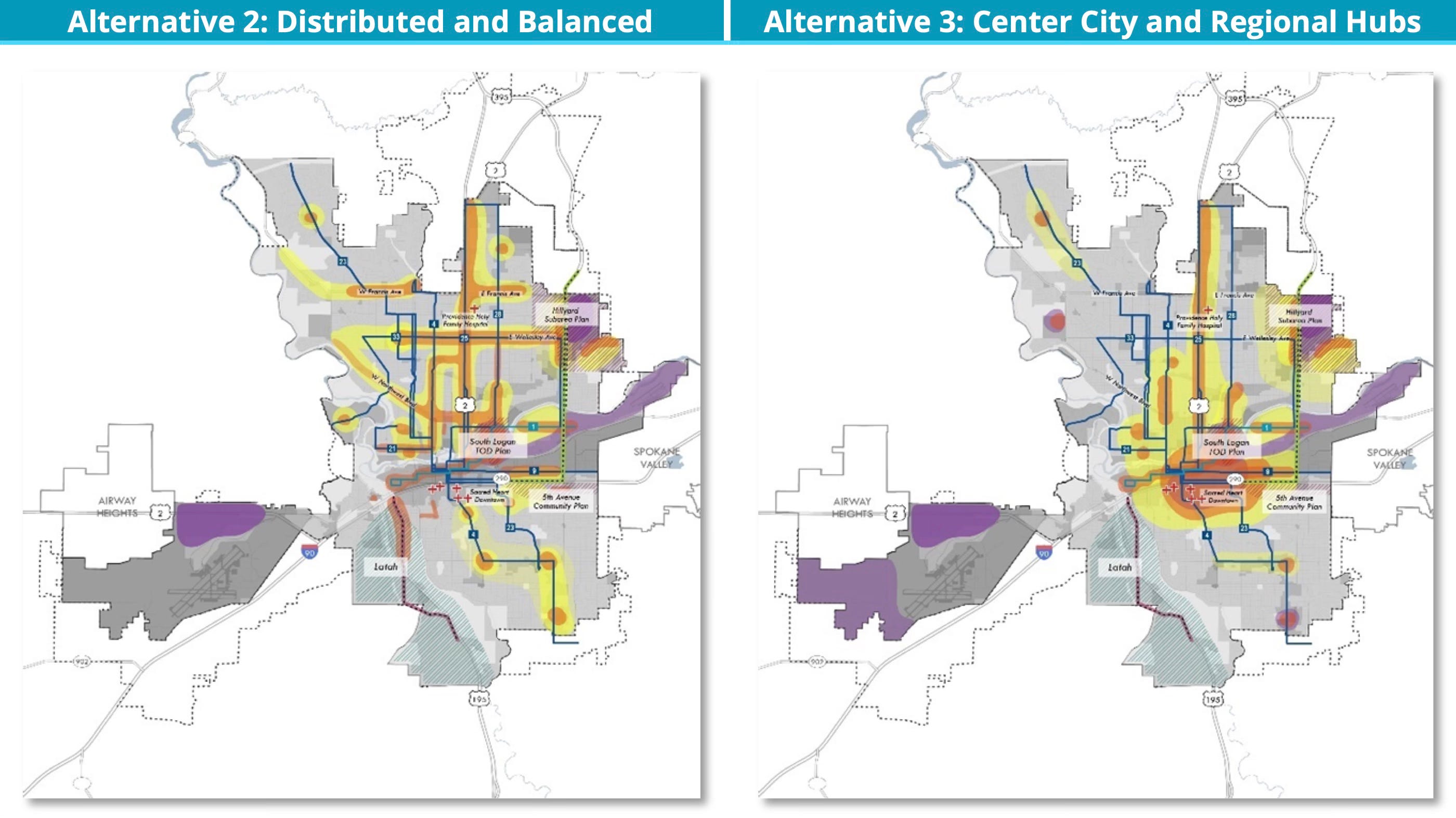
Today, in lieu of a deeper dive or a news summary, I wanted to share my comments on the city’s PlanSpokane 2046 Comprehensive Plan DEIS, which is the city’s official growth strategy for the next 20 years. It’s required by law under the state’s Growth Management Act, and it needs to be updated every ten years. This is a big opportunity to unlock additional housing and economic growth across the city.
Comments are due today at 5pm to planspokane@spokanecity.org. You can learn more about the plan and how to submit comments here.
Hello, Spokane Planning team ––
I wanted to write a quick note to thank you for your hard work on the CPPU (PlanSpokane) Draft EIS. I have a couple comments which, for simplicity, I want to summarize here:
1. Please ensure the FEIS and adopted growth strategy accommodates sufficient growth in high-resource areas like the South Hill. I’m very concerned that both Alternative 2 and Alternative 3 distribute too little housing growth in areas of high relative economic opportunity, like Manito, Lincoln Heights, Comstock, and Southgate. Instead, a substantial amount of growth is concentrated in places like downtown and Hillyard, which have disproportionately borne high environmental and economic burdens. As you know, HB 1220requires planning for and accommodating housing at all income levels, and requires communities to identify policies that result in exclusion in housing. Too little growth being dedicated to high-resource areas could be seen as not adequately complying with HB 1220. The final EIS growth strategy should include additional growth corridors and nodes on the South Hill.
2. Please ensure the FEIS and adopted growth strategy plans for (a) sufficient housing growth and (b) additional commercial opportunities in legacy R1 neighborhoods. It’s important to recognize that the Centers and Corridors growth strategy which undergirded Spokane’s original Comprehensive Plan centered growth on high-traffic, high-noise areas with significantly higher environmental burdens. There is substantial research showing that living in these places takes a toll on human health and increases risk of serious injury through traffic violence. In order to address this, and indeed, in order to ensure a high quality of life even for apartment-dwellers and renters, we need to allow more growth (even beyond that allowed through our middle housing code) outside of these busy arterials, in legacy R1 neighborhoods. Additionally, there is significant demand for additional retail opportunities, like cafés and corner stores, in these neighborhoods. Places like Doyle’s and The Scoop are beloved community gathering places, and more neighborhoods across the city deserve the opportunity to enjoy them. Please ensure the FEIS includes policy and the adopted code includes allowances for these small-scale commercial uses in legacy R1 residential zones.
3. Please ensure the FEIS and adopted growth strategy plans for the higher job growth target of 38,848 new jobs by 2046. I was pleased to see the inclusion of a more ambitious jobs growth target in the studied alternatives. This recognizes the critical need to provide more high-wage jobs in growth industries for Spokanites. As the economy continues to change, primary employment (that is, jobs in industries other than healthcare, education, and government) is becoming increasingly critical. We need to ensure our growth targets and lands allocations accommodate this essential growth to increase opportunity for local residents.
4. Please adopt the maximum possible SEPA exemption for infill development allowed by state law. As you know, under SB 5412, the state has allowed cities to conduct all environmental review for more types of projects, including housing and small commercial development, at the plan level, instead of the project level. This type of reform makes housing much less expensive to build, reducing delay and risk in the development process. It also makes it easier to construct office buildings and other types of development in areas where environmental impacts are unlikely. To ensure certainty for developers while adequately planning for potential adverse impacts, the City should adopt the maximum exemption allowed under the statute––200 units of multifamily development or 65,000 sf of commercial development.
5. Please ensure the FEIS and adopted Comprehensive Plan sufficiently plan for greenhouse gas emissions reductions as required under HB 1181. While the EIS appears to do a decent job of addressing climate resilience, I would like to see additional policies and guidance aimed at achieving meaningful GHG reductions. For example, the Comprehensive Plan could adopt powerful new policy aimed at reducing vehicle miles traveled (VMT) through investments in the transportation system, or adopt policy aimed at incentivizing mode shift toward sustainable modes, like walking, biking, and using transit. Importantly, these policies would then need to be backed up through project-level decisionmaking and the adoption of capital plans. These types of policies––which actually reduce GHG emissions, rather than merely planning for resilience––are required under HB 1181.
Thank you so much for your hard work. I’m looking forward to seeing the plan adopted and implemented.
Thank you,
Anthony Gill
Want to submit comments of your own? There’s still some time!
You can learn more about the plan and how to submit comments here. But be quick: comments close at 5pm sharp!
Thanks for reading Spokane Rising! This post is public so feel free to share it.
No posts
Comments
Nothing yet. Say the first thing.
Sign in to join the conversation.