
Dear word explorer,
House of Wyrd continues its worldwide book tour. People have contacted me from lands close and distant to notify me they’ve received their copies. I’ve also been hearing fine reports from readers who have loved the strange adventures of the mother/daughter duo Aly and Pallas.
Don’t forget to recommend the book if you’ve enjoyed the wild ride on the Wyrd train, or just buy a friend a copy.
This is an irregular reminder that NASA’s James Webb Space Telescope continues to wow with its astonishing observations. The above image was taken on the 10th of August, and it’s a spectacular, awe-inspiring image of the Lion’s Mane Nebula.
The mane of the lion is the interior of a dust shell that is being illuminated by the white dwarf at the center. The tufts of hair, which look like cometary tails of material, are compact clumps of dust that have survived the stellar core’s radiation and protect the material that lies behind them.
The skies are particularly potent right now, with a total solar eclipse arriving on the 12th of August: the path of totality will pass over parts of Greenland, Iceland, northern Russia, the Atlantic Ocean, Spain, and a smidge of Portugal.
If you don’t live in any of those regions you can livestream the eclipse courtesy of the ESA’s telescopes at the Observatorio Astrofísico de Javalambre in Teruel, Spain at approximately 6.30 pm (Irish Time).
The total solar eclipse that’s already attracting attention is next year’s show on the 2nd of August 2027, which is being nicknamed the Eclipse of the Century. It will be visible across stretches of Spain, Morocco, North Africa, and the Middle East. Eclipse chasers are planning to watch the event in Luxor in Egypt where the solar blackout will last approximately six minutes and 23 seconds.
Luxor is best known for its Karnak Temple Complex, which was part of the magnificent ancient city of Thebes (Waset in Egyptian), and is also home to an extraordinary Necropolis. The God most associated with Thebes during the New Kingdom period (ca. 1550-1100 BCE) was Amun, one of the eight primordial Egyptian gods, often known as the Ogdoad (‘eightfold’). He eventually became associated with the sun god, Ra, and was known as Amun-Ra, which boosted him to become ‘King of the Gods’. If you fancy watching a solar eclipse in action (and many traditions consider that a dangerous act), this is a area charged with strong solar associations.
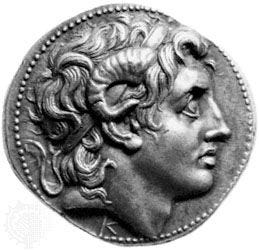
It should be no surprise that the Greeks associated Amun-Ra with Zeus (or Jupiter for the Romans), and they created another merged entity known as Zeus-Ammon. The interesting story here is that after invading Egypt Alexander the Great consulted the oracle of Amun-Ra in the Siwah Oasis, where it is said the Oracle declared Alexander as the offspring of the God. Thereafter, Alexander referred to himself as the son of Zeus-Ammon, and many statues and coins were created that showed him with the Horns of Ammon.1
Ever have conquerors bestowed upon themselves the mantle of divinity; yet all of them have perished.
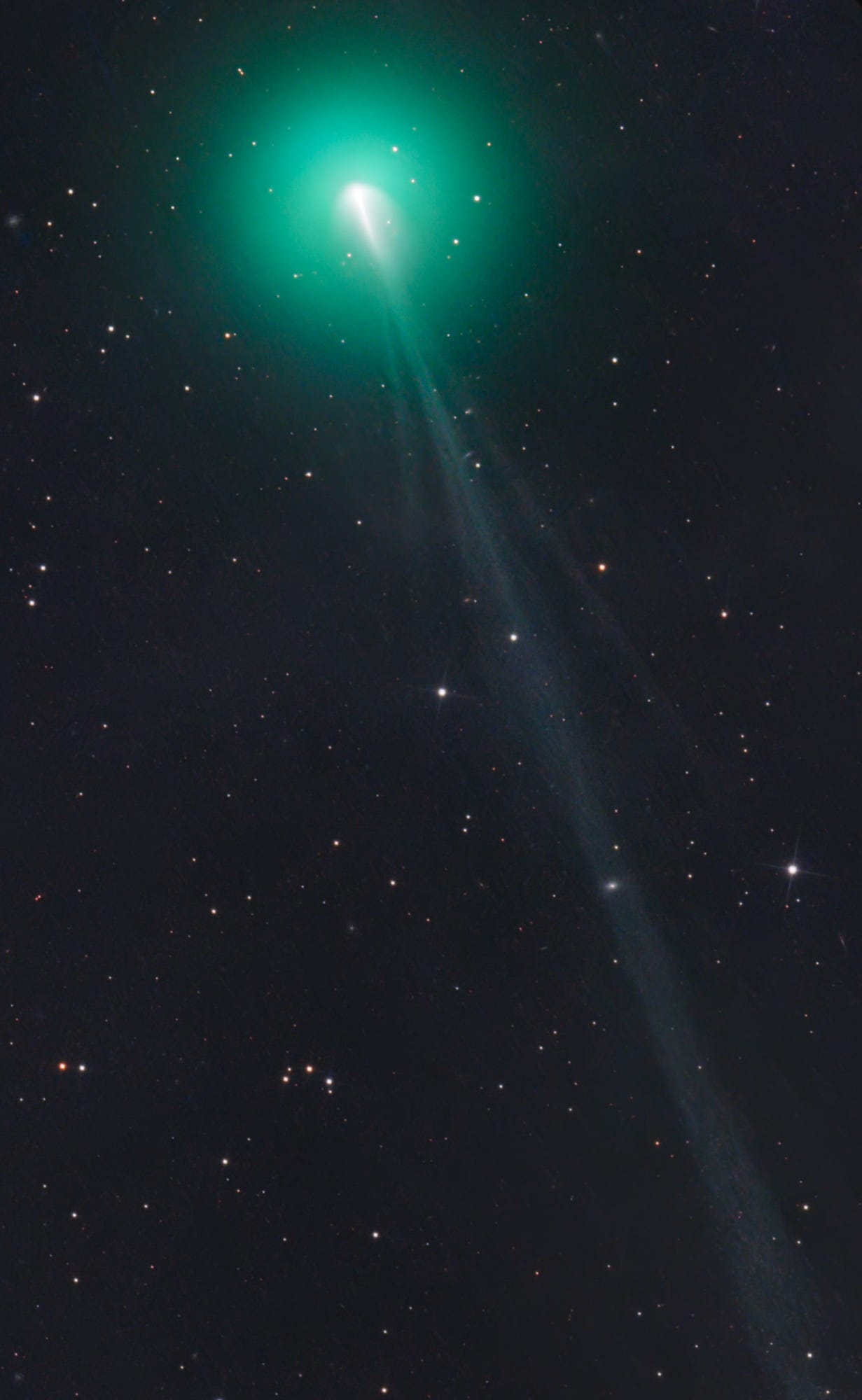
Since the solar eclipse tomorrow is technically a New Moon the heavens are quite dark, which means we should have a terrific view of the annual Perseid meteor shower (from approximately the 12-13th of August). What a night — a solar eclipse and comets! It’s a good time to get outdoors and enjoy our visiting fireworks.
Plus, there’s also been a surprising double outburst from Comet 220P/McNaught:
220P/McNaught, is a Jupiter-family comet with a 5.5-year orbit around the Sun. It is one of several comets discovered by Australian astronomer, Robert H. McNaught. It reached perihelion on June 14, 2026, two weeks after a large outburst in which the comet brightened as much as 8,000 times. In August 2026 there was a second outburst brightening by a factor of about 600.
Keeping with the theme of being impressed by the extraordinary beauty of our cosmos, have you seen the images from the Daniel K. Inouye Solar Telescope, near the summit of Maui’s Haleakalā, of the sun’s photosphere (its surface)?
It includes never before seen details of Kelvin-Helmholtz instability (KHI) on the Sun’s surface, which appear like small whirlpools.
An effect caused by fluid motion, KHI occurs when two fluids slide past each other at different velocities creating a “shear” at the interface—causing small disturbances to grow into striking, wave-like or spiraling, vortices that look like breaking ocean waves.

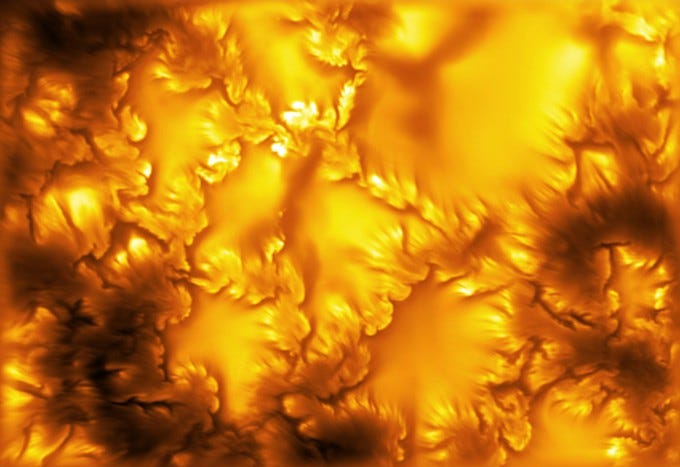
To me, this still image seems like solar lichen! We are part of a luminous and enchanting universe.
Sadly, the issue of launching more and more satellites into orbit around Earth continues to be the latest tech gold rush. The latest proposal by SpaceX is to place a million AI data-centre satellites in orbit so they can be powered by solar energy: this is being dubbed the Starmind system.
SpaceX filed its application on January 30, 2026. The Federal Communications Commission accepted it for public comment on February 4.
The filing seeks authority for a non-geostationary system of up to one million satellites between 500 and 2,000 kilometers altitude. The spacecraft would exchange data through optical links and connect with SpaceX’s Starlink network.
Once again, how can the American FCC rule on a system that will affect the entire globe?
The Earth and its atmospheric layers is a holistic system with an established balance, and this level of interference will have consequences.
Perhaps these plans will not be enacted. Perhaps the regulators will see sense. Perhaps people will demand a change.
Go out and enjoy the natural celestial displays while you can.
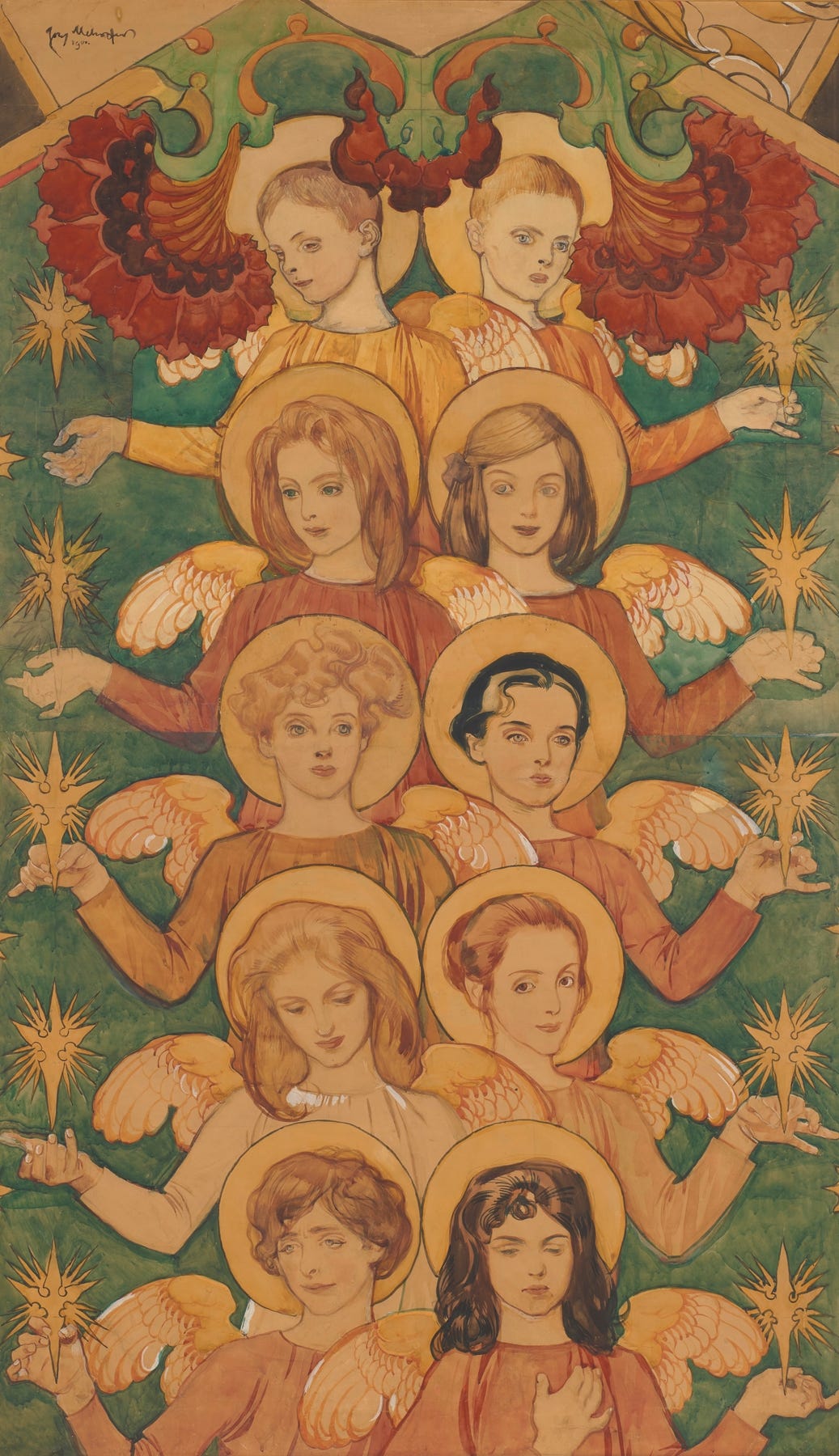
In 1848 German paleontologist Karl Alfred von Zittel officially introduced the word Ammonite (and the class Ammonoidea) to describe the spiral fossil shell, based on the Horns of Ammon.
Comments
Nothing yet. Say the first thing.
Sign in to join the conversation.