
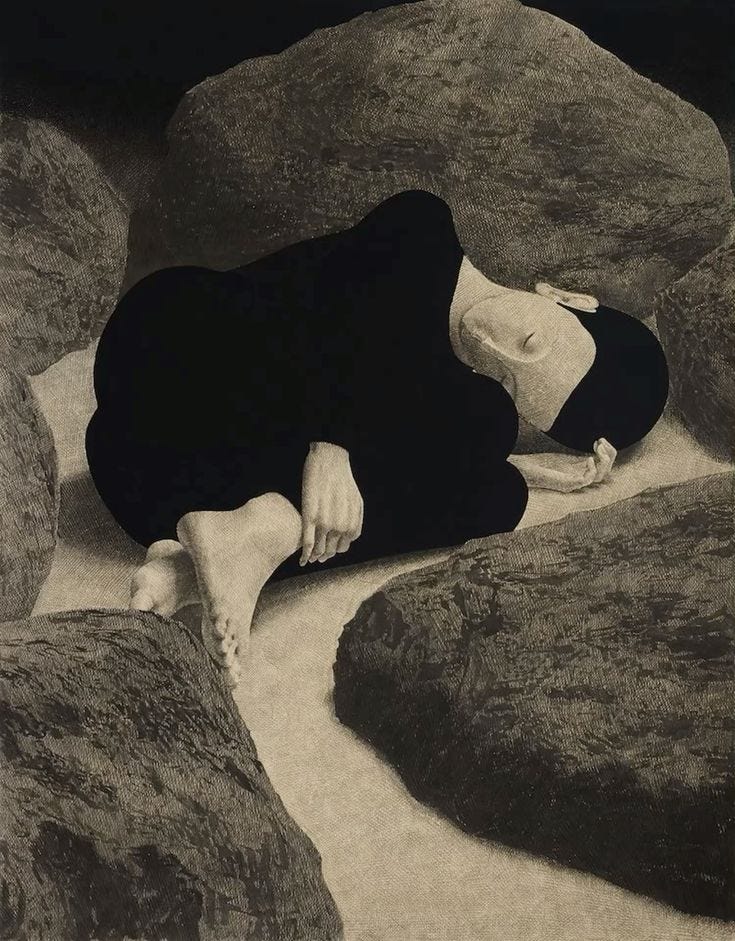
“Before, the only thing I was interested in was love, how it grips you, how it terrifies you, how it annihilates and resuscitates you. I didn’t know then that it wasn’t even love that I was interested in, but my own suffering. I thought suffering kept things interesting. How funny that I called it love and the whole time it was pain.”
— Ada Limón “Calling Things What They Are”
It’s so easy to find sadness, sorrow, and melodrama to be more interesting than happiness and joy.
What is the mystery of joy? Is it as easily accessible as the mysteries of sadness?
Do we think that joy or happiness is less interesting because people are so forthcoming about why they are happy or why they are joyful, and there is an exclusivity to being let into someone’s melodrama?
Although, in a literary sense, when I consider the landscape today, I don’t know how true that is, because I feel sadness has sold a lot. It is marketable and profitable. Maybe that’s just because again, there feels like a mystery to it. Because to express your sadness and discontent is a vulnerable thing.
It is similar to when it’s late at night, and you scroll through someone’s page on social media. You see their highlight reels and a gallery of their best and brightest moments. Staring at it, you think, okay, your joy is on display for all to see. And it’s very explicitly clear why you’re happy.
Or standing at an event with all of your friends and family, beaming with joy, and you know, like second-nature, doubtless that the depth of this happiness is rooted in the community you stand with, and the value you place on it.
But regarding sadness…sometimes a lot of work is required, much digging to figure out why you’re even sad and how to remedy that.
It’s worth asking how often people visit therapists to discover why they’re happy. I feel as though we are more keen to invest in discovering the roots of sorrow and the fruits of sorrow. It feels like a problem to be solved, in a way that joy is not.
It almost feels as if there’s some kind of economy for sadness and the melodramatic, and that it’s worth more because of the exclusivity in discovering answers, or what’s more, how forthcoming one might be about the answers they have discovered.
And then there’s this payoff of relatability, because most people are developed in their suffering, and most people want to find someone who can relate, because more than anything, we want to know that we haven’t come into this world to be scathed on our own, but that there is this communal aspect of suffering.
So when I think about these things, it’s really no wonder to me at all why, sometimes, when I write or create, I feel the best art I’ve created is because I dove into this exploration of sadness. Like I’ve hit a gold mine. Doesn’t make it true, but the concept lingers.
And so we look to the sad movies after the breakup, the book about rejection and loss, and grief when we are either scared of them and trying to understand them, or have already experienced it and are either still trying to further understand it, or just find that relatable aspect to feel less alone in the world.
Moreover, I also have “flood subjects”, as Emily Dickinson called them—things that I think about all the time because I feel as though the more I can understand something, the better I can shield myself from it.
That maybe if I am a field expert, something will not impact me, or that, in the worst-case event that it does, I am perfectly logically prepared to deal with the emotional devastation of a thing. So, the day after I close the book about the thing that I hope never happens to me, I live in the illusion that that is my defense.
Perhaps this is why sadness sells as well as it does. Maybe between the relatability and the communal aspect of not wanting to be alone in suffering, we are also just students of the things that we don’t actually want to feel or experience because we think that our knowledge base will be our best line of defense.
We make a move that says: if we can understand our deepest sorrows and fears, they will not overcome us, because something you don't understand can feel like it has power over you. We might obsess over the things we can't understand, but we still don't like them. That’s the theory anyway.
I don’t know how to explain to myself that my sorrow is not more interesting than my joy. I am not sure if it is the truth, or if I lack the maturity it takes to find joy more intriguing.
Maybe I just believe that suffering is more interesting, and my suffering being more interesting to me does not mean that interesting is better. So perhaps it’s okay to come to a conclusion at this point in my life that I am more interested in my suffering in a lot of ways.
My relationship with suffering and my understanding of it or preoccupation with it is dynamic, and has different movements and forms throughout the years. Something I have learned, though, is that I don’t have to cling to my suffering, like a life jacket, or make close friends with my sadness.
I believe the point is to be able to distance myself from a thing and be intrigued by it without having to develop myself in it or let it consume me, rather.
Maybe it’s just a season of my life that I find the lows more interesting, and I will be more enthralled by joy because the person I am today finds joy to be theoretically more apprehensible than my sadness.
It feels like the darkest days that I have are more fleeting than the joyful ones, and it can feel as though I have to jump on every ounce of somber to experience some kind of depth when really there is still depth in joy—fullness of joy.
It feels sad to think that my art is better based on the deepest, darkest parts that I can dig into myself with. But actually, in a way, it doesn’t feel that sad because I am also met with the redemption of those moments.
I feel the Lord just bookends these moments of obsession with the saddest and the darkest with His redeeming quality.
I can’t help but see His fingerprints and his redemptive nature on everything. In this way, it almost feels safe for me to harp on sorrow and sadness and worry because I know that the savior is not far and that his arm is not short and that he is willing to save.
The lines then only become blurred when I cannot tell whether I am observing sorrow or being consumed by it. But sorrow is not to be explored at the mercy of it, but walking alongside the one Who is the Man of sorrow.
With love,
Rebecca
Thanks for reading splendor letters! This post is public so feel free to share it.
No posts
Comments
Nothing yet. Say the first thing.
Sign in to join the conversation.