
HKJA attacked (again); US Journalism visa update; Afghan evacuations
Press Freedom News Reports from Around the World
SPJ News: Code of Ethics revisions out for comments; LDF auction seeks donations
Last week we noted that Hong Kong Security Secretary Chris Tang criticized the Hong Kong Journalists Association for not making its membership and list of candidates for HKJA leadership public, even though the organization has no legal requirement to do so.
We spoke with HKJA president Selina Cheng about the situation.
Cheng said HKJA kept the candidates’ list secret because board members and officers had previously faced harassment, including anonymous letters to their families, online trolling campaigns and derogatory social media posts. She added that Tang criticized the election process and suggested the government would “nail down” or “crucify” the union.
Cheng made it clear that the candidate names were known to HKJA members. She said following the certification of the elections, which closed August 8, the list of elected officials would be filed with the government as required by law.
The attack from Tang came after a reporter from a pro-Beijing newspaper, Wen Wei Po, tossed up a softball question about the HKJA election. After that, what started as a briefing on reforms to the sex-crime law, became a tirade against the HKJA by Tang.
David Bandurski, the director of the China Media Project, laid out the history of the campaign against the HKJA by pro-Beijing elements in Hong Kong.
The campaign began one week ago, on August 5, when the Bastille Post ran a piece full of innuendo titled “Is the Hong Kong Journalists Association Still a Union?” The article accused the association of ignoring wage disputes at outlets that had employed one of its candidates, citing the union’s own response that “no case has been reported to us for help.” The outlet continued the attack the next day, directing its accusatory tone at Danny Vincent, a British former BBC reporter and HKJA candidate, with baseless accusations that he had fabricated reporting on the prison health of former Apple Daily publisher Jimmy Lai.
Bastille Post was once owned by a member of the Chinese People’s Political Consultative Conference, a pro-Beijing rubber stamp advisory body. About three years ago ownership shifted to Lo Wing Hung, who is also a delegate to the Chinese government advisory group.
Among the news groups attacking the HKJA, was Orange News, which is run by a conglomerate that is a front for the Liaison Office, the official link between the Chinese Communist Party and Hong Kong.
As Bandurski noted, Tang bristled when U.S. economist Stephen Roach said Hong Kong’s deteriorating civil liberties were making it “just another big Chinese city.” Local pro-Beijing outlets then amplified Tang’s criticism.
Leading Bandurski to ask:
Is this not exactly the kind of ingratiating, uncritical amplification an official could expect in “just another big Chinese city”?
“To be clear, work authorization or a pending application do NOT confer legal status in the United States,” the [DHS] said in a statement.
This quote from the Sunday New York Times article “He Was a MAGA Patriot. ICE Took His Wife Away” makes an important point: work authorization or a pending renewal does not guarantee that a person will avoid detention or deportation.
That risk is why press freedom groups, led by SPJ and the Foreign Press Association, launched a campaign to stop the new journalism-visa rules. We have covered the campaign in several newsletter issues; you can read the latest update here.
Our latest step is to get Congress to block the new rules from taking effect on Sept. 15. However, given that Congress is on break until then AND this has not been a particularly active Congress, we are also calling on members of Congress to engage in active and vigorous oversight. We want to make sure that our colleagues with journalism visas get their applications for renewal processed in a timely manner. We will also be watching to see that the renewal process is not used to punish journalists for producing stories that the Administration dislikes.
Good friend of the SPJ-IC Kami Rice has dedicated a lot of her time and energy to getting Afghan journalists and other professionals out of Afghanistan before the Taliban government could make them disappear.
The Afghan Evac organization was created to coordinate activities between U.S. government agencies and non-governmental groups working to keep America’s promise to Afghans who either worked for the US government or who took advantage of the liberties that existed before the Taliban re-took control of the country. Unfortunately that cooperation ended when the Trump Administration stopped all support of the program without any announcement.
Last week Afghan Evac was part of a program that provided an update on how many of the promises to accept Afghan refugees have been pulled back. The report – The Unfinished Mission – showed that after a peak of about 1,700 fully processed immigrant visa requests by the US government in 2024, the number has dropped to zero in 2026.
The report is well worth reading and passing on.
Fareed Zakaria at CNN also took a look at the efforts of US veterans who served in Afghanistan to get people out. GPS with Fareed Zakaria (The interview begins at 14:30)
The Committee to Protect Journalists has also stepped up its call for protection of Afghan journalists - 5 years after Taliban takeover, CPJ calls for an end to deepening repression of journalists.
The extraction of journalists and other professionals from Afghanistan is an ongoing concern on many fronts and one worthy of regular coverage.
The SPJ Ethic Committee has presented proposed changes to the SPJ Code of Ethics. This is the first revision since 2014.
The committee is looking for comments and input on the revision. And, no, you do not need to be an SPJ member to comment, although if you are a regular reader of this publication, we would recommend you join.
Watch the video about the revisions, read the proposed revised Code and make your comments at the Code Revision page at the SPJ site.
During the pre-COVID days, at each national convention the SPJ sponsored an auction of journalism memorabilia and journalist related swag. The purpose of the auction was to raise money for the Legal Defense Fund. The Fund is an account separate from the operating budget of the SPJ. Its sole purpose is to provide journalists with legal or direct financial assistance.
The auction is coming back this year at the SPJ conference in Columbus, OH, October 1-4. So far, the plan is to have a hybrid auction. Some material will be offered online and some will be auctioned live at the conference.
If you have some swag from your news organization, maybe you can offer it for the auction. Items such as branded notepads, pens, caps, tote bags, etc. have always been in demand.
Autographed copies of books about journalism or by journalists are also popular items.
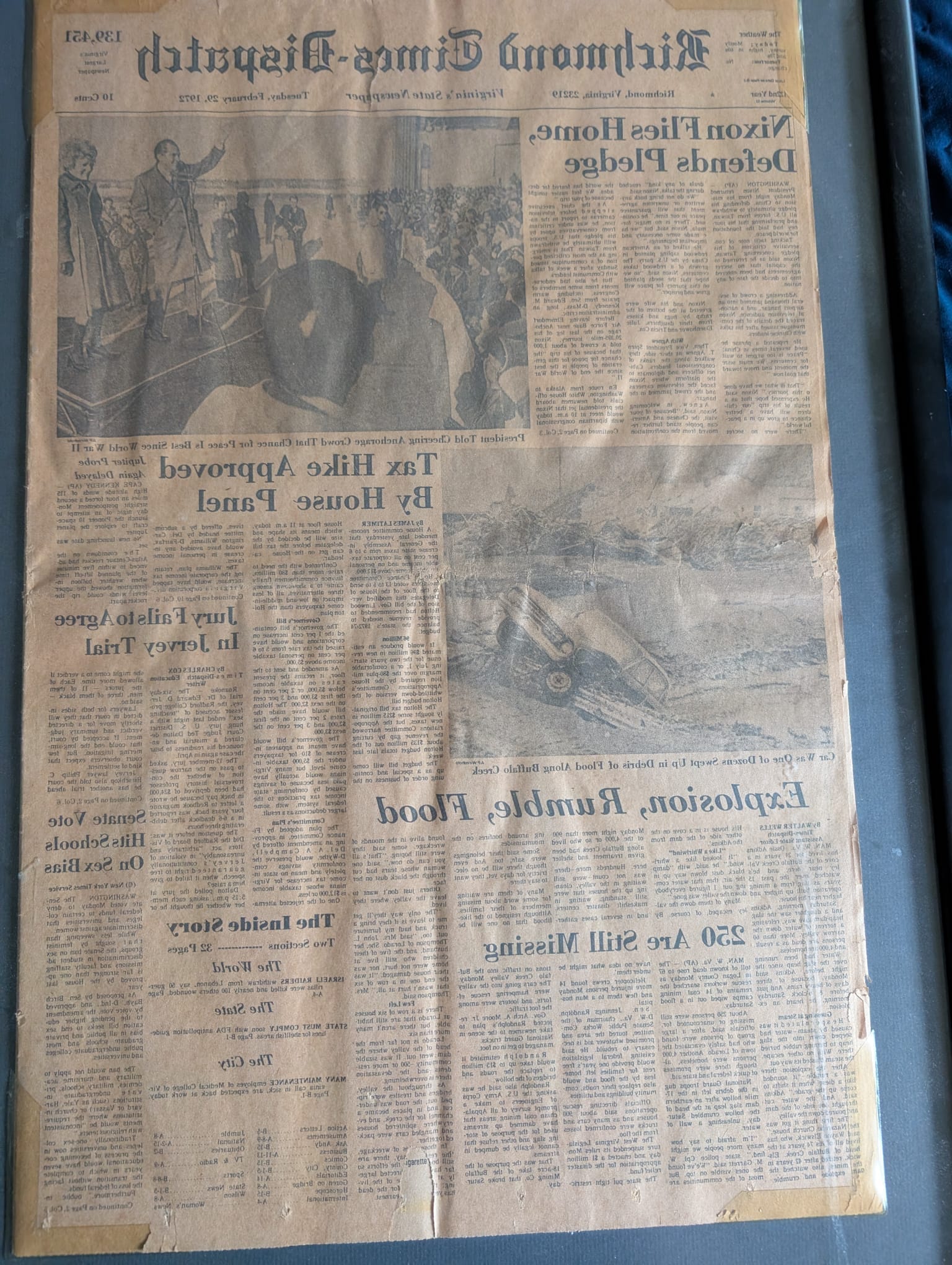
There are also some items of journalism history or error. Like a whole newspaper printed backwards.
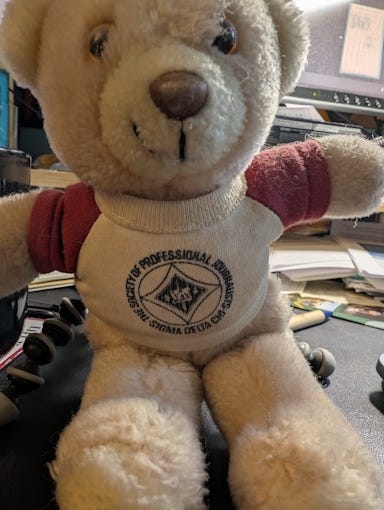
For older members who are downsizing, you probably have some an item or two from the days when the SPJ was known as SDX. Historic items are always popular.
To further encourage you, donations to the auction are tax deductible at fair market value.
We will soon have details about how to donate and where to send the item(s). In the meantime, ask your editors for donations and/or start going through your storage bins.
Reporters Without Borders: US journalist Austin Tice, missing since 2012, still prisoner of Damascus’ secrets
Committee to Protect Journalists: In Ethiopia, 5 journalists pressured to apologize for terrorism to win release
Al Jazeera: Union reports 108 attacks on Palestinian journalists in July
Global Investigative Journalism Network: The Innovators Turning Investigations on Spying Scandals and Vote Rigging into Video Games
Reuters Institute: How newsrooms are rethinking AI governance
International Press Institute: DOCUMENTARY: Defending the Future of Free Media.
Latin America Journalism Review: Indigenous journalists in Brazil launch first-of-its-kind journalism manual
Latin America Journalism Review: Audience rights or media control? Government proposal sparks debate in Mexico
Thank you for reading SPJ International Community’s latest newsletter. If you know some one who would also like to see this, please use the SHARE button below.
Comments
Nothing yet. Say the first thing.
Sign in to join the conversation.