
I am starting to notice advertisements for “back to school” sales. That means that the first day of school is on the horizon. It brings to mind the decision announced in June by the Texas State Board of Education requiring all Texas schoolchildren to study Bible stories in school, beginning in 2030.
The 24-hour cycle has long ago moved on from this controversial announcement, but I am still pondering the consequences of this decision. The concern of most critics of the plan is that this is a violation of the separation of church and state. That is a concern for me as well.
The reason for that “wall of separation” as Thomas Jefferson called it (and yes, I know that phrase is not found in the Constitution) is to protect religious liberty, specifically to protect the church from the state. State-endorsed religion does not fare well, as the sharp decline of Christianity in Great Britain and Europe can attest. Historically, whenever church and state have joined forces, it has not turned out well for church.
On the other hand, it is important that the role of religion in history is taught. How else can we understand what is going on in the world? Religion plays a large role in geopolitics. For that reason, it has always been legal to teach about religion in school, as long as it does not involve religious indoctrination.
I wish I had learned about non-Christian religions earlier in my education. I did not read the scriptures of other faiths until I was a religion major in college. I never read through the entire Quran until I took a graduate seminar in Islam. I think the country would be better off if students learned more about all religions, including their own. Many American Christians have never read through their own Bible!
The problem in Texas is that only passages from the Christian Bible – Old and New Testaments - are required. Furthermore, those selected passages are read without their context. When I first heard about this, I wondered which Bible passages would be required reading for all children.
From all the media commotion surrounding this, I thought they would be passages that support Christian nationalism. That is not the case. Most of the required readings are innocuous. For example, seventh graders will study the 23rd Psalm and the Beatitudes from Jesus’ Sermon on the Mount. Eighth graders will be studying the famous passage from Ecclesiastes: “For everything there is a season....”
High schoolers will study the parable of the Prodigal Son, the Love Chapter of the apostle Paul, portions of the Book of Job, and the story of Adam and Eve from Genesis. Only the last of these raises possible issues, if it is taught as science and not ancient Hebrew mythology.
The real problem is the stories chosen to be taught to the youngest children. First graders are required to study the story of Noah’s Ark. I have nothing against Noah. My oldest grandchild is named Noah (and his middle name is Marshall, which makes it even better!). When our Noah was born, we bought lots of Noah themed items for his bedroom. Noah is an interesting character – both the biblical one and our teenage grandson!
It is important to know that the required version of the story of Noah and the Flood will not be read from the Bible. It is to be read from the children’s storybook Noah’s Ark by Peter Spier. The 1977 book is a classic, the winner of the Caldecott Medal, an ALA Notable Children’s Book, and a New York Times Best Illustrated Book of the Year.
I am familiar with the book. I read it to our kids when they were small. I did not read it to our grandkids because by then my theology had changed. The book is not all bad. It has beautiful illustrations and a healthy sense of humor. Here is a YouTube reading of the book by someone’s grandma, if you want to hear it.
The first thing one notices about the book is that it has very few words, which seems strange for a “required reading” text. It has no scripture in it. It is almost all pictures, which leaves a lot of room for ad lib interpretation by the teacher “reading” the book to the class.
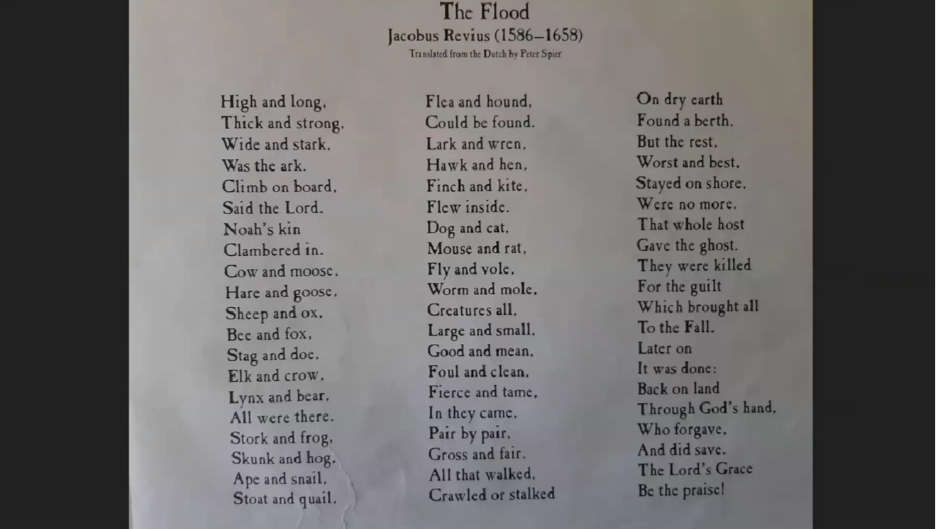
Most of the words in the book are from a 17th century poem translated from the Dutch, entitled “The Flood” by Dutch poet and Calvinist theologian Jacobus Revius. The screenshot at the top of this post shows this page from the book. The poem is almost all one-syllable words, which is probably why it was chosen for first grade readers.
The content, on the other hand, is not appropriate for first graders. One concern is children (and teachers!) may mistake the ancient myth for ancient history. Yet my chief concern is what the biblical story and the storybook teach about God. Here is the troublesome part of the poem in the book:
Text within this block will maintain its original spacing when published
All that walked
Crawled or stalked
On dry earth
Found a berth.
But the rest
Worst and best
Stayed on shore
Were no more.
That whole host
Gave the ghost.
They were killed
For the guilt
Which brought all
To the Fall.
In other words, it teaches Original Sin, the Fall, and the Judgment of God. Anyone familiar with the biblical story knows that the Flood account is about God exterminating all humans and animals on the earth ... except for a chosen few. Two of every type of animal ... and seven of some. The only humans to survive were Noah and his family because Noah alone was “a righteous man, blameless among the people of his time....”
In other words, the Bible teaches that God committed genocide. But that is all right according to the story because God is all-powerful and can do whatever God wants to do, even if it is mass murder. In other words, “might makes right.” That is not a good lesson for kids in this age of rampant bullying.
That murderous attitude sets the stage for the story of the Exodus (which Texas children will read in fifth grade) when God kills all first-born children in Egypt. Then God kills all the Egyptians soldiers at the Red Sea – again by drowning.
A little later in the Bible God commands the Hebrews to cross the river Jordan and exterminate all the indigenous tribes of the Land of Canaan. That divine imperative set a biblical precedent for settlers to do the same to Native peoples in the American promised land.
Finally, there is the reference at the end of the Flood story cursing Ham, the son of Noah, which was used by Americans to justify enslaving black people because they were thought to be descendants of Ham.
There are a lot of good stories in the Bible, and there are a lot of problematic ones. The Flood story is one of the latter types. The same is true of the Exodus and the Conquest. Biblical stories told out of context can become a pretext for justifying unthinkable acts today committed by those who consider themselves God’s people - whether that be Israelis, Muslims, or Christians.
That is the problem with bringing biblical texts into schools. These stories are difficult to interpret, especially for children. That is why ordained ministers generally spend three years (or more) in seminary after four years of undergraduate college learning how to do it correctly. That is why mainline denominations require an educated clergy. Unfortunately, seminary education is no longer a requirement in many churches and denominations, which is only adding to the problem.
Public school teachers are not trained to exegete and exposit biblical texts, and they should not be expected to. Biblical stories should either be taught in a scholarly manner or not at all. Suspecting how these biblical stories will be taught in the Republic of Texas, I fear that requiring Bible stories in public schools may cause more harm than good. They may sow the seeds of violence.
Teaching religion in public schools is a bad idea. Teaching about religion is a good idea. We need to know more about our neighbor’s religion. That can avert religious prejudice and xenophobia. Such teaching about religion must be done objectively and fairly - and at an appropriate age level. All religions need to be taught, and not just our own. All religions’ scriptures should read and not just the Christian Bible.
If I were to teach about religion in schools, I would teach religions as social constructs. All religions are manmade. Religions are products of the human mind seeking to explain what cannot be understood.
Some people say the various faiths are different paths up the same mountain. I say there is no mountain, and there is no path. The mystery of the Divine is not to be found on the top of a mountain, doled out by enlightened gurus, ordained preachers, or modern-day spiritual teachers. No need to travel to India, Israel, Tibet, Texas, or any other Holy Land. It is accessible here ... now ... free ... for all to see.
As the Torah says, “It is not in heaven, that you should say, ‘Who will ascend to heaven for us and bring it to us, that we may hear it and do it?’ Neither is it beyond the sea, that you should say, ‘Who will go over the sea for us and bring it to us, that we may hear it and do it?’ But the word is very near you. It is in your mouth and in your heart....” As Jesus said, “The Kingdom of God is within you.”
Spiritual Truth cannot be taught through religious instruction in private schools or teaching about religion in public schools. It is seldom found in churches, mosques, synagogues or temples. It is discovered only by those who are searching with all their heart, mind, soul, and strength. When it is found, it is seen that the searching did not cause the finding; it was purely grace. Religion can be taught, but spiritual Truth cannot be taught ... inside or outside of school.
Thanks for reading Spiritual Reflections by Marshall Davis! Please subscribe and share this blog with others. And take a moment to look at my books, podcast, and YouTube channel.
No posts
Comments
Nothing yet. Say the first thing.
Sign in to join the conversation.