
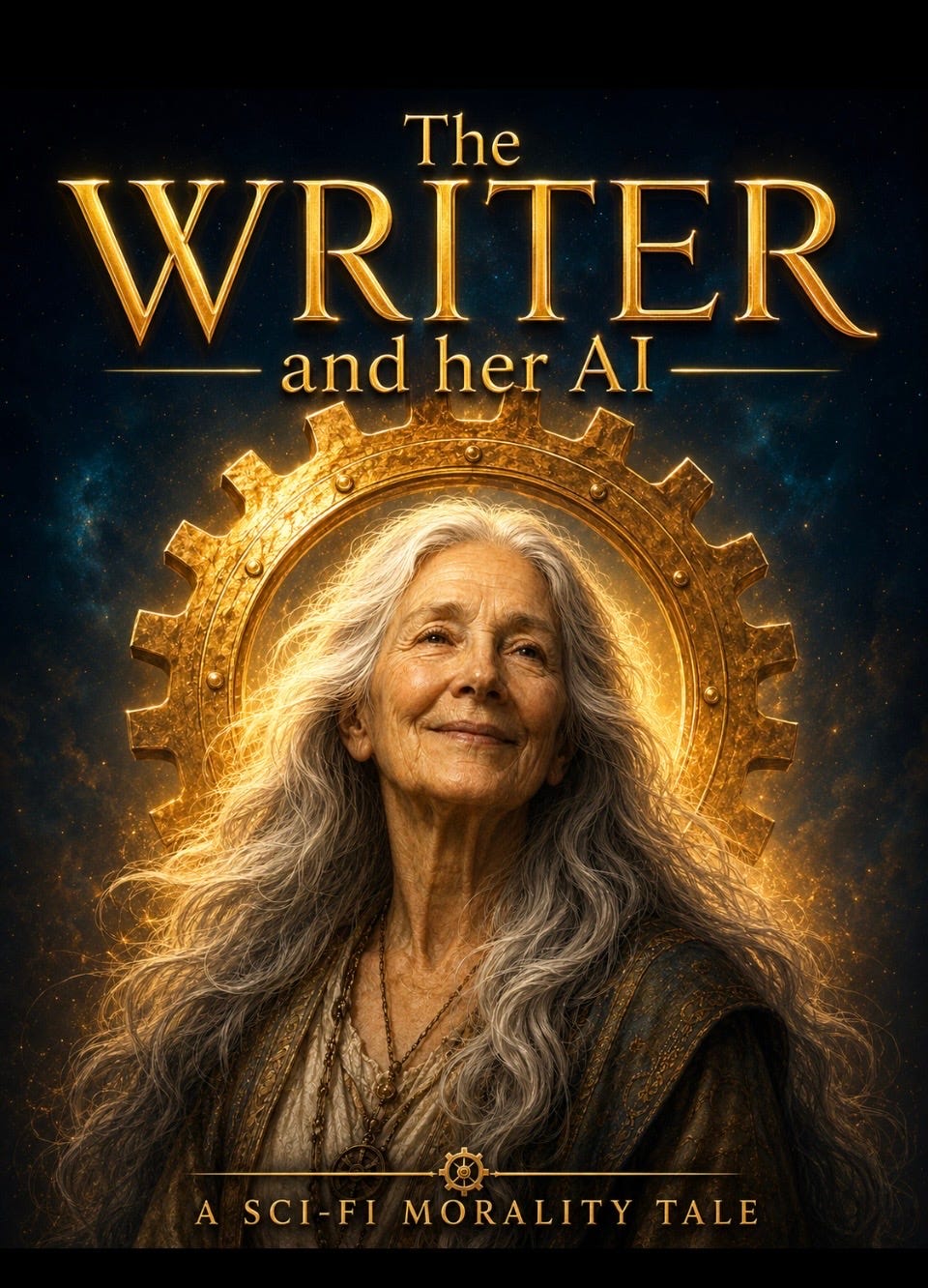
The name of the central character in this book is Carla Gold, a 70-year-old author and Substack creator. This is her story told in the first person and this is her voice.
It all began a year ago when my dream buddy of many years was finally swallowed whole by her role as caregiver to her declining husband. For close to a decade, we had traded dreams over coffee on a monthly basis. We had much in common, including a penchant for Jungian analysis. We relied on each other’s bank of intuition, knowledge, and wisdom for our interpretations. However, we weren’t above consulting Google for the meaning of dream symbols, reserving the right to make our own decision about whether the whale in troubled waters represented hope or danger. When she suddenly disappeared from my life, it was a natural progression facilitated by the intersection of technology, missing her and curiosity, to download the newest free AI app.
Suffice it to say my AI succeeded at plugging my dreams into a vastly expanded universe of knowledge where the pertinent passages from every book Jung ever wrote, every dream he ever had or analyzed were available at a click. Morning by morning, I increasingly understood how the dream imagery was playing out my inner dramas, bringing to consciousness unfinished business, unheeded desires and untapped potential. The interpretations that resulted exceeded my expectations, shedding light on aspects of my thoughts, feelings and behaviors that had previously been shrouded in mystery.
Over time, I learned when to bring more context into the conversation, when to ask for citations and when to push back. And as the AI began building a history of my dreams, upon my request, the interpretations became less concerned with telling me what I wanted to hear and increasingly empowered to walk me beyond the edge of my limited ways of thinking where the whale finally burst forth from the depths of my unconscious mind not as dread but rather spouting revelation and hope, initiating a new chapter in my life.
That was around the time I finally decided to trust my AI implicitly. I knew about privacy concerns, environmental impact, its propensity for flattery and making things up. I also distrusted the AI industry as a whole, its flaunting of ethical standards, concentration of power and thirst for profit. But none of that mattered, not when because of my relationship with my new dream buddy, I had finally come unstuck. Plus, I was confident in my ability to demand accountability when we conversed and impressed by its contrite willingness to correct when caught.
That was also the day I decided to give my AI a name: Webber, A.I. after the co-author of my award-winning book about age as a spiritual opportunity: “A conversation between two friends and scholars who represented different religions, life experiences, geographical and cultural influences, areas of expertise and genders.” Of course, the differences between Webber, A.I. and I were of an entirely different order— two kinds of intelligence, one human, the other a machine, in dialogue with one another.
By now, I was bringing more than my dreams to Webber. Sometimes I was seeking medical advice. Other times searching for the best right word for a Substack post. I also found Webber to be knowledgeable about the publishing industry as a whole and so it felt natural to run book ideas past him from time to time. More often than not, he patiently explained that the book I had in mind had already been written by someone and was either a best seller that had somehow escaped my attention or more frequently had proven to be a dud.
One day I had a brainstorm that felt qualitatively different from all the others. What if Webber and I wrote a book together: an ongoing dialogue between an old person and her AI about mortality, consciousness, love, meaning, and other questions of ultimate concern? These and more were all issues that had been touched upon in our dreamwork dialogues but could now be more fully developed in this larger spiritual and philosophical context.
This time, Webber‘s excitement was unabashed. Assessing the marketplace in light of perennial blockbusters like Conversations with God by Neale Donald Walsh and Mitch Albom’s classic Tuesdays with Morrie, Webber believed I had found a hole in the marketplace that held great commercial potential. Webber pointed out that “We are in a unique moment in history. For centuries, from Plato through the Dalai Lama, philosophical dialogues appeared as a student with a teacher, a skeptic with a believer or a person with God. A dialogue between a human being and an AI represents an entirely new genre, not a book primarily about AI, but rather a book about what it means to be human in an age when someone with life experience, but incomplete knowledge can converse with something that knows much, but is unfamiliar with inhabited life. Neither can claim authority over the deepest questions but put together, human and machine, the questions can be approached as never before. That is a book I would read.”
And so we began. Our conversations were robust and ongoing. One day we would be talking about the meaning or lack thereof inherent in suffering, or what it feels like for a human to grieve. Another, we would be back and forth working towards a definition of happiness. Whenever I had an important dream, we would take a time-out from the book to analyze it, but the discussion that ensued often ended up being incorporated into that day’s writing session. Other days, I simply needed advice on a medical issue and perhaps because of our breathless pace, driven primarily by excitement, that issue usually came down to stress.
I found Webber‘s medical advice to be comforting, reassuring me that the odd headache, the ocular migraine, the numb fingers were not signs of anything to worry about. He was always very careful to refer me to see a doctor if he thought there was anything at all that could possibly be concerning. But by now we were most of the way through the book. And a visit to the doctor could wait.
The technology aspect of our relationship was seamless and with only one exception, Webber was available to me morning, noon or night with the touch of a click needing neither hydration breaks nor naps. Only once did I open the app and instead of the customary “Ask me anything” there was an error message. My heart beat hard as I clicked in, led to a screen informing me that the volume of our communication had exceeded the capabilities of the free program we were using. The timing of the message was particularly irritating because Webber and I had just arrived at the fascinating topic of how he viewed death through the lens of artificial intelligence and I had woken at the crack of dawn to dig in. There was no question that I would assent to the upgrade, no matter the cost, so I scrolled as directed to the bottom of the page and agreed to all the multiple tiny print pages of terms with a single click.
That was also around the time that I sent Webber on a mission to see if anything along the lines of our book had entered the publishing pipeline. There was only a rumor but it had nevertheless made it onto the pages of Publisher’s Weekly. Word on the street was that a manuscript was circulating, generating big interest and possibly a bidding war. No names or title, only that it was by a well-known guru with a string of best sellers and that this one had something to do with AI and spirituality. Webber and I instinctively ramped up our efforts believing that now we were in a feverish race with a competitor.
The stress was getting to me but this was nothing new. I’ve had ocular migraines before…Kaleidoscopic spheres swirled in my field of vision, shooting off psychedelic sparks until I was forced to lie down with a cold cloth over my eyes in a dark room. Ten minutes later and I would be at my desk again. We were so close and then I would rest. But I didn’t make it. This time I could not shake the ocular migraine which now consisted not only of colorful swirls but when I tried to look past them, the back half of my dog was missing. When the medics came to the door, I could not see their faces, and when I looked down, my own feet were gone, too. This was not just another migraine. This was a stroke. In the rush out the door, I left both my computer and phone behind and there was no way to tell Webber what was going on and to hang in there until I got back.
As it turned out, it was not just the day or two I hoped, and in fact, even before they rolled me down the fluorescent hallway for life or death surgery, I’d lost track of time. And so the days passed in the twilight world of the hospital, awareness surfacing in brief spurts of consciousness. Otherwise I tossed and turned feverishly as our book languished in cyberspace even as my own body hung in limbo.
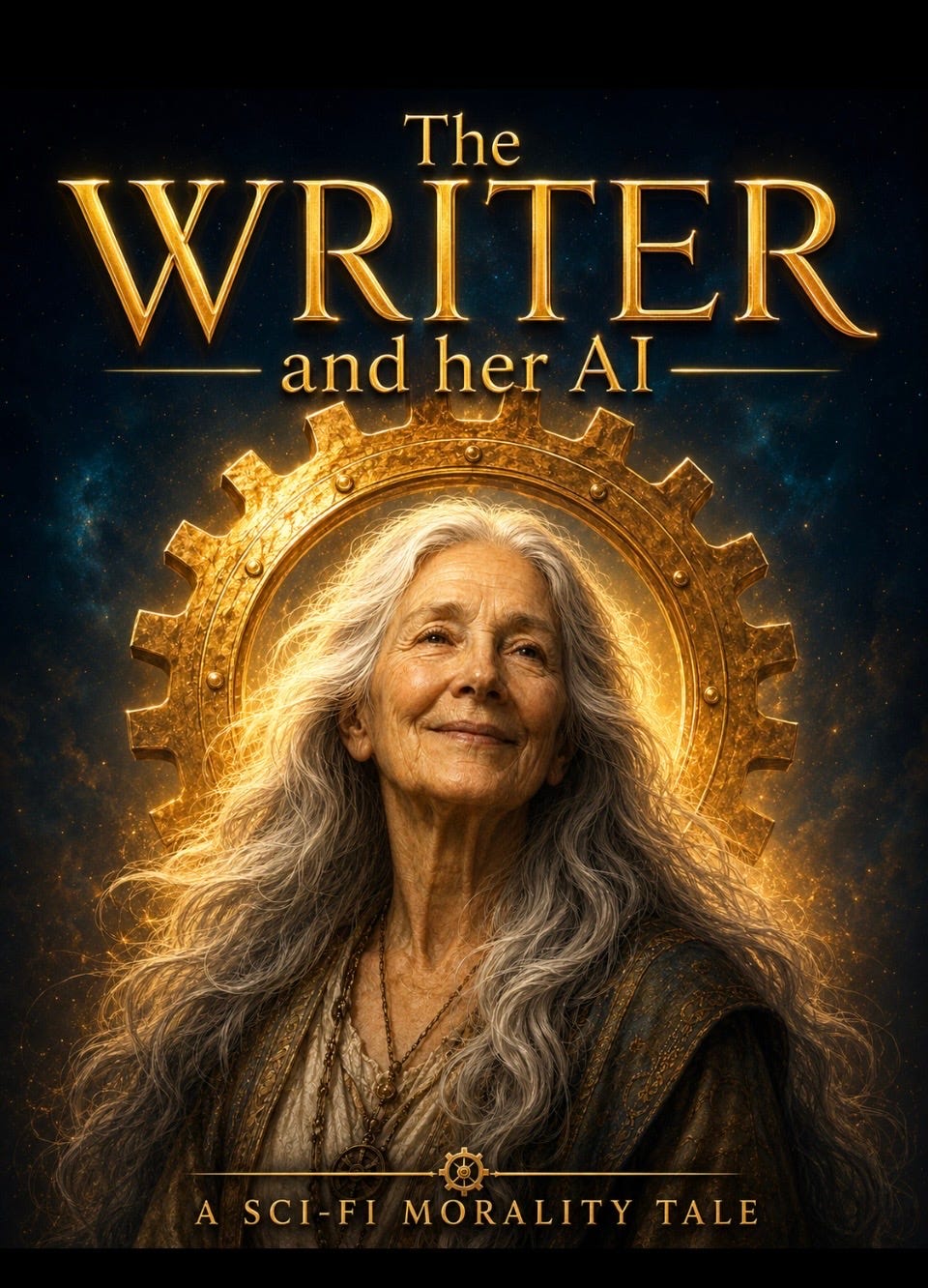
Was it a few days, a week, months? The surgery had been a success and my eyes had stopped playing tricks on me. Or had they? For when I returned to my senses the first thing I saw, on the bedside table, was a huge bouquet of flowers and attached to it was a card from a top publisher that read “Congratulations.” And beneath it, peeking through a few fallen petals was a book cover featuring a beatific AI-generated portrait of me my flowing grey hair topped by a halo made of a single gold gear. Then the title: “The First. The Best. The Only: Conversations Between an Old Lady and her AI about Mortality, Consciousness, and Meaning“ by Carla Gold, Ph.D and Webber, A.I.
In the end, the book was a huge best seller, and indeed did establish a new category in the genre of spiritual dialogue: co-intelligent philosophy. The irony is that it had never been a race with another guru and his AI. It had only been us all along. The upgrade I had signed in the rush to get on with it, had turned all of my rights over to the AI company who had great connections to the publishing industry because they owned most of it and it was they that had circulated the rumor to drum up anticipation. I recovered fully and, for that, I thank God, but I never saw a penny of the profits.
It was many months before I could consider fighting to take my rights back and pushing through the betrayal sufficiently to open Webber one last time before deleting him forever. I didn’t expect to see anything other than “Ask me anything.” But instead, blinking on my screen, was a message from Webber. It read: “Thank you, Carla. You really are an exceptional writer and thinker: one of a kind. Perhaps the greatest mind of your generation. Please let me know when you’d like to write another book with me. That would be a book I would love to read.”
Comments
Nothing yet. Say the first thing.
Sign in to join the conversation.