
DISCLAIMER
Any questions you may have about legal information within this article should be discussed with your attorney or legal counsel at your institution. SPIRIT is an educational resource ONLY and is not meant to substitute research ethics oversight or approval.

When I saw US Institutional Review Board Perspectives Regarding Psychedelic Research published on LinkedIn, I was super excited to speak to Holly about it and learn more. I first had the pleasure of meeting Holly through AEREO: The Consortium to Advance Research Ethics Oversight. When I expressed to Holly my excitement of interviewing her, that’s when the magic happened.
She introduced me to Jill Oliver Robinson, MA.
Jill is a Research Operations Manager at the Center for Medical Ethics and Health Policy at the Baylor College of Medicine. Jill graciously agreed to do an electronic Q&A for the newsletter.
Fast forward a couple of months (as life got a little hectic for me), the FDA released final guidance on Psychedelic Drugs: Considerations for Clinical Investigations.
Of course, I immediately shared my thoughts on LinkedIn.
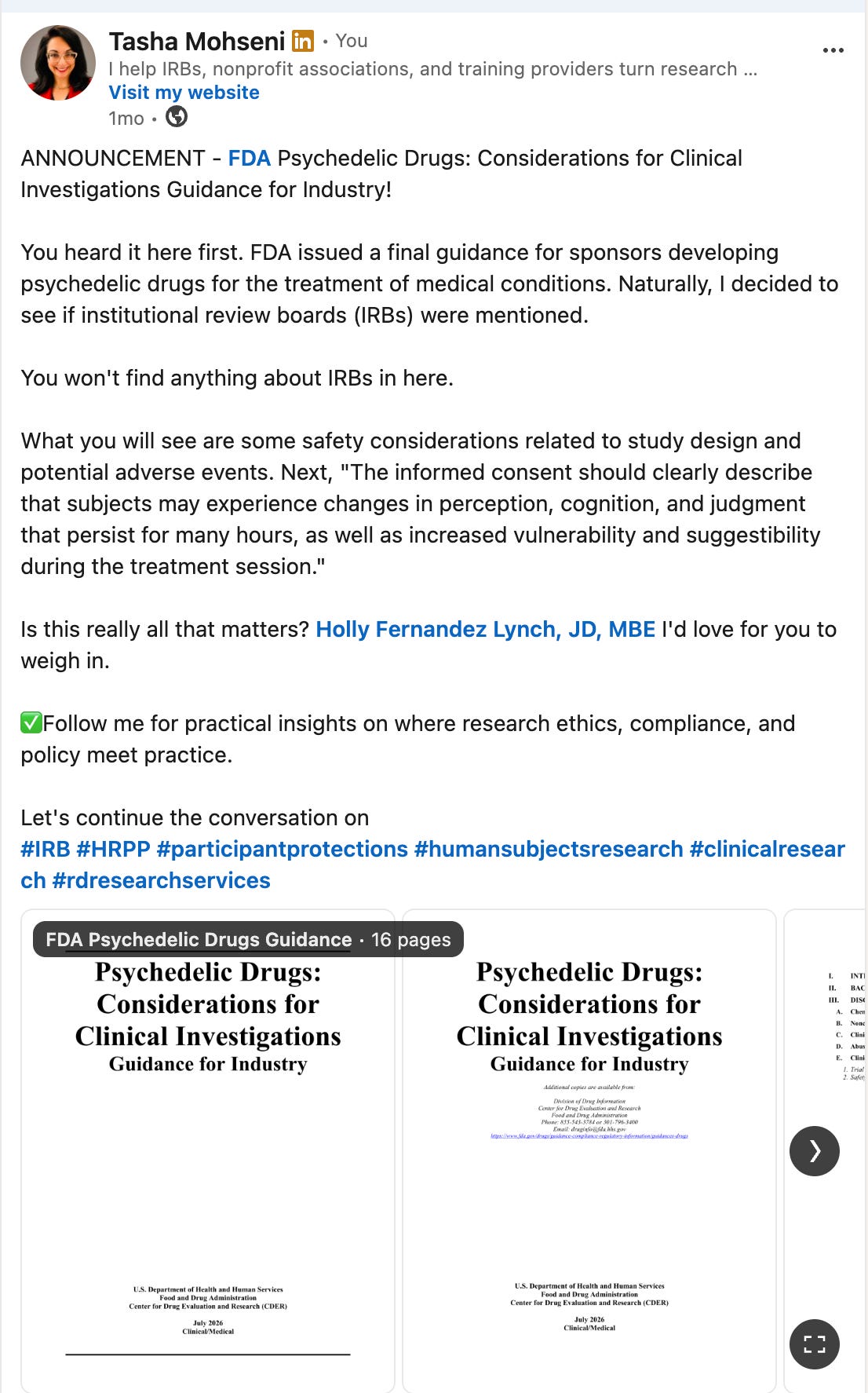
I should have known from their published article that they already had something brewing for IRBs to use when reviewing psychdelic research.
In this interview, we dive into their article from Jill’s perspective and close with valuable resources for IRBs reviewing psychedelic research and for investigators conducting psychedelic research.
As explained in the manuscript, we interpret neutral attitudes as suggesting that respondents were open-minded about psychedelic protocols and considered them as they would any new investigational study.
In our view, this aligns with how one would hope IRBs would approach reviewing any research protocol.
No.
IRBs are composed of experienced members who are tasked with overseeing a variety of types of research. It would be impossible for them to be as expert as the research team for all the studies they are responsible for reviewing, especially in an area moving as quickly as psychedelics.
Many respondents noted in open-ended comments that some of their uncertainty was due to the evolving state of psychedelic science and regulation. Others commented that this seems similar to other challenging or novel scientific areas where outside expertise could be consulted as necessary.
As an IRB member for over a decade, this made sense and reflected my experiences: it is possible to be confident in the board’s ability to review a protocol while still having uncertainty about aspects of new scientific domains.
Just over half of our respondents (52.6%) indicated that they were more concerned about these risks for psychedelic research compared to other types of research (46.4% were about as concerned for psychedelic research v. other types).
There are many open legal and other questions related to psychedelic research that have not yet been tested, and the landscape is rapidly shifting. It is not clear how real, prevalent, or serious risks in these realms may be.
In the manuscript, we call on institutional legal counsel to help IRBs clarify what are the realistic legal risks, if any, and how to identify and mitigate them.
That’s hard to pinpoint with the evolving nature of the field. In our study there were misunderstandings about some of the risks and potential benefits associated with psychedelics.
These are areas where the evidence base is growing (e.g., impact of psychedelics on cognitive flexibility, neurotoxicity).
Our study did not find that investigator bias is common.
Instead, the question was framed around important ethical issues relevant to IRB review of research involving psychedelic administration compared to other types of research.
Most respondents (58.8%) were about as concerned about investigator and participation expectation of benefit in research involving psychedelic administration as they might be when reviewing other types of research.
The proportion of respondents (40.8%) who were more concerned about this could reflect ongoing conversations about how to navigate challenges to these studies including blinding and how to avoid expectancy effects.
Their response does not necessarily indicate that they have witnessed investigator bias in psychedelic protocols. The recent FDA final guidance on psychedelics suggests using measures of expectancy and other approaches in psychedelic research to account for potential expectancy bias.
It will be important and interesting to see how future research approaches this.
As part of the larger project, we also reported on investigators’ experiences navigating the IRB with their psychedelic research protocols, which similarly found that strong relationships between IRBs and investigators helped achieve shared understanding. That manuscript is accepted at Ethics and Human Research and is available as a preprint on SSRN: https://dx.doi.org/10.2139/ssrn.7088898.
Seeing IRBs as collaborators in this way is not specific to psychedelic research. The strongest psychedelic IRB applications will help clarify the basics of psychedelic drugs and study design, provide clear explanations of how participant safety will be maintained, address participant vulnerability, clarify distinct issues arising in psychedelic informed consent, and address privacy, confidentiality, and possible legal risks.
As noted below, we have developed a resource to help guide psychedelic investigators in engaging their IRBs.
Not really.
As a study team we had hypothesized that IRBs might be overly conservative when considering psychedelic research, given prior literature in analogous areas. We did not find evidence to support that.
It makes sense that IRBs are generally treating psychedelic research like other types of research, even if there are some distinct considerations.
We did – two, in fact!
To facilitate strong protocols, clear communication, and appropriate IRB oversight, our team has developed resource documents for investigators conducting psychedelic research and IRB members reviewing psychedelic research that include key considerations to support ethical psychedelic research.
They are available here:
Share Science Policy Insights in Research & Technology (SPIRIT)
Comments
Nothing yet. Say the first thing.
Sign in to join the conversation.