
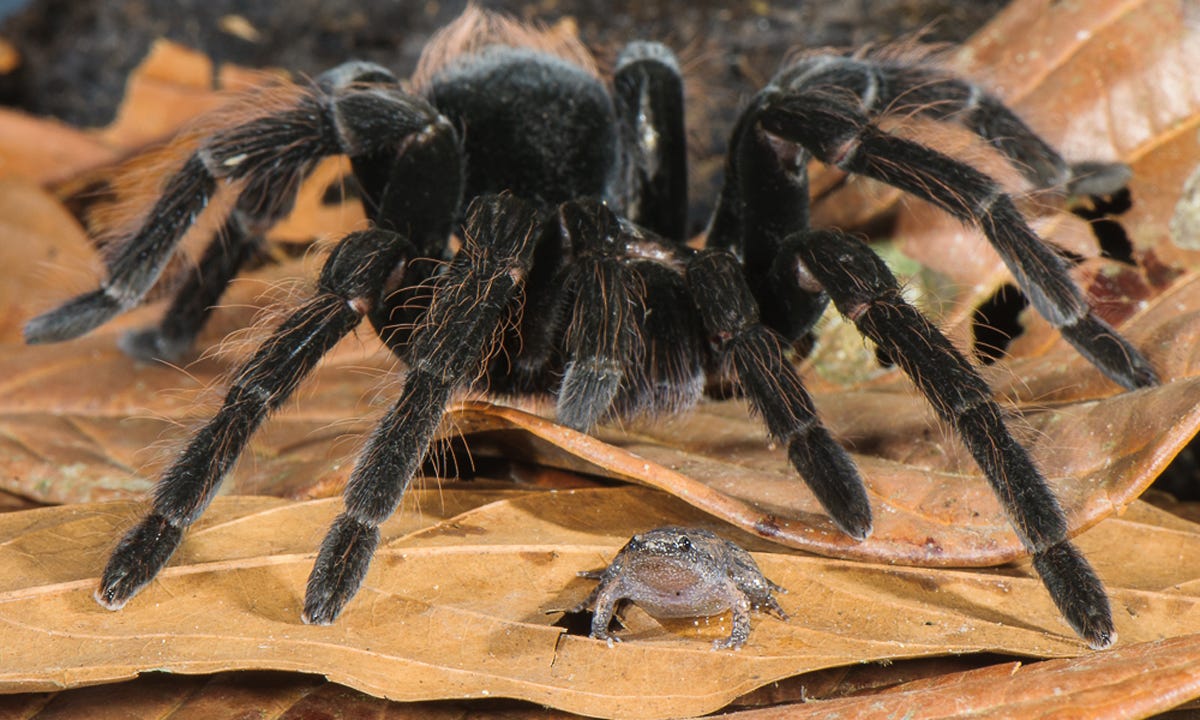
🕷 Scientific name: Xenesthis Immanis (ft. Chiasmocles Ventrimaculata)
🕷 Endemic to: Rainforest in Colombia, Venezuela, and Peru
🕷 Family: Theraphosidae (New World Tarantulas)
Spider Sundays began on iFunny more than a year ago. The first post of its kind was an inside joke, written to make one person laugh. To my surprise, that first “article” was well received, and many took it more seriously than I ever would have predicted. When I took to the Samsung Notes app to mock up some more posts, I quickly discovered an interest in nature writing. Contrary to its reception, my aim has never been serious; almost all Spider Sundays are heavily embellished with inside jokes and sourced primarily from Wikipedia and quick Google queries.
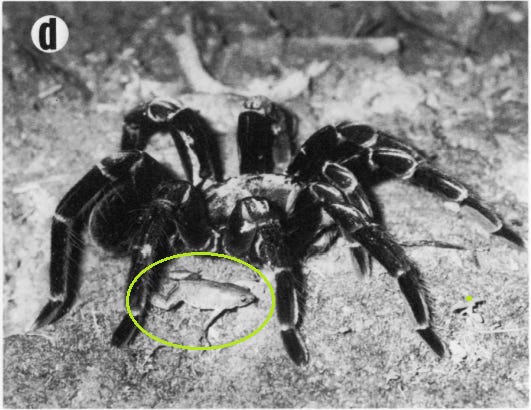
Today will be a little bit different. I want to talk about my recent foray into academic arachnology with today’s subject. The primary source for this ‘stack is Cocroft & Hambler’s 1989 paper: Observations on a Commensal Relationship of the Microhylid Frog Chiasmocleis ventrimaculata and the Burrowing Theraphosid Spider Xenesthis immanis in Southeastern Peru. It is a rainforest field study of a curious cohabitation between a frog-eating spider… and a frog.
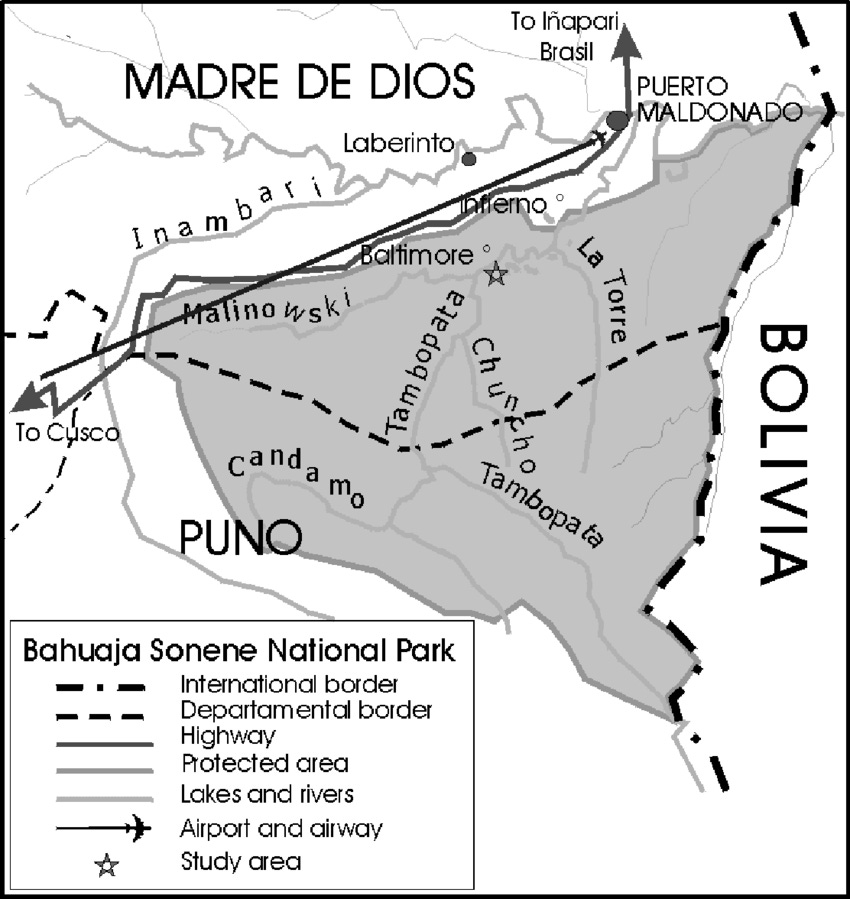
As the title states, the Colombian Lesser Black Tarantula (CLB) is a Theraphosid, a tarantula taxon endemic to the Americas. It’s a bog-standard burrowing tarantula native to the Tambopata reserve on the Western rim of the Amazon. In youth, it lives in the back of it’s mom’s hole its mother’s burrow, primarily eating prey items captured by its parent until it grows big enough to dig its own hole and have its own children. Not a terribly interesting subject on its own. It’s one of those animals with a short Wikipedia article.
It’s the other inhabitants of the burrow that make this spider noteworthy. Alongside the giant broodmother and her children, several Dotted Humming Frogs are commonly found fearlessly freeloading in the spider’s nest. This isn’t a pit stop either — the two species live together. Cocroft & Hambler wanted to know why.
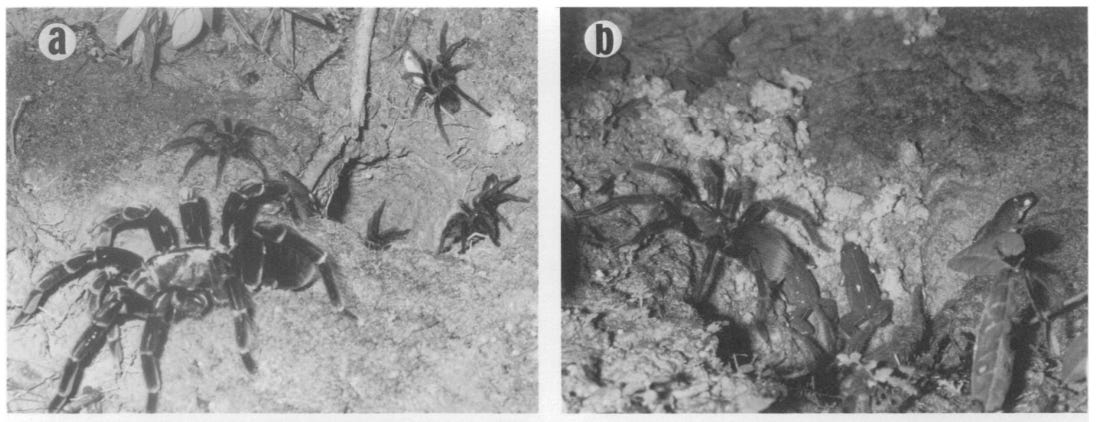
For roughly a month, the two scientists staked out an occupied burrow in the Tambopata reserve — one single adult female tarantula, five spiderling dependents, and at least two frogs. Every night, the scientists observed the hunting routine of these nocturnal roommates, and took careful notes on how the frogs and spiders interacted. On these outings, the spiders attacked and captured beetles and moths, while the frogs fed freely on ants and other, smaller prey.
Usually right around sundown, the mother surfaced, typically followed by her children. As they emerged, each spider took post to cover a perimeter around mouth of the burrow. On most outings, the frogs accompanied them. The amphibians usually trickled out only after the spiders took their posts, but sometimes spider and frog emerged together. In the 37-night stakeout, only once did the frogs emerge without their spiders. Even then, they stayed within 2cm of the burrow entrance and only remained there for a few minutes before ducking back inside. The mother emerged on 28 nights and always stayed out until sunrise.
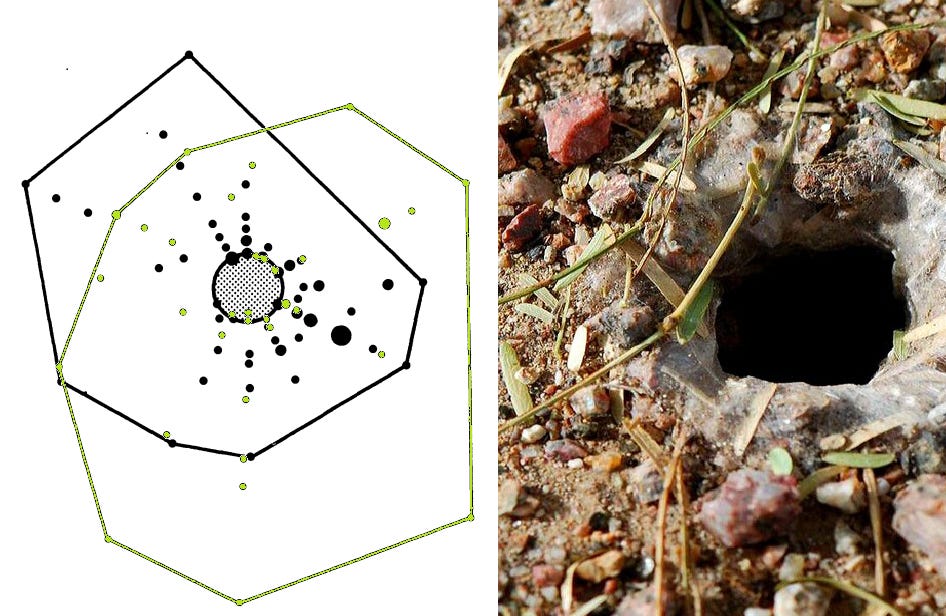
When out of the burrow, the frogs strongly preferred to stay near the large mother, usually taking refuge underneath her, safe in the cage of her limbs and carapace. Sometimes the frogs paired up with the smaller adolescents in the same way. Other times, the frogs would venture more freely — up to 50cm away from the burrow so long as there was a spider nearby.
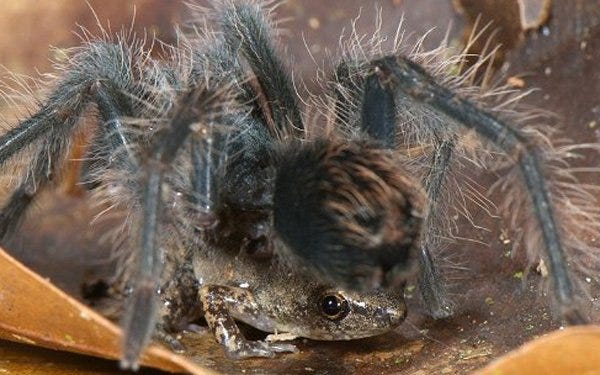
One night, Cocroft & Hambler decided they would simulate a frog predator coming close to the burrow. The idea was to see if the spiders were protecting the frogs. They captured and anesthetized a meter-long Lora snake, tied its snout to some fishing line, and dragged it past the burrow while the tarantulas were out and about. As expected, the mother gunned for it, sank her fangs into nape of its neck, and even tried to pull the (now dead) snake back into the burrow to feed her young.
I think the benefit to the frogs is pretty clear. Being a small amphibian probably sucks. Birds, snakes, rodents, army ants, and of course spiders spend their days and nights looking for little frogs to eat, and so sitting out in the open is suicide. However, few of these predators would be keen to take on six venomous, aggressive tarantula bodyguards.
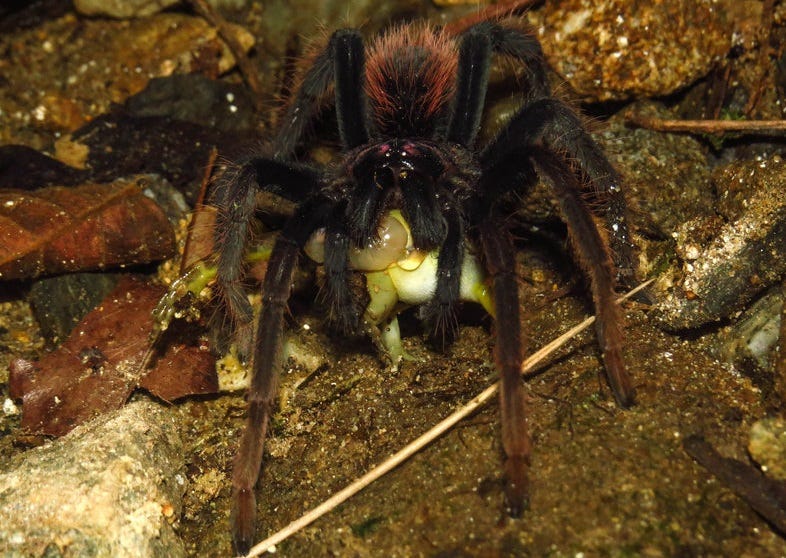
Even in 1989, frog and spider commensalism was not a new discovery. What’s surprising about the Colombian Lesser Black’s frogs is that the CLB tarantula eats frogs. This was one of the puzzles that Cocroft & Hambler set out to solve: why would a frog-eating spider choose to protect its food instead of just eating it? What could they possibly be getting out of it?
Throughout the course of a week, the scientists presented various different species of frogs to the hunting party, and most of the time the mother pounced on, killed, and fed the prey to her young. But sometimes after securing the prey in her chelicerae (mouthparts), she paused. Shortly after, she would let go. The scientists were able to collect these “rejected” frogs, and there wasn’t a scratch on them. The mother hadn’t attempted to kill them.
Rejecting a prey item is not strange on its own. Spiders do that all the time. What was strange is that the “catch-and-release” strongly resembled a quirky interaction that the scientists had repeatedly observed between the younger spiders with their own cohabitating amphibians. The interaction goes like this: a frog would emerge from the burrow, and one of the spiderlings, already outside, would pounce atop the frog as if to kill it. While winding up the lethal bite, the spiderling would hover its fangs just above the helpless frog, and after a few seconds, relax and skitter away. This was observed five times and, importantly, only with the spiderlings. Their mother was never seen engaging in this sort of tomfoolery with her frogs.
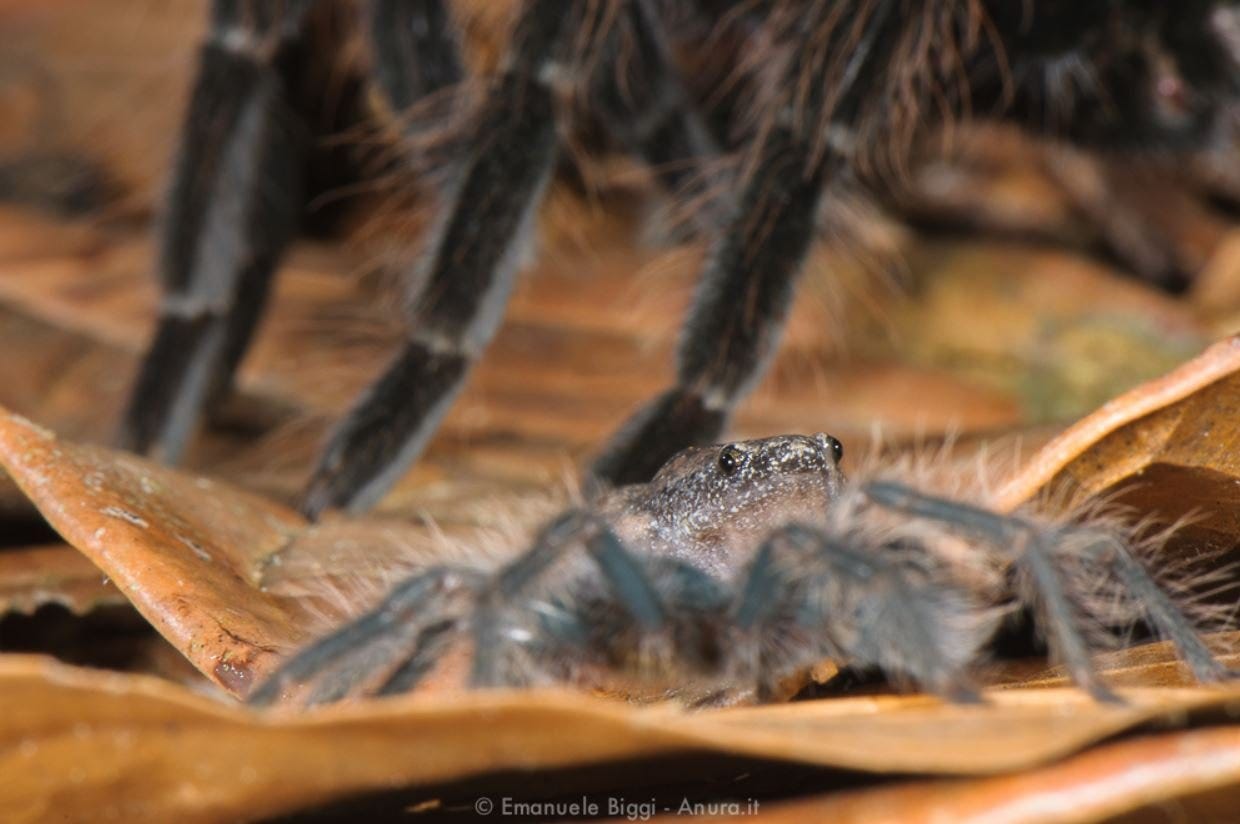
Here is the picture the scientists had: a burrow with six spiders and two frogs. The frogs stayed with the spiders for protection, never going outside the burrow without them, which allowed for hunting on the surface without worry. The mother spider — whom routinely captured and devoured frogs — never hunted her own frogs. In some cases, the younger spiders began to hunt their own frogs, but never followed through. It seemed like the tarantulas knew that their frog roommates were, in fact, tasty little amphibians, but they did not actually care to eat them. So what was going on with the tarantulas? What did they get out of having frogs in their burrow?
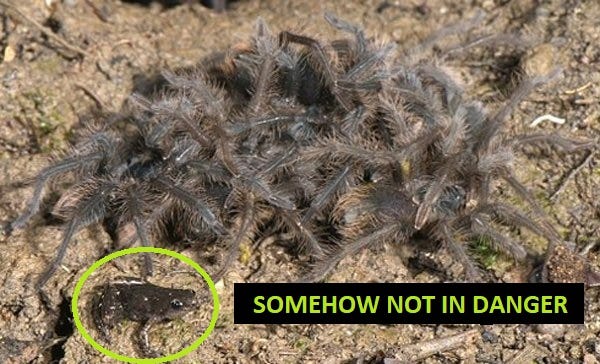
The least divisive answer is that the frogs eat ants, and ants are a huge threat to a nesting mother tarantula.
This may sound ridiculous at first. After all, an adult female tarantula is the size of many thousands of ants. We humans are rarely threatened by bugs of the same relative size, but we do have opposable thumbs, versatile limbs, bony stomping feet, and vacuum cleaners. It’s hard to imagine a bug that a human couldn’t kill. It’s also hard to imagine a bug that a human couldn’t toss in his or her mouth and chew to death… if he or she was so compelled.1
Spiders do not have the generalist tools of humanity. Beneath a certain aggressor size, the mygalomorph arsenal is useless. Spiders are nigh incapable of squashing ants underfoot or sweeping large numbers of them away like we can. Most importantly, though, a tarantula is physically incapable of eating something as small as an ant. Like all spiders, they cannot chew or digest solid food. Instead their digestive system works on a “sucking stomach” meant for draining the nutritious juices from similarly sized prey. Ants are too small for that — the straw is wider than the juice box. When an ant colony finds a clutch of tarantula eggs or infant spiderlings, the mother is essentially helpless.
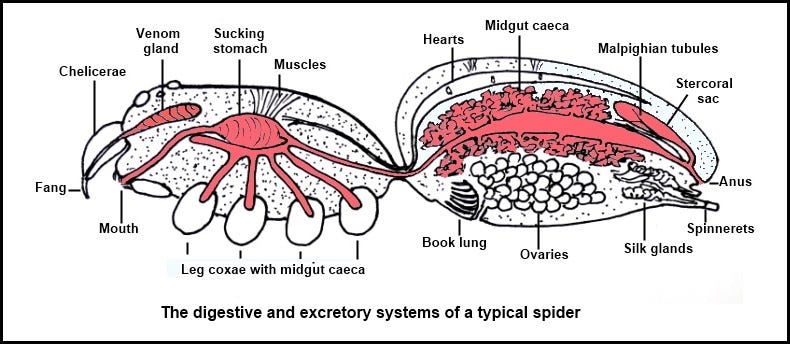
Unless the burrow happened to contain a critter who could repel ants, or, better yet, eat them. This is the niche filled by the Dotted Humming Frog. It doesn’t answer the question of why the friend frogs don’t get Capri-Sun’d six times over, though. If the tarantula eats frogs, how does the commensal relationship even begin? How does the CLB tarantula know that certain kinds of frogs are friends?
Cocroft & Hambler offer chemical signals as a likely explanation. The theory goes that when a tarantula mistakenly captures a roommate frog in its chelicerae, the specific taste tells the spider that the frog in its grasp is an ally, prompting the spider to let go. Whether it’s shitty taste or a friendly taste is both unknown irrelevant: the lesson learned by the spider is the same: this one is ours. In this way, young Colombian Lesser Black tarantulas nesting with their mother might “learn” which frogs are theirs. This would explain why the experienced mother tarantula was never observed trying to harm her own frogs: in youth, she made the mistake, and she learned from it.2
The chemical signal theory also explains why tarantulas sometimes refused to harm prey frogs of a similar but different species from their roommate frogs — basically, sometimes different frogs taste the same. More recent research in the Tambopata reserve involved presenting frog skin samples to tarantulas (Csakany, 2003), and the results supported the chemical signal theory.
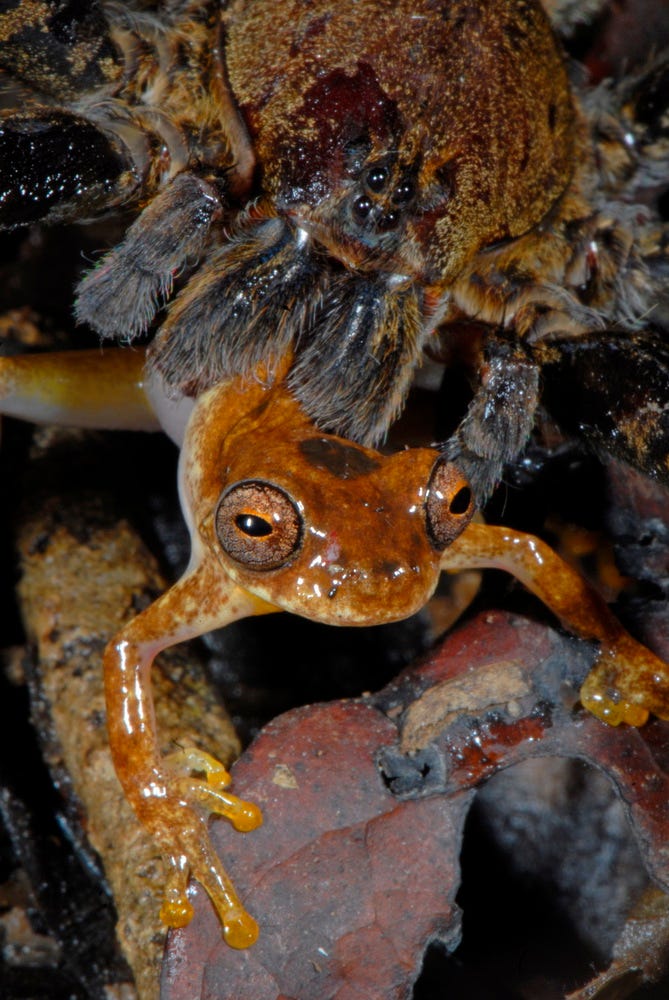
Another rising theory about this particular frog-tarantula relationship postulates the frogs secrete a natural antiseptic to protect the vulnerable tarantula eggs from infection, but this is disputed. Additionally, it’s more recently been found that Cocroft & Hambler probably had the exact tarantula species wrong, or that the Dotted Humming Frog might have a commensal relationship with more than one species of spider. There may exist a large system of chemical signals, frog species, and tarantulas in the Amazon. That and the inevitability of mimicry in all its forms has made research on the subject all the more complicated.
Even if it was a misidentification, there’s no doubt about Cocroft & Hambler’s findings. Since their work in 1989, similar alliances between frogs and spiders have been observed in Mexico, Sri Lanka, and India. It might be that little frogs and giant tarantulas are built for one another: two vastly different soldiers in a pact of war against pest and predator large and small. In any case, X. immanis and C. ventrimaculata are the pair that made this cross-species collaboration famous, and that makes them a little special to me — at least special enough for a Spider Sunday.
SOURCES
Cocroft, R. B., & Hambler, K. (1989). Observations on a Commensal Relationship of the Microhylid Frog Chiasmocleis ventrimaculata and the Burrowing Theraphosid Spider Xenesthis immanis in Southeastern Peru. Biotropica, 21(1), 2. doi:10.2307/2388434
Csakany, Jolene Jeana (2003). Some aspects of the relationship between the Peruvian microhylid frog, Chiasmocleis ventrimaculata, and a theraphosid spider, Pamphobetus sp. State University of New York College of Environmental Science and Forestry ProQuest Dissertations & Theses. 1413905.
Siliwal, M. & Ravichandran, B. 2008. Commensalism in microhylid frogs and mygalomorph spiders. Zoos' Print 23, 13.
Hunt, R. H. 1980. Frog sanctuary in a tarantula burrow. Natural History 89 (3), 48-53.
Marín-Martínez, Mateo & Rojas, Julián. (2016). Predation by a Mygalomorphic Spider Xenesthis immanis (Araneae: Theraphosidae) on a Stream-dwelling Frog, Rheobates palmatus (Anura: Aromobatidae). IRCF Reptiles and Amphibians Conservation and Natural History. 23. 10.17161/randa.v23i3.14128.
…and of course, Wikipedia
Or if they were born South of the the Rio Grande
Disclaimer: Cocroft & Hambler don’t go as far to suggest the whole learning thing, but it seems to me like a natural elaboration of the chemical signal theory so I included it in my thoughts.
Comments
Nothing yet. Say the first thing.
Sign in to join the conversation.