

Inflation is always and everywhere a monetary phenomenon. So argued Milton Friedman. But inflation does not proceed in an orderly way. The Irish-French economist Richard Cantillon showed that money injected into an economy does not raise all prices simultaneously; its effects flow unevenly through product markets over time at different rates.
Similarly, when a relative price shock is large and persistent, it affects other prices with a lag, sometimes long after the initial shock has faded. Wary of Friedman’s observation, central banks must manage the most recent energy price shock despite the uncertainty over the lag between the shock and its eventual impact on economy-wide prices. Their tardy response to delayed action in 2022 shows the necessity of acting on a forecast rather than waiting for confirmation.
The 2022 inflation process was complex, stemming from the combined COVID disruption to supply chains and the impact on energy prices from Russia’s invasion of Ukraine. We relearned that a price shock in tradable goods spills over to non-tradable service prices following a process that can extend for years after the initial shock dissipates.
Central banks have long known that the larger the negative supply shock, the more likely it is that they must raise interest rates to contain second-round effects. The more central banks do up front, the less monetary pain they inflict later. The longer they wait, the more they must hold rates above the level the real economy needs to prevent inflation expectations from rising. Once the pain starts, the more the pressure builds to ease-up before inflation is put back in its box.
There is unfinished business from the 2022 break-out from the 2.0% inflation era, especially since survey measures of inflation expectations remain about 0.5 percentage points above their pre-2020 level.
The Fed arguably eased interest rates too early in the fall of 2024, and here we go again. Investors must be alert to how the long tail of commodity-price inflation it works its way through to other prices with persistence.
What is the evidence for the long tail from commodity prices to broader inflation?
The disruption to oil and natural gas exports from the Persian Gulf has driven up not just energy prices — the worst of which has for now eased — but also related raw materials derived from oil and natural gas, including fertiliser, sulphur and helium, all of which are inputs to food production and manufacturing.
The AI boom has already lifted microchip prices, raising costs for consumer electronics and gaming hardware, while helium shortages have constrained chip production. Add to this disruption China’s reduced supply of tungsten, which has prompted a 300% surge in the price of tungsten hexafluoride a precursor gas in microchip production. Japanese gas producers are warning that they may suspend production, underscoring the breadth of supply-chain disruption across other regions and products.
As for the commodity price tail, CME Group’s Mark Shore shows a strong correlation of about 0.68 between changes in the Bloomberg Commodity Index and PCE inflation from July 2010 to November 2024. As the shock passes through distribution chains, the correlation rises to 0.78 against total PCE and 0.85 against core PCE non-durables after a lag of three to five months. The proof of the pudding will soon be in the eating.
A more interesting, and more alarming, finding from Lapo Bini at UC San Diego shows that supply-chain disruptions can add to pressures as they generate negative price dynamics of their own, extending and amplifying the initial commodity-price disturbance.
Using data provided by global shipping companies from 2014 to 2026, Bini shows that constraints along distribution chains — such as port stoppages and other obstructions, including China’s willingness to restrict the supply of rare earths and other commodities — compound the pressure from the initial energy shock.
Bini argues that these frictions accounted for 45% of the post-pandemic consumer price increase in 2021. Moreover, that effect had not fully dissipated before the Iran conflict began, so we should be wary of concluding too quickly that this inflation scare is over.
Central banks relied too heavily on stable inflation expectations to absorb the inflation shock after a long period of price quiescence. They underplayed the impact of supply-chain disruption and the lockdown-induced labour market disruption, treating inflation as transitory.
While price changes in the year before the 2026 energy shock were benign, all is not well in inflation management given higher average rates of inflation and unsettled inflation expectations.
The ECB has been the first to signal caution, which is hardly surprising given the hawkish German Bundesbank was its antecedent. The ECB is sensitive to the risk that, while tradable-goods prices absorb the initial shock first the shock to non-tradable goods, services and wages, is coming so they are following their forecast rather than waiting for confirmation.
Lags matter, will surface, and need management as non-tradable services can take up to a year to pass on. Commodity-price pressures may soon recede, but higher input costs likely already been paid by the non-tradable sector especially where domestic firms have no alternative suppliers.
Bad timing
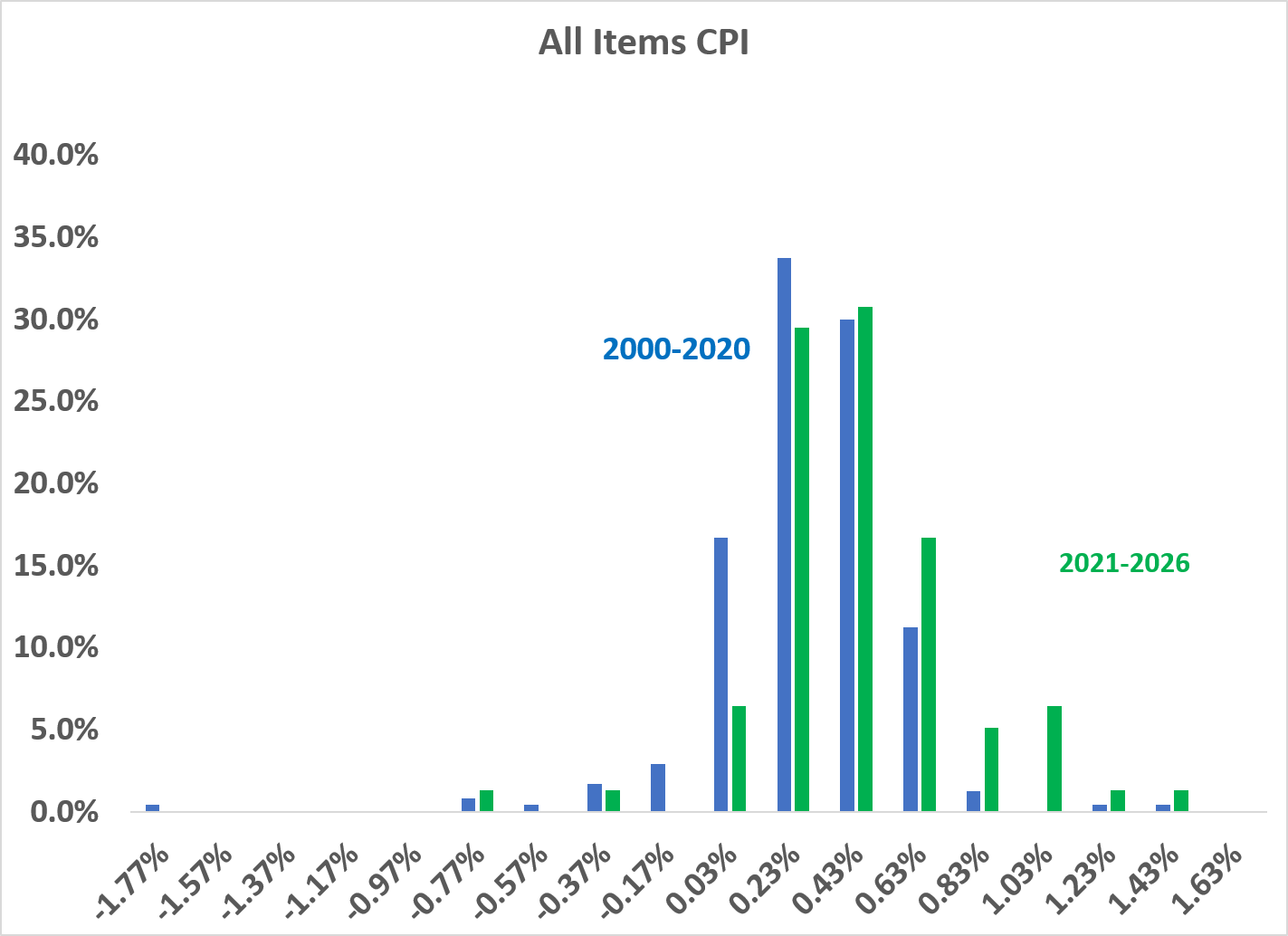
Inflation remains well above the 2.0% target in most countries, sitting in the top half of the 1.0% to 3.0% target range that approximates a 95% confidence interval. Between 2000 and 2020 inflation in most inflation targeting countries tracked 2.0% closely so stabilizing inflation expectations at target. The inflation process was predictable, so inflation expectations were almost bang-on 2.0%. More precisely, US all-items inflation averaged 2.1% annually and 70% of all monthly changes lay between 0% and 0.4%.
After the start of 2021, however, 70% of all monthly changes were greater than the 0.2% consistent with the inflation target, as the price change distribution shifted to the right taking the average up to 3.9%.
Core inflation experienced an even larger shift, with 75% of the distribution showing monthly changes above 0.2%, lifting core inflation from an annual rate of 2.0% between 2000 and 2020 to 4.1% after the start of 2021.
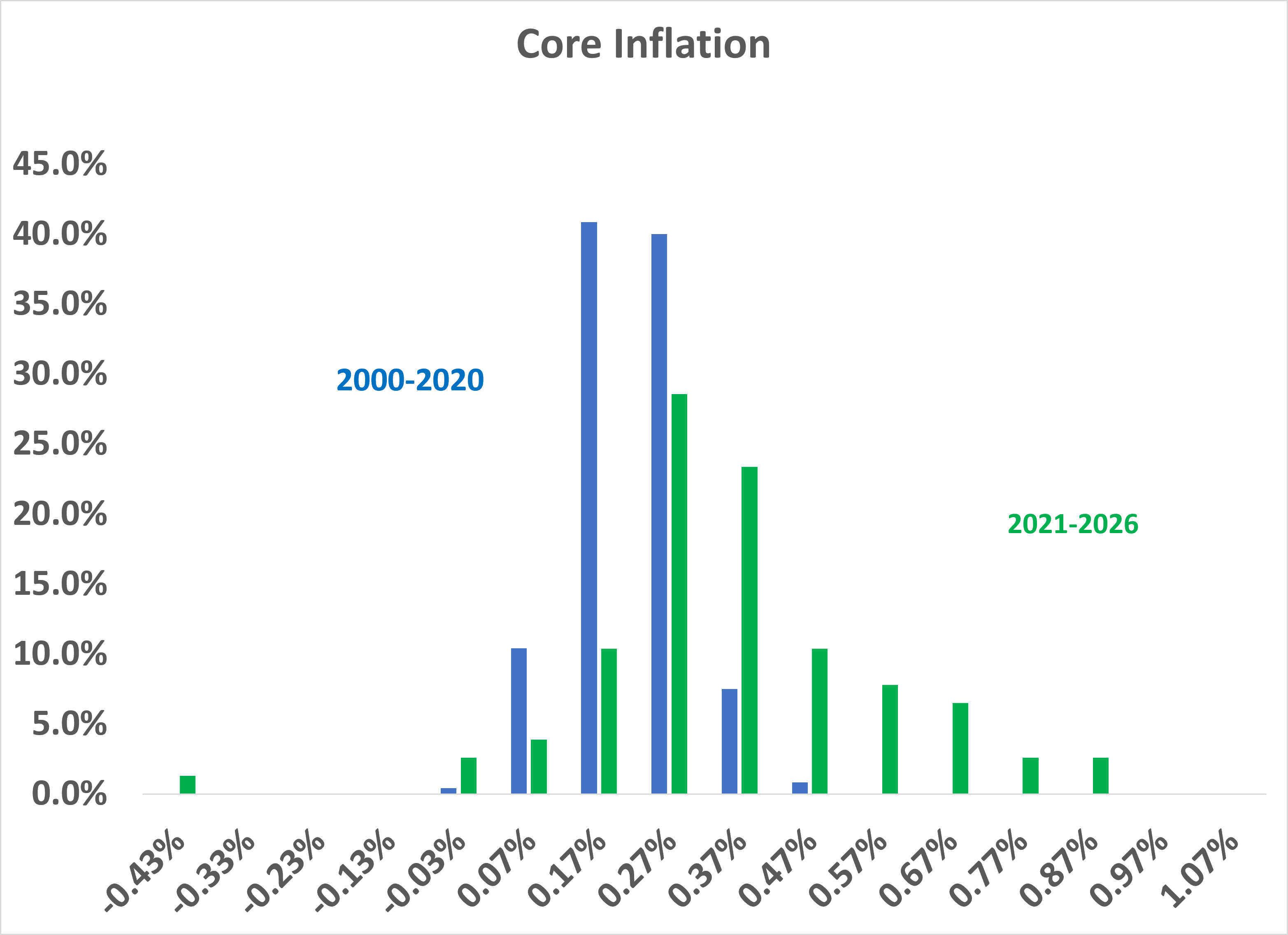
Today’s data suggest that, while monthly price changes were easing and moving towards the pre-COVID average at the start of this year, the reversion of inflation to its pre-COVID stability was incomplete.
Inflation management was poorly positioned to absorb the current exogenous price shock and maintain confidence that inflation would return to the 2.0% target without intervention. Inflation has still not returned convincingly to the 2.0% rate needed to stabilise expectations, and consumers and producers are nervous, even if investors and savers are more confident.
We should be wary, as there is likely some unobservable price tension between tradable and non-tradable goods that is on the verge of spilling into the open. Holding benign expectations for future inflation and downplaying the need to lean into potential inflation is a big bet. The ECB has shown the way, and the Fed appears to be taking the risk more seriously.
There’s a new sheriff in town
Central bank independence is under pressure in more populist and emotional times, but investors have benefited from politicians outsourcing inflation control to central banks. The bargain is simple: the public grants central banks operational independence on the understanding that they will deliver price stability. For that outsourcing contract to be honoured, central banks must keep inflation on target.
Kevin Warsh has made clear how he wants to put an anti-inflation stamp on the Fed. Yet his dismissal and ridicule of economic forecasting suggest a misunderstanding of inflation management under an inflation-targeting regime.
To be a good inflation targeter, a central banker must be a good forecaster. To meet the target and minimise inflation variance, interest-rate decisions today must be based on a forecast of where inflation will be tomorrow, not merely where it is today. Lags in the inflation propagation mechanism demand the best possible forecast: the central bank cannot wait until inflation is visible before managing it.
Alternatively, Warsh may be signalling a quiet retreat from inflation targeting altogether in favour of something more amorphous, something less well defined. That would leave investors searching for the inflation picture in the speckled brushstrokes of Degas rather than the clean lines of Piet Mondrian.
Central banks, as the outsourced inflation manager, must manage inflation for us -- but if they fall short then we will have to manage it ourselves. And, if we do not know what Warsh’s target is, then we must build-in a margin of inflation protection for ourselves, redirecting return seeking assets to less efficient and potentially costly inflation protection.
No posts
Comments
Nothing yet. Say the first thing.
Sign in to join the conversation.