

The US economy, once considered to offer the indispensable market in a highly globalized economic and financial system, is showing signs of wear. This is traced to unsustainable fiscal policy, predatory behaviour towards friend and foe alike, a casual disregard for the law, and an emerging domestic economic system based on tribute. Its growth is slowing and is increasingly vulnerable to a shock that may not be easy to stabilize.
US economic growth surprised on the upside through the middle of 2025 but began to peter-out at the end, rising just 2.2% on an annual average basis a fall of about half a percent over 2024. Core inflation continued to decline from its peak in 2022 but remains stubbornly 0.6% above the 2.0% target.
US GDP growth is narrowly focused, propelled mostly by personal consumption driven by just the top 20% of households. In contrast, the AI data centre boom is assumed to be a strong add to GDP growth, but in actuality it contributed just 0.4% to growth in the year, all of it traced to ICT investment. ICT investment added less to growth than commonly held largely because so much of what sits in data centres is imported. Finally, non residential construction subtracted from growth in the year. If there is an AI boom, it is mostly in equities.
The US economy has very little breadth, leaving it with little to fall back on should consumption growth slow. The economic airplane may be flying high, but one air pocket could easily put it dangerously close to the ground, and if you are flying low you best not hit an air pocket.
The smaller than appreciated boost from ICT spending was examined in a note by the St. Louis Fed, which showed that while growth in ICT software and data centre construction was substantial, it was dwarfed by the sheer relative size of consumption. In its assessment, the St. Louis Fed showed the ICT spending surge actually peaked in Q1 and drifted down thereafter.
Labour isn’t working
The labour market stagnated through the year and seems unaffected by robust consumption and AI investment activity. Despite the surprise January increase in employment, the underlying tone is weak. Flow in and out of the labour market has ground almost to a halt and sits at pandemic lows. Labour market lassitude signals, at least for some, more interest rates reductions to come. But it is not clear whether this is enough to move the Fed given that inflation is above target and the expected boom in AI driven productivity is yet to be apparent.
The labour market may be less influential in interest rate determination, short of a recession, because rising income inequality has concentrated income and wealth growth in the top 20% of households. This makes the US economy less sensitive to changes in employment related income.
Since 2019, the top one-fifth of households have experienced a cumulative income gain of 20% before taxes and transfers, mostly driven by realized capital gains. This highlights the growth exposure to changes in the wealth of high income households. Even if employment were to shrink and equity prices continued to rise, the subtraction from growth given employment shrinkage would likely be too small to push the economy over the edge and prompt a round of interest rates reductions. Rather, the risk to GDP growth is a reversal in asset prices.
Inequality raises risk
The trend to higher US inequality has favoured the top fifth of households, and the financing of US consumption from wealth gains is traced to rising equity prices. The two top drivers of economic growth, consumption and ICT spending, are joined at the hip. Growth in net worth is driven by tech equity prices, and expectations of future gains to non-tech equities from the adoption of AI feed the overall equity market. Tech stock growth has been more volatile of late, and the wide dispersion in equity prices is consistent with investors picking winners and losers in the AI disrupted tech world. Major indices are struggling to make headway and are likely warning of potential investor and economic trouble ahead.
On the flip side of income, wealth and consumption concentration is the four-fifths of US households account for about two-fifths of the economy, depending on who’s data you use. Research by the Dallas Fed shows that the top quintile of households accrue 60% of income, own 71% of net worth, and account for 57% of total consumption. The rest of the economy must get by with 40% of total income and a claim on just 29% of the country’s net worth.
The Dallas Fed researchers conclude that the US economy today is much more sensitive to a reduction in the return on assets held by the top income quartile than to a widely distributed loss of labour income growth from a broad-based economic slowdown.
Just as the arrival of AI and its impact on equities is boosting the income and wealth of the top fifth of households, it is suppressing the welfare of the bottom four-fifths. AI driven job displacement is generating a labour market undertow, with skilled and unskilled workers pushed onto the back foot as corporate executives view AI as a tool enabling headcount reductions to boost profitability rather than deploying AI as a productivity and income enhancing tool.
While substitution of AI for labour may give a sugar high to non-tech stocks, it could result in a significant increase in the duration of unemployment for those with few assets to fall back on. This is likely – along with the stubbornly high cost of living – behind the low level of consumer confidence.
The dangers of belief to assumption setting
AI driven structural transformation will not change the economy overnight, and AI any related productivity gain will likely be hard to detect. And, such a profound shock will redistribute productive resources causing more near-term distress than long-term happiness. Resource transfer associated with general purpose technologies is asymmetric in both incidence and time to completion. The firms going down can collapse overnight, but the firms that replace them take time to emerge.
The introduction of a new general-purpose technology initially reduces productivity before it boosts it, generating a persistent and strong growth undertow for some time. This reduces demand in tandem with supply potential. The economy will appear weak as this transition completes and is unlikely to take inflation down with it as no effective slack is opened up. If productivity fails to expand, and the economy does not open up a large measure of slack, then it is hard to be assertive with monetary easing unless inflation trends unexpectedly downwards.
The US economy is now overexposed to an equity market claimed by a minority of the population. With the bulk of the working population experiencing either no income growth or declining income growth, and with inflation well above target, there is little to support demand if high income households experience capital loss.
Belief in a positive view on an AI productivity growth boosting demand and economic growth and lower inflation, one that can accommodate lower interest rates, is pollyannish and inconsistent with the stylized facts of the impact of general-purpose technologies on economies.
Consider, if the trend rate of growth is higher, then the economy should be able to support a higher real interest rate even if inflation converges to target. If growth is already on the higher trend path, and there is no slack in the economy, then there is little case for lower interest rates. Hence the Fed’s cautious approach that infuriates the current administration.
With the lower end of the central bank’s interest rate target at 3.5%, and core inflation (the better predictor of future inflation) at 2.6% the real rate is roughly 0.75%, a bit too low given the current distribution of growth and inflation risks. Two-percent inflation would deliver a real rate of 1.5% which would be a more comfortable position to either trim rates a bit or sit and wait for the AI boom to show itself. But it’s not here yet.
The signature of a positive supply shock is higher than expected growth and lower than expected inflation. Two quarters of strong growth – Q2’s 3.8% and Q3’s 4.4% are like an early sighting of swallows: they do not a spring make especially when winter reappeared with a 1.4% rate of growth.
GDP growth came in close to its 2.0% trend in 2025, consistent with labour productivity growth of about that magnitude. The immigration clamp-down limits the growth contribution from the labour force, so expectations of a rise in trend GDP is riding on AI delivering on productivity sustainably above 2.0%. Again, we aren’t there yet.
Cutting real interest rates can do little to support 80% of the economy’s earners who sustain just 40% or so of consumption, most of it likely non-discretionary. Fiscal policy is redistributing even more income from the bottom to the top, so this might help prop-up upper end consumption growth for a bit.
Positioning for lower interest rates is really, over the short-term, a bet on the fortunes of those at the top of the income heap, who in turn rely on buoyant asset returns to sustain consumption. Given dystopian levels of income inequality, and the productivity miracle a wish and a hope, the best the US economy can seem to do is trend growth carried by the top of the house.
From indispensable to dispensable market – not quite there yet
The AI complex of inflated growth and near-term productivity expectations, extreme income inequality, entrenched and large fiscal imbalances, the drift away from the rule of law and at the mercy of tribute crony capitalism leaves the US highly vulnerable to a major financial or economic shock, and with it the potential for capital flight.
Sceptics will point to the global scramble for cash following the US-Israel attack of Iran has been dollar positive, signalling that the US retains it ability to be a shelter for cash in a global risk reduction. However, it is not clear whether the run-up in the US$ was capital seeking shelter or a wider de-levering of dollar positions on risk reduction. The implied interest on US ten-year bond yields rose 15 basis points to 4.11% suggesting that we should be circumspect concluding the dollar jump reflect a flight to safety.
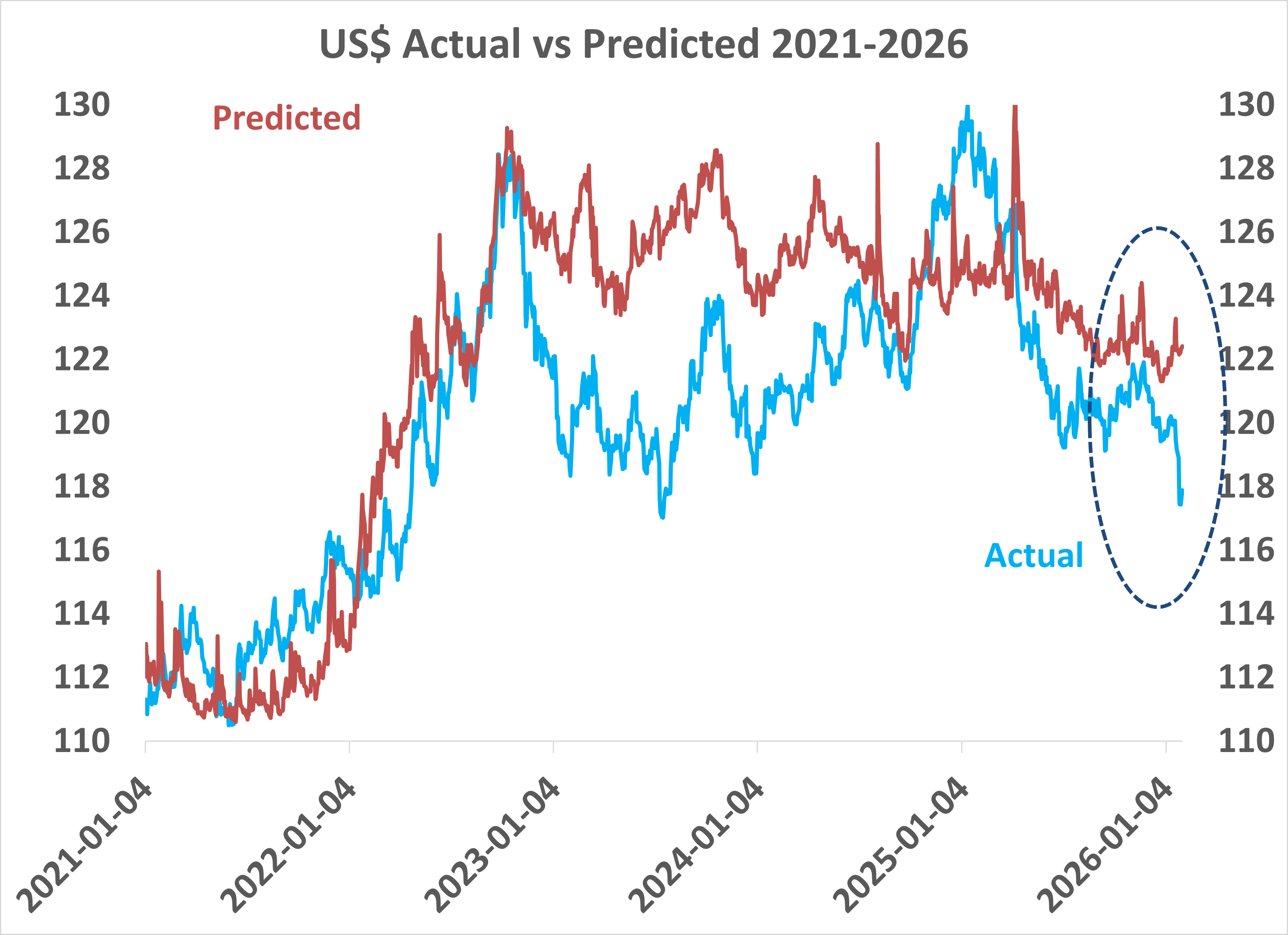
The weakening structural foundations of the US$ makes it vulnerable to a combustible mix of reactive politics and heterodox economic policy. This combustible mix and has twice moved the US$ against expectations in the past year, suggesting that the US is making the transition from the indispensable market to one increasingly best avoided. Time of US driven stress has seen the US$ move down against a simple model of interest rates and equity market volatility instead of up, as shown in the chart below[1].
Most investors have yet to exit the US market, instead hedging their exposure and directing new investment elsewhere. But the time is coming when the US authorities will likely have to use an already unsteady fiscal policy to stabilize their economy.
They may find that after extorting and bullying friend and foe alike, this will neither be easy, painless, or cheap, and the dollar will be a key adjustment variable more likely to move down rather than up and with it interest rates.
[1] Steve Kamin proposes modelling the US$ on three explanatory variables: two-year US yields, the slope of the 10yr-2yr yield curve and the VIX.
No posts
Comments
Nothing yet. Say the first thing.
Sign in to join the conversation.