
A negative supply shock delivers a toxic combination: growth weakens, inflation rises, and long-term interest rates drift higher to discount inflation. Given high debt ratios, negative debt dynamics can deteriorate with surprising speed and recent bond market volatility shows the market is nervous.
Many sovereigns sit at the precipice between “manageable” and “precarious” debt balances —especially the United States and the United Kingdom. The debt-to-GDP ratio is the base upon which debt compounds, and GDP is the proxy for the sovereign’s ability to raise revenue.
A high debt ratio is bad enough, but if it is accompanied by a primary deficit – revenues less expenditures before debt interest costs – the combination can be deadly for fiscal sustainability. The US has a primary deficit of 4.0% of GDP and an expenditure gap between revenues and expenditures equal to 9% of GDP, by far the biggest in the G7. It has got away with it because it is the world’s reserve and payments currency, but this privilege is being eroded.
This is not comforting, as a joint adverse setting for these two variables primes the fiscal system for a shock. What ignites the powder is higher interest rates and lower growth. And today’s negative supply shock might spark the powder.
The debt ratio is less an indicator of future default, and more an indicator of future inflation because a sovereign can always print money to redeem its debt when in difficulty. Of course, as this exchange approaches, investors are aware they would be exchanging an interest-bearing government IOU for a non-interest-bearing IOU so they tend not to wait around. The speed at which a high and rising debt ratio can overwhelm fiscal and inflation management should not be underestimated.
Just because a sovereign won’t resort to default, doesn’t mean there are no constraints. When markets are quiescent, persistent primary deficits will drag the debt ratio up, but there is no market pressure to rein-in over-spending. Eventually a rapidly rising debt ratio and a primary deficit left unattended causes debt interest costs to crowd out other expenditures. Rising debt interest costs eventually force higher taxes, lower spending, or some combination of the two, and the primary deficit closes. But often in adverse circumstances.
The Nitty-Gritty: Four Variables That Matter
The rate at which the debt ratio changes is determined by the interaction of four variables: how fast the economy grows, the rate of interest paid on the debt, the prior year’s debt ratio, and the primary balance.
The intuition is straightforward. This year’s debt ratio rises (or falls) roughly by the difference between the financing rate and GDP growth, scaled by last year’s debt ratio. For example, if last year’s debt ratio is 100% of GDP, the financing rate is 4%, and GDP growth is 3%, then the debt ratio rises by about 1 percentage point. Reverse the gap— a financing rate of 3% and GDP growth of 4%—and the debt ratio falls by about 1 percentage point.
Primary balances matter because they add or subtract from the debt ratio directly. If debt momentum reduced the debt ratio by 1.0 percent ,and the primary deficit was 4.0%, then the debt ratio would rise by 3.0%. A favourable interest rate -growth is nice to have but it is negated if there is a persistent primary deficit.
Debt momentum is currently benign, but it can quickly turn malignant in difficult circumstances. If interest rates rise and GDP growth slows, debt momentum adds to the debt ratio, and this force is amplified by the primary deficit: the debt ratio can quickly soar.
As the debt ratio rises, interest rates will go up to absorb additional debt (which now goes to meet the interest rate bill) GDP will go down. A vicious circle takes hold of ever higher interest rates and ever lower growth. Investors demand still more compensation, and the compounding accelerates.
The rising interest premium is not a debt default premium, rather an inflation premium. The market assigns greater priority to the levying of an inflation tax rather than a rational fiscal consolidation through higher taxes and lower expenditure.
Adjustment in these circumstances is hard. Persistent primary deficits – that built the debt in the first place -- result from an inability to forge a political consensus around the need for sound fiscal management which cannot transcend political belief and priorities. It takes a crisis to find political consensus for austerity.
The Market’s Quiet Warning Signal
The risk that negative debt momentum may kick-in is currently a tail risk. Just look at the term premium – or the compensation demanded by investors for holding long-term bonds instead of rolling short-term debt.
Back in the early 1990s, when bond markets worried about, and priced protection against, inflation the term premium was substantial. The US is the world’s most important sovereign borrower, and in April 1992 the term premium was 252 bps, inflation was 3.2%, and the debt ratio was 48.3%. Today, the term premium is 65 bps, inflation is 3.3%, but the federal debt ratio is two-and-a-half times higher at 125%, and the US has imposed a negative supply shock on itself and the rest of the world.
While today’s term premium has risen from its -65 bps 2020 low, the market has not fully discounted the elevated inflation risk embedded in the precarious US debt and deficit position. Moreover, persecuting the Chair of the Federal Reserve at a time of economic instability, and the absence of a meaningful risk premium in US interest rates, is playing with fire.
Emerging Markets Are Also Vulnerable
Fiscal vulnerability is not limited to advanced economies. The IMF’s most recent blog flags the fiscal risk facing middle income and poor countries from a new food and energy price shock when the scars of the 2022 energy and food price shock remain unhealed.
The emerging world is vulnerable as the energy price shock becomes quantity scarcity. Much of Asia’s oil and LNG comes from the Persian Gulf. Thailand sources almost half of its energy needs from the Gulf; South Korea about a third; India and Vietnam about a quarter. In the first instance, incomes are first pinched by the rise in energy prices, immediately followed by a second hit as food prices rise.
Food is roughly one-third of the CPI basket in poor countries, about one-fifth in middle-income countries, and around one-tenth in advanced economies. Governments seek to contain the political instability that comes from food-and-energy price shock.
The 2022 shock damaged vulnerable county fiscal positions and shrank shock-absorbing buffers. They have not yet fully recovered. The Fund’s policy instinct now to advocate fiscal discipline is familiar, warning of the fiscal damage that may come from preserving social and political peace by sheltering households today at the expense of households tomorrow.
Em and low-middle incomes have lower debt ratios and smaller primary deficits yet the Fund fears the negative debt and currency management challenges for middle income countries that come from adverse terms-of-trade shocks (higher energy prices). Fiscal adjustment can be wrenching if shocks are large, real interest rates can soar and currencies depreciate catastrophically.
But like advanced economies this remains a tail risk. Many EM countries have built up large US$ reserves to provide self-insurance against interruptions to capital flows—but those reserves are finite, and poorer countries cannot outbid richer countries for long when global energy supplies become scarce.
Lucky Canada
The punishment from long neglected fiscal imbalances and devastating debt momentum in the advanced world comes from Canada’s 1990’s experience. At the end of the 1980s, Canada sought to head off a cyclical rise in inflation, running around 5%, and then lower average inflation to 2%. This ambitious objective was viewed with some scepticism by financial markets.
A trend tightening in interest rates began in 1987, with three-month interest rates rising from about 9% at the start of 1988 to a peak near 14% in early 1990. Then the trouble began.
Knowing that monetary policy works with a lag, and with its inflation objectives in sight, the Bank of Canada eased interest rates in 1990 as a mild recession loomed. But markets were not confident that cyclical inflation was truly tamed, or that the 2% objective would be met.
The market responded negatively and jarringly. The C$ dropped dramatically and interest rates surged undermining the Bank of Canada’s ability to manage inflation. The Bank backed off and held interest rates too high for too long to shelter the currency at the expense of growth.
This opened the Pandora’s Box of negative debt dynamics. Debt service costs surged: the interest rate on the debt rose to 10.3% while nominal GDP growth shrank to 3.6%, leaving a gap of 6.7 percentage points. The debt ratio took off. Even though Canada funded its expenditure from taxes and ran a primary deficit, debt interest costs overwhelmed any attempt to manage either fiscal or monetary policy.
As the market moves much faster than policy, stabilization demands a large reduction in expenditure to get the markets on side. While this eventually happened, it took almost five years to achieve. The chart shows that even a primary surplus of 2.0% of GDP could not stem the magnitude of debt momentum, which required huge primary surpluses to overcome.
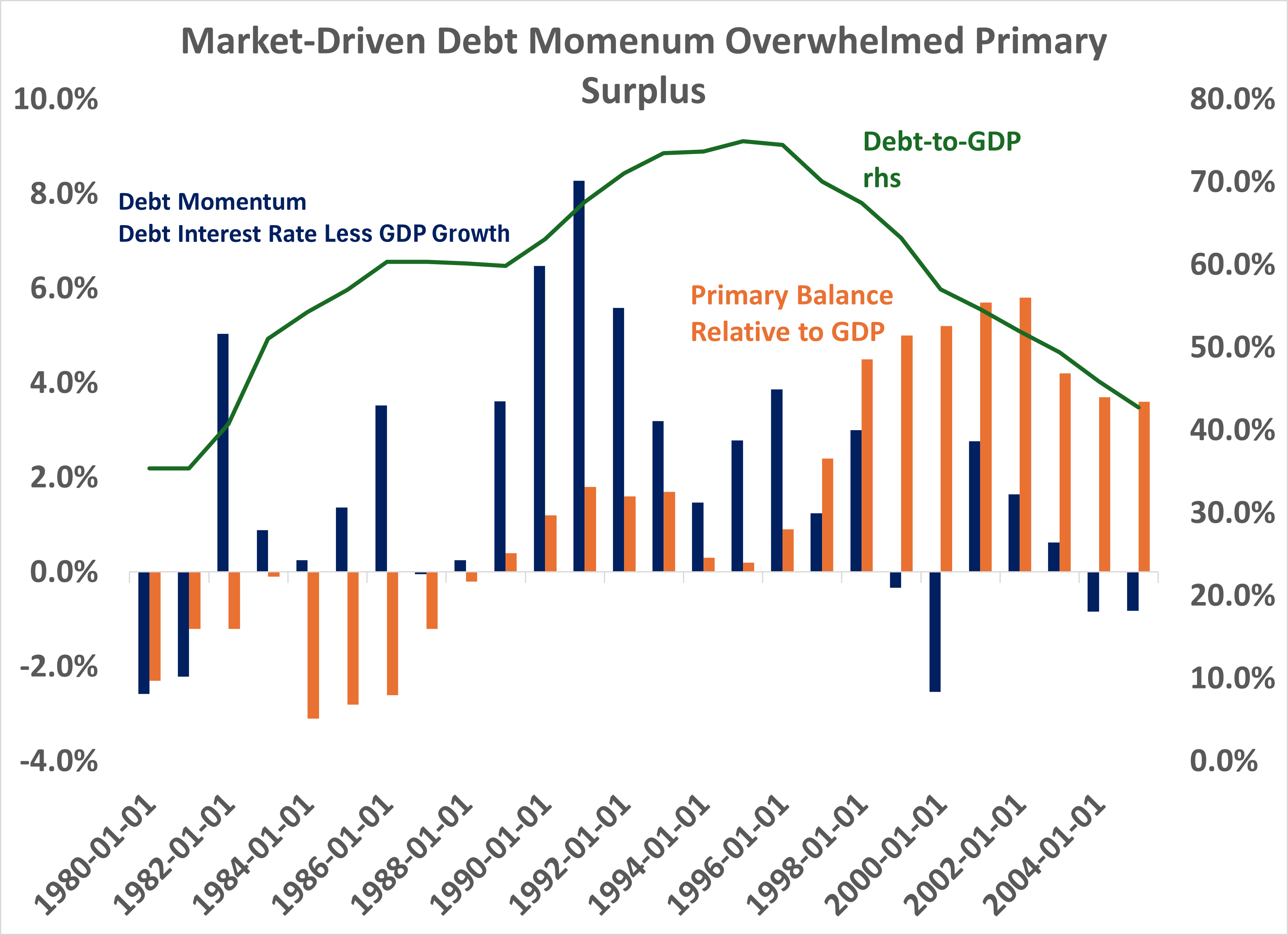
As a small open economy Canada got lucky, and the fiscal adjustment was relatively painless compared to expectations. NAFTA gave Canada access to US demand, the C$ depreciated significantly, and real interest rates plummeted by 500 basis points. Export demand filled the demand gap created by fiscal contraction (which was about 5% of GDP) and growth resumed as interest rates fell so negative debt momentum was blunted.
You Wouldn’t Start from Here
The menace of potential negative debt momentum today comes not from today’s interest-growth differential, but high debt ratios and serially wide primary deficits. Markets understand how devastating debt momentum can be and how quickly it works against you. If GDP growth turns down, negligible debt momentum can quickly become significant. Debt compounding can become menacing with unsettling speed.
Large sovereigns do not enjoy the same escape route. Canada was lucky, the UK less so. The U.K.’s experience with austerity in the 2010s is a cautionary tale. As a much bigger economy, and being a relatively open economy, the UK could not rely on exports to offset the economic drag from fiscal austerity. And Brexit worsened Britain’s terms-of-trade making it even harder. The NBER estimates that Brexit cost the U.K. 8% of GDP, vital support that would have eased its fiscal austerity.
The United States retains the exorbitant privilege from reserve currency status and dollar dominance in international payments, but bullying and intimidating trading partners will surely undermine its privilege. US activity in the Persian Growth gives some evidence this is already the case. Some investors have moved away from US Treasuries and instead accumulated supranational dollar bonds that allows them access to US$’s but avoids exposure to the quixotic US government liability.
We Are Not Well Positioned
When debt momentum turns against sovereign issuers, markets can reprice sovereign risk much faster than sovereigns can respond, putting them on the back foot. Credibility takes years to build and lost in an instant. The world’s major sovereigns are not well positioned to absorb the pressures coming from the US, upending of thirty years or more of trade and security stability in the face of a second energy and food price shock just four years after the last.
The war in the Gulf is far from settled, and the market is already separating the weak from the strong sovereigns. The market now prefers supranational dollar borrowers to the US state, and the market has singed out the UK, France and Italy as Europe’s troubling sovereigns[1]. Emerging markets are not immune.
We have been warned, and if fiscal contraction is coming, no one will get off as easily as Canada did in the 1990s – including Canada itself.
[1] We have discussed the dangers of fiscal dominance in previous essays, and we are about to see how stressful this can be as illustrated by recent bond performance of the BIF’s: Britain Italy & France who have experienced a big increase in funding costs on the commencement of the Iran-US-Israel War.
No posts
Comments
Nothing yet. Say the first thing.
Sign in to join the conversation.