
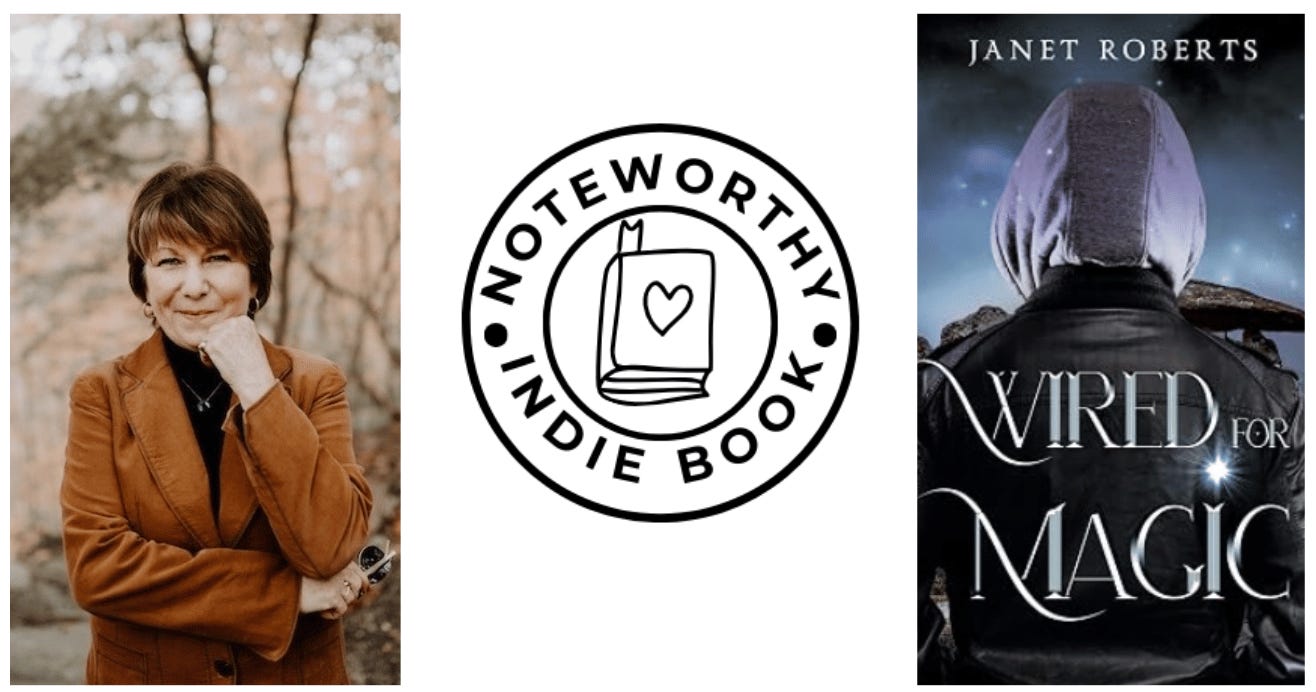
“The story combines this cat-and-mouse game with Rowan’s journey to understand and accept her power, and be transformed by it, into an independent, ass-kicking, witchy woman who is strengthened by the support of the strong women who came before her.” - Heather Dodge Martin, Author
Q: How did you first connect with the notion of magic?
A: As a child, I loved Alice in Wonderland and Through the Looking Glass. I was fascinated by them and then, later, Tolkien’s The Hobbit and Mary Stewart’s The Crystal Cave. I was drawn to stories with magical realism. King Arthur pulling a sword from a stone or Alice stepping into a looking glass. Recently, I read several books in The Crow Investigation Series by Sarah Painter, starting with The Night Raven, and loved them. Painter does an interesting and believable job of setting magical realism in London. Generally, the concept of an average person having magic has always fascinated me.
Q: You do a good job of leading skeptical readers into the power and excitement of magic. Where are you on the spectrum of believer vs. skeptic?
A: That’s a great question. I do believe that some people are born with second sight or psychic abilities - perhaps a larger than normal sixth sense - but I’m skeptical around the ability of any human to be born with actual magical powers. It’s fun to imagine in fiction, but I don’t think it’s possible in real life.
Q: What is the relationship between spiritualism and magic in your book?
A: Wow, that’s a tough one. No one has ever asked me this question. While researching Wired For Magic, I thought about how many cultures adopted Christianity but kept pagan holidays - Halloween, Summer Soltice, Beltain, Samhain - and kept folk tales that involved magic, keeping it alive through retelling. Spiritualism, for me, is more in line with a belief system as to how your spirit interacts in this world and where you think it will go when your mortal life ends. I don’t think the Hollywood version of “heaven” is real. I am a person of faith and when I leave this world I’ll learn what a spirit realm is all about. I admit to being drawn to a good ghost story, like Simone St. James’ novels, because she fictionalizes things I wonder about. Magic, or having magical abilities, is how we imagine we might like to be — something fun and mysterious, something that makes us different, something that could be used to right wrongs in the world. But it only exists in fiction. Harry Potter is a great example of the endless attraction people have to imagining magic and what it can do in the world!
Q: Tell us about your cybersecurity background and how it informed Wired for Magic.
A: With a B.A. in Journalism and, later, an M.A. in Communications, I tried a number of careers — journalist, paralegal, media relations, corporate communications. It was while working in the latter, that the company CSO asked me to build a security education and awareness program. I’d never heard of this type of program. I was both ignorant about and fascinated with cybersecurity. But I was over age 50 and still making a small salary, unsure if I’d be able to build a decent retirement. I decided to take a risk and try it. From the beginning, I loved the topic, the program building, and offering people information they needed and wanted. That was in 2010, when about 200 people around the world were doing this work and very few — 5 that I knew of — came from a marketing and communications background. I entered the profession early and stayed a long time.
I moved from the domestic company where I built my first program to an international credit card company, rebuilding its security awareness education, and then was approached by a multi-national insurance company to build its first program. I spent over 8 years there and created a well-respected global program. Even as a retired person, I still love cyber and try to keep current by reading a variety of publications.
Cybersecurity experts are very technical, many are software engineers who love to read science fiction. None that I know believe in magic. Wired For Magic was built on a series of “what ifs”:
· What if a woman inherited magic from her mother but her mother died before she could train her in how to use her gifts?
· What if she had a brother who was a cyber expert and complete skeptic, therefore nothing she said or did would work to convince him she had magical abilities?
· What if she had a problem so terrible the only way to make it go away was to face her personal power and use it?
I like the women in my novels to be on a transformational journey to find their personal power, perhaps because it took me a long time to reach that goal. In Wired For Magic, I decided to insert a twist and make Rowan’s journey accepting and controlling her magic.
Finding, owning, and unleashing your personal power is your magic.
“Harry Potter meets Taken in this grown-up, high-tech thriller. Author Janet Roberts cleverly injects magic and romance into the world of cybersecurity. Wired for Magic is a satisfying story that combines old magic and new technology to deliver a message about enduring love.” ~Ann Howley, author of “The Memory of Cotton”
Q: Are any of your characters inspired by real people?
A: No, at least not in Wired For Magic. I’m an avid people watcher. I see and remember behaviors and mannerisms that roll up when creating characters. While writing, I imagine what it would be like to be the character in a scene. I’m tapping that knowledge to create the character’s emotions, reactions, and more. At times, if there is a similarity to something that happened to me or someone I know, I’ll rely on those memories to guide the writing. There are times when I look at a character I’ve created and think it’s an amalgamation of a few people I’ve known, or that it has some of me in the mix. I had the most fun I’ve had as an author writing Rowan because she’s a lot of things I wish I’d been at a younger age and love being able to create, then live vicariously through, in her adventures.
Q: A portion of the story takes place in Wales. What is your connection to that country?
A: My third great-grandfather emigrated to America from Ruabon, Wales. Roberts is the sixth most common Welsh surname. I’ve been to the country several times to visit friends and like it there. I was searching for ancient ruins that felt like the type of spot I could imagine Rowan visiting to recharge her magic. A friend in Wales sent me an article in The Guardian by a writer who hiked through Wales and wrote about a number of ancient sites, many old druid ruins, that he saw along the way. The part of me that loved the Arturian legends was instantly interested. When I saw the picture of Pentre Ifan, I asked my friend how far it was from her home. She said “30 minutes. I’ll drive you there if you come to visit.” The rest is history!
Q: Is there a sequel? If so, can you give us a hint what it’s about?
A: I’m considering making it a series. I’m currently researching several cyber related topics and sketching out plot ideas for a second Rowan book! At this point, I’m reading about agenic AI and working out where Huw can accept an assignment that will put him up against bad people with access to dangerous elements of AI… and, of course, how Rowan’s magic might be needed to save the day. I’m in the early days of research, juggling it with finishing a sequel to my 2024 novel, What Lies We Keep.
Q: How did you get started writing mysteries? Which mystery authors inspire you?
A: From the first time read The Secret of the Old Clock by Carolyn Keene in the second grade, I was fascinated. I read the entire Nancy Drew mystery series. A few years later, I began sneaking my parents adult thriller novels, like Day of the Jackal, into my room to read. When I began writing novels, I didn’t have the confidence to try mystery or thriller books. I started writing my first books while working in corporate communications and finished them in the early days of my cybersecurity career. They have a little bit of suspense but nothing like the style I’ve evolved to in my recent work. Initially, I thought I wasn’t “technical” enough to incorporate elements of cyber in the plot of a novel. But by the time I wrote What Lies We Keep, I’d built three security awareness programs, had lots of friends with technical expertise, and had the confidence to fold it into my work. That said, I don’t set out to write cyber into the plot. If it fits, then I use it. With the Rowan books, it will always fit somewhere due to the men in her life she cares about.
I’m inspired by Julie Clark, Tana French, Harlan Coban, Laura Dave, Ruth Ware, Mary Kubica, Ashley Elston, and Sarah Painter. So many authors I love and so little time to read them all!
Q: What is your writing Kryptonite, i.e., what can steal you away from writing?
A: A really good book, the chance to travel to a place I’ve never been, a long walk in the park on a beautiful day, a coffee or a glass of wine with a friend, or spending any time with my 92-year-old mother who is an avid reader! Also, an hour relaxing on my porch swing which is usually paired with a good book!
“Reading ‘Wired for Magic’ is like assembling a high-stakes jigsaw puzzle; as the pieces click into place, you become more and more obsessed with the story.
Once I started reading, there was no turning back.”
P.S. Know someone who’s been bit by the mystery bug? Help them scratch that itch and take life a little easier — refer them and win prizes! (And many thanks to all of you who have recommended Spellbound to your friends and colleagues. We really appreciate it!)
Comments
Nothing yet. Say the first thing.
Sign in to join the conversation.