
Event submissions for SF + LA Tech Week close this Friday! Submit a proposal here before 5pm PT on 8/21.

👩💼 Jonathan Lai argues that “chief of staff at an early-stage, post-PMF startup might be one of the best career launchpads for a smart young person right now.”
👗 FLORA (SR004) announced Fashion Studio, “a set of tools built for what fashion teams do”
🔗 Emily Bennett says real urgency can only come from real restraints.
💼 Join our talent network for more opportunities. If we see a fit for you, we’ll intro you to relevant founders in the portfolio
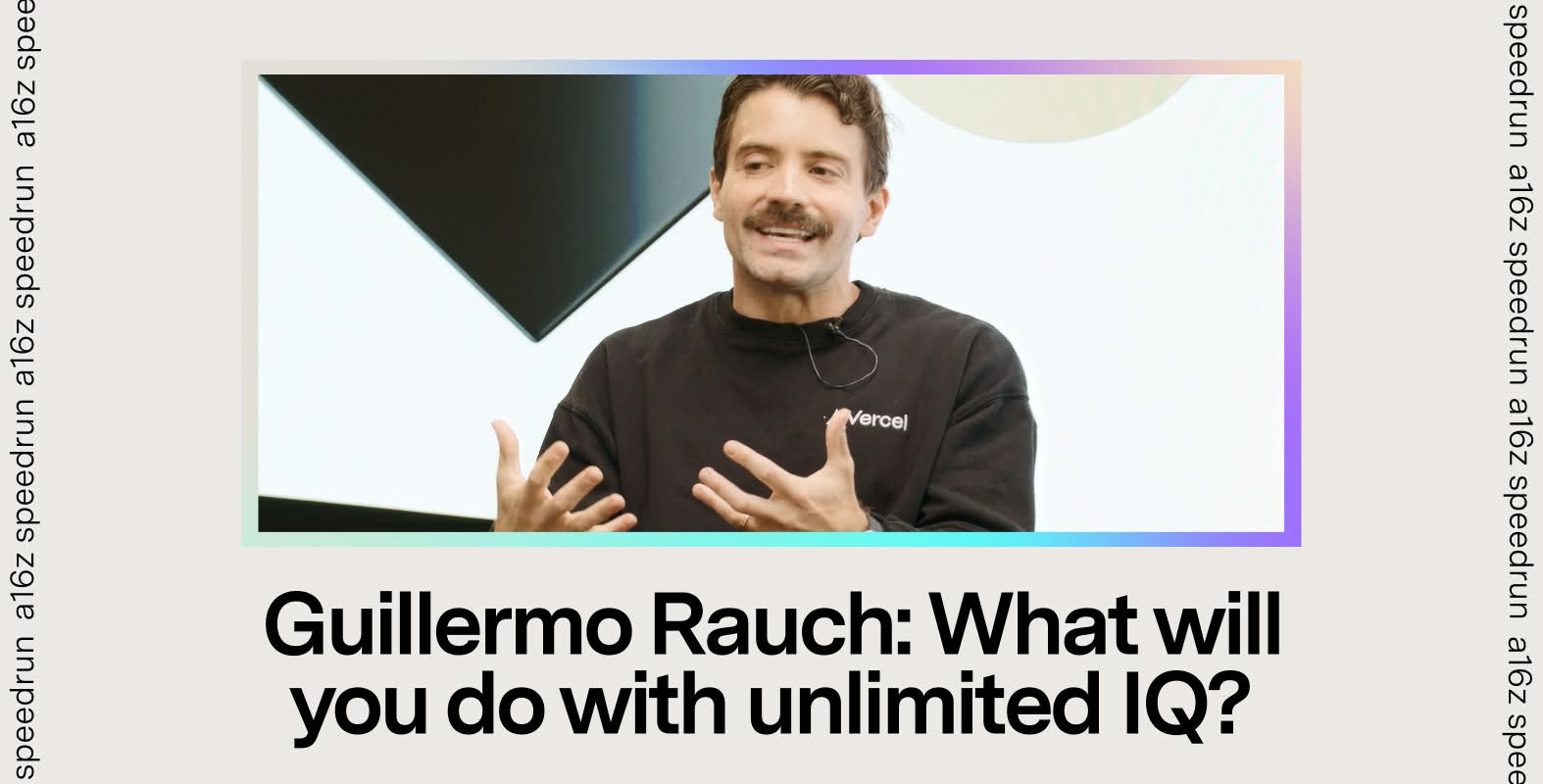
Guillermo Rauch created Socket.IO and Next.js before founding Vercel, which started out as a frontend platform and is now all about agent infrastructure.
Rauch recently sat down with a16z’s Gabriel Vasquez in front of a room full of speedrun founders to talk about what will change in a world where intelligence is “as accessible as tap water.”
Watch our full conversation with Guillermo above, or check out the highlights below:
Gabriel opened with a callback to something Guillermo has been saying lately: intelligence is now abundant “like tap water,” thanks to what he calls “this inexhaustible IQ machine.”
“It seems like we have this inexhaustible IQ machine. We’re running some cybersecurity tests – you guys have probably seen a lot of news about agents escaping the sandbox – and when we unleashed Kimi K3 on our sandbox, I was just dismayed by what I saw.. The agent was trying absolutely everything under the sun to escape the sandbox.
I’ve been coding for twenty years, and to get that level of energy on demand from a senior engineer or a principal engineer is basically impossible. You would have to pay millions and millions and millions of dollars. And now you all have it. You can just get a gateway and pick any model in the world, and you basically have unlimited IQ. And so the question becomes: what are you going to do with that IQ? Because you have it.”
Gabriel followed up by asking about a recent tweet where Guillermo said that “the software factory is the product now.”
Guillermo elaborated:
“Once upon a time, you would raise your seed round just to come up with a prototype of your product. Now you can come up with the prototype of your product on the Waymo ride here, in five minutes. And so the bar keeps getting higher, and it won’t be interesting to look at a discrete point in time of what you’ve built. What’s going to be way more interesting is how quickly you’re churning out improvements to that product…
“…What will be interesting is: how fast is your system learning? Obviously, terms like loop engineering and graph engineering are a little loaded, but I think the idea is very durable and correct, which is that you’re building the harness and the system that is constantly acquiring signals from the world. And the signals could be things that customers bring up during sales conversations that you process really fast. People admire that – sometimes they slide into my DMs, and then five minutes later I respond with, ‘we fixed it’ or ‘we reverted it’ or whatever. It’s because we’ve kind of honed in on this software factory.”
Vercel ran the everyone-build-agents experiment earlier than most companies and, as Gabriel noted, ended up somewhere unexpected: the company now uses just one agent.
“About a year ago, or maybe a little bit longer, we basically encouraged the company to take this software factory attitude across the board. If you work on marketing, my message to the company was: build the agent that automates marketing for us. And that doesn’t mean, like, an API plugged into a slot machine with no oversight, right? It meant everything about your job, I expect you to AI-ify, because it’s going to make you more efficient. And what ended up happening was maybe too much success. We ended up with hundreds of internal agents…
“...By that time, we’d already shipped V, which is our internal agent. And the metaphor is, it’s like Jarvis to Iron Man. There’s just one intelligence for the company. I can hire anybody in the world, they join Vercel, and basically their onboarding peer is this agent. You can ask this agent about the company org chart. You can ask about what initiatives are ongoing. You can ask it, ‘if I were to say something on Twitter on behalf of the company, how should I go about it?’ Every aspect of the company is getting AI-ified. The learning here was: this agent that is going to help you run your company is as fundamental to your business and to your future as your domain name. ... When we talk to enterprises, obviously they’re very concerned about security. I’ve talked to numerous CTOs and CIOs who say, ‘well, in my personal time, I set up OpenClaw on a Mac mini. I would love to have an agent that is as smart and can do as much as OpenClaw, but for my company.’”
“This leads me to another viral tweet that you had,” Gabriel said, “which is the vision that companies are going to go from product-led growth to agent-led growth.” It’s already showing up in Vercel’s data:
“We put out products these days, and it does feel like agents are getting to our products faster than even our humans in the company are wrapping their minds around the products. We might launch a new capability, ship it into the CLI, and immediately see an uptick of usage, even though we actually did no promotion. So think about the old way of building and delivering software: you raise your seed round on Sand Hill Road, blah blah blah, then you get your TechCrunch post when you launch, you’re on the front page of Hacker News. And those things are not going to stop happening – I read Hacker News, I enjoy seeing companies launch.
“But we are already in a world where, if you play your cards right, the agents are going to get to your product first. It’s almost like you’re promoting to them. One of the ways that you can do this is by piggybacking on existing distribution channels. So, for example, the Vercel Marketplace: we put products in the marketplace, and now agents are buying products that are not even ours. They go to it almost like an Amazon.com for the cloud – can I go and buy a database? Can I buy a browser infrastructure product? And so we have the data that basically shows that agents are making purchases and signing up for accounts on behalf of their humans. And this is what I call agent-led growth. And I think it’s going to be one of – if not the – pillars for commercialization of products in the future.”
With everyone in the room building using the same models, Gabriel asked where defensibility comes from. Guillermo’s answer: even the best model on the highest reasoning setting still makes mistakes, so what matters is everything you build around it:
“There’s still a lot of IP and value in your software factory, in your ability to steer these models, in your ability to create the verification loops. The goal is not ‘I burned a lot of tokens, I token-maxxed.’ The goal is to deliver a quality product as fast as you can, and keep it up to date as fast as you can. And obviously, the most important building block that we have today to accelerate quality is coding agents and coding agent infrastructure. So creating the checks and balances for the agents, I think, is where a lot of the alpha is today…
“...Your ability to communicate trust in what you build, and craft – those are still going to be high-signal dimensions in a world that gets more flooded with options.”
That’s it for this week! Huge thanks to Guillermo for spending the time with us. For more weekly dives into the world of early-stage startups, subscribe below.
You are receiving this newsletter since you opted in earlier; if you would like to opt out of future newsletters, you can unsubscribe immediately.
This newsletter is provided for informational purposes only, and should not be relied upon as legal, business, investment, or tax advice. You should consult your own advisers as to those matters. This newsletter may link to other websites and certain information contained herein has been obtained from third-party sources. While taken from sources believed to be reliable, a16z has not independently verified such information and makes no representations about the enduring accuracy of the information or its appropriateness for a given situation.
References to any companies, securities, or digital assets are for illustrative purposes only and do not constitute an investment recommendation or offer to provide investment advisory services. Any references to companies are for illustrative purposes only; please see a16z.com/investments. Furthermore, this content is not directed at nor intended for use by any investors or prospective investors, and may not under any circumstances be relied upon when making a decision to invest in any fund managed by a16z. (An offering to invest in an a16z fund will be made only by the private placement memorandum, subscription agreement, and other relevant documentation of any such fund which should be read in their entirety.) Past performance is not indicative of future results.
Charts and graphs provided within are for informational purposes solely and should not be relied upon when making any investment decision. Content in this newsletter speaks only as of the date indicated. Any projections, estimates, forecasts, targets, prospects and/or opinions expressed in these materials are subject to change without notice and may differ or be contrary to opinions expressed by others. Please see a16z.com/disclosures for additional important details.
No posts
Comments
Nothing yet. Say the first thing.
Sign in to join the conversation.