
We are pleased to share the following excerpt from Belle Tindall-Riley’s The Sacred Ache. This passage is from chapter 4, ‘Witches: The female Roman Empire’.
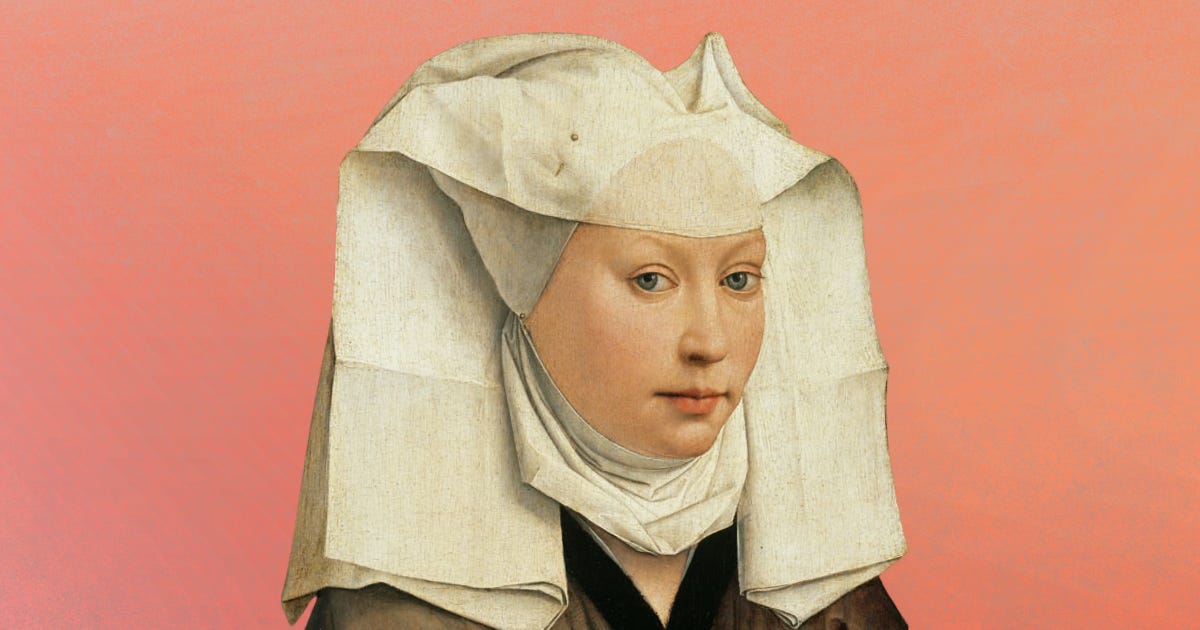
I have recently fallen head over heels in love with a medieval mystic. I have feasted on her (yes, her) thoughts, lapping up each weird thing she has to say. The mystic I’m referring to is Julian of Norwich.
We don’t know very much about her, as she was incredibly firm that people pay her very little attention (sorry, Julian), wanting her work to point away from her and towards the God she loved so deeply. Nevertheless, here are the very few pieces of the puzzle that we do have. We think she was born in 1342 and lived a completely run-of-the-mill life until, at the age of thirty, she fell incredibly ill. So ill, in fact, that she received her last rites and had her eyes closed by her mother who, at one point, presumed her dead. While she was in this dizzyingly ill state, she had sixteen incredibly vivid visions of God and Jesus. Oh, and then she was completely healed of her illness.
So captivated was she, both by these visions and by the God she was certain had sent them to her, that she became an anchoress. This means that she spent the rest of her life in a cell built onto the side of St Julian of Norwich Church (hence the name we use for her). She was literally bricked into this room, unable to leave; it makes me hyperventilate to think about it. Her only access to the outside world was through three windows. One faced the high altar of the church. This meant that she could see into the church, and participate in worship, without being seen. The second window was the one through which she would be cared for, with provisions passed through. And the third faced out into Norwich city. You see, this eccentric mystic had quite the reputation, and people would come to her, from far and wide, for counsel and prayer.
Mostly, though, she was alone.
And that was just how she wanted it. To quote Claire Gilbert, who wrote the historical novel I, Julian: ‘She could ask the world to recede, and it would.’1 Julian desired quiet, solitude, freedom and, most importantly, time. Living to an old age, Julian used this time alone to ponder, again and again, the visions she’d had. She asked God, endlessly, to tell her what they meant, what he wanted to show her and tell her. She turned them over and over in her mind, praying them through continuously. And then she wrote them down. Her visions and ponderings are now a book that we call Revelations of Divine Love. And, gosh, it’s quite something. Was she ever accused of being a witch, I wonder?
Anyway, the reason I bring her up (aside from my great love for her) is that she referred to God and Jesus as Mother. Here are a few snippets of her thoughts, as found in Revelations of Divine Love:
‘Our Savior is our true Mother in whom we are endlessly born and out of whom we shall never come.’
‘God is as really our Mother as he is our Father.’
‘Jesus Christ therefore, who himself overcame evil with good, is our true Mother.’2
Interesting, isn’t it? Kind of radical sounding. Definitely not something I grew up hearing a lot of. But that’s our problem, because this really isn’t a Julian-exclusive idea. On the contrary, it’s in the Bible. Right there in black and white. Would you mind if we dove into the Bible for a moment, got a little studious with it? It’s kind of my natural state, if I’m honest, so I’ll be a good tour guide.
A. W. Tozer once famously wrote that ‘what comes into our minds when we think about god is the most important thing about us’.3 His thinking is that, whether we know it or not, everything we do flows from what we think of God. Even if we think he’s a work of fiction, we’ll live in reaction to that belief. Well, very handily, the Bible tells us what should come into our minds when we think of God. In fact, according to the biblical account, God himself tells us. In the thirty-fourth chapter of the second book (Exodus), God says, ‘The Lord, the Lord, the compassionate and gracious God, slow to anger, abounding in love and faithfulness’ (verse 6).
The first word God uses to describe himself is ‘compassionate’, yes? In Hebrew, the language that this was originally written in, that word is rakhum and is related to the word for ‘womb’ (rekhem). So God describes the way he feels towards us, and he uses an image of a mother caring deeply for her child. His compassion is like a womb, fully enveloping us, growing us, sustaining us, keeping us alive. This is important.
Remember how we spoke about women’s emotions being perceived as a weakness at best and a danger at worst? How they certainly disqualify women from being President of the United States? And historically qualify them as being witches? Remember how we noticed the tendency that feminism has, with all of its best intentions, to train women to assimilate men, ensuring that male characteristics are still the ones being centred and celebrated? It appears that such thinking simply cannot be traced back to the God who likens himself to an emotionally driven mother. But wait, it goes even further.
Later on, in another book nestled into the Bible (the book of Isaiah), God says this: ‘Can a mother forget the baby at her breast and have no compassion on the child she has borne?’ (Isaiah 49:15). Now, you need a little bit of context to understand quite how wonderful this line is. First, it’s a rhetorical question. The answer to God’s question is, of course: no, a woman cannot forget the baby at her breast; she can feel its presence there, physically and emotionally.
The second thing to know is that God is speaking to his people here. You see, they have been complaining that he has forgotten about them, that he’s turned away, that his care has somehow run dry. And this is his reply to them. Once again, he’s likening himself to a mother of a vulnerable child. He’s trying to instil in his people how deeply, how fiercely, how self-sacrificially, how unconditionally he loves and cares for them, and the metaphor he reaches for is a feminine, motherly one. And a really vivid, tactile, bodily one at that.
In a society like ours, where it is still seen as some kind of micro-protest to feed your baby in public without draping something over yourself and your little one, the idea that breastfeeding is something God does – that it’s that sacred, that natural, that powerful – is quite something, isn’t it? God does this, again and again: he likens himself to a woman in labour (Isaiah 42:14), he likens himself to a mother who’s weaning her child (Psalm 131:2), he likens himself to a woman comforting a child and who gathers her children (Isaiah 66:13; Matthew 23:37).
It’s just as Julian said: ‘God is as really our Mother as he is our Father.’ It shouldn’t shock us, disconcert us, ick us out. We’re told, right in the first chapter of the first book of the Bible, that God made both men and women in his image – to resemble him, to represent him, to be his mirror image. He is as feminine as he is masculine. Sure, we may use male pronouns for him but, as Chine McDonald writes, ‘to conceive of God as male alone, or even as a father alone, is to have an incomplete picture of who God is’.4
Personally, I have no problem using male pronouns for God – I don’t feel threatened by them, I don’t feel excluded. I guess it’s because I know that they’re a tool, more helpful from my end than they are from his. I know that they don’t sum him up, they don’t box him in. They are, as Chine notes, incomplete. I’ll say it again: he ‘is as really our Mother as he is our Father’.
So if what comes to mind when I think about God is the most important thing about me, what comes to my mind? Well, right now, having had this chat with you, what comes to mind is a mother who has scooped me up, whose love for me is woven into who she is, whose care for me comes from the core of her. A mother who is attentive to me, who gives me life, who gives her very self to me. It’s intimate, it’s fierce, it’s tender, it’s a force to be reckoned with.
It’s the love that is God.
So, apart from welling up at the beauty of it, how do I live in response to this? How does this affect how I, as a woman, feel about myself and, more importantly, about God? Why does this mean that witches aren’t my Roman Empire? That I can tell White Lotus’s Jaclyn that I do find myself in the Christian story?
Get Your Copy Of 'The Sacred Ache'
Claire Gilbert, I, Julian: The fictional autobiography of Julian of Norwich (London: Hodder & Stoughton, 2024), p. 204.
Julian of Norwich, Revelations of Divine Love, trans. E. Spearing (London: Penguin Books, 1998).
A. W. Tozer, The Knowledge of the Holy (London: Tate Publishing, 2014), p. 1.
Chine McDonald, Unmaking Mary: Shattering the myth of perfect motherhood (London: Hodder & Stoughton, 2025), p. 70.
No posts
Comments
Nothing yet. Say the first thing.
Sign in to join the conversation.