
What would you change if you knew you had the power to change it?
Hello everyone,
This update covers progress from September through October.
The sections of this update are as follows:
TL;DR
Primary Updates
Accomplishments and Wins
Failures and Learnings
Upcoming Priorities and Planning
Asks
Gratitude
Attending conferences (EAGxBerkeley, Circuit Breakers, SF/LA Tech Week) yielded mixed results. Some events led to valuable connections that could generate exciting opportunities for Spartacus, while others were less productive.
We’ve gotten strong indications that publishing notable campaign results, even if the outcomes are mixed, will likely lead to additional funding.
The Spartacus presentation and live demo consistently receive positive reactions, but we need to reach larger audiences.
We’re working on UX improvements based on feedback from recent test sessions and demos.
We applied to several fall/winter accelerator programs, but unfortunately, none of them moved forward to interviews.
Demonstrating Spartacus to many labor organizers at a Bay Area activist conference generated mixed feedback but provided valuable insights.
Attending conferences and hosting events by myself is too time-consuming, low ROI, and high opportunity cost. Event planning is on pause for now. On a positive note, my pitch and presentation have reached TED Talk-level polish (anyone have Chris Anderson’s email)?
1:1 outreach has proven not to be a viable strategy for acquiring Spartacus users.
We’re aggressively pivoting to online marketing for user acquisition.
Failing to establish sufficient social capital in online communities before launching Spartacus continues to impact us, has been the biggest drag on our progress and is probably my biggest mistake.
We're looking to hire a growth/marketing expert and social media manager as soon as possible.
I postponed our previously scheduled update due to a series of back-to-back conferences in October. I was overwhelmed with three consecutive weeks of preparation and travel, hosting our own events and attending several others. I decided to delay the status report until we could process the outcomes of all this activity.
The results could have been better.
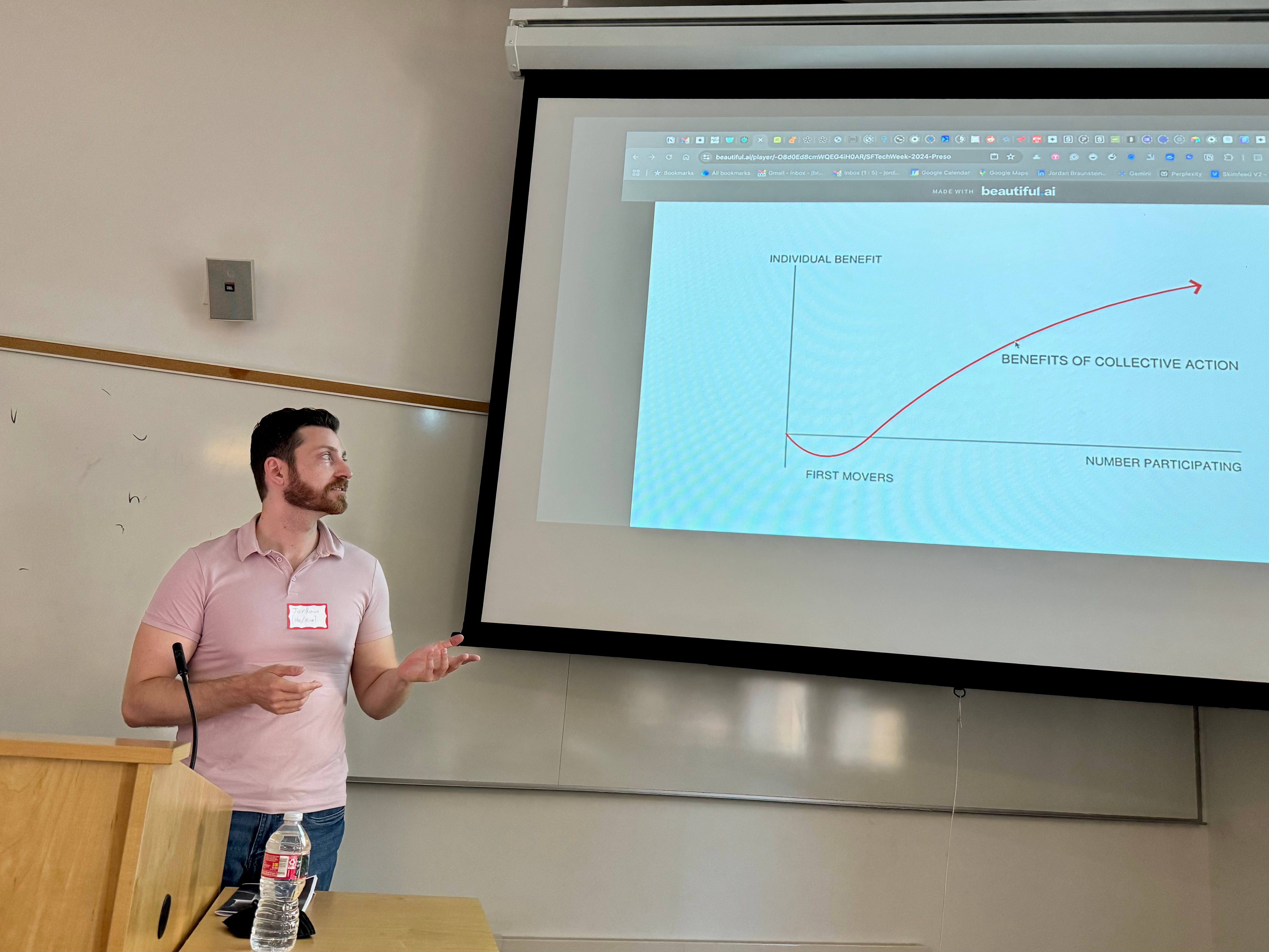
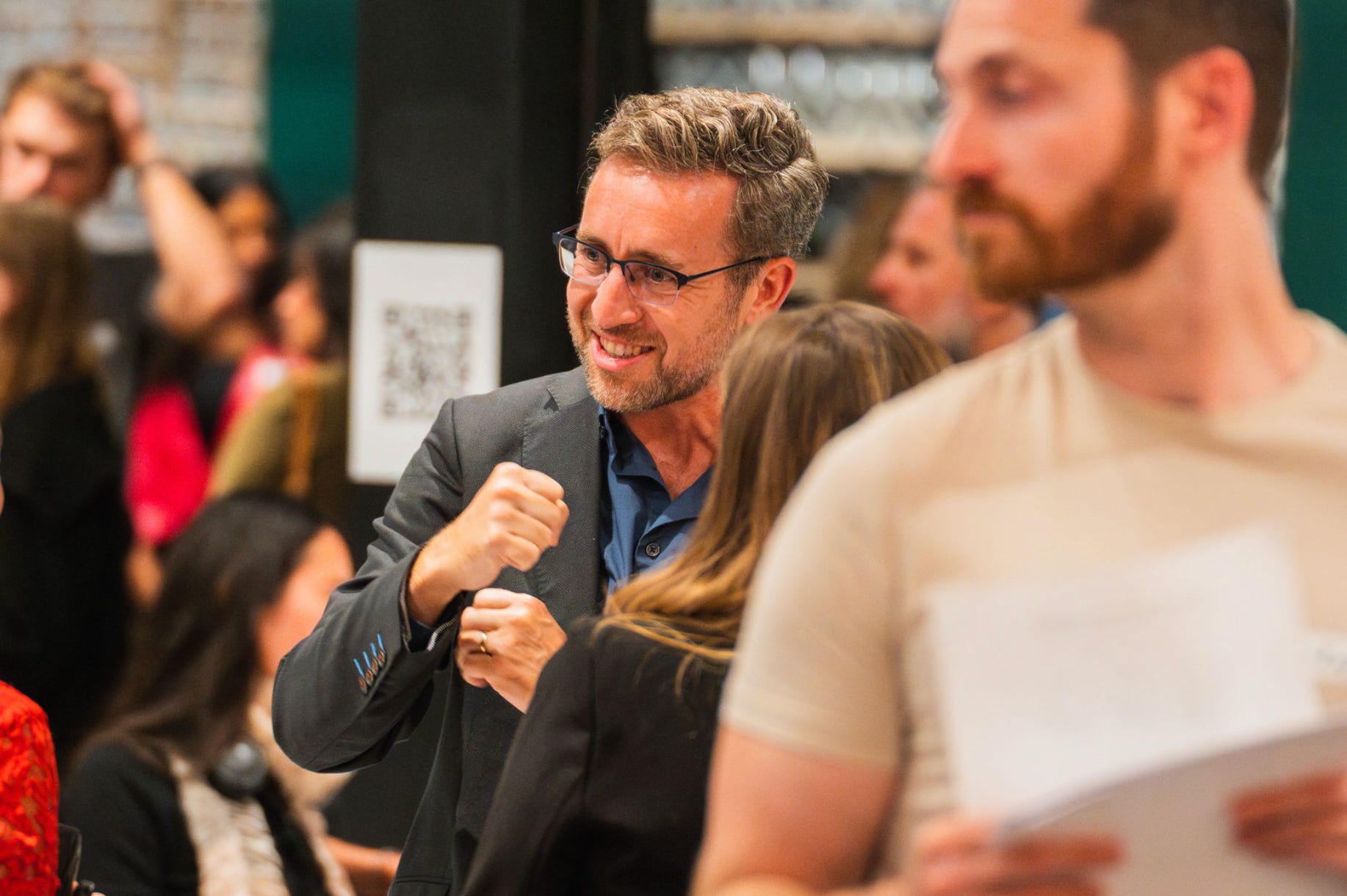
EAGxBerkeley was our strongest showing. We connected with over 200 attendees and had nine excellent 1:1 meetings, which led to several ongoing engagements.
SF Tech Week drew huge crowds (5000+ overall), but while we had 89 RSVPs to our event, we experienced 80% attrition.
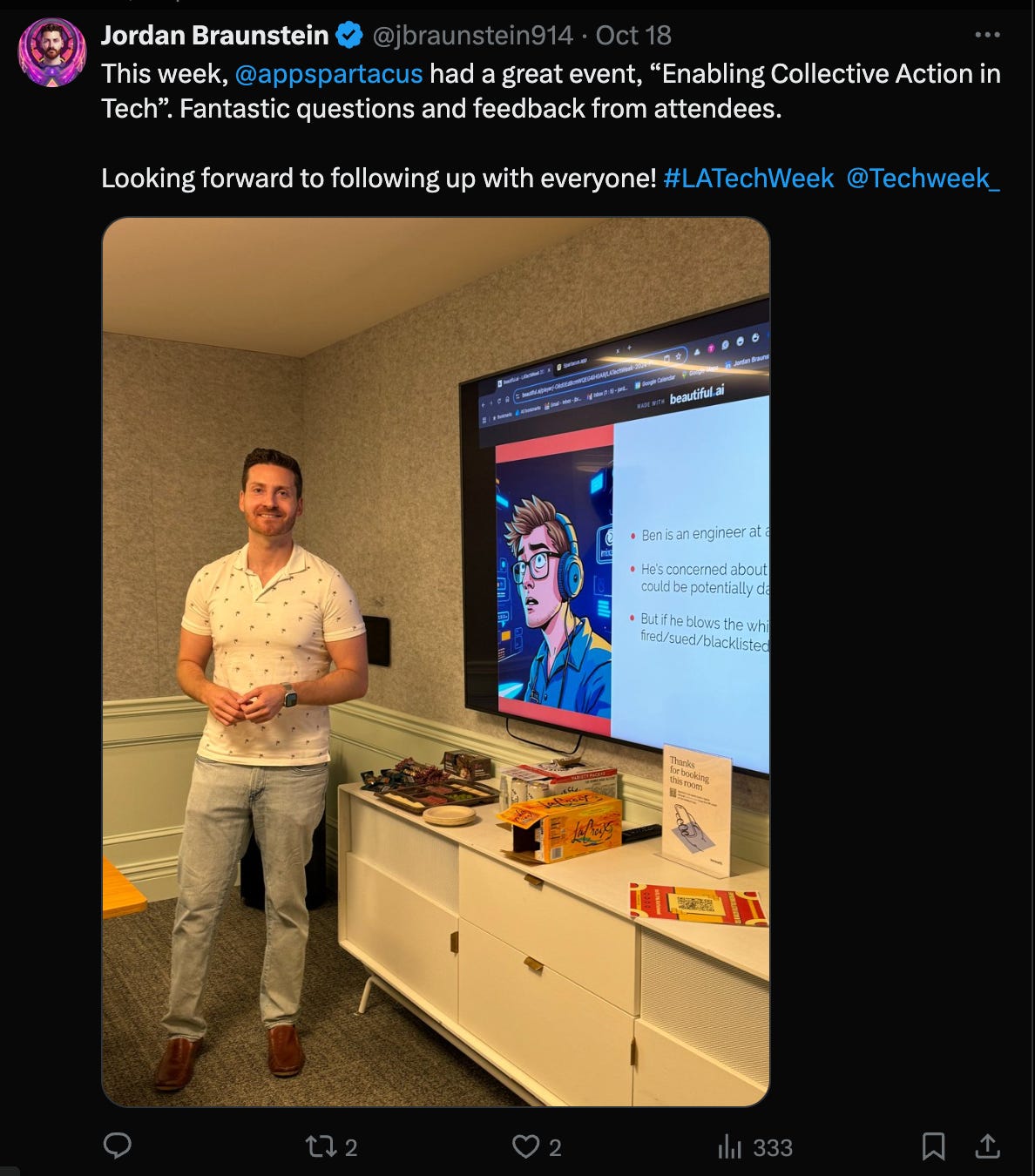
It was a similar story at LA Tech Week: 4000+ attendees, 86 RSVPs to our event, and 80% attrition.
Circuit Breakers brought in 300+ people overall, with a handful making it to our impromptu self-organized session at the end of the final day.
Does this imply that people are indifferent to collective action, coordination challenges, and the role of technology in solving these issues?
Is everyone lying when they say they want a better world, and their revealed preference is to attend yet another AI-themed happy hour sponsored by Deel and Brex?!
I think it’s complicated.
We dealt with several headwinds trying to drive attendance to our TechWeek Events. While getting listed on A16z's public calendar gave us free marketing and exposure to thousands of potential attendees, we had some disadvantages:
Attendees had to fit in multiple events across different venues with limited time and energy to get from one to the next.
We were running on a bootstrap budget - no sponsors meant we couldn't match the perks other events were offering.
We had no "hooks" - like an open bar, impressive speakers, brand recognition, or an attractive venue—but many competing events did.
Our mid-day timing was strategic (to avoid competing with the packed evening schedule), but it came with trade-offs.
We are not an AI-centric project. AI is the bright, shiny object. Without an AI angle, we’re invisible to many, and trying to get attention can feel like swimming up a waterfall.
Let’s be honest - Our passion for coordination problems, game theory, and incentive design is not mainstream. It appeals to a more narrow audience.
Our in-person demo and presentation have become polished and compelling, receiving excellent reception. We pared back the technical jargon and high-level abstractions, focusing instead on a storytelling approach that includes emotionally resonant real-world scenarios.
We also added some interactive coordination games that have a visceral impact. They help things “click” about why this project matters and how Spartacus can provide tremendous value. People commented on how engaging it was every time I ran through it.
You can check out a version of our presentation HERE
We've started building some promising relationships with several key organizations:
https://collectiveaction.tech/
(an association of labor activists and researchers focused on organizing tech companies).
https://alltechishuman.org/
(A non-profit consortium of professionals and organizations working in tech with a social benefit/impact mission)
https://www.effectivealtruism.org/ea-global
(A key EA organization planning events, promoting EA causes, and fundraising).
I’ve had or scheduled meetings with several people who can materially benefit Spartacus through their expertise, introductions, beta testing, or funding.
Here’s a small sample:
Behavioral science consultant from the Harvard Kennedy School
Senior social science research consultant from UC Berkeley
Angel investor and former official at USAID
Plaintiff's Attorney from UCLA
Several labor organizers and activists with direct experience in union drives and whistleblowing
Several Program Managers at multi-million dollar foundations
Several Founder/CEOs of social impact startups
Several Angels/VCs involved in philanthropic giving and grant-making
Attending EAGxBerkeley, in particular, was very worthwhile. The EA community has been supportive of Spartacus's mission, and we’re exploring pilot projects related to AI safety, animal rights and welfare, peacemaking, and governance.
Interest among academic researchers is strong, but procedural and institutional friction makes engagements unlikely to produce quick results. Finding the right sponsor, passing review, getting approval from multiple stakeholders, setting up a study, and running a campaign for several weeks or months would not produce something helpful within a reasonable timeframe. We’ll follow up on these opportunities, but not as a high priority.
After some harsh but fair feedback, I rewrote our proposal for supplementary funding. It now represents the most comprehensive overview of the Spartacus project and its current status to date:
We received substantial feedback from the discovery interviews I organized during these conferences, leading to changes in the user experience (UX) and adjustments to the roadmap that made sense but required more external validation before we could justify the work cycles.
With hindsight, you realize some mistakes are tactical, reflecting the typical trial and error of early startup volatility. But others stem from deeper, more foundational misunderstandings about the state of the world or your own knowledge.
By mid-summer, it had become apparent I’d been operating on a set of mistaken assumptions:
The interest generated from the early Spartacus prototype represented a baseline that, if extrapolated, would be sufficient to propel us past our first user acquisition milestones and create momentum for continuous growth.
Receiving the ACX grant would validate our project, and the buzz of the announcement would attract enough people interested in beta testing to run several campaigns and get our social proof.
Anyone who outlined dealbreakers during the prototype phase or in discovery interviews would be excited to reengage once we fixed those issues.
The people most enthusiastic about our mission would be the most positively inclined to use the platform.
Things didn’t quite work out that way.

Interest in the MVP was higher than in the prototype, but only by a small margin. The grant announcement did raise our profile and led to several inbound inquiries, but most didn’t become beta testers.
For every person interested in testing, five wanted to join the dev team. People who told me they would use Spartacus "if only we did X, Y, or Z" did not, in fact, come rushing back when we implemented X, Y, or Z.
The initial burst of activity and usage I'd been counting on to kickstart our momentum didn’t materialize.
Several weeks of targeted online outreach and attending events faired no better at recruiting a meaningful number of users. Over the summer, I arranged meetings with employees from unions, non-profits, advocacy groups, PACs, foundations, and other organizations to explore the possibility of collaborating on a supervised pilot program.
We ran headfirst into the chicken-or-egg problem. Without public endorsements, preexisting relationships, published case studies, or social proof, no one I met with in a position of organizational responsibility was willing to be the first to work with an obscure startup, run by someone with no background in their space, funded by a grant program they’d never heard of. Despite genuine curiosity, they all understandably wanted assurances we couldn’t provide before committing time and resources or required us to jump through regulatory and bureaucratic hoops we couldn’t afford.
(Incidentally, I have NOT been willing to create false impressions of success through juiced metrics, staged activity, or fake testimonials from friends doing me a favor. I now fully understand why some people resort to this.)
Leaving organizations aside, the ROI of finding individual campaign organizers through manual outreach and interviews is quite bad.
To be a good Spartacus campaign organizer candidate, a person must meet most of the following criteria:
They have a relevant concern necessitating a collective action campaign.
Their concern must cross the threshold of mere annoyance or frustration into a willingness to act.
They must be willing to take on (at least some) responsibility for organizing that campaign and its aftermath.
The timing must be right; they must be ready to begin.
The campaign duration cannot be too long or open-ended.
The campaign must only require a modest number of participants to succeed.
They must be able to share the campaign with a large enough receptive audience.
It can’t be something that can be easily organized through regular communication channels (otherwise, there’s no point in using Spartacus).
It needs to be compelling enough to the target audience that people unfamiliar with Spartacus and who may not know the organizer's provenance will still want to join.
The stake for the individuals involved cannot be too high, as we aren’t prepared to be liable for severe consequences if it fails.
Searching for people one at a time who check even most of these boxes is…tough.
If I email 100 folks using a 5-step automated follow-up sequence, about 20 might respond, 5-10 will schedule meetings, and perhaps 2 will meet most of the criteria. This process can take 2 to 4 weeks from start to finish.
Attempting this with any degree of genuine personalization will not fill our pipeline at the rate we need.
But candidly, this is also a consequence of product design choices. The “building critical mass” campaign type—similar to a Kickstarter or petition drive—is the only type Spartacus currently supports. It’s a poor vehicle for producing rapid feedback loops. Its usefulness is highly time-sensitive, situational, and difficult to generalize. Making it so the right people—campaign organizers—know about Spartacus when it’s most salient to them can’t be accomplished by spearfishing.
Looking back, it was a big mistake not to establish a presence in online communities, forums, Discord servers, and Subreddits from the outset. Instead of sporadic and opportunistic posts at irregular intervals, we should have cultivated a reputation gradually and consistently during the spring and summer months, making sure we had a network(s) from which to recruit a pool of early adopters.
In fairness to myself, I (incorrectly) believed we did! I assumed the readership of the ACX blog, adjacent blogs, meetup groups, and hosting some events would be enough to get us over the first hump. I thought mere awareness of this cool new project, addressing a challenge important to these communities, would generate enough organic excitement and digital word-of-mouth.
I’ve worked at various early-stage B2B startups for over 12 years. My background is in consultative, enterprise sales, and business development for high-ticket tech hardware and SaaS. A founder with more experience in marketing, community building, and social media management, or just one more adept at being present in virtual spaces, would not have made these mistakes.
I think I misapprehended the situation for a few reasons:
My working assumptions about how we would get our early adopters conveniently didn't require directly engaging with the “attention economy.”
As a human being, I have an aversion to the attention economy, social media, and advertising in general—the constant posting, promoting, shilling, bullshitting, provocation, and dancing to the tune of an algorithm. It's not a stretch to think my perception stemmed, at least partly, from wishful thinking that I could avoid engaging in this stuff.
I have been relatively solitary during this process, except for regular meetings with TetraSpace. I don’t have an extensive network of expert friends and colleagues at my disposal for spontaneous help. I’d prefer an incubator or accelerator's enriching, collaborative environment - which is why I’ve been applying to them. The dynamic they enable would have exposed misjudgments much sooner. Absent that, if I have a blind spot, my first recognition of it may be the consequence of it. (I did sample some online communities for early-stage founders and didn’t find them very helpful - I probably should have kept looking).
We needed an active presence in online networks of sufficient size for the machinery of a marketing funnel to work properly. Competent marketing and community engagement are the only viable paths forward. More on that shortly.
I spent considerable time preparing new applications to Y Combinator, FoundersBoost, Techstars, FS6, and Norrsken. Unfortunately, all were rejected prior to the interview stage. Our project diverges from the prevailing investment thesis of most accelerators today, which is heavily weighted toward AI, and we're not presenting meaningful growth indicators, much less product-market fit. No new applications until we make some progress.
Working with interns has not been particularly beneficial under these conditions. This responsibility falls on me. We can’t afford to spend the budget on someone learning new skills on the job with unpredictable results. I can’t accept less than specific outcomes when I spend money to delegate work.
The attitude of the grassroots labor activist cohort I met at Circuit Breakers was predominantly skeptical.
Many experienced activists believe that even temporary anonymity undermines “skin in the game” needed to build trust during the early phase of organizing.
Contrary to our thesis - that the disproportionate risk burden on early movers is more likely to lock in a bad equilibrium, some believe that a heroic, quasi-altruistic risk-taker, i.e., a charismatic leader, is necessary to establish the credibility of the action and inspire others to join in.
There was skepticism of any substitute for classic relational organizing techniques, considered best practice, validated by over a hundred years of data. Many doubted that an app, even if flawlessly designed, could replace the effort of persuading people to join a movement one by one through personal trust and relationship building.
Assurance Contracts and Game Theory ideas like the “Prisoner’s Dilemma” were unfamiliar to most people I spoke to, with some notable exceptions.
I sensed a hesitancy rooted in uncertainty about my reputation and motives. I lack preexisting relationships in this activist network, so there was some concern about the project's provenance. That said, a plurality were open-minded and curious.
I was kicked out of the event Slack for inviting people to sign up for the beta. Apparently, this violated a community norm. I’m appealing the decision.
Despite not receiving as positive a reception as I’d hoped, I was able to connect with several activists, organizers, and academics who are interested in exploring the potential of Spartacus further.
Some people I reached out to for help boosting attendance at my Tech Week events did not follow through, even though it would have been trivially easy for them. This was disappointing and made me rethink those relationships.
Our first, second, and third priority remains user acquisition. Given all the above, here's how we plan to do it:
Over the past months, I spent countless hours trying to connect with social media accounts that I believed would be open to learning more about Spartacus. I crafted thoughtful replies, asked questions, and sent direct messages, hoping these accounts might engage or follow back.
The results have been minimal. My posts have an average of 30 views.
Instead, we need to create and share content similar to what already gets engagement.
We’ll collaborate with marketing experts to produce a collection of short-form text and video content focused on activism, collective action, and other topics connected to Spartacus.
We’ll have one account on each platform (TikTok, Instagram, YT shorts) and experiment with hooks, posting at least 1 video per day.
Initially, we’ll post content similar to what is already performing well for aligned topics and creators, then experiment with videos featuring Spartacus.
Eventually, hopefully, something will catch on.
We’ll experiment and turn the most successful content into a “series.”
Then, start tweaking and posting this series on multiple accounts.
Finally, use the best-performing content as the basis for paid ads.
We need to target influencers based on the types of people and accounts that show interest in Spartacus. Since this pool of individuals is currently tiny, there will be some trial and error.
When we identify some popular influencers among our target user demographic, we can expand our list of potential accounts to collaborate with by examining "suggested similar accounts.”
We’re building a list of aligned influencers with established followings to boost content from our accounts.
Once we have an extensive list, we’ll contact them and propose collaborations. There’s a payola aspect to this, but I’m well past thinking there’s a non-transactional way of rapidly increasing our visibility.
We need to cast a large net and double down on anything that works.
We’ll conduct small experiments with paid ads to test our assumptions and see if we can achieve a slight spike in signups. Any sustained campaign must be based on data we gather from the aforementioned short-form content marketing and influencer collaboration initiatives.
Politically engaged students are a vital user demographic for Spartacus. They’re also more likely to experiment with new platforms and share the results.
We'll post contract, intern, and volunteer positions on various online job boards, recruit one or more representatives from each campus to serve as our point of contact, and incentivize them accordingly.
This person can facilitate meetings with on-campus groups that may have Spartacus use cases if more active supervision is needed.
A strong indicator that someone is a potential Spartacus user is if they’re already trying to use a less effective solution for coordinating collective action.
Given this, many campaigns on platforms like Change.org, actionnetwork.org, coworker.org, and organise.network can potentially get better results with Spartacus.app. The organizer's contact information is usually public.
We'll create a list of prospects and contact those we believe are suitable candidates to run Spartacus campaigns concurrently. We’ll provide incentives to the organizers for their added effort.
One thing is clear: finding an organizer is a bigger stumbling block and source of inertia than finding participants. It’s harder to find leaders than followers.
We're scanning subreddits to identify where people are frustrated by the need for coordination around a cause everyone acknowledges is important.
We can seize the initiative and conduct experiments with Spartacus to determine if we can stimulate latent demand for coordination that only requires a willing organizer.
If the campaigns succeed…we’ll cross those bridges later.
We’re developing a new onboarding sequence to orient and contextualize Spartacus's functionality for new users.
We’re making anonymity optional for organizers and participants.
We’ll implement a matching algorithm that allows participants to set their success thresholds, giving everyone more flexibility in deciding when to reveal their identities.
We’re exploring other coordination use cases with tight feedback loops, like straw polls and surveys, with a quick create/join model and allowing live participant input to coordinate omnidirectionally around questions, proposals, and problems.
We’ll resume building the “Chain of Trust” single-use invitation token.
We need to hire marketing experts. I’m looking at students, freelancers, and professional services.
My sense is that a 20-something with TikTok brain rot and a great work ethic will probably outperform any digital marketing agency.
We’re seeking supplementary funding to extend our runway for another 9-12 months. Anyone can still donate to us through Manifund HERE.
If you want to support Spartacus through some alternate means, contact me directly at jordan@spartacus.app.
We appreciate warm introductions to anyone interested in learning more about Spartacus.
We want to hear from anyone with thoughts on coordination problems that matter to them. These can range from simple group decision-making challenges to ambitious, global-scale issues. We also want to engage with skeptics who are aware of user concerns or problem areas we might not adequately address.
We cannot currently deploy or support Spartacus outside the US. We are, however, open to collaborating with a partner who can take the initiative to ensure compliance with local laws and regulations.
If we don’t have a specific need for your skills now, we may soon! Please inquire at jordan@spartacus.app
Thank you, Tetra Jones, for your indispensable work.
Thank you, William Bookman III, for your insights and enthusiasm.
Thank you, Matthew Braunstein, for lending a hand!
That’s it for now! Expect the next update In Early December.
"One of the most important things you can do on this earth is to let people know they are not alone."
- Shannon L. Adler
Comments
Nothing yet. Say the first thing.
Sign in to join the conversation.