
Hope just means another world might be possible, not promised, not guaranteed. Hope calls for action; action is impossible without hope.
— Rebecca Solnit, from the book “Hope in the dark”
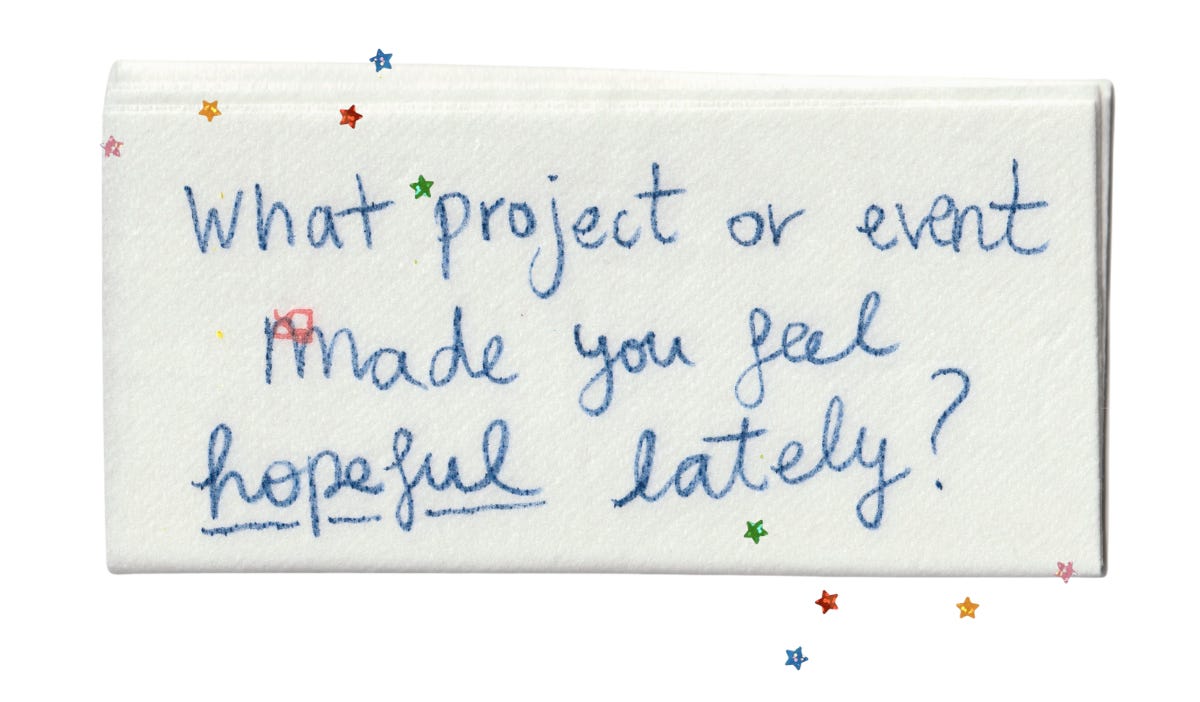
This wasn’t asked by a person or a questionnaire. This was printed on a paper tablecloth. I was sitting at the table with this tablecloth on a Friday night this March in another country.
I arrived in Bucharest, Romania, for a long weekend to attend a conference I loved ten years ago once more: The Power of Storytelling. This year, “Hope” was announced as the theme, and I booked an early-bird ticket right away.
Officially, the event lasted two days: Saturday and Sunday, with a rich stage program and spontaneous conversations with strangers during the coffee breaks. But on Friday night, an additional welcome dinner was organized. Participants and speakers were brought together before it all started.
This conference is known for breaking the hierarchy; the speakers learn here as much as the listeners do. The people on the stage are professional listeners, as approachable as the volunteers keeping the production together or the guests. Everyone has stories, and everyone listens.
Around the dinner table on a Friday night, we were five. A local participant who works in finance and is eager to learn how to use stories professionally. Two guests from the European Press Prize foundation flew from the Netherlands. A local performer who was to play jazz at the closing event. And I, a writer from Berlin who loves stories and meeting people.
The tablecloth question was supposed to bring us together over the conference’s theme. We were prompted to discuss it, and I read it aloud.
“So what project or event made you feel hopeful lately?”
We were all a little bit intimidated by this big question. We expected the conference to answer it for us over the weekend. Why are they asking us one day before? We’ve come here to find the solution, and we weren’t too hopeful. With the current state of the world? Come on. Haven’t you read the news?
But slowly, over drinks, every one of us found a thing to share. We brought up smaller, personal experiences. Initially, we were shy about how compact our examples of hope were, but as we shared them, we all started smiling. They were good, and they all had something in common.
“I recently joined a choir in Amsterdam. It is called “Some voices.” What really makes me hopeful is the diversity of people. From young to old, with different backgrounds and experiences, people come together to sing… in that moment, you feel a unity that doesn’t exist otherwise in the crowd. It comes from our bodies sounding together regularly, and it really shows me that we can do things together, even if we’re different.”
“I am from Romania. You know how difficult it is for us to get a good election result. Yes, we’ve managed to get ourselves a stable president last time, but with a jumpstart and a jumpscare. We are all fearing that the next election could bring the far right to power. This is why my hopeful feeling comes from local elections, where the real, local, hardworking people won lately. That was a small win, giving me hope for the future.”
“Dancing classes! And music events for friends. I’ve been gathering people for a while now to create music that brings us together, helps us to relax, and gives us joy. It grounds me and allows me to focus on things I believe in. Jamming with my friends and spending time with people I love are the ways I recharge and find the strength to move forward.”
What did I say when it was my turn?
“I started my Anchor Berlin newsletter last October. Just a couple of months later, I was invited to be a part of the Späti Stories editorial team. Before that, after I emigrated, I missed having creative side projects alongside work and other adult responsibilities. Being surrounded by like-minded people who share people’s stories now gives me hope that Berlin is not only a place to live, but also to create, experiment, and be inspired by one another.”
With 550 participants this year, both locals and guests like myself, The Power of Storytelling is working relentlessly to connect people through stories. Speakers are international and local writers, journalists, and activists. The 2026 keynotes will be published on YouTube, as is done every year.
Every speaker started their talk in a similar way to us staring at the tablecloth on Friday: “When I was asked to speak on hope, I was surprised. Me? And hope?”
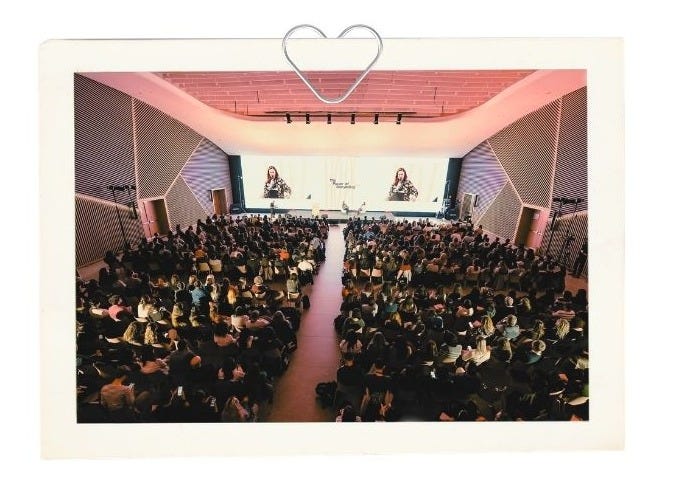
And yet, every speaker worked out their way to the topic. It might be that people who have mastered hope have successfully faced hard challenges, thereby sharpening the skill. Maybe we need to go to the people who’ve had it rough to learn how to hope actively, fiercely, collectively, and towards a tangible goal.
“Hoping as a group can change the world,” Mikhael Simmonds said. “But hope is not something you find; it is something you have to seek. Hope can be loud and active. And hope without action is a waste.”
The themes speakers brought up varied, ranging from personal challenges to political journalism. Some speakers have written the books that I want to read now, and I’ll leave reading recommendations below. Some brought me to tears, such as Elena Stancu, a Pulitzer fellow. She quit her successful career at a glossy magazine to live in a camper van.
Together with her partner, Cosmin Bumbuț, a documentary photographer, Elena has been traveling around Romania and the EU for more than a decade, reporting on extreme poverty and domestic violence. For the last few years, they’ve been crowdfunding the reporting on the lives of Romanian migrants abroad, be it seasonal farm workers in Germany or live-in carers for the elderly in Italy:
Nearly 6 million Romanians live abroad—one-fifth of Romania’s workforce—making it the EU country with the highest number of migrants relative to its total population. Migration is the most significant chapter in Romania’s contemporary history, and documenting this phenomenon has been the most complex and personal journalistic project we have ever undertaken.
“Even if you are a pessimistic Hungarian journalist like me, you can still find hope in what you do. If you are strong and determined enough, you can move the wagon in a better direction,” András Pethö said on the stage.
András, along with other like-minded independent journalists in Hungary, had to step down from his successful career at a well-known media outlet that was increasingly under state control. “Politics is also made in a pub with a glass of beer,” said András, only half-jokingly, because a pub was precisely where they decided to create Direkt36, a crowdfunded outlet of investigative journalism, one of the new, brave sources of reliable information in the sea of fake news. They started with texts and recently extended into YouTube documentaries.
“Brushing the teeth in the evening is the act of hope: it means you believe there will be a new day, and a future where you will feel cared for,” Ioana Sopov said. Living with a serious illness, she had to learn how to rely on friends and community, asking instead of being helpful, letting go instead of exhausting herself.
It was incredibly tough for a person who takes pride in being resourceful, independent, and a perfectionist… but the warmth she experienced from people who love her was incomparable, too. “Hoping is never solitary. Isolated hope tends to collapse under its own weight. There will be days when someone else must pick it up and carry it for you until you are ready to carry it again.”
More from this year’s edition:
The keynote transcribed: Seven Guideposts for Stories and Life by Jacqui Banaszynski
The Bravest Souls: Reflection from the organizers
As I shared at the table on Friday before the conference, I started publishing my writing in English last year. A lot has changed for me as a result.
I craved the community, the exchange of thoughts, which was sometimes a bit too hollow or superficial on Instagram or other short-form platforms. Substack, the platform Späti Stories also uses, is where I keep finding like-minded creatives who live all over the world. This gives me hope for human connection—between people, between countries, and between experiences.
While working on this text, I came across Ioana Carp’s blog. She lives in Austria and also traveled to the Power of Storytelling conference this year. Last year, she started a storytelling-based business, a remarkable act of bravery.
Here are Ioana’s reflections on the question of Hope:
For me, hope as a choice is living in a country that is not my own, while sharing my everyday struggles, questions, and ideas in a language that is not my own.
Hope is leaving what was a predictable and possibly promising career path packed with a tight, trustworthy circle of people for the uncertainty of building a career abroad, in a country I don’t have access to all the jobs and opportunities, so I simply have to take what’s left.
Hope is knowing I can’t afford to say no because it doesn’t feel right, but rather find the grinding ways to make it right — whether it’s a different culture, the unemployment rollercoaster, or a lack of a network I trust and can help out.
Hope is taking a crazy gamble in an attempt to leave my mark on a city that is not mine but I want it to be — and failing.
Hope is the choice of becoming vulnerable in front of authorities, institutions, clinics, clerks, and recognizing my limits, but still navigating the system, and even opening a business.
Hope is the wish of one day having a family in a country that is not my own, and yet it’s the country where I want to live my life fully and grow my roots — however tangled that might prove to be.
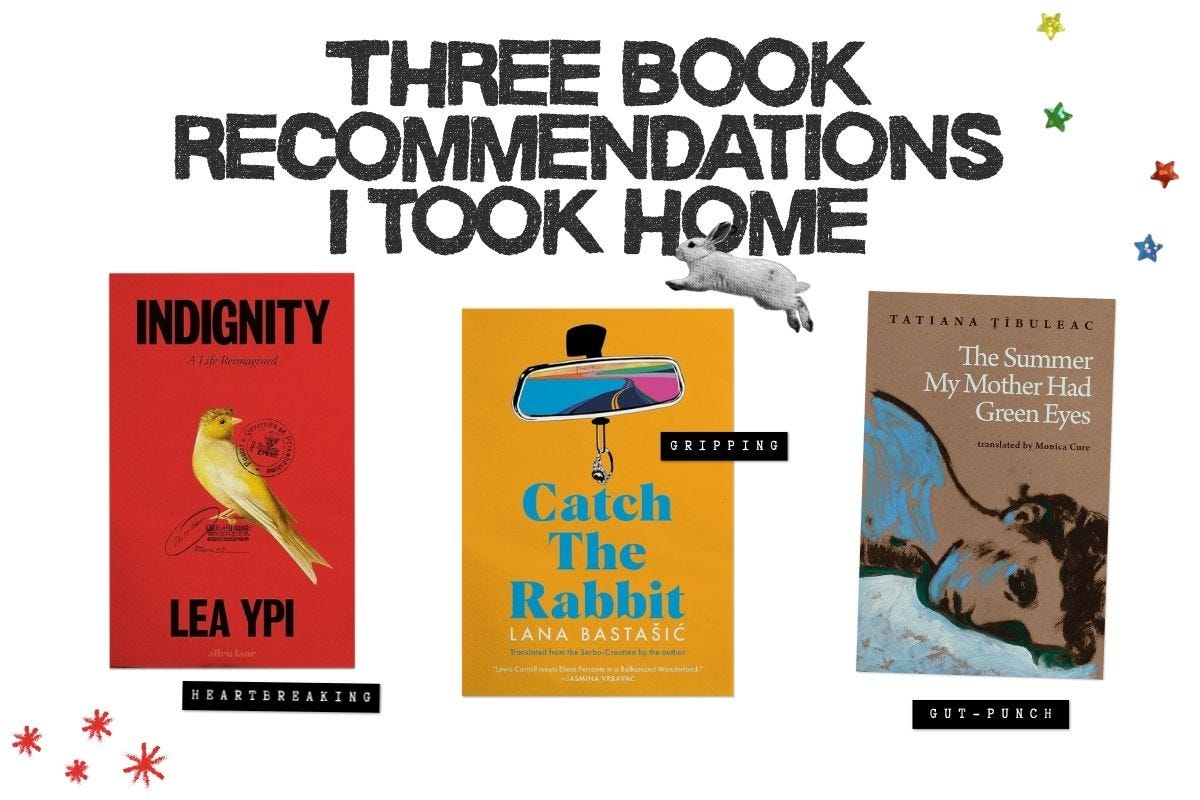
📚 Indignity by Lea Ypi
The first of Lea’s books, Free, is an amazing and heartbreaking account of growing up in Albania. The protagonist is a child who witnesses political regimes, the economy, and the lives around her going off the rails. I was born in the USSR, and the book really resonated with me. I’m excited to start reading Indignity now.
From the stage, Lea spoke about the archival research she had to go through to learn more about the past of her remarkable grandmother for Indignity. She showed a picture of a young woman smiling to the camera and said, “This was 1941, before my family members faced persecution. My grandmother always said it was the happiest year of her life. She was young and happy then.”
Hope, Lea Ypi says in her interview with The Guardian, is a moral duty — we have to act as though there is a chance of things going in a way that is favorable to what we want to achieve.
📚 Catch the Rabbit by Lana Bastašić
From the stage, Lana shared that she had to be her own book’s translator because “editors prefer dealing with women authors that are already dead: they are easier to get along with”. She suggested that if she were waiting for a publishing house to catch an interest, she might never live to see that day.
This is why she translated her book into English herself, learning a lot about how to be a better writer and how tough the translator’s job is.
“Writing is hope that somebody on the other side will read it and connect to it at some level. Because writing also exists within a community. We started telling stories in order to survive.” — Lana Bastašić
📚 The Summer My Mother Had Green Eyes by Tatiana Țîbuleac
Tatiana wasn’t a speaker this year, but in 2019, when the theme was “Heal” (I missed that edition). Her first book, Modern Fables, a collection of 50 short stories about migration, was published in Moldova in 2014.
This year, I got a recommendation to read Tatiana's book during a coffee break from a new friend, a documentary movie screenwriter. Later, I also met Tatiana’s book translator, Monica Cure — we happened to sit next to each other on the second day. Next, I’ll read the book.
Hope is not a lottery ticket you can sit on the sofa and clutch, feeling lucky. It is an axe you break down doors with in an emergency. Hope should shove you out the door, because it will take everything you have to steer the future away from endless war, from the annihilation of the earth’s treasures and the grinding down of the poor and marginal... To hope is to give yourself to the future—and that commitment to the future is what makes the present inhabitable.
— Rebecca Solnit, from the book “Hope in the dark”
In 2016, just when I visited The Power of Storytelling for the first time, the Hope Prize was established in Australia, with Cate Blanchett as a judge, no less.
In 2023, the Hope Prize was reimagined as an international award. Starting in 2024, the anthologies are being published (Tomorrow There Will Be Sun from last year, and the next one soon). All royalties from the book sales go to the charity partners, and the winners get a monetary prize.
Would you submit a story next year?
Or, not to plan too much in the future: how would you answer the tablecloth’s question? What makes you hopeful today?
Comments
Nothing yet. Say the first thing.
Sign in to join the conversation.