
NOTE: If you want to see a video of this presentation, check out the preliminary webinar #18 of the IV SRI World Congress (SRIC4), sponsored by my friends at Space Renaissance International.
This is a long one folks! Fortunately, I am a guy who likes visuals, so the story will be interspersed with slides from my recent presentation with the Space Renaissance International group.
The title is inspired from the classic children’s story The Little Engine That Could: “I think I can, I think I can,” about a small locomotive struggling to climb a hill and finally making it over the top. The same story applies to rockets and private spacecraft. It has taken a very long time to reach the point where we are today, with companies like SpaceX reshaping the entire industry.
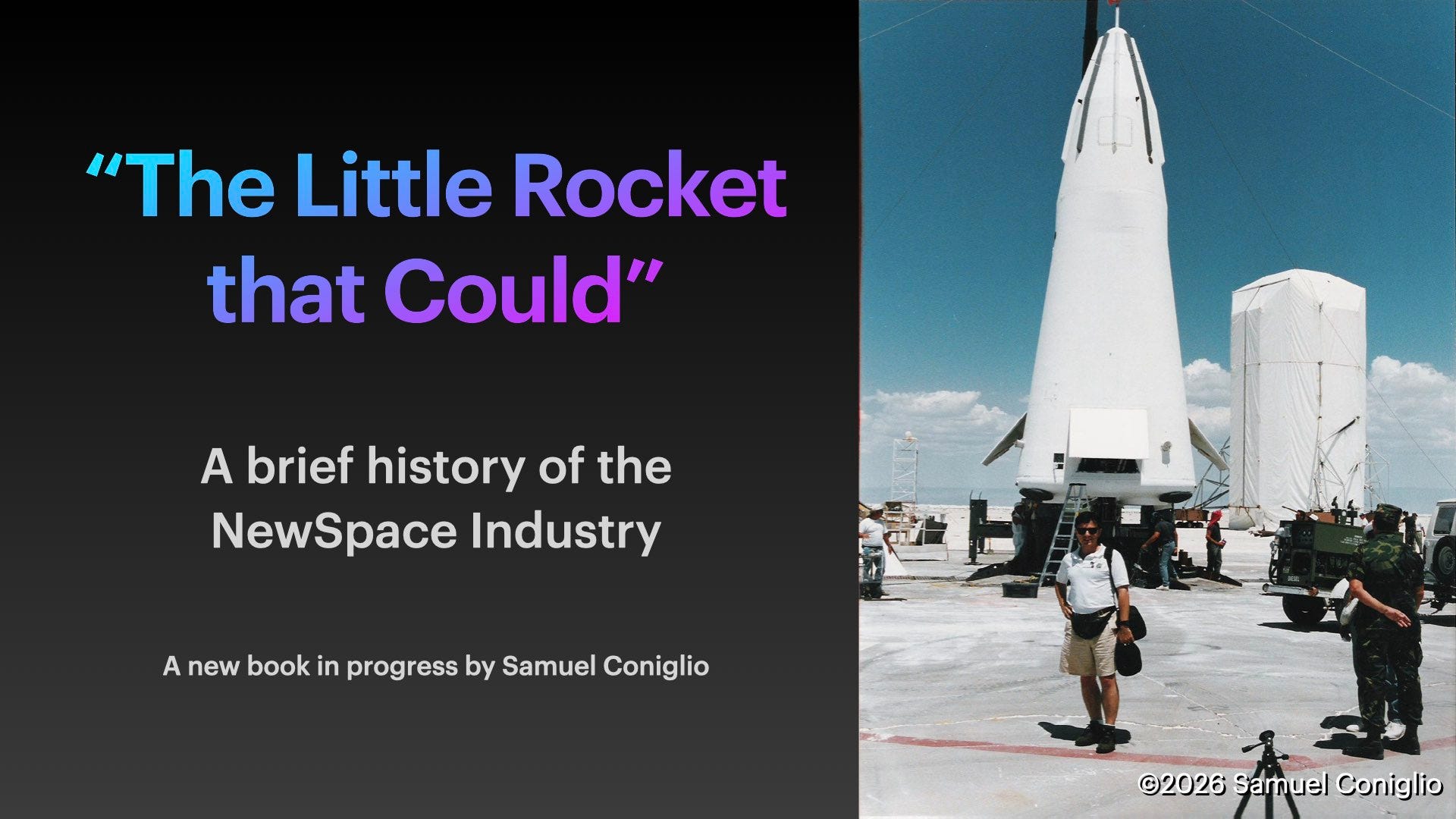
Over the years, I have taken thousands of photographs at various space events and been a witness to space history over a long period of time. I wanted to capture these stories, the history before my time, the events I witnessed firsthand, and everything beyond, and write a book that explains how we got here and, importantly, why it took so long.
We are on the edge of a new golden age of space travel. Not the golden age of government space agencies, but an age of diversification: where private rocket companies offer their services to any person, company, or government to take a ride to Low Earth Orbit and beyond. How did we get here? How come it took nearly 60 years from the first landing on the Moon to finally have a variety of space services that nearly anyone with the money could participate in? “The Little Rocket that Could” honors the pioneers of the “NewSpace” Movement: engineers and entrepreneurs who took chances to build rockets and spacecraft as alternatives to NASA’s Delta, Atlas, Titan, Saturn V and the Space Shuttle. It will cover the stories of people like Gary Hudson, a serial space entrepreneur and engineer, who since the 1980’s battled bureaucrats, the media, and lack of investors to build reusable rockets. Pioneering companies like Space Services Incorporated of America and their Conestoga 1 rocket helped streamline the launch approval process from dozens of US Government bureaucracies to just one. Then there was the saga of the Delta Clipper Experimental, the world’s first reusable rocket, which flew 12 times, and each time nearly ran out of funding. These stories and more are not known to modern audiences, who are blinded by the successes of the Billionaire-owned space companies. This new book will compare the pioneers with the latest companies and what the industry has learned.
Here is a little joke that space advocates say that is still relevant decades later:
“If we can land people on the moon, how come can’t we land people on the moon?”
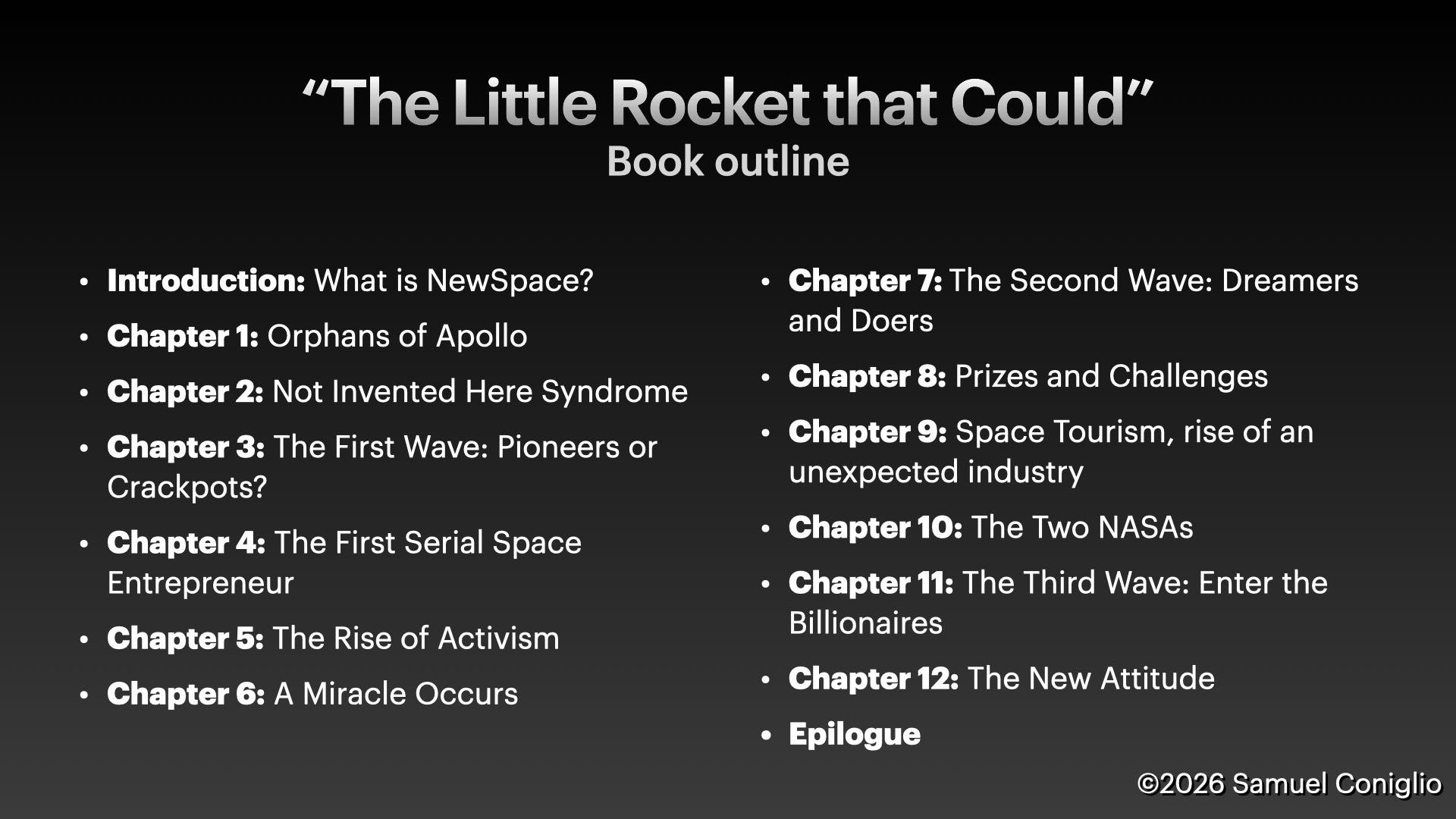
The chapters are fairly well developed at this stage, so you can get a clear sense of everything I am going to cover.
Currently, the book has 12 chapters, an epilogue, and an introduction. Together, they trace step by step where we were, where we are now, and how we got here — including the obstacles, the setbacks, and the moments that made us ask, “Why is this taking so long?”
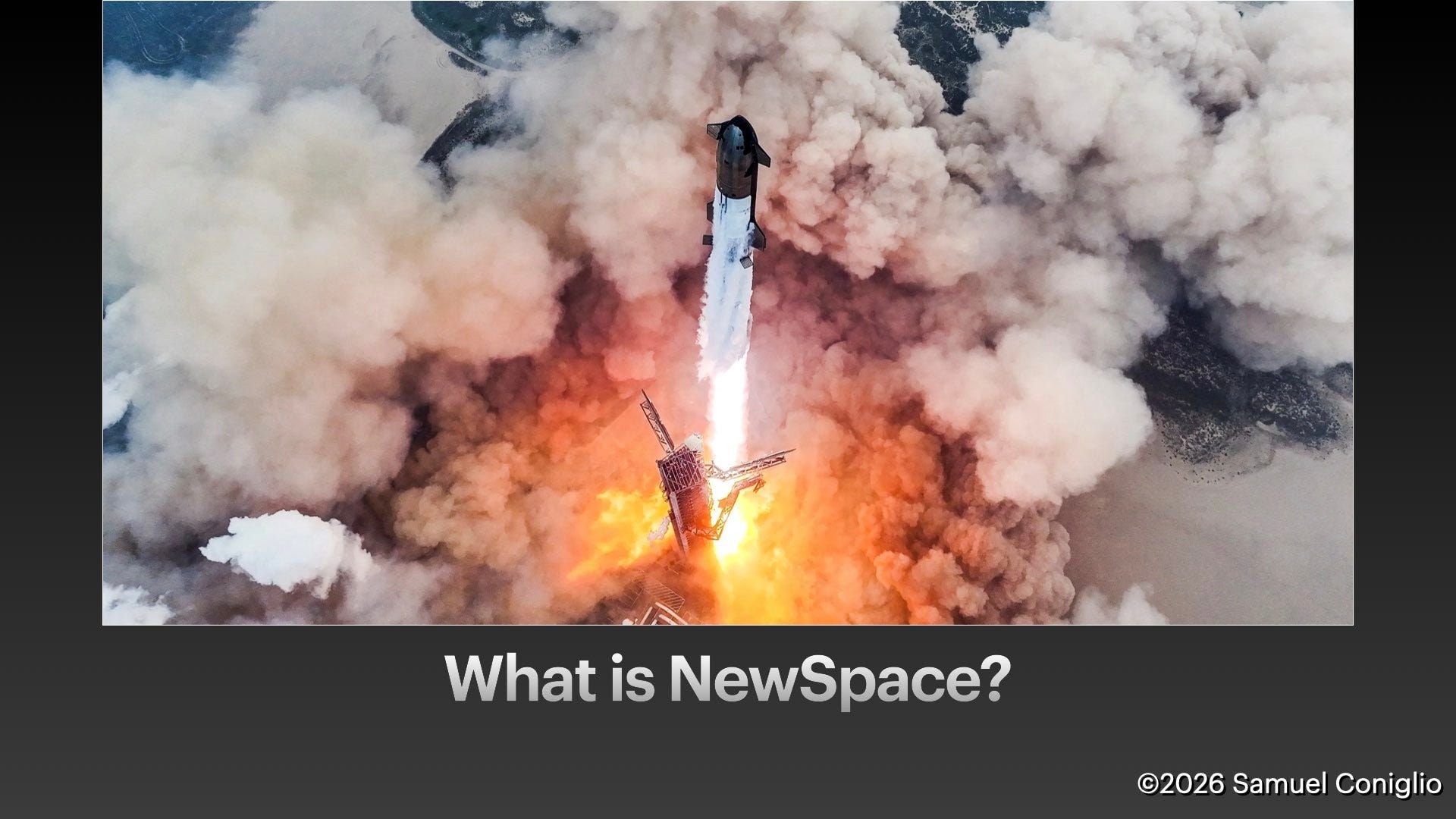
What does this phrase actually mean? It used to be called “alt-space,” along with a few other nicknames. At its core, NewSpace is a way of distinguishing individuals and private companies that were doing things differently from NASA: outside the NASA-military-industrial complex, or the space-industrial complex if you prefer. These are people and organizations not affiliated with the legacy contractors from the NASA’s Apollo Moon program.
Apollo was an extraordinary achievement — but the industry also needs room for new ideas, new people, and fresh starts. NewSpace became a movement of people working to bring alternative ideas, products, and services to the space market.
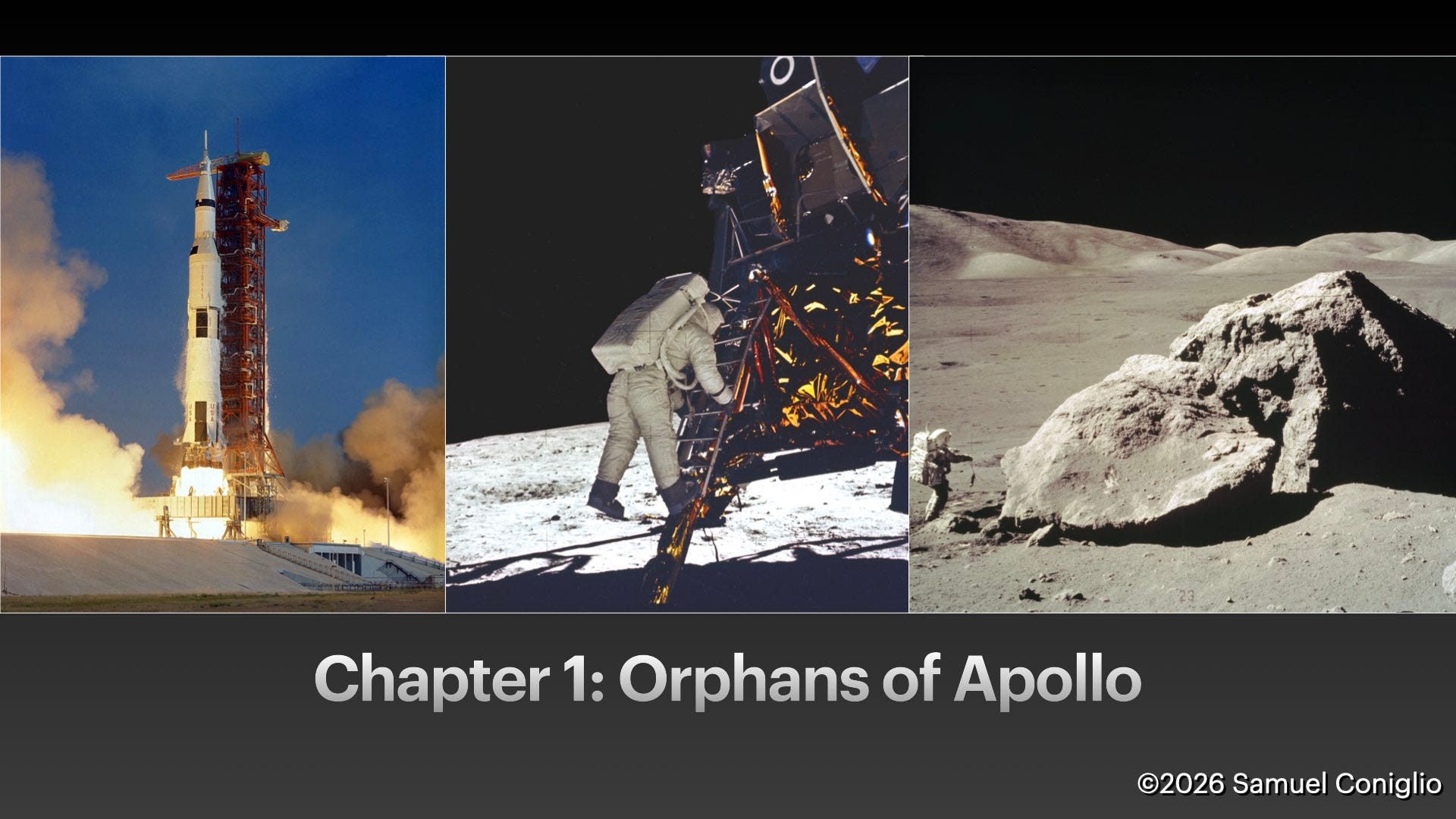
You may have heard this phrase before. There was actually a documentary by that title released several years ago. Those of us born in the 1960s and ‘70s were immersed in the culture of space travel. We were obsessed with it. Television was saturated with space shows: the original Star Trek television series, Walt Disney’s collaborations with Wernher von Braun for Tomorrowland, countless films and shows about exploration and the future. Everyone was excited about going to space.
When Sputnik launched in 1957, there was a rare moment when the excitement about space synchronized with geopolitics. The challenge was real: the Soviet Union might beat us to the Moon, or launch missiles from orbit. Money appeared seemingly out of nowhere. Space enthusiasts suddenly had funding. NASA was formed out of the National Advisory Committee for Aeronautics (NACA). Research groups came together to accomplish the extraordinary feat of landing humans on the Moon and returning them safely. It was driven as much by politics as by science. It was a way of proving the United States’ superiority over the Soviet Union without a shooting war. It was the Cold War Space Race.
So there we were, young people watching history unfold on television, genuinely thrilled and inspired. And then it stopped. When NASA canceled Apollo missions 18, 19, and 20, due to budget cuts under Richard Nixon. NASA lost a significant portion of its budget for new programs. Skylab was possible because there were leftover Saturn V components on hand. The Apollo-Soyuz Test Project served as a diplomatic gesture of détente with the Soviet Union. And there was this promised concept called the Space Shuttle, originally envisioned as part of a much larger program including a space station and an expanded Moon mission, that was dramatically scaled back and took years to get off the ground.
During the 1970s, all of us who had been so excited were left wondering: what is happening? Where do we go from here? That disillusionment is also where the space conspiracy theories began to take hold. People who had been enthusiastic suddenly had nothing, and some started to doubt whether any of it had been real.
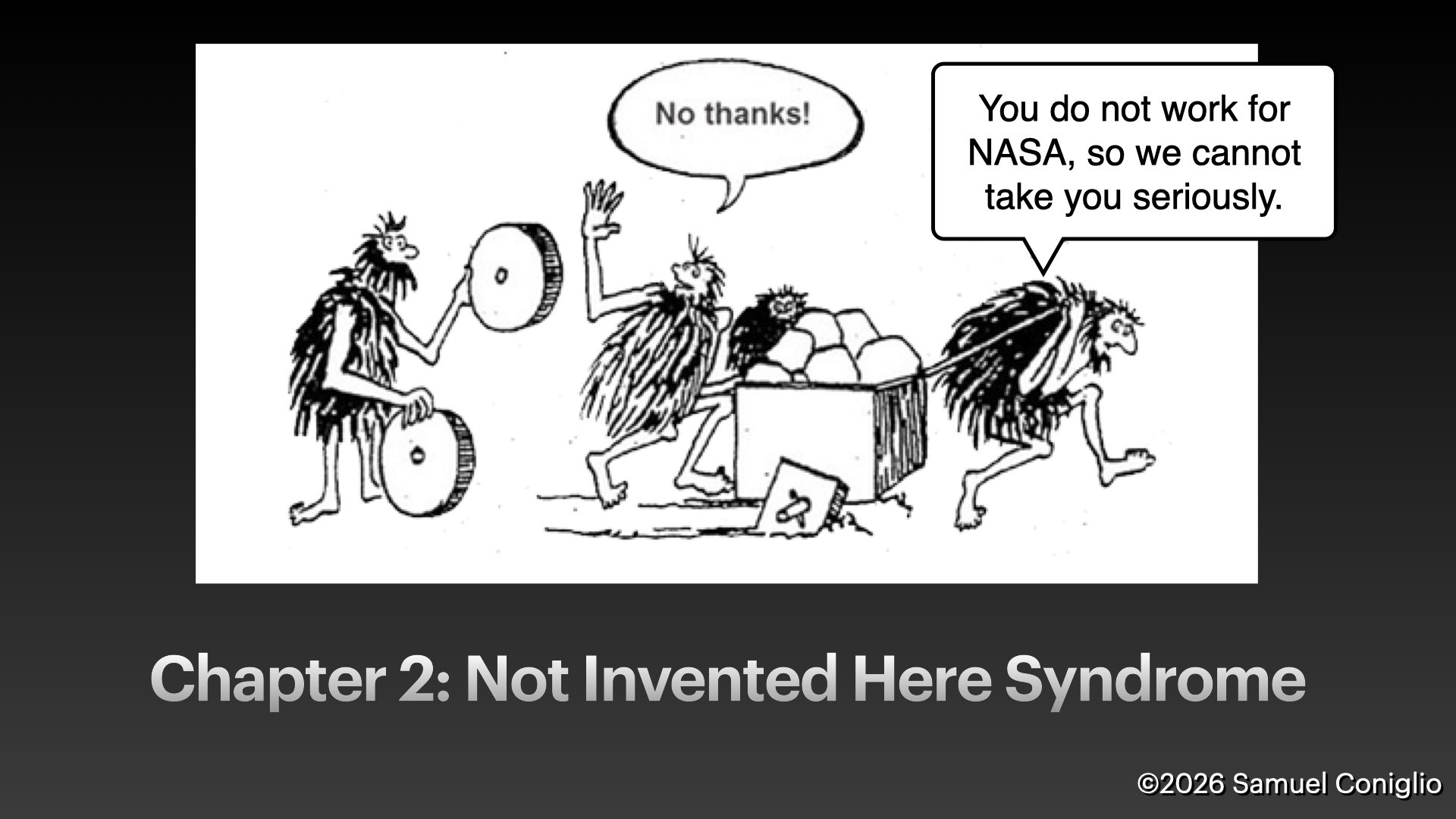
Some of you may have encountered this in business or in dealings with government agencies: the institutional attitude that, because we are the established authority on this subject, outside ideas has lesser value.
In the 1970s, NASA was the undisputed rock star of space. Time magazine, Life magazine, all major media covered NASA obsessively. They had been to the Moon. No one could compete with that. So when private individuals began coming forward with their own ideas for launching vehicles and payloads into space, the response from investors was essentially: “Who are you? You’re not NASA. You’re not a major corporation. You don’t know what you’re talking about. Go away.”
That attitude made it extraordinarily difficult for innovators and pioneers to gain any traction. They had to improvise, to find unconventional paths forward. That is where Chapter 3 comes in.
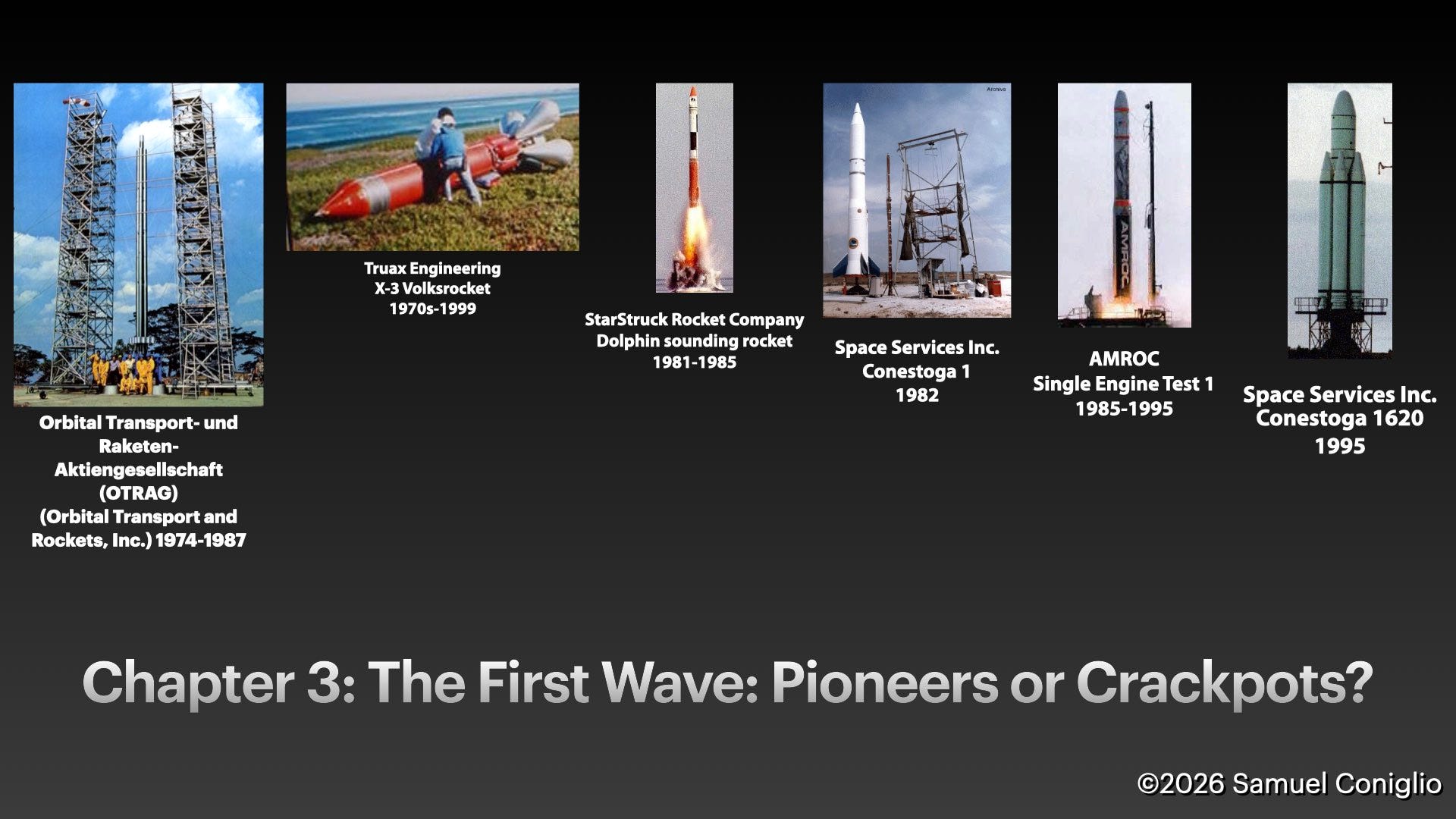
It covers companies that many people, including myself, have never heard of. Take OTRAG, for example. The acronym means “Orbital Transport-und Raketen-Aktiengesellschaft” in German. It was a West Germany-based rocket company with a simple but scalable concept: build straightforward rocket engines and cluster them together, with more engines producing greater range and altitude. In the 1970’s they were building prototypes in West Germany with some investor backing, but the political climate in Europe made the work impossible. So they moved operations to the Democratic Republic of the Congo in Africa, which was then under a dictatorship. The awkwardness of German engineers building what could be interpreted as missile technology in an authoritarian country was considerable. They were eventually told to leave and relocated to Libya, which was under the dictatorship of Muammar Gaddafi. It was an extraordinarily uncomfortable situation: a company genuinely trying to do space work, repeatedly hampered by politics and unreliable investors.
Then there was Truax Engineering. Robert Truax did pioneering work for the military, including the Sea Dragon sea-launched rocket concept. He was also developing prototypes on a shoestring budget — testing whatever he could build with whatever funding he had. His most famous collaboration, though not his finest hour, was with the stuntman Evel Knievel in the 1970s. Knievel was attempting a rocket-powered jump across a canyon, and Truax was involved in building the vehicle. The attempt failed when a parachute deployed prematurely, among other problems — but they kept trying.
Other pioneers from this era include Starstruck, Space Services Inc., and Amroc. Space Services Inc. is particularly notable. To launch their Conestoga 1 rocket off the coast of Texas, they had to obtain approval from every relevant U.S. government agency imaginable — the State Department, the Department of Defense, the EPA — every agency you can think of. They were simultaneously navigating a political battle and an engineering battle, and it was not clear which was harder. They eventually succeeded, and people were genuinely shocked and impressed. Check out my recent article on Conestoga and Celestis, Inc.
Not long after the successful launch on September 9, 1982, SSIA founder David Hannah, Jr. was invited to testify before Congress providing his thoughts and recommendations on what might be done to assist the development of this nascent private space industry. The answer was simple: simplify the approval process. And that is how we got the Commercial Space Launch Act, passed in 1984. Someone had to endure the grueling effort of going through the entire regulatory gauntlet so that future companies would have a cleaner path.
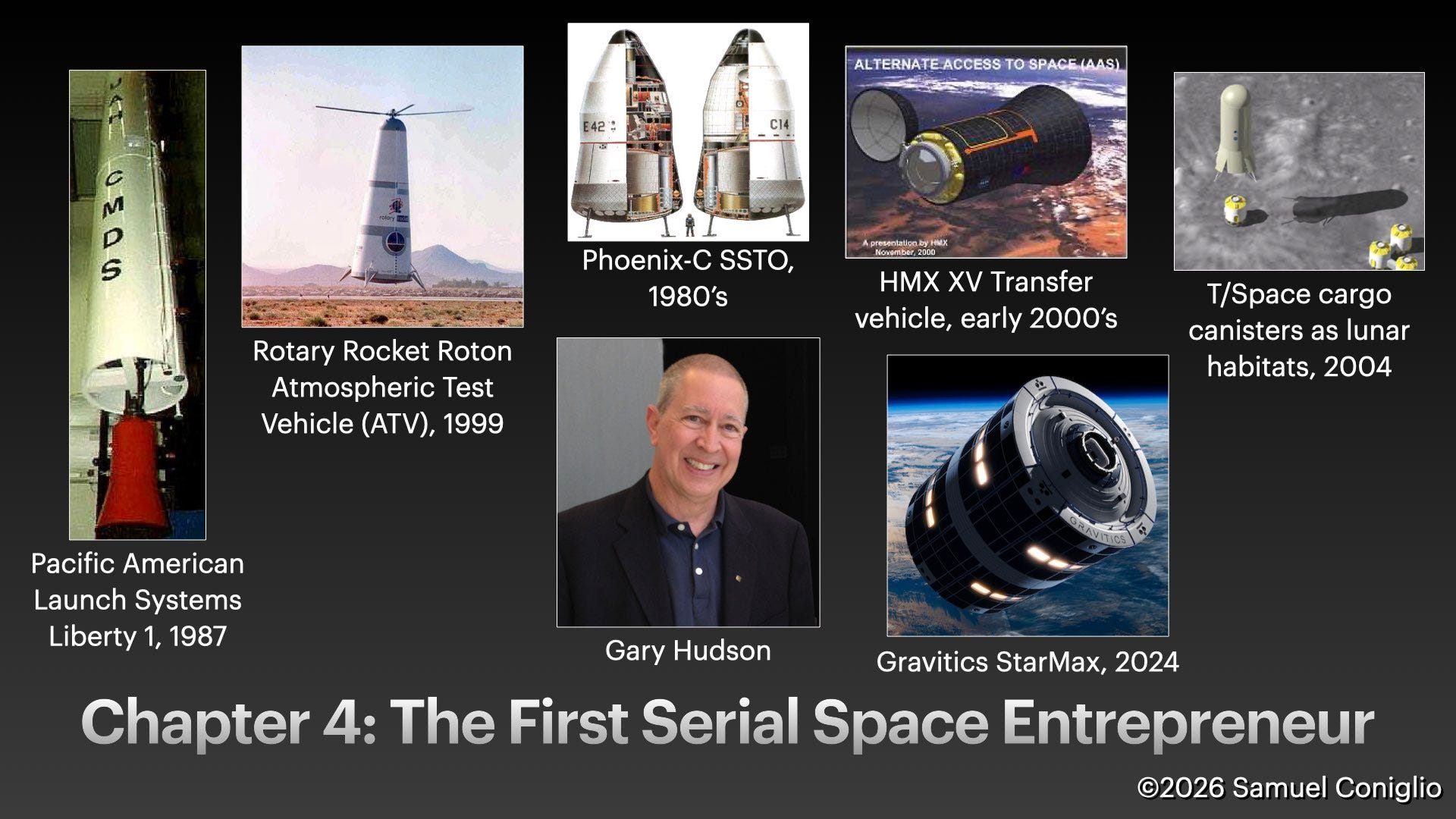
Chapter 4 focuses on a specific individual: Gary Hudson, arguably the first serial space entrepreneur. The word “serial” is key. This is someone who tried repeatedly over decades, starting company after company, launching project after project, always trying to build something that would reach space. He tried and failed many times, but he never stopped.
One of his more notable projects was the Rotary Rocket in the 1990s, built at the Mojave Air Port (which became the hub of many private rocket efforts). It was a helicopter-launched and -landing vehicle, which raised a few eyebrows. The original concept involved a spinning rocket base for launching and rocket-powered blades on the tips of helicopter rotors for controlled landing, but his company could never find enough funding to build both. He secured some investor funding, actually built a prototype with the rocket copter blades, and tested it. It proved to be very unbalanced and unstable, so the funding eventually dried up.
Mr. Hudson went on to work on several different projects over the following decades. Today, in his 80s, he serves as an advisor for a company called Gravitics, working on the StarMax space habitat. This man has been pushing private space projects since the 1980s and is still going. In our community, he is a genuine hero.
You will recognize some of these organizations on the slide: the National Space Society, the Space Frontier Foundation, and the Planetary Society. Two of these were essentially enthusiast and advocacy groups supporting NASA and space exploration broadly. The third — the Space Frontier Foundation — was something very different. They were, frankly, rebels. I was involved with them for quite some time. Their mission was to push the door open for commercial space.
They lobbied Congress directly. They had a program called March Storm, in which every March they would descend on Capitol Hill and lobby a dozen or more members of Congress and their staff to advance policies that would make it easier to launch and land spacecraft commercially.
Here is something many people do not know: for many years, it was technically not legal to land a spacecraft on the ground in the United States. There was simply no regulatory framework for it. You could launch a missile. You could put something into orbit. But the idea of a vehicle returning and landing on solid ground — no one had written rules for that, because no one had thought it was possible. The Space Frontier Foundation worked with legislators to get laws passed specifically addressing the landing and reuse of spacecraft. They helped build the legal foundation that made reusable rockets possible.
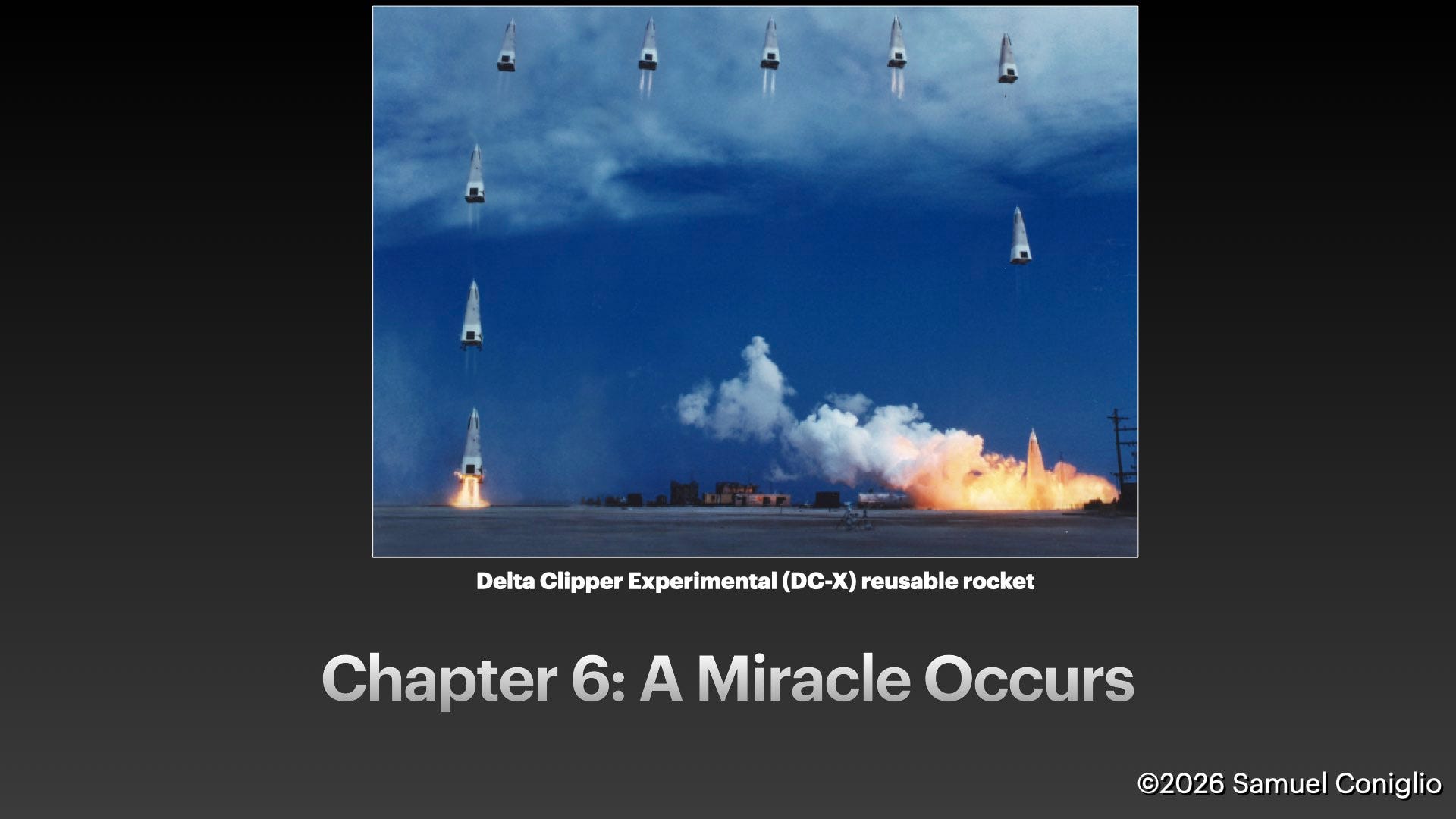
The Delta Clipper Experimental — DCX — was born out of ideas from several people, including Gary Hudson and aerospace engineer Max Hunter. It embodied the concept of a fully reusable rocket ship. There was enormous resistance within the aerospace establishment. People said it could not be done. You cannot reuse a rocket. The mindset was deeply entrenched, and that mindset is one of the key themes of this book.
The DCX only came into existence because a small group of people had strong political connections within the Reagan White House. The project was placed under the Department of Defense’s Strategic Defense Initiative Organization — the SDIO, known for its Brilliant Pebbles missile-defense program. Their strategic problem was straightforward: in the 1980s, it took months to prepare a single rocket for launch. A credible orbital defense system required the ability to launch quickly. Space activists proposed a solution — a fully reusable rocket — and SDIO agreed to fund it.
They built it on a remarkably small budget of approximately $60 million. Every time it flew, they nearly ran out of money. The Space Frontier Foundation and other activist groups scrambled to secure additional funding from various sources to keep the program alive, again and again. The DC-X flew 12 times in total. Eventually the program was transferred from the DOD to NASA — which the space activists were not thrilled about, given NASA’s institutional resistance to unconventional ideas — but through the strange workings of politics, NASA took it on and flew it four more times before it finally crashed. Eight flights under the DOD, four under NASA. The full story will be in the book. Teaser: Rick Tumlinson (co-founder of the Space Frontier Foundation), told me that NASA took on the DC-X project as a compromise in return for the Foundation to stop lobbying Congress to prevent the International Space Station from being funded.
The reaction across the private space community was excitement. They were saying to each other: “Reusable rockets are real. We can actually do this. We can reduce the cost to orbit, far less than the space shuttle’s cost of $10,000 per pound. All we have to do is figure out how to reuse these vehicles, and we can open space to everyone.”
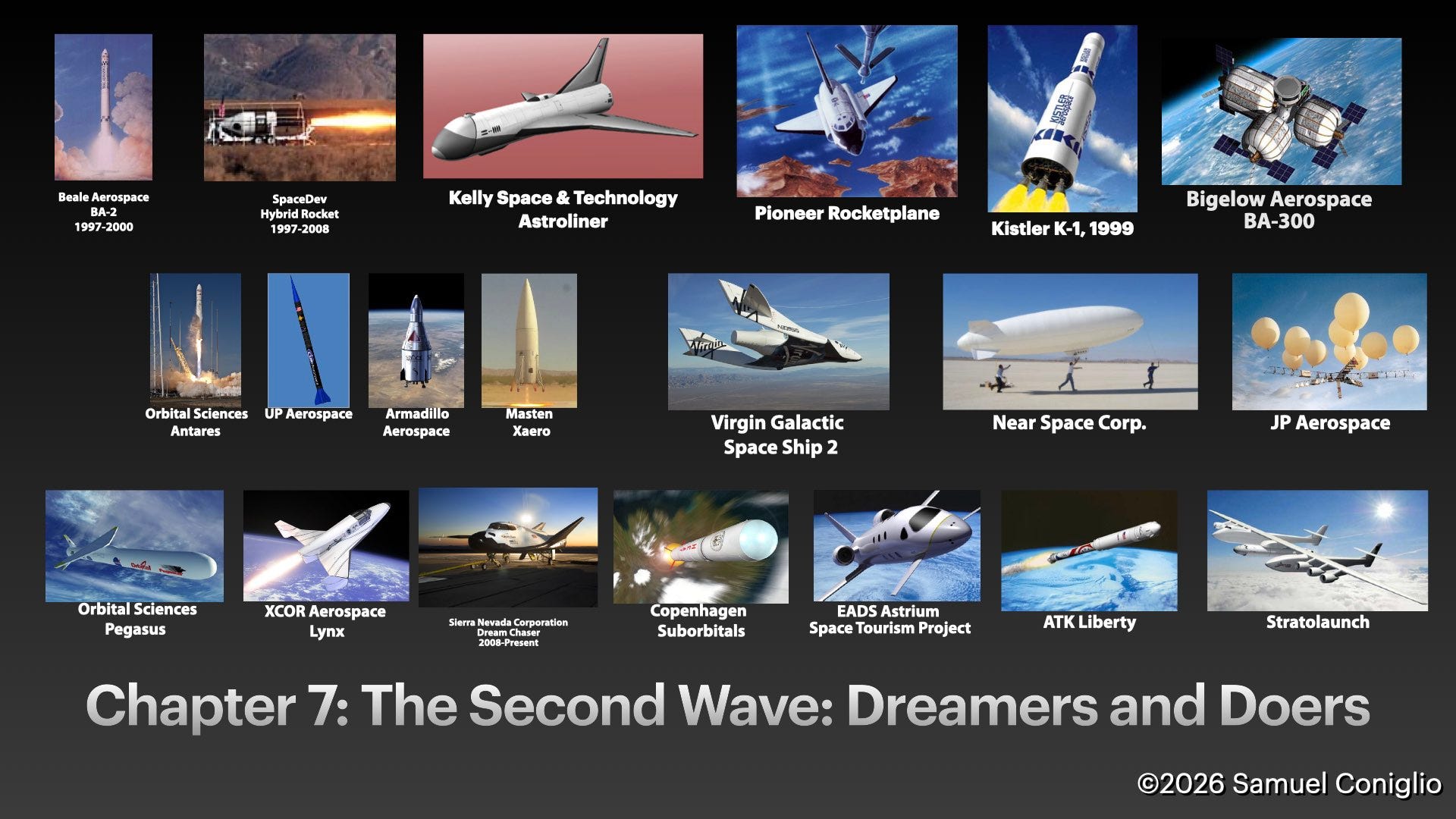
What you see on this slide is a panorama of companies that came and went during this period. Only a handful are still be operating today. Rockets were designed for small payloads, medium payloads, and large payloads; vehicles aimed at low Earth orbit and beyond. These companies began emerging in the 1990s and early 2000s. Most eventually failed due to funding shortfalls, engineering challenges, management problems, or political obstacles. They were all operating in the shadow of the Space Shuttle era, when NASA commanded an enormous budget and these private ventures were surviving on donations, one or two investors, or in a few notable cases, billionaire backing — which, as you might imagine, helps considerably.
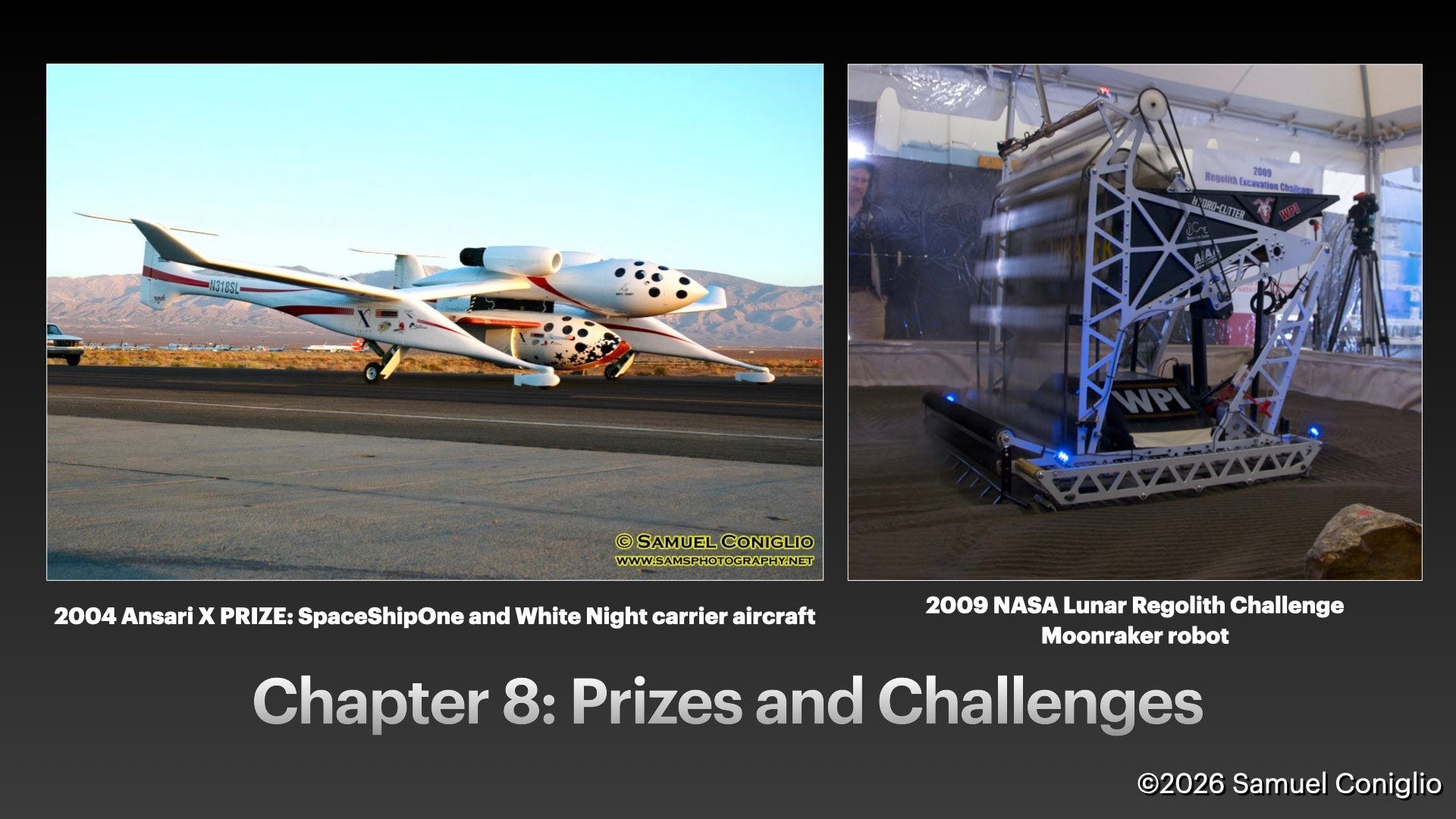
The centerpiece is the Ansari X Prize. Peter Diamandis — himself another serial space entrepreneur — had the idea to replicate the model of the Orteig Prize, which inspired Charles Lindbergh’s 1927 transatlantic flight and accelerated the development of commercial aviation. With the Ansari X Prize, the goal was a privately built, reusable spacecraft capable of reaching the edge of space and returning safely, and doing it twice within two weeks.
The winner was Burt Rutan — essentially the modern Wright Brothers. A visionary aircraft designer working out of the Mojave Desert, Rutan had spent decades producing extraordinary and unconventional aircraft designs. With financial support from Paul Allen, he decided to build a reusable spacecraft based on aircraft technology principles. The result was the WhiteKnightOne carrier aircraft with SpaceShipOne carried beneath it — a concept inspired by the X-15 rocket plane, which had been carried aloft by a B-52 in the 1950s before being released and igniting its engine. SpaceShipOne won the Ansari X Prize in October 2004.
That success inspired a wave of other space-related competitions and challenges. On the right side of the slide, you can see me at an event called the NASA Lunar Regolith Challenge. I am actually friends with the team that built the Moonraker mining robot shown there — a machine designed to excavate lunar regolith efficiently and transport it across the surface. This was a remarkable era of innovation and encouragement for a new generation of people to build things, push boundaries, and maybe win a prize along the way.
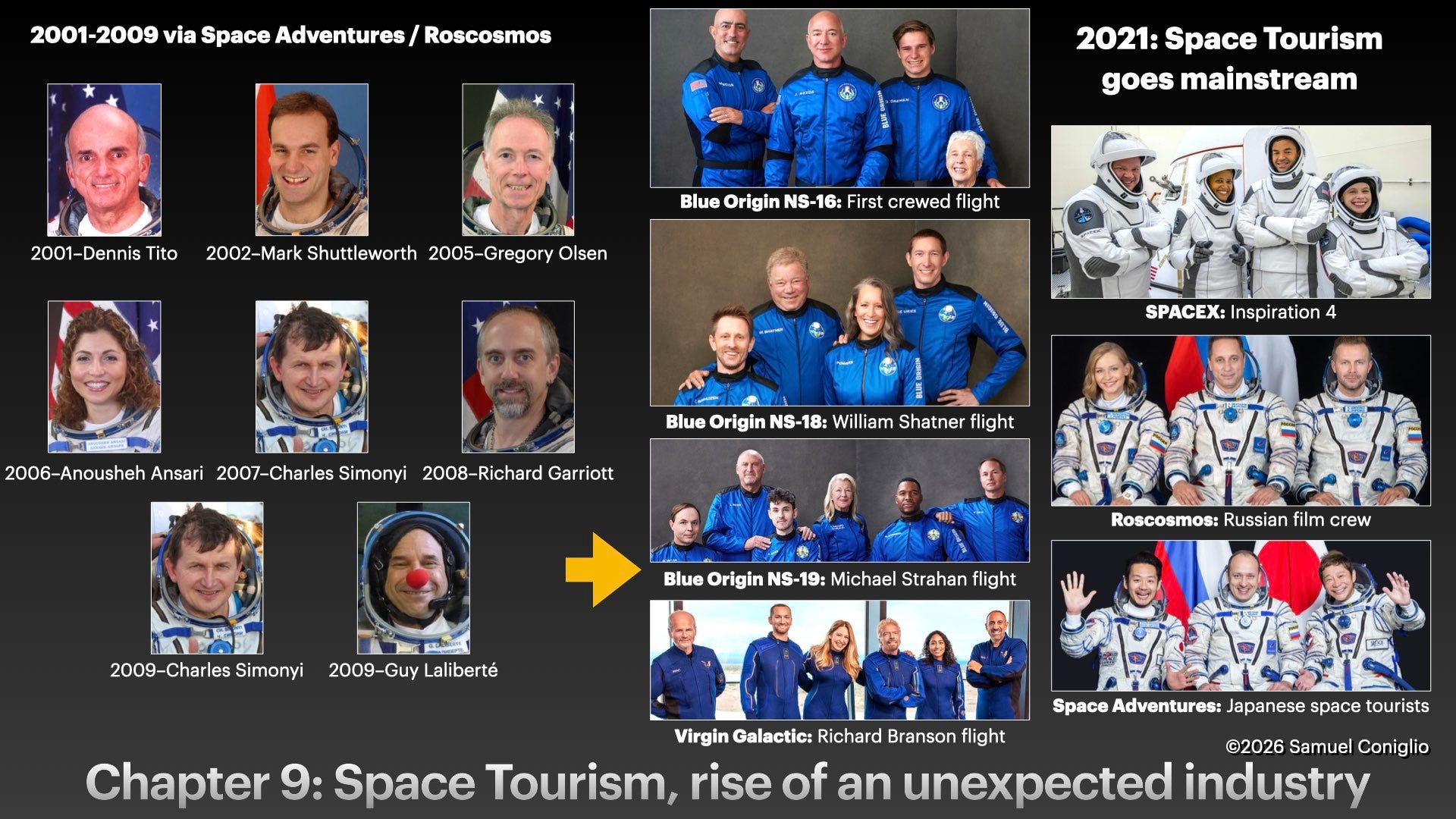
The idea that ordinary people could buy a ticket and go to space seemed absurd. And then it happened.
The story starts effectively in 2001 with Dennis Tito, shown on the far left of this slide. He worked very hard to find a way to fly in space. He initially signed a contract with MIRCorp, which was the first private organization to lease a space station. MIRCorp negotiated with Roscosmos, the Russian Space Agency, to lease the MIR space station in late 1999 and early 2000, during the transition period from MIR to the International Space Station. Russia was in serious financial difficulty after the end of the Cold War and needed revenue streams. MIRCorp sent a crew of privately paid cosmonauts up to conduct a maintenance mission, which was successful.
But then politics intervened. NASA pressured the Russians to stop focusing on MIR and redirect all resources toward the ISS. The MIR station, the pride of Russian space achievement, was deorbited and crashed into the Pacific Ocean. Dennis Tito paid for a ticket that suddenly had no destination.
Enter Space Adventures, which helped negotiate with Roscosmos on Tito’s behalf. The result: he flew to the International Space Station in 2001. It was not without fierce controversy. The battles to make that flight happen were considerable, and things were tense enough that crew members aboard the ISS were initially told not to shake Tito’s hand or embrace him when he arrived. Ridiculous — but it was a turning point for the industry.
After that, a series of wealthy private individuals bought tickets to orbit for roughly $30 million each, including Anousheh Ansari and others. Things quieted down between approximately 2009 and 2021, primarily because when the Space Shuttle retired in 2011, Russia redirected all Soyuz capacity to professional astronaut flights.
Then 2021 happened, and in the middle of a global pandemic, everything changed. Dozens of private individuals flew to space from multiple providers: Blue Origin, Virgin Galactic, SpaceX, and Roscosmos with Space Adventures. Space tourism had gone mainstream. Blue Origin flew repeatedly. Virgin Galactic flew periodically. SpaceX flew individuals directly to the space station. Space tourism is now a legitimate industry, and I cannot wait to see what comes next.
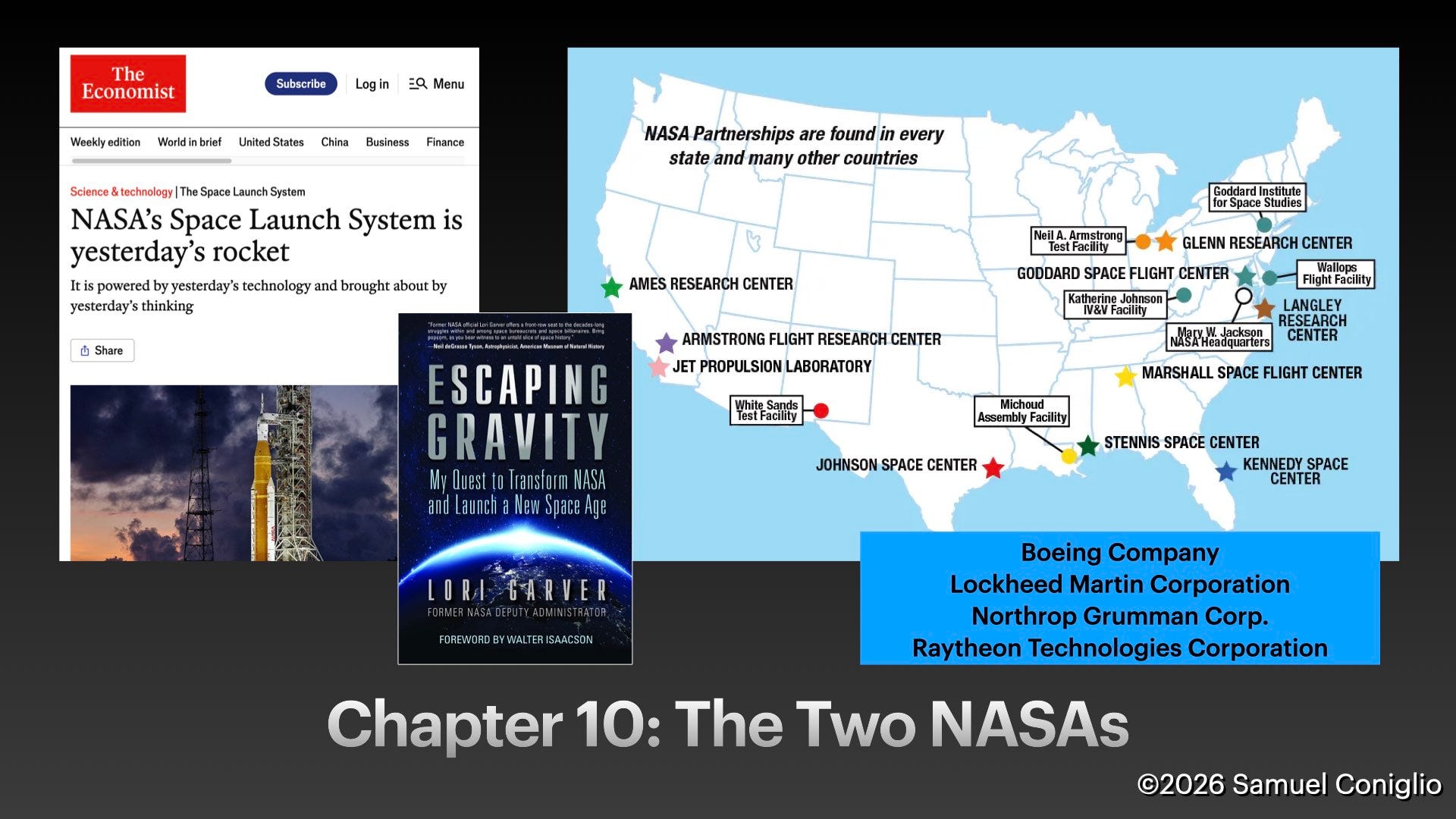
Beginning in the early 2000s, there was a fundamental tension within the agency between those who genuinely believed in diversifying into private industry partnerships and those who were focused primarily on keeping legacy contractors employed — because the political realities demanded it.
This chapter will describe some of the major rocket programs that emerged during this period, several of which arguably existed more to sustain existing contracts and employment than to efficiently advance space exploration. That is why so many major NASA programs take 20 years or more from conception to first flight. The NASA industrial complex is not just a metaphor — it is the literal geography of how Apollo was funded. Money flowed to space centers strategically distributed across the country to provide employment in the right congressional districts. After Apollo ended, those centers remained, those contractors were retained, and new work was found for them on new contracts. The cycle just kept going.
There is a book by Lori Garver, a former NASA Deputy Administrator, that tells this story in painful detail — the internal contradictions, the resistance to commercial ventures, the dismissal of companies like SpaceX in their early days. The Space Launch System is the clearest modern example. Some in our community call it the “Senate Launch System,” because Senator Richard Shelby of Alabama was instrumental in keeping that program alive to preserve jobs in his state. A substantial portion of the SLS hardware is derived directly from Space Shuttle components — the boosters and external tanks essentially reworked and reused over decades. It took an extraordinarily long time to test and eventually fly.
I am genuinely thrilled that the Artemis 2 mission succeeded — it was a remarkable achievement. But I hope we do not have to wait another 20 years for the next one.
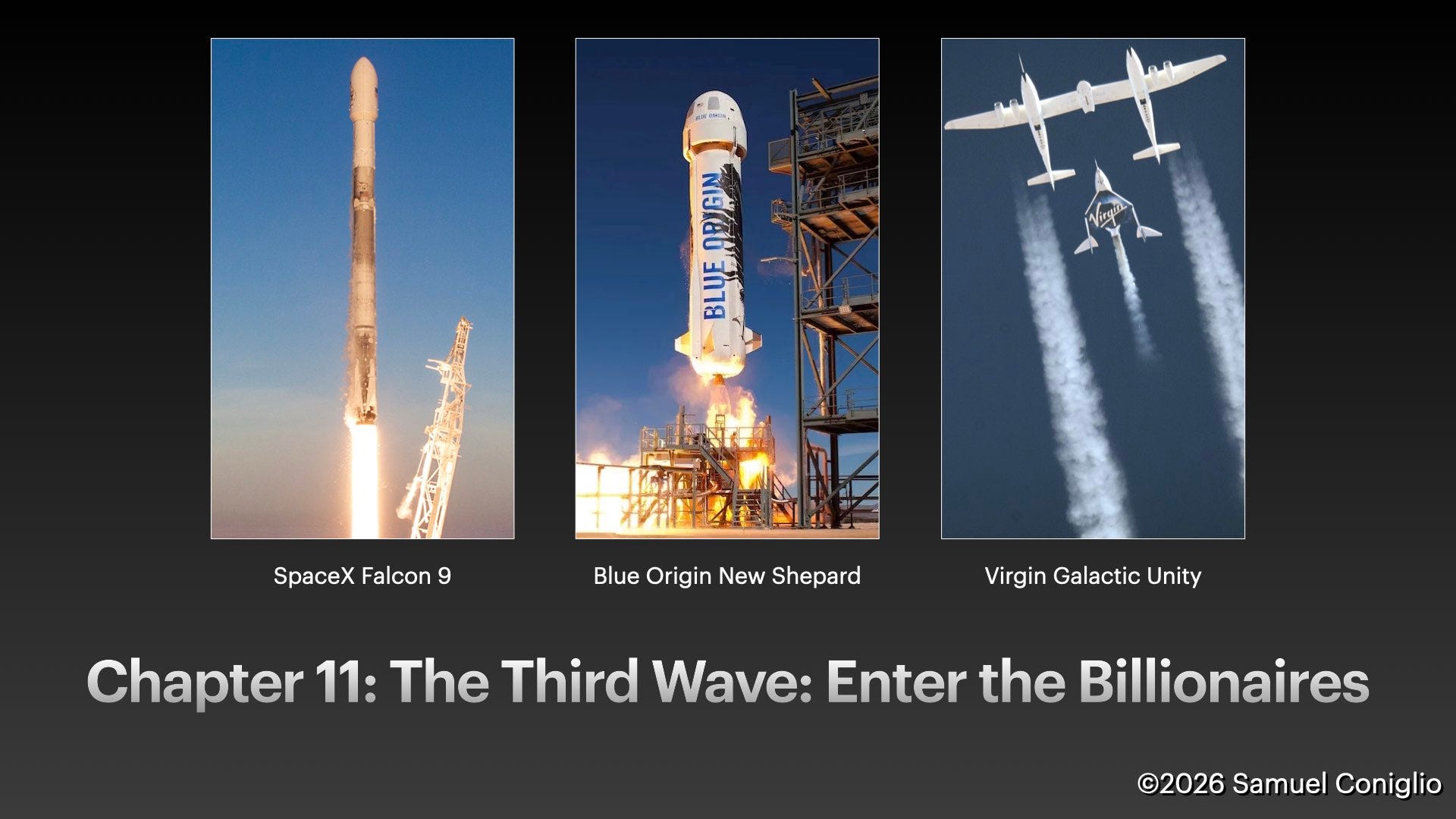
Suddenly, we have extraordinarily wealthy individuals who are genuinely serious about space, building their own companies and launching new industries with resources that no grassroots entrepreneur could match.
Everyone knows SpaceX. They have set a new standard and raised the bar for the entire industry. But competition matters — and Blue Origin demonstrated how reusable space tourism could work with their New Shepard vehicle, flying again and again. Now they are developing New Glenn, which had its inaugural launch recently. Virgin Galactic continues working to perfect its business model, which has taken far longer than anticipated — but they are still at it.
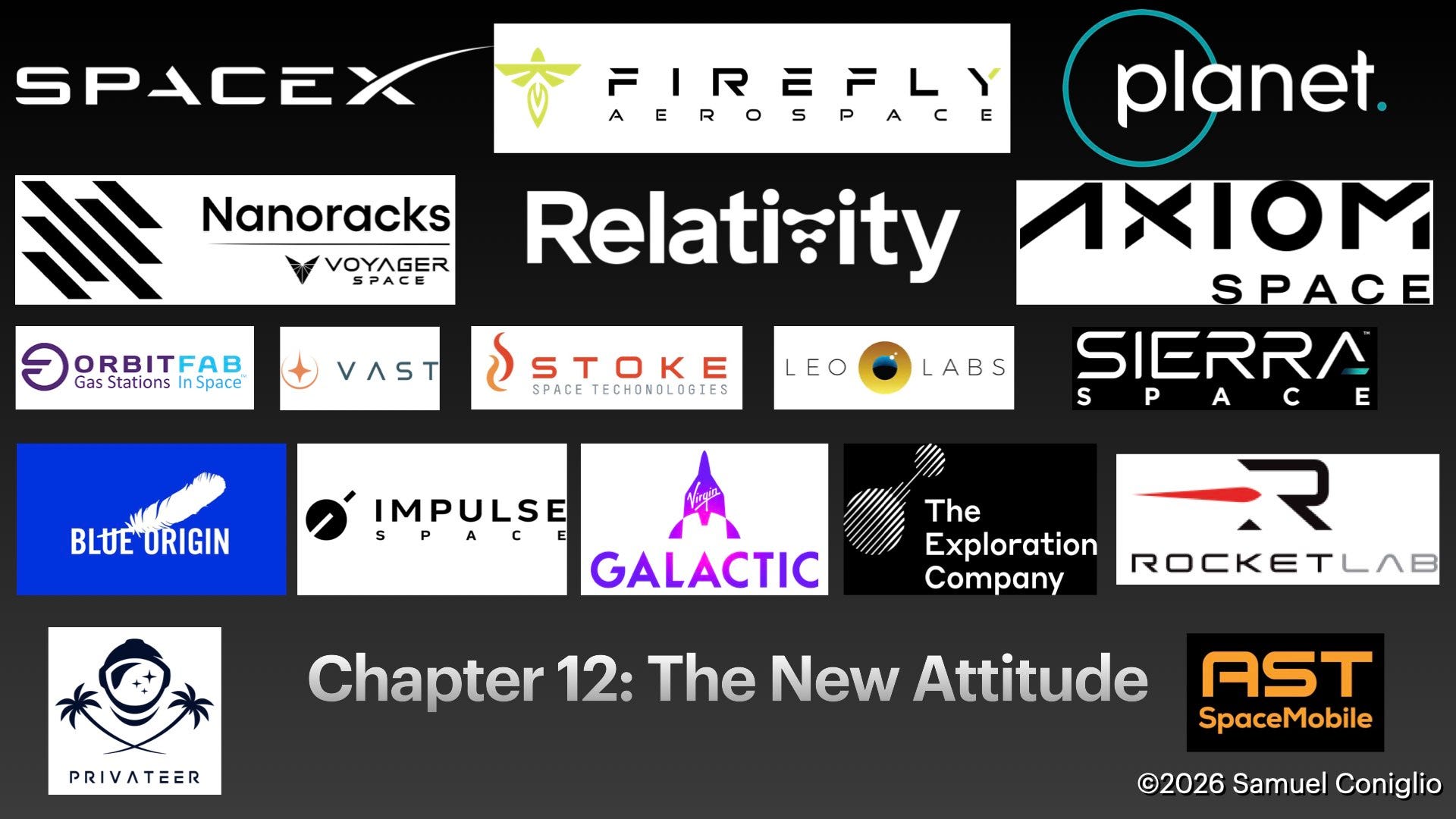
The broader picture is genuinely exciting. We are in an era where serious investors are entering aerospace like never before. People from the technology and AI worlds in Silicon Valley are looking at aerospace as the next frontier. Companies like Rocket Lab, Firefly Aerospace, and Voyager Space are receiving substantial funding and actually building and flying real hardware. Planet Labs is a fascinating example: their individual satellites are small, but they have deployed thousands of them, forming constellations capable of continuous Earth observation with viable business models attached.
This is where we are today. Private industry has finally arrived to complement NASA, to compete with it in healthy ways, and in some cases to outpace it entirely. That is what this chapter is about.
Why are we spending all this time, money, and effort to go to space?
Honestly — it is what humans do. We have a deep need to travel. We have a need to explore, to see what is beyond the next mountain, to understand what is out there. We need to continue our explorations, to build new economies and businesses along the way, and to learn how to live differently. We are an explorer species. New challenges are our defining characteristic. Space travel is the next great challenge for humanity, and with any luck, pursuing it will improve our society in the process.
This article is a loong interpretation of an interview I had with Space Renaissance International (SRI). SRI is a global space advocacy group that promoting off-world development through education and lobbying groups like the United Nations. Here is a link to the interview.
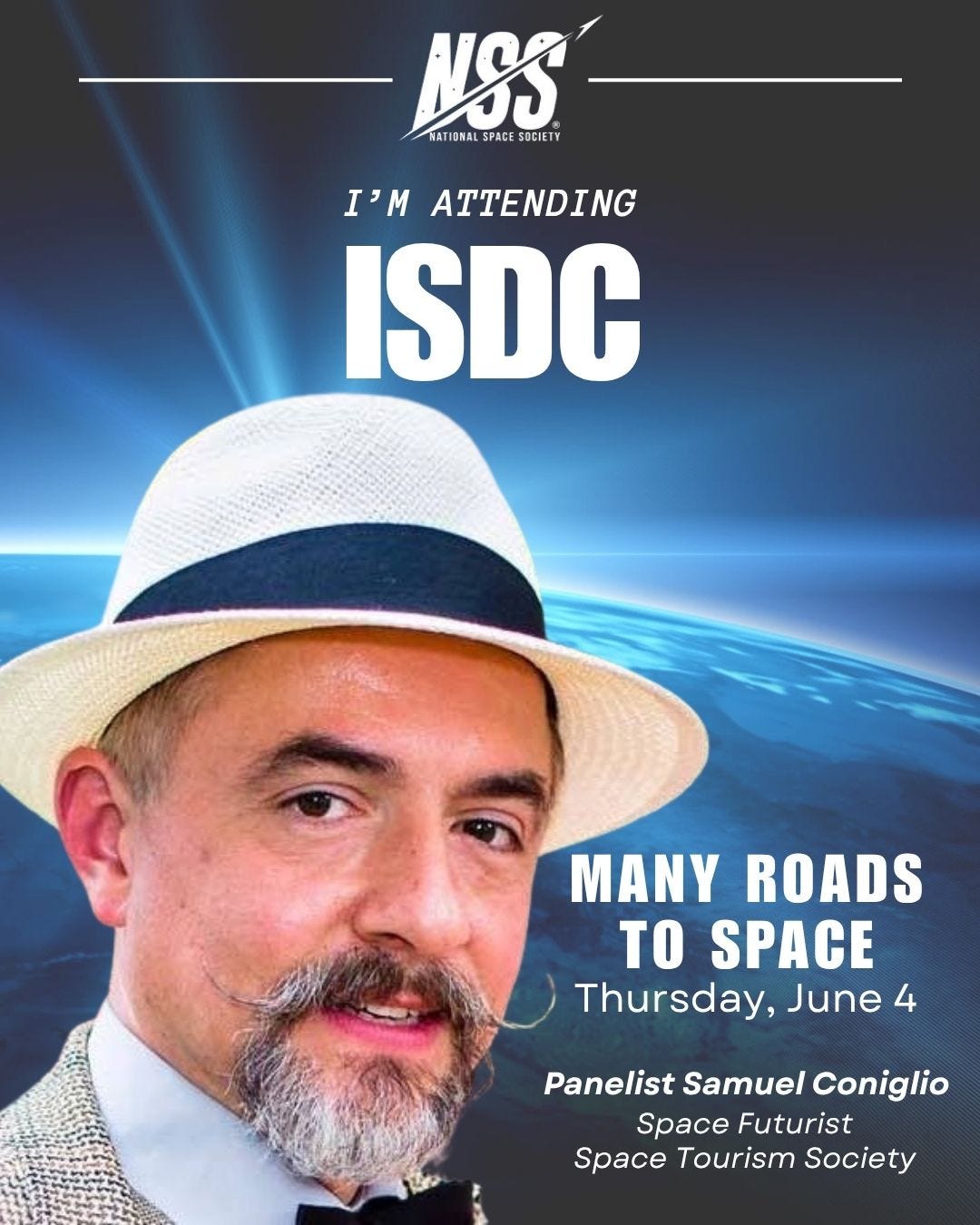
Hey folks, if you happen to be in McClean, Virginia, the first week of June, I hope we can meet up at the International Space Development Conference!
This is a popular science book about the challenges of living in space and using them as design constraints for better off-world living.

ISBN & PRICE
Paperback: 979-8-218-24640-2 | $33.00
Ebook: 979-8-218-24639-6 | $9.99
https://retro-futurist.com
*Don’t forget to write a review! Thanks!
Thanks for reading Spaceman Sam’s Retro-Futurist Newsletter! Subscribe for free to receive new posts and support my work.
No posts
Comments
Nothing yet. Say the first thing.
Sign in to join the conversation.