
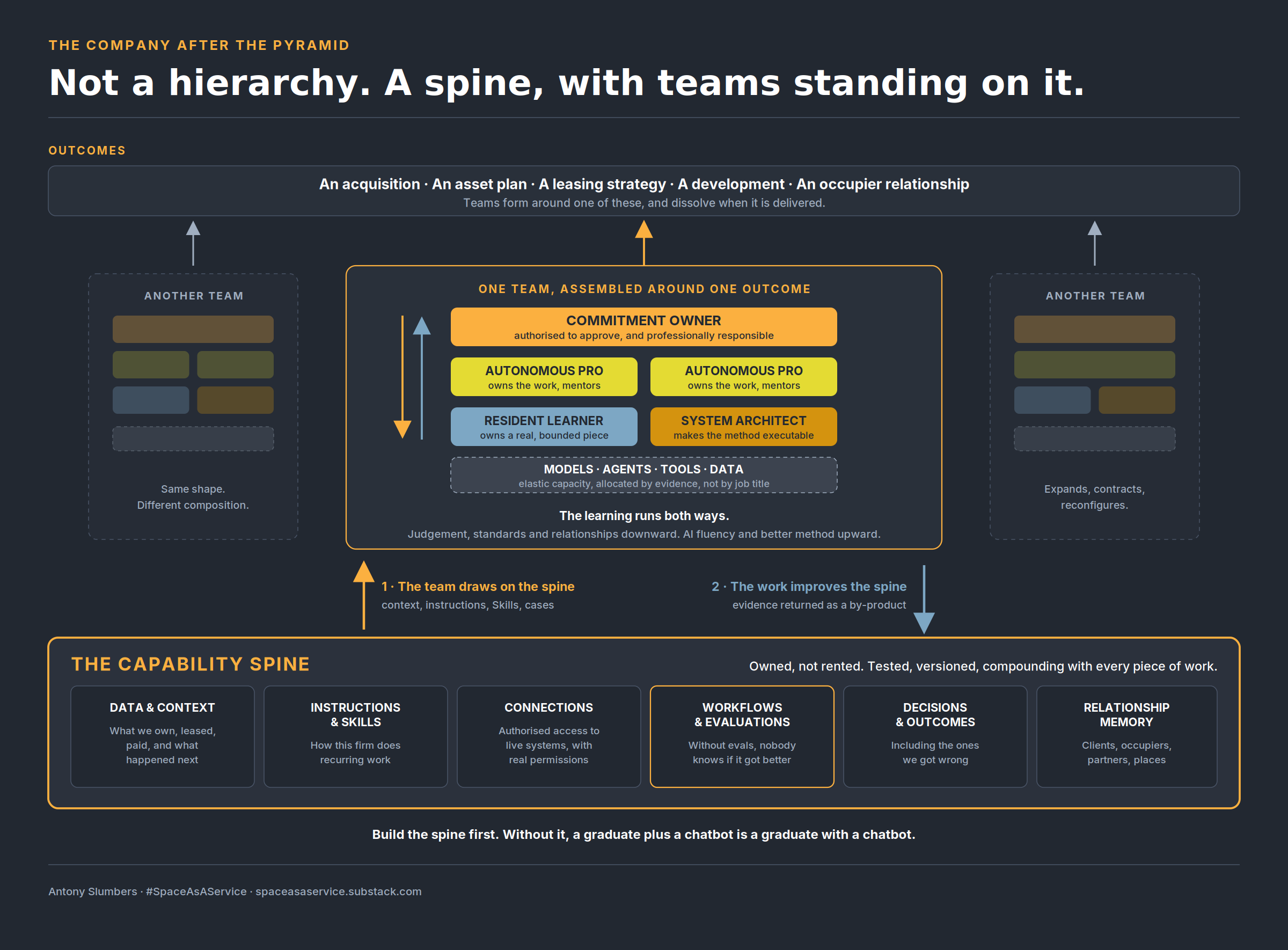
A professional firm made up solely of experienced people and AI is a cul-de-sac. Its successor is a network of small human+machine teams standing on a shared capability spine, in which the learning runs in both directions.
Last week I ended with a question: what does a commercial real estate company designed to learn this way actually look like? I first tried to answer this in December 2025, with a proposed ‘Human+Machine Organisational Architecture’. The structure of that framework still stands. Some of what I attached to it does not, particularly the numbers I put on productivity and on the compression of professional development, which were hypotheses dressed in more precision than the evidence supported. I withdraw those. Two other parts of the argument now need much more weight: the shared institutional intelligence a company builds for itself, and the route in for young people.
EXECUTIVE SUMMARY
The professional pyramid used junior production work to fund the development of future experts. AI is destroying the economics of that work, and some firms have responded by dispensing with juniors altogether. That works for a firm able to buy experienced people from elsewhere. It fails as the general model for a profession, and it may fail faster than its architects expect.
The company after the pyramid will be built on a capability spine foundation. The data, context, instructions, Skills, workflows, evaluations, decision cases and relationship memory that make a company more than the sum of the models it rents. As frontier models become commodities, every firm will have the same intelligence available and none of it will be an advantage. What a company puts around the model is the advantage. This is not an advanced move for the technically ambitious. It is the new baseline, in the way a computer on the desk stopped being a strategy around 1995. And if your method lives inside somebody else’s product, it is their asset, not yours.
The structure will be small teams standing on that spine. Accountable leaders, autonomous professionals, resident learners on a deliberate development path, and a crossover System Architect who turns how we work into something a machine can execute reliably. Five people commanding capabilities that used to need fifty.
The learning runs in both directions. The right graduate arrives fluent in tools most senior people use tentatively, so the junior is an input to the firm’s capability and not only a draw on it. Without a spine, a graduate plus a chatbot leaves nothing behind. With one, everything they improve lands somewhere permanent.
The bargain is two outputs. Every consequential piece of work delivers value for the client or asset today, AND leaves the company more capable tomorrow. A company exists to create value for customers and investors. Capability is a co-product of that, and we need both.
Start with the spine. Write down what you have, build one recurring workflow properly, and count how many of your core processes run on instructions you wrote yourselves. Everything else in this piece develops from that.
ONE ANSWER HAS ALREADY APPEARED
In May I wrote about Pierson Ferdinand, the fast-growing US law firm built around hundreds of partners, AI and no US associates.
It is a wonderfully clean answer to the broken pyramid. Keep the experienced people. Give them excellent AI. Remove the expensive junior tier. Recruit laterally whenever more capability is required. It launched in January 2024 with around 130 partners, is now past 280, and it is no longer a distant American curiosity: it operates in London as Pierson Ferdinand UK LLP, regulated by the SRA. It is also fully distributed with no offices, which produces a small irony for readers of this newsletter. The flagship AI-native professional firm makes a large part of its saving by not renting our product!
For Pierson Ferdinand, this may remain an excellent business. For the professions as a whole, it is a cul-de-sac. A firm can buy rather than build talent only while other firms continue to build it. Everybody is fishing the lateral market and nobody is stocking the lake. If law firms, investment managers, architects, surveyors and accountants all remove their entry-level roles, the lake empties, and in the meantime large numbers of capable young people lose their route into productive professional work.
Questions, of course, remain about the timescale. The lateral market will not run dry next year. A generation of experienced professionals already exists and international talent pools are deep, so a firm harvesting that supply could do well for a decade, longer than most planning horizons. If the case for building people rests only on the collective interest of the profession, a finance director will reasonably ignore it.
Longer than most planning horizons is the operative phrase. Very few C-suites are greatly exercised about what happens a decade out, because bonuses are paid on this year and the next, and the person who harvests now will have banked it before the bill lands. Shareholders might want to think hard about whether those incentives still make sense. Employees would do well to understand their bosses’ time horizons and plan accordingly.
But the decade is a guess, not a forecast. How confident are you in it, really? If this takes fifteen years, the harvesting firm is right, and its leaders will be out and cashed in long before anything hurts. If it takes three to five, which is not unthinkable based on the last three, then a firm that spent that time buying capability instead of building it might turn out to be roadkill. I do not know which it will be. Neither do you. What I do know is that only one of those two bets is recoverable if you get it wrong.
So hiring juniors has to pay at the level of the individual firm. It does, for reasons I underrated when I first sketched this architecture. First, though, let’s look at the thing the whole design stands on.
THE CAPABILITY SPINE IS THE COMPANY
Everything else in this piece rests on this.
As frontier models become commodities, and they are becoming commodities fast, no company’s advantage will come from having access to the best model. Everyone will have access to the best model. Advantage will come from everything a firm puts around it. That collection of things is what I am calling the capability spine, and it contains:
Trusted data and institutional context. What we own, what we leased, what we paid, what happened next. Everything related to whatever area of CRE you operate in. Cleaned, connected and available to a machine rather than sitting in fourteen systems and a filing cabinet.
Precise instructions and reusable Skills encoding how this firm does recurring work. Not a prompt somebody typed once. The written-down, tested, versioned method by which our company appraises a site, abstracts a lease, screens an acquisition or answers an occupier. Or whatever we do.
Authorised connections to live systems, with permissions reflecting who may do what.
Tested workflows, agents and evaluations. Above all evaluations. Capability is jagged and the boundary between human and machine work moves constantly, so a task a junior does today may go to an agent tomorrow and come back the month after. Evaluations are how a firm knows where that line currently sits, rather than guessing.
The history of decisions and outcomes, including the ones we got wrong, kept in a form a machine can learn from.
Relationship memory covering clients, occupiers, partners and places.
Generic prompts and public data are available to everyone. Context capturing how a particular company evaluates an asset, serves an occupier, prices risk and learns from the consequences is much harder to reproduce. This is why I think the spine is the foundational rock. Whatever strengths a company decides it needs over the next decade, in valuation, in operations, in development, in customer service, it will build them on this or it will not build them at all.
The spine also compounds, which almost nothing else in a professional firm does. A team draws on it to do the work. The work produces evidence that improves it. The next team starts from a better position. Ten years of that is a genuine moat, and one of the few a mid-sized CRE company can realistically dig. It is also, as a consequence rather than a purpose, the thing that makes hiring a junior worth doing again. I will come back to that.
None of this is a novel idea outside our industry. Anyone building seriously with AI has been calling some version of it context engineering for a couple of years now, and among people who do this for a living it is close to common knowledge. In commercial real estate it is not common knowledge at all. Which is precisely why there is still an advantage sitting in it, and why that advantage has a shelf life.
The obvious objection is that most CRE firms cannot do this. Many could not tell you what an evaluation is, have never written an instruction they would describe as tested, and would respond to the word Skills with a blank look. All true, and it changes nothing. No successful commercial real estate company of the next decade will be without a capability spine. This is not an advanced manoeuvre for the technically ambitious. It is the new baseline, in the way that a computer on the desk stopped being a strategy somewhere around 1995 and became the price of entry. You do not get to opt out of a baseline. You only get to be late to it.
There is a second reason to own this rather than rent it, and I made the argument at length in The Toll and the Amputation. The dangerous form of AI dependence is the supplier whose system quietly learns the judgement that distinguishes your firm, in a form you never possessed and cannot take with you. The spine is the positive version of that argument: the place where the judgement accrues to you instead. Every instruction you do not write is an instruction somebody else writes for you, and keeps.
There is a catch, and it falls unevenly across our industry. Much of the material that would make an adviser’s spine valuable belongs to somebody else. Engagement letters, data processing terms and professional obligations decide how much client and occupier data a firm may retain, and whether it may be used to serve the next client. Sort that out at the contract stage, not during a due diligence exercise on your own firm. It is also why this model is cleanest for principals: an owner building a spine from its own portfolio has no such conversation to have.
Treating any of this as IT infrastructure would be a profound mistake. Building, testing and pruning the spine needs to be core business activity, funded and governed like one, with someone senior accountable for it.
Building one out properly is a subject in itself, and there is a section at the end of this piece on where to begin. What concerns us here is what it does to the shape of the company standing on it.
SMALL TEAMS, VERY LARGE CAPABILITIES
The post-pyramid company will be a network of small teams organised around outcomes: an acquisition, an asset plan, a development, a leasing strategy, a building, a portfolio. A typical team might contain:
a Commitment Owner, authorised to approve consequential decisions and professionally responsible for them
one or more Autonomous Professionals, owning substantial parts of the work and mentoring others
a Resident Learner, contributing to the live outcome while progressing through a deliberate development programme
access to a System Architect, improving the workflows, context and AI capabilities the team uses
a changing collection of models, agents, tools and data supplying elastic analytical capacity
The team expands, contracts and reconfigures around the problem, then dissolves when the outcome is delivered. People still belong to a firm and a professional community, but much of working life happens in these teams. Without the spine underneath them, each one is a talented group renting intelligence from the same suppliers as everyone else. With it, five people command capabilities that used to need fifty.
The fourth item on that list deserves more than a line, because the System Architect is the only genuinely new role in the whole design. Half domain expert, half knowledge engineer, this is the person who turns how we do things into something a machine can execute reliably, then keeps testing whether it still works. It does not mean hiring a floor of technologists. Most firms need one strong crossover person to begin with, and a good number already have that person on the payroll without appreciating it. The analyst who automated the rent-roll reconciliation nobody asked them to automate. The building manager who is quietly better with a model than the head of technology. Go and find them, before somebody who understands what they are worth finds them first.
THE LEARNING RUNS BOTH WAYS
This is the part I would most like you to take away, and the part I missed entirely the first time I sketched this.
The pyramid taught in one direction. Knowledge flowed downhill from partner to associate to analyst, because the partner had seen more deals and the analyst had seen none. That gradient was the whole basis of apprenticeship, and it is why the seniors-plus-AI firm looks so rational: if juniors only ever receive, and the receiving is expensive, stop hiring them.
That gradient has partially reversed.
A capable graduate now arrives fluent in tools that most senior people in commercial real estate use tentatively, if at all. Fluent in the sense of knowing what a model is good and bad at, when to argue with it, how to structure a problem so it produces something worth having, and how to tell workslop from work. That fluency is scarce in exactly the population holding the decision rights.
So the Resident Learner is an input to the firm’s capability, not only a draw on it. They stress-test the workflows a System Architect builds. They find where the shared context is wrong. They show a twenty-five-year veteran a way of interrogating a lease portfolio the veteran would not have thought to ask for. In return they get what no model gives them: judgement, relationships, a sense of which questions matter, and a Commitment Owner who has been wrong enough times to know why the standards exist.
That is also the answer to an objection I would put to myself. Why hire a learner when the same money buys another agent pointed at the same neglected work? Because the agent does not improve the seniors around it, cannot be accountable to a customer, and does not appreciate in value. The learner does all three.
And none of it works without the spine. A graduate plus a chatbot is a graduate with a chatbot: quick, occasionally impressive, leaving nothing behind. A graduate plus a spine is someone whose every improvement lands somewhere permanent, gets executed by the next team, and raises the floor for everybody. The spine is not built for the juniors. It is built because an AI-fluent company cannot function without one. But it is what turns a junior from a cost you tolerate into an asset that compounds, and firms without one will keep concluding, quite logically, that juniors are not worth hiring.
But two important conditions apply.
The first is who you hire. What is worth paying for is a combination of four things:
- strong human skills
- real critical thinking
- problem-solving ability
- data fluency.
Or, at minimum, the demonstrated ability to acquire them quickly, since the frontier moves every few months and today’s fluency is next year’s baseline. Candidates now have a patient world-class tutor available at conversational cost, so the ones who have taught themselves are visible, and so are the ones who have not bothered. Design the interview to tell them apart. A degree classification will not.
The second is on us. A senior professional who will not learn anything from someone twenty-five years younger closes the loop before it starts. That is a cultural problem long before it is a technological one, and in our industry it is a substantial one.
One more group, and it is not the juniors who have it hardest. It is the middle. If your value has been production capacity plus a portion of judgement, both halves are under pressure at the same time, and no amount of seniority-in-waiting will protect either. I have said repeatedly that the middle of the road is the worst place to stand, and it is truer now than when I first wrote it. The way out is to go full stack: real CRE domain depth and real AI capability, in the same head. That combination is rare, entirely learnable, and where the leverage in this industry now sits.
THE RESIDENT LEARNER OWNS PART OF THE OUTCOME
Renaming the graduate analyst a ‘Resident Learner’ achieves precisely nothing if they spend their days checking AI output and watching senior people make decisions.
A Resident Learner must own a defined, commercially valuable part of the outcome.
In an investment business that might be a submarket thesis, a particular risk or a defined part of the asset plan; in an operating business, a group of occupiers or a small improvement budget. Bounded ownership means owning the analysis, the recommendation, the follow-through and the capture of what was learned. Consequential commitments still pass through a senior, but the learner’s work changes what the team does, and the boundary widens as evidence of capability grows.
On material judgements they must form a view before the model offers one, then use AI to attack it. Do that for every routine task and you have built theatre. Do it where framing and calibration matter and you are building a professional.
They must also be in front of clients early. Relationship skill may end up mattering more than Excel skill, and under the old model serious client exposure began somewhere around Associate Director. That was defensible when the scarce commodity was technical production. If the scarce commodity is becoming trust and judgement in the room, starting the clock a decade late is an expensive habit.
Much of the risk in this is handled by the shape of the team rather than by rules. In the pyramid, a junior’s work travelled up three levels to someone remote from it, and review was a gate at the end. Here the Commitment Owner sits inside the work and watches it form, so supervision is continuous, and the boundary widens on evidence seen first-hand by the person carrying the responsibility.
What the team cannot solve is credentials and contracts. Red Book valuations need a qualified valuer’s signature, regulated advice needs permissions, PI insurers have views about who does what, and engagement letters make representations about the seniority of the team. So draw the boundary in the language the risk register already uses: what a learner may own outright, what needs review before it leaves the building, what needs a named signature regardless of quality. Tell your insurer before you start, not after.
And one thing the old structure did well by accident, this one has to do on purpose. Formal review gates left a paper trail. Continuous supervision produces better work and, left alone, no record of when authority was exercised. The instrumented workflow that captures learning for the spine is also what records who approved what. Use it for both.
THE TWO-OUTPUT RULE
A company exists to create value for customers and investors. Capability development is not a rival objective, it is the co-product. Lose the commercial outcome and you have built an academy. Lose the capability outcome and you are consuming human capital without replenishing it.
The traditional firm asked every project for one output: the work the client commissioned. The learning company asks consequential work for two. The external outcome, and the capability-spine update: the evidence and learning returned to the shared context, instructions, Skills, workflows, evaluations and decision cases.
At which point a reasonable reader thinks: knowledge management. We tried that, and there is a shared drive full of lessons-learned documents nobody has opened since 2019. When I put an early version of this to my own virtual board it was attacked precisely there. The board was right about the old design and wrong about the new one, for two reasons.
The artefact has changed. A lessons-learned document has to be found, opened and read by someone who does not know it exists. An evaluation, a Skill, an updated context file or a revised workflow gets executed by the next team whether or not anyone reads it. The learning applies by default rather than on discovery.
And capture should be an architectural property of the system rather than a task appended to a project. If work happens inside instrumented workflows, the decision, the inputs, the model version, the alternatives considered and the expected outcome are recorded as a by-product of doing the work at all. AI systems are already moving this way: persistent memory that writes itself is becoming a feature rather than a discipline. What is left for a human is small, the annotation saying why and the judgement about what generalises. Ask people to write up their experience and you’ll be lucky to get much coherence. Ask them to add two lines to what the system already captured and you might get the truth.
And you have to pay for it. Teaching, challenging, externalising expertise and extending decision rights are part of a senior’s commercial contribution, so they belong in the compensation formula rather than an appraisal form. Incentives, not cost, are the binding constraint.
You get what you pay for.
WHY THIS PAYS
The old model generated margin by selling large quantities of relatively inexpensive human time, much of which funded learning indirectly, although clients were rarely told this was part of the bargain. AI weakens that model and creates the means to build another. The return has four sources, and they are the reason to design the company this way rather than simply shrink it.
Greater coverage. CRE leaves enormous amounts of valuable work undone because the economics never supported it. Smaller assets get superficial attention. Occupiers are contacted at the lease event and rarely in between. Alternative plans go unexplored because exploring them costs a fortnight nobody has. A learner with the tools and the spine behind them makes a meaningful slice of that affordable, and unlike an agent, can be accountable to a customer at the end of it.
Better service. More responsiveness, explanation, scenario work and human contact, without returning to the old cost base. Attentive human service commands a premium where the outcome is consequential or emotionally charged, which in real estate it usually is.
New products. Portfolio intelligence an investment manager could not previously staff. Bespoke work for clients always too small to support it. More combinations of use, design, phasing and commercial model tested before capital is committed, which is where development value is won or lost.
Compounding capability, both ways. The learner improves the workflows now, raises the AI fluency of the people around them, and later becomes an autonomous professional carrying firm-specific knowledge the lateral market cannot supply.
I am not going to attach numbers to any of that. This is emergent organisational work, not a solved problem with a spreadsheet at the end, and an invented figure would be worse than saying nothing.
The economics will vary. A balance-sheet investor captures the benefit directly and has no client-data problem, which is why I expect this among owners before advisers. An adviser may need to move from selling hours towards pricing outcomes or continuing service. Smaller firms can share infrastructure, mentors and case libraries through guilds or consortia. There will be no single model. There does need to be a profitable one.
Regular readers know where this goes. The choice is how much of the capacity AI releases we harvest as margin and how much we reinvest in growth. More output alone gets us nowhere: ten times as many scenarios that nobody uses is ‘Workslop’ at industrial scale. New capacity creates value when it reaches a decision, a service, a relationship or a place. That is how you build a bigger pie.
WHERE TO START, AND IN WHAT ORDER
The order matters. Do it backwards and you’ll conclude it doesn’t work.
One. Fix the incentives first. If senior reward recognises only personal revenue, everything below will wither in the first busy week. Add capability contribution to the next compensation review as a named line, not a comment in an appraisal.
Two. Start the spine. Write down which of the six components listed above you actually have, in what state, and who owns each. Then pick one recurring piece of work small enough that one person does it in a morning, and map it out properly: what it needs to know, how this firm does it, what good and bad output look like, where the live data comes from, and how anyone can tell it worked. That assembly is what the tools call context, Skills and evaluations, and it is the smallest complete unit of a capability spine. Do one. It will take longer than you expect but will be very instructive.
Then a question rather than a count. Take your five most important recurring pieces of work and ask, for each, where the method for getting it done actually lives: in somebody’s head, inside a vendor’s product, or written down and owned by you. Most firms will find that third column empty. Which gives us a starting position.
Three. Name a System Architect. One person, from inside, with the time genuinely protected rather than notionally allocated.
Four. Only then, give a learner something real to own. Bounded, commercially valuable, with the boundary drawn in the language your risk register already uses. Do this before the first three and you get a graduate with a chatbot, which is precisely the failure this piece is about.
Five. Promote on decision rights, not years. Progress should be visible in expanding authority, and movement should depend on evidence: the quality of someone’s decisions and challenge, how they respond when wrong, the people they teach, the systems they leave better. Resolved decisions become the training cases, so a learner works with the information available at the time, defends a recommendation, then finds out what actually happened. Young people finally get to see what capability looks like and what they must demonstrate to earn more of it.
AND WHAT YOU STOP DOING
Every transformation that works is as much cessation as addition, and I have just added a great deal to the job of a senior professional. Some things have to come off the other side.
Stop reviewing what the system should be checking. If a senior’s week is spent finding errors in first drafts, that is an evaluation you have not written yet. Reviewing for judgement is the job. Reviewing for arithmetic is a workflow defect.
Stop buying tools that keep your method inside them. Every procurement decision from here is also a decision about who owns the resulting intelligence. Ask the question in the room, before signing.
Stop the graduate milk round you designed in 2015. It selects for the wrong things and it will keep doing so, efficiently, for as long as you leave it running.
Stop calling capability spending an overhead. It belongs in the operating model and the investment budget alongside technology. Left in HR, it is first against the wall the moment margins tighten.
None of that is free. Each one is somebody’s habit, somebody’s budget line, or somebody’s sense of what their job is. That is the actual work.
THE COMPANY AFTER THE PYRAMID
So what does a commercial real estate company designed to learn this way actually look like? Four things are different from a CRE company of today.
Its intelligence is owned, not rented. Today the method sits in people’s heads and inside suppliers’ products. In the new firm it is written down, tested, versioned, and it compounds. That is the capability spine, and it is the foundation everything else stands on.
Its shape is teams, not grades. Today position is a rank you hold. In the new firm it is a role you take for the duration of an outcome, in a small group that assembles, delivers and dissolves.
Its learning is a property of the system, not an accident of who you sat next to. Today what a firm knows walks out of the door at six o’clock, and again permanently at retirement. In the new firm every consequential piece of work leaves the place more capable, because the capture is built into how the work is done rather than bolted on afterwards.
Its juniors are productive in months and useful upwards from the first week. Today they are inexpensive production capacity who become valuable in a decade. In the new firm they own real work early, and they arrive with fluency the people above them do not yet have.
None of this is free. It asks senior people to teach, expose assumptions, share relationships, externalise expertise and let their own judgement be examined, including by someone with two years’ experience and better instincts about the tools. The easier option is seniors plus AI, buying in capability that other firms paid to create. Let us call that what it is: consuming a profession’s training capacity while contributing nothing to it, and describing the result as an AI strategy. It works until it doesn’t, and it stops replenishing the company long before anybody notices.
I should say what would prove me wrong. By 2031, firms that have built this properly should be visibly different on three measures:
- the proportion of client-facing decisions owned by people with under three years’ experience
- the share of revenue from work that could not have been sold profitably in 2025
- the number of core processes running on instructions the firm wrote itself rather than bought.
If those are flat across the industry in five years, the seniors-plus-AI firm won the argument and I was wrong.
If you do nothing else after reading this, start the spine. It is the one decision that makes every later decision easier, and the one asset in a professional firm that compounds.
Almost none of this is how CRE firms are built today, and for the most part not because anyone decided against it. It has simply not been on the table. It is now. And it happens by design, or it does not happen.
——————————————————————————————————————
This is part three in a series.
1. The PropTech Paradox - AI is opening a much larger market, and making the resulting value harder to capture.
Human Judgement has a Timestamp - Commercial real estate’s answer to AI is judgement and relationships. Fine. But which judgement, doing what, verified how, and as of when?
No posts
Comments
Nothing yet. Say the first thing.
Sign in to join the conversation.