
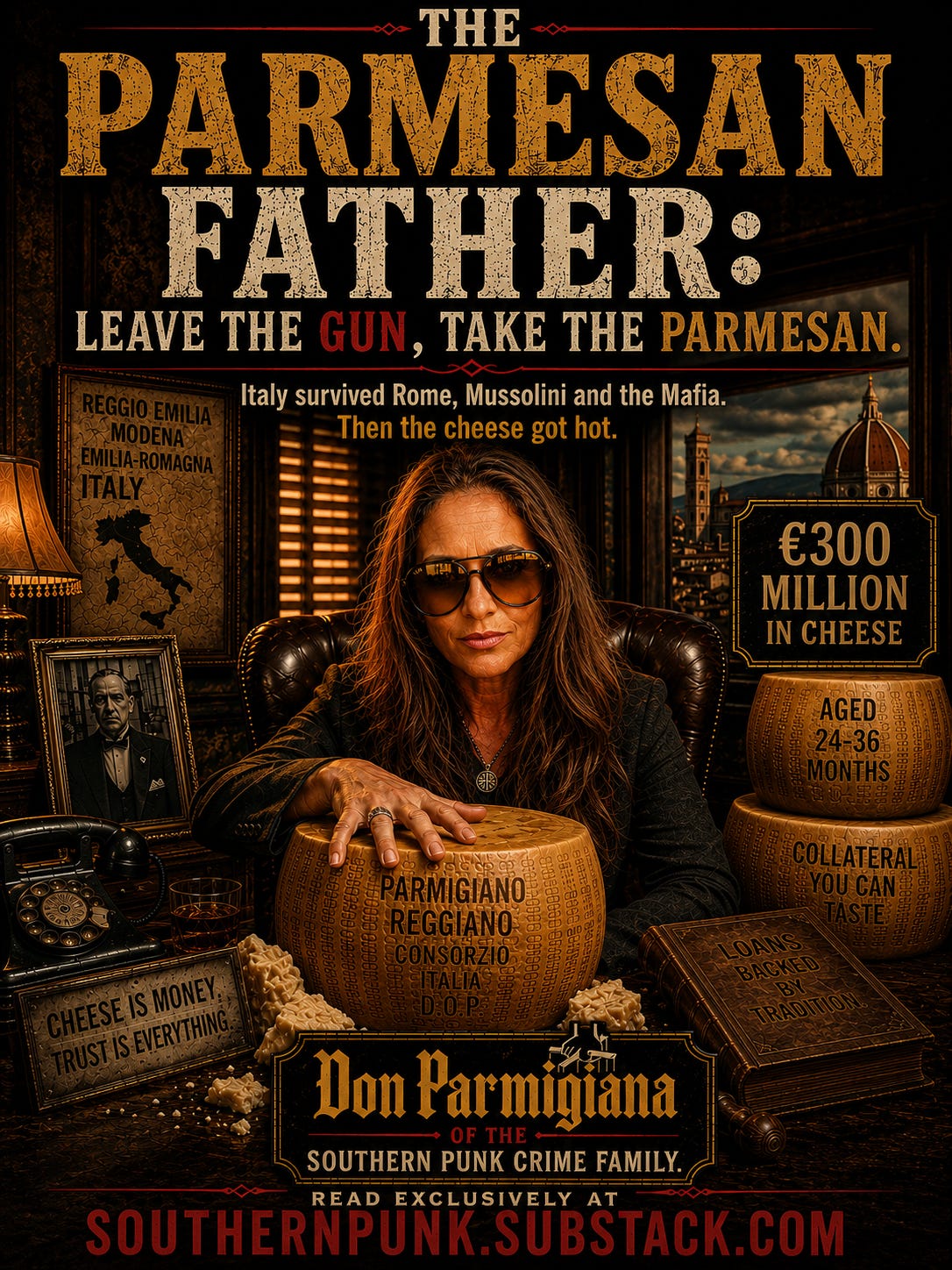
Y’all, I never thought I would be sitting here telling you that the thing that might finally bring Italy to its knees is cheese, but apparently here we are.
And listen, this is Italy we are talking about. These folks have survived the fall of the Roman Empire, invasions, wars, Mussolini, fascism, two World Wars, earthquakes, volcanoes, and the Mafia. I mean I don’t even know how many governments they have gone through over there. So its crazy to we are sitting here in 2026 wondering if Parmesan is going to be what finally gets them.
And no, Italy isn’t about to collapse because somebody forgot to put the Parmesan back in the refrigerator. That’s not what I’m saying, so don’t go telling people Southern Punk said Italy is about to be taken out by a cheese wheel.
Although after what I just spent the last several hours reading, I have questions. Lots of questions.
Because did y’all know Italy has cheese banks?
I did not know this.
And this isn’t some new thing either. Italian farmers have been using wheels of Parmigiano Reggiano as collateral for bank loans since 1953, and y’all, ever since I heard that I haven’t been able to get past the fact that somewhere in Italy there are hundreds of millions of euros worth of Parmesan sitting in warehouses backing actual bank loans.
So let’s talk about the bank that backs the cheese.
It’s called Credito Emiliano, or Credem, and when I first started reading about this I couldn’t understand why a bank would want hundreds of thousands of wheels of Parmesan as collateral, but then I found out how long this stuff has to sit there before anybody can sell it.
Parmigiano Reggiano has to age for at least 12 months, and a lot of it ages for two or three years.
And three years is an awfully long time to have your money sitting there in cheese when you’ve still got a farm to run and bills coming in.
So instead of making the farmers wait until the cheese is ready to sell, Credem lets them borrow against what those wheels are already worth. The farmer gets access to money now, the cheese backs the loan while it ages, and suddenly the whole cheese-bank thing starts making a lot more sense.
And y’all, we are not talking about a small stash of cheese here. Credem has more than 500,000 wheels sitting in two warehouses in Reggio Emilia and Modena worth more than €300 million, and according to Fortune, those warehouses handle around 2.3 million wheels a year.
That’s when the scale of this whole operation came into focus. We are talking about hundreds of millions of euros tied up in Parmesan.
So let’s talk about the four-letter word that has caused all of this...
HEAT.
Italy has been getting absolutely ravaged by heat this summer. Right now they are experiencing their fourth heatwave of the summer. Temperatures have soared above 104 degrees and parts of Emilia-Romagna have hit 109. And at one point, all 27 cities included in Italy’s heat-alert system were under the highest red alert at the same damn time.
That’s the kind of heat where even if you’re naked you still feel like you’re wearing too much. Have you ever been so hot you wished you could unzip your skin for a few hours and just put it back on when the sun goes down?
Ya well that's the kind of hot I'm talking about.
And remember, some of these cheese wheels are going to be sitting in those warehouses for as long as three years. It doesn’t matter if it’s 70 degrees outside or 109, the cheese still needs the same conditions while it ages, and keeping those conditions during this kind of heat takes a whole lot more energy.
Thirty percent more, to be exact. That’s how much Credem says its daily energy use has jumped during the worst of these heatwaves just to keep the warehouses where they need to be.
Thirty percent.
And when you’ve got more than €300 million worth of Parmesan sitting in there, turning the thermostat up and hoping for the best isn’t exactly an option.
But the heat isn’t just causing problems once the cheese gets into the warehouse.
Oh no you have to make the cheese first.
And for that, you need milk.
Which brings us to the cows. And a hot cow is a lazy cow.
Now I say lazy, but they’re really not. They’re just trying to keep cool. Once it gets above 104 degrees, these cows start spending more of their time lying down because they’re overheated and trying to conserve energy, and while they’re lying there they aren’t eating as much. And that matters because the less they eat, the less milk they produce. In this kind of heat, their milk production can drop by as much as 10%.
And my first thought was well couldn’t they just get milk from somewhere else?
Nope.
Parmigiano Reggiano can only be made in five provinces, mostly in Emilia-Romagna, and there are rules about what those cows eat too. Most of their forage has to come from the production area, meaning the grass and hay they’re feeding these cows has to come from right there too.
And that's where we run into another problem because if the cows have to eat grass and hay grown there, somebody has to be able to grow the grass.
So now we need rain.
I did not expect rain to enter my cheese-bank story, but here we are.
So why do we need rain? Because if it doesn’t rain enough, they don’t get the grass they need to make the hay they need to feed the cows. And remember what I said about them eating less? The less they eat, the less milk they produce to make the cheese. Cheese that has to sit in a climate-controlled warehouse for up to three years because somebody borrowed money against it.
And at this point I thought surely that has to be the end of it. We’ve got the heat screwing with the cheese in the warehouse, the cows that make the milk and now even the grass those cows eat.
But oh no… apparently the grapes are having problems too.
And problems with grapes means problems with wine.
So what's the problem? The same one that's affecting the cheese…. HEAT.
Now I don’t know if you know this, but heat pushes the sugar content in grapes along faster, but it doesn’t do the same thing to the flavor. So what you end up with is a grape basically raising its hand saying, “I’m ready,” when really it’s still developing.
Now I don’t know if you know this, but heat pushes the sugar content in grapes along faster, but it doesn’t do the same thing to the flavor. So what you end up with is a grape basically raising its hand saying, “I’m ready,” when really it’s still developing.
And that’s a problem because the winemaker can’t just look at the sugar and say okay, we’re good to go. If they leave the grapes hanging there waiting for the flavor to catch up, the sugar keeps climbing, which can mean more alcohol once that sugar ferments. But if they pick them because the sugar says it’s time, they can end up picking before the grapes have developed the flavor and balance they’re looking for.
So now they’re having to make a choice they didn’t used to have to make quite this early: do you pick because the sugar says the grape is ready, or do you wait because the rest of the grape is telling you it isn’t?
The desperation this is creating is like nothing I have ever seen. Some of these vineyards are so desperate to slow the grapes down and give the flavor time to catch up that they are literally putting shade netting over them to try to protect them from the heat.
And then I got to the olive oil and I thought oh come on, not the olive oil too. You have got to be kidding me.
Now I don’t know if you know this, but Italy is one of the world’s major olive oil producers, and two of the areas in southern Italy where a huge amount of those olives are grown have been getting crucified by drought. And when I say crucified, I mean there have been years where one of those regions, Puglia, which is basically the heel of Italy’s boot, lost more than HALF of its olive oil production in one season.
Half the olive oil.
And y’all, these aren’t just foods Italy happens to be known for. This is a huge part of what Italy produces and sells to the rest of the world.
Parmigiano Reggiano alone is around a €4.5 billion-a-year industry, more than half of what they make gets exported, and the United States buys more of it than any other foreign country.
That’s right... us.
We’re eating the cheese.
But here is where this story really started bothering me because look at what we are doing. The farmers are having to spend more money trying to keep their cows comfortable enough to produce milk, and once that milk becomes cheese, the warehouses are burning through more energy trying to protect it from the same heat. Then you get over to the vineyards and they’re literally putting shade over the grapes trying to keep the sun from screwing with those too.
And while we’re doing all of that, there is an entirely different food industry being built around figuring out how to make some of the same things without depending on the cow or sometimes even the farm.
Bill Gates has spent years putting money behind alternatives to traditional meat and dairy, and one of the companies he’s invested in, Savor, is now making fat without animals or plants. They take carbon dioxide from the air and hydrogen from water and use them to make the same kinds of fat molecules we normally get from things like milk, cheese, beef and vegetable oils.
Read that part again because we’re talking about making fat without the cow, the olive tree or even the farm being involved.
And maybe that technology turns out to be incredible. I don’t know. But I know this: I don’t trust someone who has enough money to never have to worry about whether they can afford real food telling the rest of us what the future of food should look like.
Which brings me to a question I keep coming back to.
Why are we spending millions of dollars trying to figure out how to make the components of cheese without the cow?
Think about that for a second. People in Italy have been making Parmigiano Reggiano with actual cows for more than 800 years, and now they’re having to spend more and more money just trying to keep those cows cool enough to keep doing what they’ve always done.
And I don’t what you think but to me the whole thing feels like an oxymoron.
I mean how did we get to the point where making cheese without the cow started looking like the answer?
And why are we so willing to accept these conditions?
In my opinion, I think that’s the part we need to be paying attention to.
Not because new food technology is automatically bad. Or because somebody is secretly plotting to take away our Parmesan.
But because we are being pushed into choices our great-grandparents never in a million years would have imagined they would have to make.
My great-grandparents came from Italy, and the Parmesan they knew didn’t need to be reinvented. You needed cows producing the milk, grass and hay to feed them, enough rain to grow it, some salt and a whole lot of time.
Now only a few generations later we’re misting cows through temperatures above 104 degrees, putting shade over grapes and spending 30% more energy during the worst of a heatwave just to protect hundreds of millions of euros worth of cheese.
I know technology can do incredible things, and maybe one day we will need some of this stuff. Maybe we’ll even be grateful somebody figured it out. But forgive me if I’m a little skeptical when the people helping shape the future of food have enough money that they’ll never have to worry about whether they can afford the real thing. That’s a choice most of us don’t have the luxury of ignoring.
And again, I'm not against the research. I think as a civilization we should learn everything we can. We should keep inventing things nobody has thought of yet. But don't lose the plot.
Because as my Grandma use to say… not everything that glitters is gold.
Oh, and one more thing before I let y’all go.
Reuters talked to Paolo Ganzerli about what all this heat could mean for Parmigiano Reggiano. And in case you're wondering who that is. He is the international sales director for GranTerre, one of Italy’s major food groups.
He said:
“We don't want to be the last generation to eat it.”
And after everything I just told y’all, that’s a pretty sobering thought.
Because 800 years of tradition shouldn’t end with us figuring out how to live without it.
I want to explain something because I don’t think most people realize how Southern Punk actually stays alive.
I can spend six, eight, sometimes ten hours researching one story. Then I sit down and write it, make the video, edit everything that goes with it and put that work across Facebook, TikTok, Instagram and YouTube.
And here’s the part most people don’t know.
Facebook is the ONLY one of those platforms paying me for the views on my videos right now, and that only just started.
TikTok can give one of my videos thousands of views and I make nothing from those views. Same thing on Instagram. Same thing on YouTube. People can watch Southern Punk all day long on those platforms, but unless somebody chooses to subscribe or directly support the Porch, none of those views pay for the hours it took to create what they just watched.
That’s why I talk about subscriptions.
Not because I enjoy asking y’all for money. Trust me, I would much rather sit here talking about hot Italian cows and banks full of Parmesan.
I talk about it because this is my job now, and if we want Southern Punk to remain independent and keep doing the kind of work you just read, the money to do it has to come from somewhere.
And I would much rather it come from y’all than from some corporation deciding what I can and cannot say.
When you become a paid subscriber, you’re not just unlocking a write-up. You’re giving me the time to research the next one. You’re helping pay for the hours nobody sees before a video ever lands on your screen. You’re helping Southern Punk stay independent, and you become part of our Porch Council with a voice in what we investigate next.
And I’m adding something new for y’all too.
I’m going to start doing Southern Punk Uncensored videos exclusively for my paid subscribers. These will be the ones where I don’t have to worry about making everything fit what Facebook, TikTok or Instagram will allow me to say. If I’ve got something to say and the regular platforms would make me water it down, the uncensored version is coming to the Porch.
And all of that costs less than 34 cents a day.
I know ten dollars a month can sound like another subscription, especially when it feels like everything wants a piece of our paycheck these days.
But broken down, we’re talking about less than 34 cents a day to help keep this Porch independent, support the work you’re already reading and watching, be part of the Porch Council, and now get Southern Punk Uncensored too.
And if you’ve been reading these write-ups and watching these videos week after week and thinking, I really should support them one of these days, I’m asking you to make today that day if you can.
Because this only works if some of the people enjoying what we make decide it’s worth helping us keep making it.
If a paid subscription isn’t for you, you can always help keep the Porch light on directly over at BMAC.
https://buymeacoffee.com/southernpunk
And if money is genuinely tight right now, share us. Send the write-up to somebody. Put one of our videos in front of someone who has never heard of Southern Punk.
But if you can afford to support the Porch, please don’t assume somebody else will do it.
Southern Punk doesn’t have a corporation paying the bills behind the scenes.
We have y’all.
And every time you subscribe, share or help keep the Porch light on, you’re making sure there’s still a chair sitting here tomorrow. ❤️🪑
This IS the People’s Porch.
The Porch is where we gather...
The RESISTANCE is what we’ve become. 🥊
I’ll be honest...
I thought I was researching a funny story about an Italian bank with hundreds of millions of euros worth of Parmesan sitting in a warehouse.
And technically, I was.
But then the cheese got hot.
And once I started following that part of the story, suddenly I was reading about cows being sprayed with water, warehouses using more energy, grass and hay, drought, wine grapes ripening too fast, olive groves getting hammered in southern Italy and people trying to make fat without animals or plants at all.
That is how we ended up here.
And because there are a LOT of numbers in this one, I want y’all to be able to see exactly where they came from.
Read the reporting.
Check the receipts.
Then make up your own mind.
Parmigiano Reggiano, the Cheese Banks & the Heat
Toronto Sun l Summer heat threatens Italy’s billion-dollar cheese economy
Reuters | Extreme Heat Threatens Italy's Parmesan Heartland
Euro News l Extreme heat strains Italy's 'cheese banks,' where Parmigiano backs farm loans
What the Parmigiano Reggiano Cows Are Allowed to Eat
Parmigiano Reggiano Consortium | Production Specifications
Traversetolese l Feeding Dairy Cattle for Parmigiano Reggiano: Quality and Sustainability
The Wine & What Extreme Heat Is Doing to the Grapes
Associated Press | Extreme Heat Is Reshaping Italy's Sparkling Wine Industry With Early Harvests and Nighttime Picking
Associated Press | Photos Show Italian Winemakers Harvesting Grapes Earlier Due to Extreme Heat
The Olive Oil & Drought in Puglia
Euronews | Bad News for Gourmets: Italian Olive Oil Production Suffers From Extreme Heat and Drought
Coldiretti Puglia | OLIVE OIL: OLIVE HARVEST BEGINS IN PUGLIA WITH PRODUCTION PEAK (-40%) DUE TO DROUGHT AND RECORD HEAT
📍Note: This site is in Italian but there is a link to click to translate it into English
Bill Gates, Savor & Making Fat Without Animals or Plants
Gates Notes l Greasy—and good for the planet
ESGDIVE l Bill Gates-backed startup launches sustainable butter made from carbon
Chemistry World l How is carbon dioxide being turned into food in the lab?
Green Queen l This Act Targets Savor’s ‘Lab-Created’ Butter – Here is the Bill Gates-Backed Startup’s Response
Read the reporting.
Read the production rules.
Follow the cheese.
Then make up your own mind.
— Southern Punk
No posts
Comments
Nothing yet. Say the first thing.
Sign in to join the conversation.