
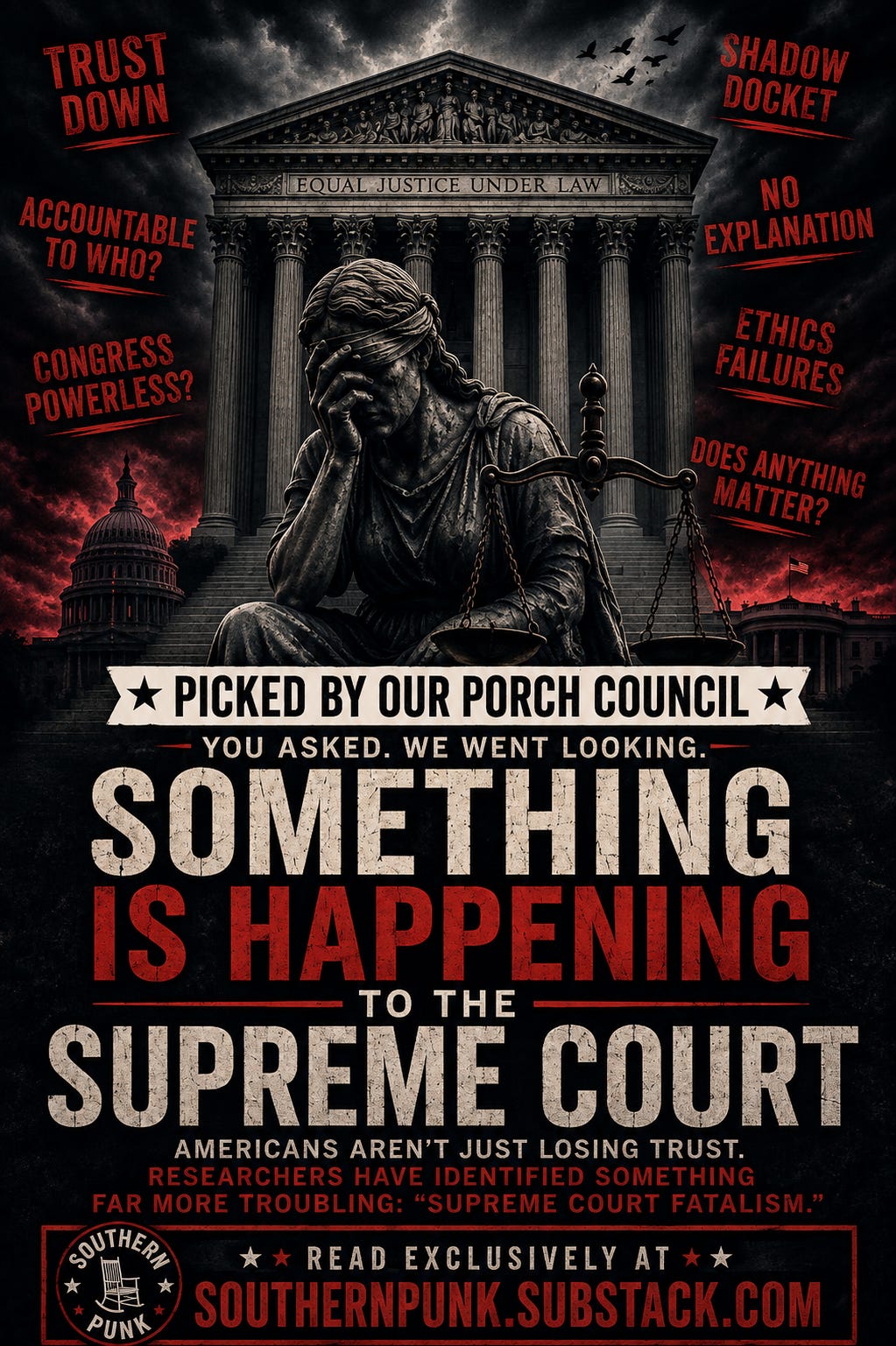
You ever hear a word and just the sound of it tells you it doesn’t mean something good. Like the word fatalism. Because when I found out that word has been tied to the Supreme Court as of late, my first thought was, well that can’t be good.
And I was right. It’s called Supreme Court fatalism, which was something I had never even heard of before I started looking into the question y’all chose for the Porch Council this week. But once I found out what it meant, I immediately was brought back to the comments under the vote. And I mean some of y’all must be clairvoyant because you were basically describing it without knowing there was a name for it.
And boy oh boy, did y’all have questions. I mean, some of y’all wanted to know who the hell actually holds the Supreme Court accountable, which is a pretty fair question when you think about it because who does? Then somebody asked what happens if Congress doesn’t do anything, and another one of you wanted to know where the Justice Department fits into all of this. And the more comments I read, the more I kept seeing the same worry underneath them. What happens if the Supreme Court does something it shouldn’t do and nobody stops them?
And I’m reading all of this thinking, wait a minute. Y’all were already talking about it. Because part of this fatalism thing is believing it doesn’t really matter what Congress does anyway. The Supreme Court is going to win.
The whole reason I put Option B in front of y’all was because Gallup had posted that the Supreme Court’s approval was sitting at a mere 33 percent, which is the lowest they’ve measured in 26 years. I saw 33 percent and thought, Jesus Christ, I guess nobody really does trust the Supreme Court anymore.
Except 33 percent isn’t trust is it?
It’s actual approval.
And I will be honest, I hadn’t really separated those two things when I put the question on the ballot. Because they’re not necessarily the same thing, are they? I mean, someone can be pissed as hell about what the Supreme Court is doing and still think we need one.
And Lord knows getting pissed at the Supreme Court isn’t anything new. Hell, people have been getting mad at their decisions forever, even knowing those decisions can stick around for generations. So then what the hell is different now? Because if being pissed off at the Court was enough to make people stop believing in it, we would’ve and should’ve been in trouble a long damn time ago.
So now I’m sitting here thinking, okay, if people have always gotten pissed at the Supreme Court, when the hell did pissed off turn into I don’t trust these folks anymore?
When did we get there? If you’re like me you probably think it was with Dobbs. I mean, they overturned Roe v. Wade after damn near fifty years, so that made sense to me.
Except that wasn’t it. The numbers were already changing long before Dobbs ever even happened.
And I will tell you, when I went back through the numbers, that sh*t started getting real. I mean, did you know that from 2012 through 2016, Democrats and Republicans really weren’t that divided when it came to believing in the Court itself? But get this. By 2020, something had damn sure changed. Because by then, Democrats had gotten a whole lot more skeptical of the Court.
So what the hell happened in those four years? Well, Scalia died for one. And if you’ll recall, Obama did nominate Merrick Garland. But his nomination went nowhere fast because Mitch McConnell piped up saying he wouldn’t give Garland a hearing because there was an election coming up. His reasoning? He said voters should have a say in who filled that seat. Which, with all the drama surrounding McConnell right now, I find very interesting.
And of course Trump ended up winning, which meant Neil Gorsuch got the seat Garland never even got a hearing for. Then Anthony Kennedy retired, and Lord knows we all remember the sh*tshow that was Brett Kavanaugh’s confirmation.
But then we lost RBG in September of 2020, and that is where things got interesting again. Because remember McConnell’s whole thing about letting the voters have a say when an election was coming up? Well, Mitch must have had memory loss because now we were even closer to an election, so by his own damn logic they should have waited.
But that’s not what happened.
Apparently that logic didn’t apply anymore, because Republicans went ahead and confirmed Amy Coney Barrett anyway.
Now listen, I’m not saying the Senate didn’t have the constitutional power to do that. Because they absolutely did. What I’m saying is people have eyes. They literally watched one Supreme Court seat sit empty because Republicans said an election was too close, and then four years later watched Republicans fill another one when the election was even closer.
And while all of this was going on, Trump had also made the Supreme Court part of his campaign pitch. And listen, presidents have always cared about who they get to put on the Court. I am not going to pretend that’s not true, but I don’t remember ever seeing anything quite like this. I mean, the man was handing voters lists of the people he might appoint and telling them exactly what kind of judges they were going to get, especially when it came to abortion. By the time his first term was over, three of the nine people sitting on the Supreme Court were there because Donald Trump put them there.
And a couple of y’all asked whether these justices are basically Republicans and Democrats, and no, not really. I mean, they aren’t sitting up there with an R or a D beside their names like somebody in Congress. But come on. Presidents aren’t closing their eyes, spinning around three times and pointing at somebody when they pick a Supreme Court nominee either. They damn sure know who they’re choosing and how that person looks at the law.
And then Dobbs actually happened, and those numbers got even worse. The divide grew after the Court overturned Roe, which wasn’t exactly shocking. What WAS surprising was what happened afterward. Because two years later, that divide was still sitting there. People hadn’t just gotten pissed off, cussed at the television for a while and moved on. Something had stuck.
Y’all had also been talking about precedent in the comments, and I remember reading those and thinking, maybe that’s it. Maybe people are watching these old decisions disappear and wondering what is going on over there?
I mean, come on. We watched them overturn Roe, then Chevron went too, and now we’ve got other old precedents being challenged, so in my head I’m thinking these people must be tossing precedent out the damn window compared to every Court that came before them.
Nope. Apparently I had that one wrong too. Because get this. The Roberts Court actually overturns precedent LESS often per year than the Burger and Rehnquist Courts did.
I know. That wasn’t what I was expecting to find either.
Now, there is a catch. The Roberts Court hears fewer cases than the Burger and Rehnquist Courts did, so obviously they have fewer chances to overturn anything in the first place. And Lord knows when they DO overturn something, they aren’t exactly picking little cases nobody remembers. Roe had been standing for damn near fifty years. Chevron made it forty.
But still.
I went looking because I fully expected to come back here and tell y’all this Court was overturning precedent at some rate we’d never seen before.
I can’t.
Because that’s not what I found.
So I’m not going to tell you that.
And then this thing called the shadow docket showed up, which first of all, who the hell named this thing?
Because it sounds like some secret court that meets underneath the Capitol at midnight, and that’s not what it is. It’s basically how the Supreme Court handles things that need an answer before a case has gone through the whole normal process.
Which honestly sounded harmless enough to me until I started looking at what they’re using it for now, because some pretty damn important decisions are coming through there. And get this. The second Trump administration filed 19 emergency requests with the Supreme Court in its first five months.
Nineteen.
Biden filed that many in his entire four years.
I mean, good Lord. That’s not a small difference.
And we’re not talking about little tiny procedural questions either. Some of these decisions can affect what actually happens while the case is still working its way through the courts.
And sometimes they barely explain why they did it.
I mean, if people are already looking at the Supreme Court wondering whether politics has gotten mixed up in all of this, how in the hell is saying less supposed to make anybody trust them more?
And we haven’t even talked about the ethics mess yet.
Most of y’all probably know at least some of this already. Clarence Thomas took luxury trips from billionaire Harlan Crow that weren’t disclosed at the time. Crow bought the house where Thomas’s mother lived and paid private-school tuition for a relative Thomas was raising. And then there’s Samuel Alito, who took a private-jet trip to Alaska from a billionaire and didn’t disclose that at the time either.
Now, a few of y’all went straight to bought and paid for in the comments.
And listen, I did look because if I’m going to repeat something like that I better damn well be able to back it up. I couldn’t. There’s plenty about all of this that makes me uncomfortable, but I couldn’t find proof that somebody bought a Supreme Court vote, and I’m not gonna tell y’all I found something I didn’t.
What I did find was that the Supreme Court didn’t even have a written code of conduct until 2023, which surprised the hell out of me because I just assumed they did. So then I’m thinking, okay, now that they have one, what happens if one of them violates it?
Well, apparently there isn’t some outside group that comes in and enforces the damn thing. The justices are largely responsible for policing themselves, and I’m sitting here thinking, wait a minute, if they’re basically responsible for holding themselves accountable, then who the hell do they actually answer to?
You know one of the first political questions I ever asked my wife was who do you think the most powerful person or people are in the United States?
Naturally she said the President.
And to a point she was right, but then I said nope, you’re wrong. The nine most powerful people in America sit on the Supreme Court. Because think about it, they are there for life. They don’t have terms like the President does. We don’t get to go back every four years and decide whether we want to keep them around. Once they’re sitting on that Court, they can be there for decades.
And I have believed that for years.
So who actually does hold them accountable?
Turns out Congress does have a few chess moves up their sleeves. They can impeach a justice, although good luck getting through that whole mess. And obviously the Senate gets a say before anybody ever puts on the robe because they’re the ones who confirm them. But here’s something I didn’t know. Congress has actually changed the number of seats on the Supreme Court before. I always thought nine was just... nine. Apparently not. And yes, technically we could amend the Constitution after the Supreme Court has spoken too, but good Lord, have y’all ever looked at what it takes to amend the Constitution? We aren’t exactly knocking that stuff out before lunch.
Once I started getting into exactly how much control Congress has over the federal courts, I could feel another constitutional rabbit hole opening up and no ma’am. Not this week.
Now somebody did ask me where the Justice Department comes into all of this, and the answer is it really doesn’t in the way I think they were asking. The DOJ doesn’t oversee the Supreme Court.
So okay, the Supreme Court isn’t untouchable. I had that part wrong. But good Lord, look at what it takes to actually do anything about it. I mean Congress can technically have the power to do all kinds of stuff, but what happens when they just... don’t?
And hell, maybe that’s how you end up with people feeling like none of it matters anyway. Because technically somebody can do something, but if you don’t believe anybody ever will, what difference does that make to you?
I still wasn’t convinced this wasn’t mostly Democrats being pissed off because they’re the ones losing at the Supreme Court right now. I mean, it’s a six-three conservative Court and Democrats have watched some enormous decisions go against them, so that would’ve made perfect sense.
Now don’t get me wrong, Democrats ARE a whole lot more pessimistic about the Supreme Court than Republicans right now, which surprised absolutely nobody, including me. But then I got to this other part and went, wait a damn minute. Because there were these questions about whether the Supreme Court is basically always going to beat the other branches and whether Congress even matters if the other party controls the Court. And y’all, Republicans and Democrats answered those a whole lot more alike than I expected them to.
That I did not see coming.
Because apparently you don’t even have to be on the losing side of the Court right now to look at the whole thing and wonder if maybe it’s gotten too powerful. And people who feel that way have a whole lot less faith in the Court itself.
So does anybody trust the Supreme Court anymore?
Yeah, people do. And some of these numbers are absolutely political because come on, everybody likes the Supreme Court a whole lot better when they’re getting what they want out of it, no matter which side they’re on.
But that 33 percent means something different to me now than it did when I put this question in front of y’all.
Because I thought we were talking about people being pissed off at the Supreme Court.
We weren’t.
Or at least that wasn’t all we were talking about.
What y’all were asking in those comments was what happens when people start believing nobody can do anything about the Court anymore.
And no, we’re not powerless. Congress can do some things, and elections damn sure matter when the people we elect are the ones deciding who ever gets that robe in the first place.
But what the hell happens when people don’t believe any of that matters?
Because that’s what I keep coming back to. What happens when somebody looks at the Supreme Court, thinks they’ve gone too far, and honestly doesn’t believe there’s a damn thing anybody is going to do about it?
And if you start believing the answer is basically nothing, I can understand how eventually you end up wondering why any of it matters.
Apparently there’s a name for that.
And it's callee Supreme Court fatalism.
I told y’all that word didn’t mean anything good.
The Porch rests
Before you go, this write-up is probably one of the best examples yet of why we started the Porch Council. I didn't pick this story. Y'all did. Two Sunday's back, our paid subscribers chose Option B: Does Anybody Trust the Supreme Court Anymore?
But y'all didn't just vote. You started asking questions. Questions like. Who holds the Supreme Court accountable? What happens if Congress doesn't act? Where does the Justice Department fit into all of this? What about precedent? And without even knowing it, some of y'all were basically describing something researchers already had a name for: Supreme Court fatalism. Hell, I didn't even know that was a thing when we started.
That's what I love about the Porch Council. Paid subscribers aren't just supporting the work. They're helping decide where we go looking in the first place. And this week y'all sent me somewhere I absolutely wasn't expecting to go.
More than once I thought I knew what I was going to find. I thought Dobbs was where the trust problem started. It wasn't. I thought this Court must be overturning precedent at some unheard-of rate. It isn't. And when some of y'all wondered whether Supreme Court votes were being bought, I looked for that too. I couldn't prove it, so I didn't tell you I could.
That's how these write-ups happen. I don't know what I'm going to find when I start looking, and I don't want to know. Because if I already know what the answer is supposed to be before I start researching, then what the hell are we doing?
Underneath this write-up you'll find the receipts. Read them. Don't believe something because I said it. Look at the research and decide what YOU think.
Because doing this the way I do it takes time. Sometimes a lot of it. And here's the part most people probably don't realize. Facebook is the ONLY one of those platforms paying me for video views right now, and that only recently started.
TikTok can give one of my videos thousands of views and I make nothing from those views. Same thing on Instagram. Same thing on YouTube. So you can watch Southern Punk all day long on those platforms, but unless somebody chooses to subscribe or directly support the Porch, those views don't pay for the hours I spend sitting here wondering why the hell Republicans and Democrats suddenly aren't that far apart when you ask whether the Supreme Court has become too powerful.
That's why subscriptions matter so much around here.
If you subscribe to Southern Punk on Substack, you're supporting the writing and all the digging that goes into it.
If you subscribe on Facebook or Instagram, you're supporting the videos.
And if you're a paid subscriber on Substack, Instagram or Facebook you get a seat on the Porch Council. You get a vote. You get to tell me what question you want investigated next. And as this week's write-up proved, your comments can end up changing what I go looking for after the vote is over too.
That's not some little subscriber perk I slapped onto the bottom of a list. The Porch Council picked the story you just read.
Southern Punk is my job now, and subscriptions are what give me the time to keep doing it this way. Independent. No corporation sitting behind me deciding what I can talk about. Nobody telling me a rabbit hole isn't worth following because it won't generate enough clicks. Just a Porch full of people asking questions and me having enough time to go find out what the hell the answers actually are.
And paid subscribers also get Southern Punk Uncensored, which means I can finally stop wondering what Facebook is going to flag or what perfectly normal word TikTok has decided it hates today. Not there. I'm taking the filter off. No watering something down because one of the platforms might throw a fit. I'm going to say what I actually want to say.
And all of that is less than 34 cents a day.
If you've been here for a while and you've thought about becoming a paid subscriber, and you're able to do it, I'd love to have you. Really. Pull up a chair and take your seat on the Porch Council.
And if a paid subscription isn't something you can do right now, please don't feel bad about that.
Share this write-up.
Especially this one. Because I have a feeling there are a whole lot of people out there who have never heard the words Supreme Court fatalism either.
Send it to somebody. Tell somebody about the Porch. That helps more than you probably realize.
And if you feel led to help keep the Porch light on directly, you can do that through BMAC:
https://buymeacoffee.com/southernpunk
However you support this place, thank you. Because this week's write-up wasn't just written for the Porch. It happened because of the Porch. Y'all picked the question. Then you started asking better ones. And somewhere in those questions was something none of us even knew had a name when we started.
That's exactly what I hoped the Porch Council would become.
This IS the People's Porch.
The Porch is where we gather...
The RESISTANCE is what we've become. 🥊
So come join us on the Porch and let's “Leave the Noise in the Street Tonight!”
When the Porch chose Option B, I thought I already knew what I was looking for.
The Supreme Court’s approval was sitting at 33 percent, so the question seemed pretty straightforward.
Does anybody trust the Supreme Court anymore?
Well, y’all know how that went.
Because almost immediately I learned that approval and trust aren’t even the same damn thing. And once I started reading the comments y’all left under the Porch Council vote, the question got even bigger.
Who holds the Supreme Court accountable?
What happens if Congress doesn’t act?
Does the Justice Department have any authority over them?
Are the justices basically Republicans and Democrats with robes on?
What about precedent?
And what the hell happens when people start believing there’s nothing anybody can do about the Court anyway?
That last question is what eventually led me to a term I had never even heard before this week.
Supreme Court fatalism.
From there I just followed the research wherever it went.
And some of it went exactly where I expected.
Some of it absolutely did not.
I went looking fully expecting to find that the Roberts Court was overturning precedent at some unheard-of rate. That’s not what I found, so that’s not what I told y’all.
I looked into the claims that Supreme Court justices were being bought and paid for. I found plenty of documented ethics questions. What I did not find was evidence that somebody purchased a Supreme Court vote, so I didn’t tell y’all that either.
That’s the whole point of doing this.
The research isn’t here to prove whatever I thought before I started.
It’s here to tell me when I’m wrong too.
And as always, I don’t want anybody taking my word for any of it.
Where Americans Stand on the Supreme Court
Pew Research Center | Favorable Views of Supreme Court Remain Near Historic Low
Gallup | Supreme Court Job Approval Slumps to Record Low
Gallup | Supreme Court — Historical Trends
Approval, Trust & Legitimacy
Science Advances | Has the Supreme Court Become Just Another Political Branch? Public Perceptions of Court Approval and Legitimacy in a Post-Dobbs World
National Library of Medicine | Has the Supreme Court Become Just Another Political Branch?
State Court Report | Judging Democracy: A Former Justice Reflects on Bush v. Gore 25 Years Later
Journal of Race, Gender, and Ethnicity | Sounding the Legitimacy Alarm Bell: When Does the Media Discuss the U.S. Supreme Court’s Legitimacy?
Where the Supreme Court Got Its Power
Justia | Marbury v. Madison, 5 U.S. 137 (1803)
Cornell Legal Information Institute | Marbury v. Madison and Judicial Review
National Constitution Center | Marbury v. Madison and the Independent Supreme Court
Who Can Check the Supreme Court?
Congress.gov Constitution Annotated | Separation of Powers Under the Constitution
Cooley Law School | The Constitutional Powers of the Supreme and Inferior Courts
American Constitution Society | Congress Needs to Check the Court
Are Supreme Court Justices Basically Partisans in Robes?
Empirical SCOTUS | Are the Justices Still Party Players?
SCOTUSblog | Who Is the Supreme Court’s Most “Ideological” Justice? And Does That Question Even Make Sense?
Harvard Law School | Evaluating Supreme Court’s 2025–26 Term: “A Conservative Court That Has Also Checked the Trump Administration”
Precedent & the Roberts Court
SCOTUSblog | Overturning Precedent on the Roberts Court
The Shadow Docket
Brennan Center for Justice | The Supreme Court “Shadow Docket” Explained
Alliance for Justice | The Supreme Court’s Shadow Docket Foreshadows Its Future Harmful Rulings
Ballotpedia | Supreme Court Interim Orders Involving the Trump Administration, 2025–2026
Missouri Independent | How Did Trump Do in the Most Recent U.S. Supreme Court Term?
Brennan Center for Justice | Supreme Court Abuse of the Shadow Docket Under Trump
Ethics, Gifts & the Supreme Court’s Code of Conduct
ProPublica | The Supreme Court Has Adopted a Conduct Code, but Who Will Enforce It?
Brennan Center for Justice | What Gifts Must Supreme Court Justices Disclose?
Forbes | Supreme Court Ethics Controversies: All the Scandals That Led Biden to Endorse Code of Conduct
The Bigger Legitimacy Problem
Harvard Law Review | The Supreme Court’s Legitimacy Dilemma
Brennan Center for Justice | A Legitimacy Crisis of the Supreme Court’s Own Making
Governing | Anatomy of the Supreme Court as an Institution in Crisis
Alliance for Justice | How the Supreme Court Is Destroying Its Own Legitimacy
What Could Change?
The Washington Post | Angry at the Supreme Court, Liberals Push a Slew of Plans for Overhauling It
Brennan Center for Justice | Supreme Court Term Limits
SCOTUSblog | The Supreme Court’s Quiet Coup
And Finally... Supreme Court Fatalism
American Journal of Political Science | Partisan Sorting, Fatalism, and Supreme Court Legitimacy
Brennan Center for Justice | Dissatisfaction With the Supreme Court Spans the Political Spectrum
Judicature | The Withering of Public Confidence in the Courts
So start with the research.
Read what supports the argument.
Read what complicates it.
And especially read the stuff that tells us something we weren’t expecting to hear.
Because that’s the whole reason we turn the lights on around here.
The Porch Council handed me a question:
Does anybody trust the Supreme Court anymore?
I went looking for an answer.
And somewhere along the way, I realized trust wasn’t even the only thing we needed to be asking about.
Pull up a chair.
Read the receipts.
Then tell me what you think is happening to the Supreme Court.
— Southern Punk
No posts
Comments
Nothing yet. Say the first thing.
Sign in to join the conversation.