
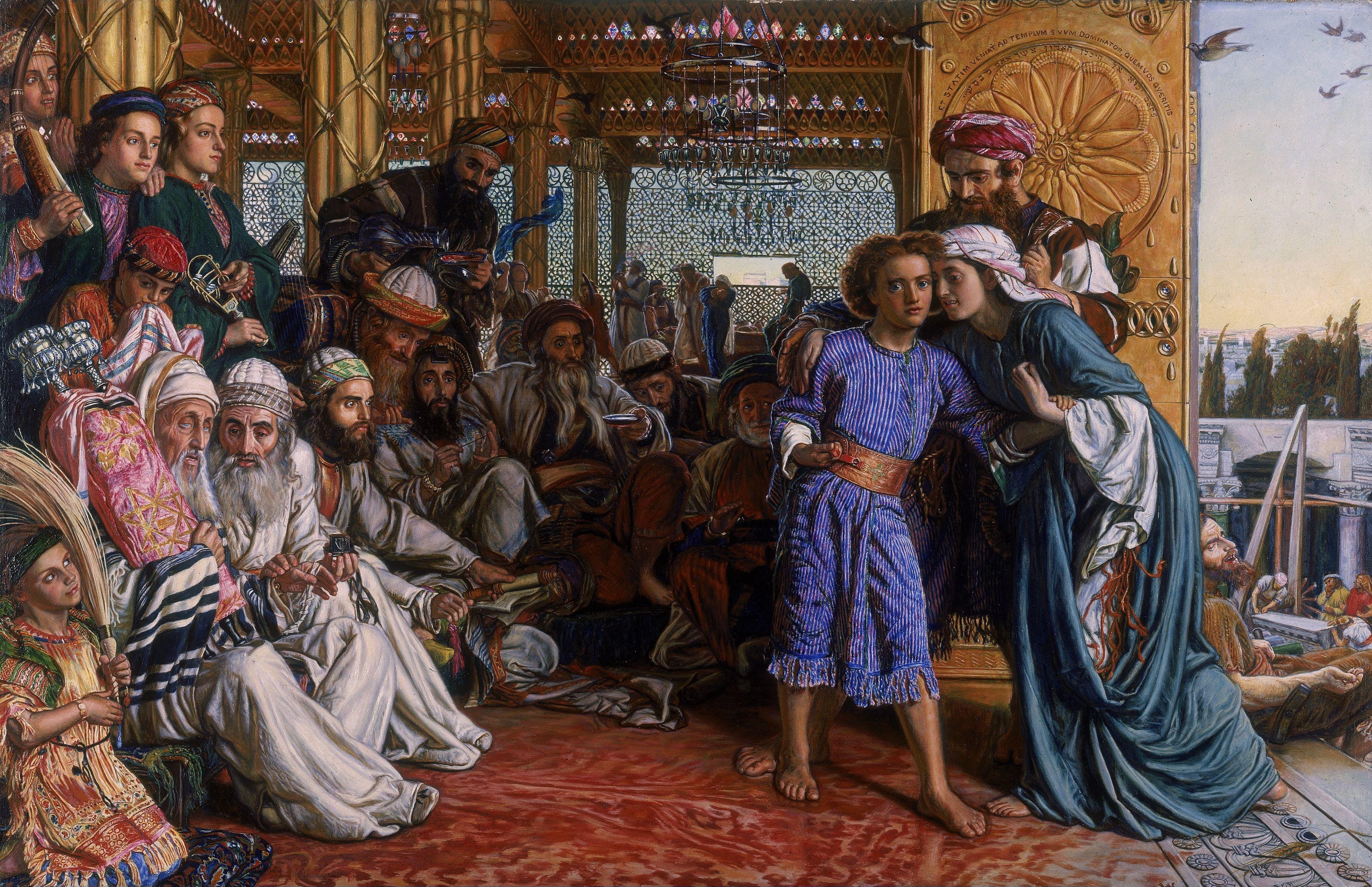
(Image: The Finding of the Saviour in the Temple, by William Holman Hunt)
There was a time in the South when a perfectly ordinary question asked of a child was, “Who’s your daddy?”
Nobody needed the question explained.
It was not simply a request for biological information. The person asking was trying to place you. Who are your people? Which family do you belong to? Where do you come from?
A boy might answer, “Donald Moore,” and that could be enough. The older man asking the question might nod and say, “Oh, yes. I knew your granddaddy.” Perhaps he knew where the family lived. He might know what church they attended, who the boy’s uncles were, or some story about his grandfather from forty years earlier.
The question assumed something that has become increasingly foreign to modern Western life:
A man does not come from nowhere.
He belongs to people.
For much of human history, names themselves answered the question.
Among the Scots, a man might be identified as mac someone—son of someone. In Wales, ap performed much the same function. Hebrew used ben and Aramaic bar. Icelanders preserve the patronymic system even today with -son and -dóttir.
Thus the same basic relationship can be expressed in several languages:
Thomas mac Ronald.
Thomas ap Ronald.
Thomas ben Ronald.
Thomas Ronaldsson.
Different languages. Different peoples. The same idea:
Thomas, Ronald’s son.
Our ordinary surnames still preserve the remains of this ancient way of identifying ourselves. Johnson was once John’s son. Richardson was Richard’s son. MacDonald identified the son of Donald. Names that eventually became permanent family surnames began as answers to a very simple question:
Whose boy are you?
The older world understood identity relationally. You were not simply an isolated individual who happened to have appeared upon the earth. You came from somewhere. You belonged to someone.
Identity was received before it was invented.
Scripture speaks this way almost instinctively.
Joshua is Joshua the son of Nun.
David is the son of Jesse.
James and John are the sons of Zebedee.
Simon Peter is called Bar-Jonah—son of Jonah.
Bartimaeus bears the same construction in his name: bar-Timaeus, son of Timaeus.
One of the clearest examples comes from the story of David and Goliath.
After David goes out against the Philistine, Saul asks Abner:
“Whose son is this youth?”
— 1 Samuel 17:55
After David returns, Saul asks him directly:
“Whose son art thou, thou young man?”
David answers:
“I am the son of thy servant Jesse the Bethlehemite.”
— 1 Samuel 17:58
It is difficult for a Southerner of a certain generation not to hear the familiar question hiding underneath the ancient Hebrew:
“Boy, who’s your daddy?”
And David answers accordingly.
Jesse. Jesse from Bethlehem.
Now Saul knows where to place him.
But the old question carried another assumption.
Having a daddy was supposed to mean something.
Fatherhood was more than biological paternity. A father gave his children a name, but he was also expected to give them a home, protection, discipline, instruction, provision, an inheritance, and eventually a place among the adults of the community.
A son carried his father’s name into the world. Consequently, the boy’s conduct reflected upon his father.
That could sometimes be burdensome, certainly. But it also meant that somebody stood behind the boy.
If a neighbor came to the door and said, “Your boy has been getting into trouble,” a father could hardly answer, “What does that have to do with me?”
It had everything to do with him.
That was his boy.
The relationship imposed obligations upon the son, but it imposed even greater obligations upon the father.
A father was responsible for his children.
That is part of what we have lost.
Today there are children who cannot answer the question, “Who’s your daddy?”
Others can supply a name but little more.
They may know who their biological father is but have no meaningful relationship with him. He does not live with them. He does not teach them. He does not discipline them. He does not pray with them. He does not know their friends, their fears, their strengths, or perhaps even what grade they are in.
We should be careful how we speak about this because the child bears no guilt for the failures of adults.
But compassion for the child must not require us to pretend that nothing important has been lost.
There is a tendency in modern society to move from the entirely correct statement, “We must not stigmatize a child for growing up without a father,” to the very different claim, “Therefore a father is unnecessary.”
Those statements do not follow from one another.
A child deprived of an involved father has not failed in his duty.
Someone has failed in a duty toward the child.
We should love the fatherless without pretending that fatherlessness is good.
Indeed, Scripture repeatedly commands God’s people to care for the fatherless precisely because Scripture recognizes that something important is missing.
Yet the problem extends beyond absent fathers.
Even many children growing up with loving fathers have little sense of their people.
Ask a young person the name of his great-grandfather.
Where did your family come from?
Where are your grandparents buried?
What did they do?
What did they believe?
What church did they attend?
What trials did they endure?
What stories have been handed down through your family?
Often there is remarkably little to say.
We live in an age in which a teenager may know intimate details about the life of a celebrity he has never met while knowing almost nothing about the man whose name he carries.
Something has gone badly wrong there.
Modernity has taught us to think of identity primarily as something we construct. We decide who we are. We choose our identities. We define ourselves.
There are certainly choices involved in the kind of person we become. Christianity takes moral responsibility far too seriously to deny that.
But before I ever make a choice, certain things have already been given to me.
I am somebody’s son.
I was born somewhere.
I have ancestors.
I inherited a language, a culture, a history, a family, and a world I did not create.
Before identity becomes something I do, it is something I receive.
Jesus himself entered precisely such a world.
Philip tells Nathanael:
“We have found him, of whom Moses in the law, and the prophets, did write, Jesus of Nazareth, the son of Joseph.”
— John 1:45
Later, when Jesus teaches in Nazareth, the people ask:
“Is not this Joseph’s son?”
— Luke 4:22
To his neighbors, Jesus belonged to a household.
He was Mary’s son.
He was Joseph’s son.
He was the carpenter’s boy from Nazareth.
In the ordinary patronymic language of his world, we might think of him as:
Yeshua bar Yosef.
Jesus did not descend upon Nazareth as an unattached individual. The eternal Son of God entered human history within a family. He had a mother. He had an earthly and legal father. He belonged to a household. Joseph gave him a place within the Davidic line, a home in Nazareth, and, apparently, a trade.
Everyone knew whose boy he was.
Or so they thought.
Luke gives us only one glimpse of Jesus between his infancy and the beginning of his public ministry.
He is twelve years old.
Mary and Joseph have taken him to Jerusalem for Passover. When the company begins its journey home, Jesus remains behind. After three days of searching, Mary and Joseph find him in the Temple among the teachers.
Mary says:
“Son, why hast thou thus dealt with us? behold, thy father and I have sought thee sorrowing.”
— Luke 2:48
Jesus answers:
“How is it that ye sought me? wist ye not that I must be about my Father’s business?”
— Luke 2:49
The contrast is extraordinary.
Mary: “Thy father and I.”
Jesus: “My Father.”
Jesus is not rejecting Joseph. Luke immediately tells us that Jesus returned to Nazareth with Mary and Joseph and “was subject unto them.”
Joseph truly occupies the place of earthly father in Jesus’ human household.
But twelve-year-old Jesus knows that there is a deeper answer to the question of his identity.
The people of Nazareth know him as Yeshua bar Yosef.
Jesus knows who his Father truly is.
And remarkably, the first words the canonical Gospels place upon the lips of Jesus concern precisely that relationship:
“My Father.”
Christianity does not respond to the failures of earthly families by declaring earthly families irrelevant.
It does precisely the opposite.
It tells us why fatherhood matters.
Paul bows his knees:
“unto the Father of our Lord Jesus Christ, of whom the whole family in heaven and earth is named.”
— Ephesians 3:14–15
Earthly fatherhood is not the original.
God’s Fatherhood is.
Every good earthly father is therefore an icon—an imperfect human representation of something infinitely greater.
A father provides because our Father provides.
A father protects because our Father protects.
A father disciplines because:
“whom the Lord loveth he chasteneth.”
— Hebrews 12:6
A father teaches his children because God teaches his children.
A father gives his children a name because God places his Name upon his people.
And when earthly fathers fail—and all fathers fail to some degree—the Fatherhood of God remains perfect.
This becomes particularly important when we return to the child who cannot answer our old Southern question.
Perhaps he does not know who his father is.
Perhaps he knows but wishes he did not.
Perhaps his father walked away.
Perhaps his father died.
Perhaps the word father itself carries more pain than comfort.
The Church must never offer cheap sentimentality in response to that wound. We cannot pretend that an absent father was never needed. We cannot manufacture memories that were never made or recover childhood years that have disappeared.
But Christianity can say something much greater than, “It doesn’t matter.”
It can say:
You have a Father.
In Baptism, we are incorporated into Christ and brought into a household.
God is our Father.
Christ is our Lord and Brother.
The Church is our mother.
The saints are our people.
Suddenly the Christian discovers that his genealogy extends much farther than he imagined.
Abraham is among his fathers.
The Apostles are among his forebears in faith.
The martyrs are his people.
The saints who worshipped Christ in Jerusalem, Antioch, Rome, Alexandria, Canterbury, and countless forgotten villages belong to the same household.
He joins what Paul calls:
“the household of God.”
— Ephesians 2:19
The Church cannot give a fatherless boy the earthly father he should have had.
But she can tell him something absolutely true:
You do not come from nowhere.
You do not belong to nobody.
Perhaps we need to recover something of the instinct behind that old Southern question.
Tell your children who their grandparents were.
Tell them about their great-grandparents.
Take them to the cemetery and show them where their people are buried.
Tell the good stories.
Tell some of the bad ones too.
Let them know what their ancestors endured, where they failed, what they built, what they believed, and what they handed down.
Teach them that a family name is both a gift and a responsibility.
And fathers, give your children something more substantial than your DNA.
Give them your presence.
Give them discipline.
Give them instruction.
Give them your prayers.
Give them the Faith.
Give them memories.
Give them a name they need not be ashamed to carry.
Someday every earthly father will be gone. Every family name will eventually disappear from human memory. Even the inscriptions on our gravestones will weather away.
But there is another household whose generations cannot be numbered and whose inheritance cannot perish.
So perhaps the old question is worth asking after all.
Who are your people?
The household of God.
Whose son are you?
By adoption and grace, I am a child of God.
Who’s your Daddy?
Jesus taught us how to answer:
“Our Father, who art in heaven.”
No posts
Comments
Nothing yet. Say the first thing.
Sign in to join the conversation.