
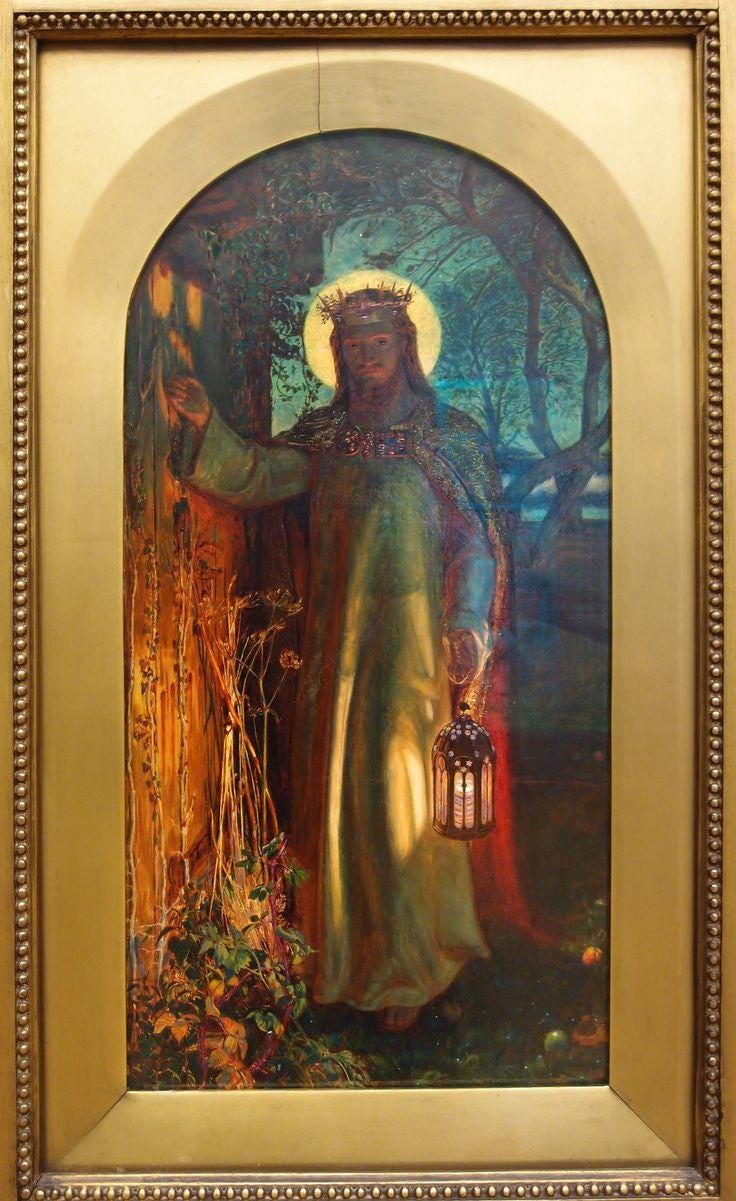
(Image: The Light of the World, by William Holman Hunt)
There are churches that suffer persecution. There are churches corrupted by false teaching. There are churches divided by scandal, seduced by immorality, or frightened into silence.
And then there is Laodicea.
The church at Laodicea does not appear to be suffering. It does not complain of poverty. It is not hiding from the authorities. There is no Jezebel corrupting it, no Balaam leading it astray, and no synagogue of Satan persecuting it.
Everything seems to be going rather well.
That is precisely the problem.
Christ says:
“Because thou sayest, I am rich, and increased with goods, and have need of nothing…”
And then comes His terrible assessment:
“…and knowest not that thou art wretched, and miserable, and poor, and blind, and naked.”
— Revelation 3:17
Two evaluations are being made of the same church.
Laodicea says, We are doing well.
Christ says, You have no idea how sick you are.
Of all the seven churches addressed in Revelation, Laodicea may therefore have the most uncomfortable word for the Western Church.
The defining sin of Laodicea is usually described as lukewarmness.
Christ tells them:
“I know thy works, that thou art neither cold nor hot: I would thou wert cold or hot. So then because thou art lukewarm, and neither cold nor hot, I will spue thee out of my mouth.”
— Revelation 3:15–16
We often interpret this as though Christ were measuring religious enthusiasm. Hot Christians are passionate, cold people are unbelievers, and lukewarm Christians occupy some miserable middle ground.
There is truth in the warning against halfhearted faith, but the image is richer than that.
Hot water is useful. Cold water is useful. Tepid water—especially mineral-laden water—is unpleasant.
Christ’s complaint is not merely, “You aren’t excited enough about Me.”
It is that the church has become spiritually useless because it has become spiritually self-satisfied.
Verse 17 tells us why:
“I…have need of nothing.”
There is Laodicea’s creed.
And perhaps there is ours.
The Western Church possesses things Christians of previous centuries could scarcely have imagined. We have theological colleges and seminaries, publishing houses, denominational headquarters, pension funds, endowments, professional staffs, sophisticated communications systems, conferences, consultants, strategic plans, demographic studies, livestreaming equipment, websites, podcasts, and libraries containing more theological knowledge than many generations of Christians could have accumulated in a lifetime.
None of these things is evil.
Many are genuine blessings.
But they carry a peculiar danger.
We can eventually build enough machinery that the machinery keeps running whether God shows up or not.
A parish can conduct a perfectly respectable Sunday service without anyone expecting the Holy Ghost actually to do anything.
A denomination can spend enormous energy managing its decline without ever seriously considering whether repentance might be required.
A seminary can teach men to analyze God without teaching them to tremble before Him.
A congregation can become consumed with whether visitors are comfortable while scarcely asking whether God is pleased.
A church can possess beautiful buildings, correct vestments, carefully prepared music, polished preaching, efficient administration, and respectable attendance and still hear Christ saying:
“Behold, I stand at the door, and knock.”
That verse is commonly used evangelistically. Christ is pictured standing at the door of the unbeliever’s heart, asking to enter.
There is certainly an evangelical truth there.
But that is not the immediate setting of Revelation 3:20.
Christ is standing outside a church.
That ought to terrify us.
The people inside are apparently continuing to be religious. Presumably they gather. They worship. They conduct the affairs of the congregation. They think themselves prosperous.
And somehow they have learned to do it with Christ outside the door.
The great danger facing the Western Church is not that we will cease doing Christianity.
It is that we may become quite good at doing Christianity without Christ.
It would be easy for theological conservatives to read Laodicea and immediately think of someone else.
We can point toward churches that have abandoned biblical morality, rewritten Christian doctrine to accommodate the surrounding culture, or exchanged the Gospel for political and social fashions.
And certainly there is much there deserving rebuke.
But Laodicea does not allow the orthodox Christian to stand comfortably outside the judgment.
For we have our own way of saying, “I am rich…and have need of nothing.”
We have the right Bible.
We have the historic Creeds.
We have apostolic order.
We have the correct doctrine.
We have traditional morality.
We have reverent liturgy.
We have preserved what others abandoned.
All of those things matter. Truth matters. Doctrine matters. Worship matters. Apostolic order matters.
But even orthodoxy can become something we possess rather than a truth before which we kneel.
We can restore the altar, recover the Prayer Book, preach the Creeds, defend apostolic order, celebrate the Sacraments reverently, and still discover Christ standing outside the door.
Because the question is not merely whether Christ is present in our theology.
The question is whether Christ is present in the house.
Laodicea’s prosperity had blinded it to its actual condition.
Christ therefore attacks precisely the things in which the city placed its confidence.
They believed themselves wealthy.
Christ tells them:
“I counsel thee to buy of me gold tried in the fire, that thou mayest be rich.”
They possessed fine clothing.
Christ tells them:
“…and white raiment, that thou mayest be clothed.”
They lived in a place associated with medicine.
Christ tells them:
“…and anoint thine eyes with eyesalve, that thou mayest see.”
The irony is devastating.
You have money, but you are poor.
You have clothing, but you are naked.
You have medicine, but you are blind.
Everything they thought proved their strength actually concealed their weakness.
We should wonder whether Christ might say something similar about the things by which we measure churches.
We say:
Look at the attendance.
Look at the budget.
Look at the building.
Look at the programs.
Look at the subscribers.
Look at the influence.
Look at the growth.
Look at the institution.
Christ may look at precisely the same church and see something entirely different.
For the Lord does not keep our accounting books.
A congregation of fifty people trembling before God may be infinitely richer in heaven than a congregation of five thousand congratulating itself upon its success.
A dying country parish where the Gospel is faithfully preached may stand higher before Christ than a thriving religious corporation that has discovered how to give people Christianity without repentance.
Numbers can tell us many useful things.
They cannot tell us whether Christ is pleased.
Perhaps the most frightening words in this entire passage are not “I will spue thee out of my mouth.”
They may be:
“And knowest not.”
Laodicea did not recognize its condition.
That is what makes spiritual complacency so dangerous.
Persecution announces itself.
Heresy can be identified.
Scandal eventually becomes visible.
But self-satisfaction feels remarkably like success.
A church can slowly lose its dependence upon God while believing that its growing ability to operate without Him is evidence of maturity.
And much of Western Christianity has become extraordinarily skilled at explaining itself.
We can explain our decline.
We can explain our divisions.
We can explain our compromises.
We can explain why our failures are someone else’s fault.
We can explain why our particular congregation, movement, denomination, or communion remains the faithful exception.
We can explain almost everything.
What we seem increasingly reluctant to say is:
We have sinned.
Yet Christ gives Laodicea no complicated recovery program.
He does not recommend a new strategic plan.
He does not tell them to commission a demographic study.
He does not suggest rebranding.
He says:
“Be zealous therefore, and repent.”
And here the passage takes an unexpected turn.
After Christ has stripped away every illusion Laodicea possesses, He says:
“As many as I love, I rebuke and chasten.”
The severity of Christ is not the opposite of His love.
It is an expression of it.
He rebukes the church because He has not abandoned the church.
He exposes its poverty because He wants to make it rich.
He exposes its nakedness because He wants to clothe it.
He exposes its blindness because He wants it to see.
And although He stands outside the door, He has not walked away.
He knocks.
“If any man hear my voice, and open the door, I will come in to him, and will sup with him, and he with me.”
There is still time to open the door.
That may be the great hope contained in the message to Laodicea.
Christ does not merely diagnose the disease of a comfortable church. He offers Himself as its cure.
Not another program.
Not another institution.
Not another technique.
Himself.
The Church does not need to discover some new secret that will rescue Christianity in the West.
She needs Christ.
She needs repentance.
She needs prayer.
She needs holiness.
She needs the Word of God.
She needs the Sacraments faithfully administered.
She needs clergy who fear God more than institutional failure and laypeople who desire holiness more than comfort.
Above all, she needs once again to understand that without Christ she has nothing.
The Western Church spends a great deal of time worrying about survival.
Will our congregations survive?
Will our denominations survive?
Will our institutions survive?
Will Christianity retain cultural influence?
Those are understandable questions.
But Revelation asks a far more important one:
Is Christ inside the church?
For a church can survive institutionally and die spiritually.
It can possess buildings while losing faith.
It can preserve endowments while losing holiness.
It can maintain apostolic structures while losing apostolic fire.
It can retain the vocabulary of Christianity while forgetting the fear of God.
And it can become so accustomed to its condition that it says:
“I have need of nothing.”
That is when we should begin to tremble.
Because somewhere beyond the noise of our committees, programs, controversies, strategies, and self-congratulation, there may yet be heard a knock at the door.
And the voice outside is saying:
“Behold, I stand at the door, and knock.”
The hope of the Western Church is not that we become richer, larger, more influential, more fashionable, or even more institutionally secure.
Our hope is that we hear the voice.
That we repent.
That we open the door.
And that Christ once again takes His rightful place in the midst of His Church.
No posts
Comments
Nothing yet. Say the first thing.
Sign in to join the conversation.