
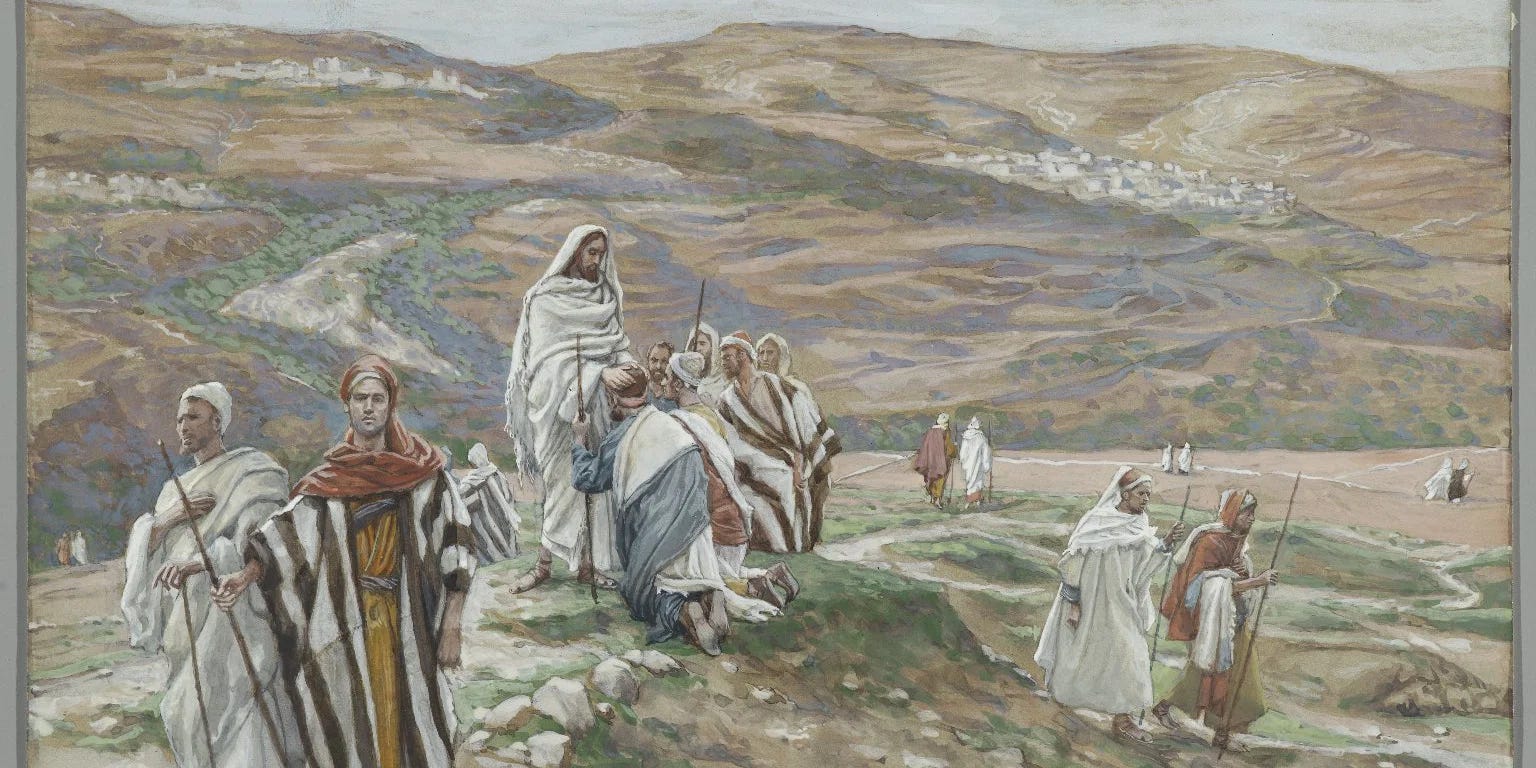
(Image: He Sent them out Two by Two, by James Tissot)
“And how shall they preach, except they be sent?”
— Romans 10:15
There is a difference between possessing power and exercising authority.
The distinction is easily forgotten because the world tends to measure power by the ability to compel: the size of an army, the reach of a government, the wealth of a corporation, the influence of a public figure. The powerful man, by the world’s reckoning, is the man who can make things happen.
But Scripture gives us a different understanding.
True authority is not seized. It is received.
Christ told Pilate:
“You could have no power at all against Me unless it had been given you from above.”
— John 19:11
Pilate must have found those words astonishing. From all outward appearances, the situation was exactly reversed. Jesus stood bound before the Roman governor. Pilate had soldiers at his command. He possessed the authority of Caesar. He could release Jesus or send Him to the cross.
Yet Christ calmly reminded him that even Caesar’s authority was borrowed.
Pilate possessed nothing that had not been permitted him from above.
This is a principle running throughout Scripture. St. Paul writes:
“For there is no authority except from God, and the authorities that exist are appointed by God.”
— Romans 13:1
Authority, properly understood, is therefore stewardship.
The man entrusted with authority does not become its ultimate owner. He becomes responsible for its exercise.
The priesthood provides a particularly clear example.
A priest is given genuine authority. He baptizes. He solemnizes marriages. He pronounces absolution. He celebrates the Holy Eucharist. He blesses. He preaches. He receives the dead at the church door and finally stands beside an open grave and commits the body to the earth in the sure and certain hope of the resurrection.
These are not insignificant things.
But none of this authority originates in the priest.
The traditional Anglican form of absolution in the Visitation of the Sick expresses the matter beautifully:
“Our Lord Jesus Christ, who hath left power to his Church to absolve all sinners who truly repent and believe in him, of his great mercy forgive thee thine offences; and by his authority committed to me, I absolve thee from all thy sins…”
Consider the weight of those words.
“I absolve thee.”
The priest really does speak with authority.
But immediately we are told whose authority it is:
“By his authority committed to me.”
There is the difference between possession and stewardship.
I cannot forgive sins sacramentally merely because I am Ronald. I cannot walk into a church as a private individual, place bread and wine upon the altar, and declare that I have authority to celebrate the Eucharist because I feel called to do so. I cannot simply decide that I possess ecclesiastical authority.
I must be sent.
And this is why St. Paul’s question matters so much:
“And how shall they preach, except they be sent?”
Christian ministry does not begin with the minister.
It begins with Christ.
Our Lord told the Apostles:
“As the Father has sent Me, I also send you.”
— John 20:21
Then He breathed upon them and said:
“Receive the Holy Spirit. If you forgive the sins of any, they are forgiven them…”
— John 20:22–23
Notice the pattern.
The Father sends the Son.
The Son sends the Apostles.
The Apostles, through the ministry of the Church, ordain and send others.
Authority descends through commission rather than rising through personal ambition.
That is why the Church has always taken ordination seriously. The question is not simply whether a man is sincere, educated, eloquent, charismatic, or convinced that God wants him to preach.
The question must also be:
Who sent him?
Scripture itself asks it.
“How shall they preach, except they be sent?”
St. Paul gives us another remarkably appropriate description of Christian ministry:
“Let a man so consider us, as servants of Christ and stewards of the mysteries of God. Moreover it is required in stewards that one be found faithful.”
— 1 Corinthians 4:1–2
Stewards of the mysteries of God.
A steward possesses considerable authority within the household, but the household is not his.
That distinction changes everything.
The faithful priest stands at an altar he did not institute.
He reads Scriptures he did not write.
He proclaims a Gospel he did not devise.
He administers Sacraments he did not create.
He speaks words handed down to him by the Church.
He invokes a Holy Spirit whom he cannot command by any natural power of his own.
He distributes a Body and Blood that certainly do not belong to him.
And when he pronounces absolution, he forgives sins by an authority that has been committed unto him.
The priest therefore exercises tremendous authority while simultaneously confessing:
None of this is mine.
That is not a diminishment of priestly authority. It is precisely what makes priestly authority real.
Every stewardship carries with it the possibility of corruption.
The moment the steward begins behaving as though the Master’s property belongs to him, stewardship becomes tyranny.
This danger exists in every form of human authority.
The father can forget that his children ultimately belong to God.
The bishop can forget that the Church belongs to Christ.
The priest can forget that the parish is not his personal possession.
The civil magistrate can forget that his authority is received rather than absolute.
The teacher can forget that those entrusted to his instruction are not his disciples in the ultimate sense.
The employer can forget that authority over another person’s labor does not give him ownership of that person.
The question confronting every person entrusted with authority is ultimately the same:
What have you done with what was entrusted to you?
For stewardship necessarily implies judgment.
If the authority is mine, I need answer only to myself.
If it has been entrusted to me, then eventually the Owner will return.
This is why humility and authority are not opposites.
Properly understood, genuine authority ought to produce humility.
The Roman centurion understood this when he approached Jesus concerning his servant:
“For I also am a man under authority, having soldiers under me.”
— Matthew 8:9
That sentence is easily overlooked.
The centurion does not merely say, “I am a man with authority.”
He says:
“I am a man under authority.”
And precisely because he is under authority, he understands how authority works.
He tells one soldier, “Go,” and he goes. He tells another, “Come,” and he comes. His commands have force because he does not stand alone. Behind the centurion stands Rome.
He therefore recognizes something in Jesus that others have failed to recognize.
Christ need not physically struggle against the disease afflicting his servant. He need only speak.
The centurion recognizes authority because he himself knows what it means to exercise authority received from another.
The Christian minister must remember the same thing.
Before he is a man with authority, he is a man under authority.
Ultimately every legitimate exercise of authority leads us back to Christ.
After His resurrection, Our Lord told the Apostles:
“All authority has been given to Me in heaven and on earth.”
— Matthew 28:18
And then:
“Go therefore and make disciples of all the nations…”
There it is again.
Authority followed by commission.
Christ sends because Christ possesses authority.
The Apostles go because Christ sends them.
Their successors minister because the Church continues that apostolic commission.
And every Christian exercise of authority remains accountable to the One from whom it ultimately came.
This is why grasping after power is fundamentally different from receiving authority.
The world says:
Take power.
Christ says:
Receive a commission.
The world asks:
How many people are beneath me?
Christ asks:
Whom have I entrusted to your care?
The world says:
Make yourself great.
Christ says:
“Whoever desires to become great among you, let him be your servant.”
— Matthew 20:26
Christ does not abolish authority.
He reveals what authority actually is.
The Church desperately needs to recover this understanding.
Ministry is not self-appointment. Priesthood is not personal spiritual achievement. Episcopal office is not ecclesiastical promotion. Christian leadership is not the accumulation of influence.
It is stewardship.
It is receiving something that belongs to Christ and being commanded to administer it faithfully until He comes.
The priest at the altar, the bishop in his diocese, the father in his household, and the magistrate in his office all stand beneath the same terrible truth:
You have authority, but the authority is not yours.
You may exercise it.
You may not possess it.
You may administer it.
You may not redefine it.
And one day you must render an account for what you did with it.
That is why the words of St. Paul remain so important:
“And how shall they preach, except they be sent?”
Before asking whether a man is powerful, perhaps we should ask whether he is faithful.
Before asking how many follow him, perhaps we should ask who sent him.
And before any of us exercises authority over another human being, perhaps we should remember the words that ought to govern every Christian steward:
By His authority committed unto me.
No posts
Comments
Nothing yet. Say the first thing.
Sign in to join the conversation.