
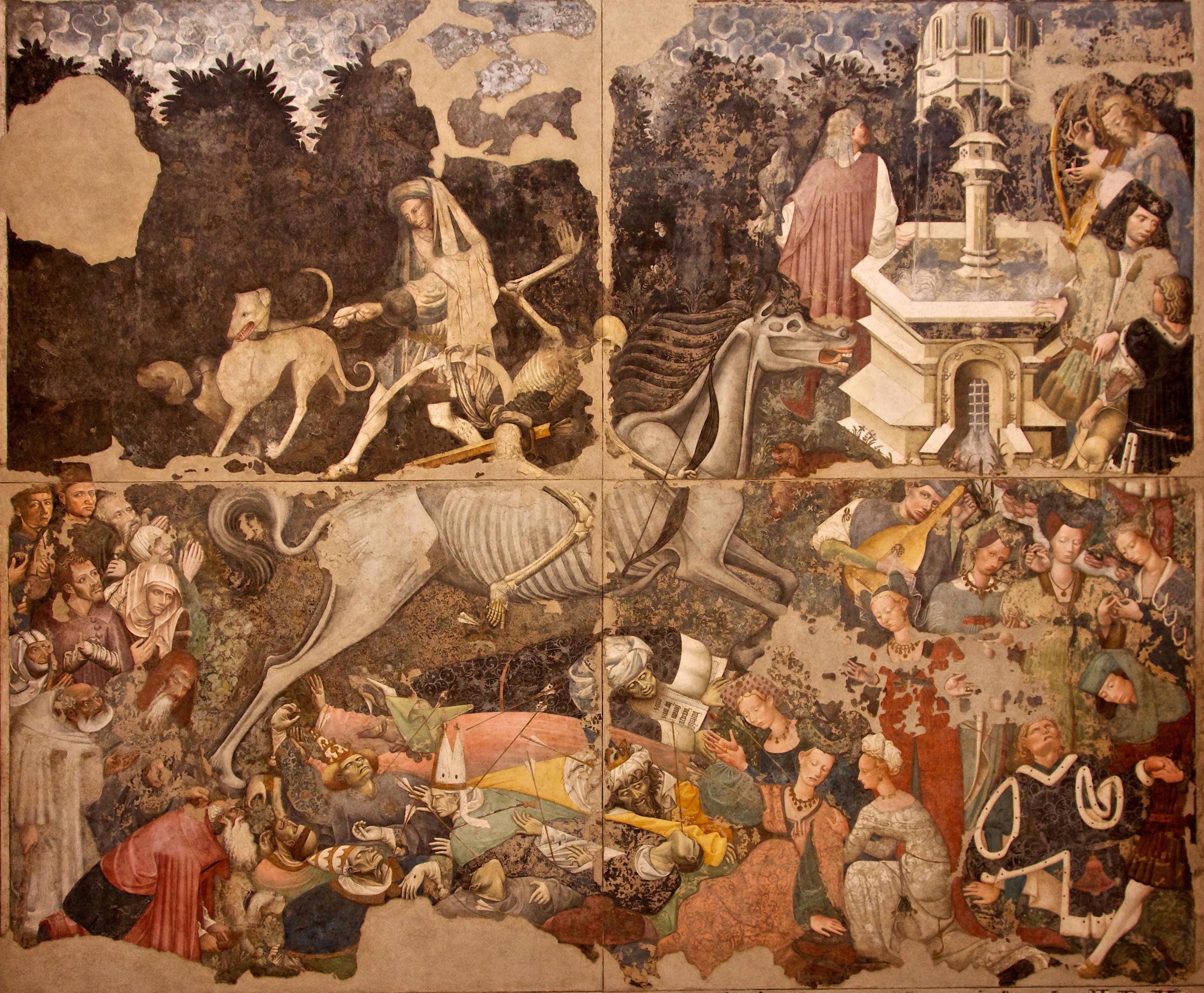
(Image: The Triumph of Death, by Antonio Pisanello, 1448)
“The last enemy that shall be destroyed is death.”
— 1 Corinthians 15:26
Samuel Taylor Coleridge once wrote a little poem called Epitaph on an Infant. It consists of only four lines:
Ere sin could blight or sorrow fade,
Death came with friendly care;
The opening bud to heaven conveyed,
And bade it blossom there.
There is something startling about that second line:
“Death came with friendly care.”
We do not ordinarily speak of death as a friend.
Nor, for that matter, does Scripture.
Death is an enemy. St. Paul calls it “the last enemy.” Death is not part of the goodness of creation as God first made it. It belongs to the catastrophe of the Fall. Man was formed from the dust of the earth and received the breath of life from God; death tears apart what God joined together. The body returns to the dust, and the soul departs.
That is why death hurts.
That is why we grieve at gravesides.
That is why even our Lord Jesus Christ, standing before the tomb of Lazarus, wept.
Christianity has never required us to look upon a coffin and pretend that nothing terrible has happened. Something terrible has happened. Someone whom we love is no longer sitting beside us. The voice we knew has fallen silent. The chair is empty. The familiar face is absent.
Death is an enemy.
But it is a defeated enemy.
That changes everything.
The Christian does not face death as the pagan faces death.
Before us stands a grave—but Someone has already been through it.
Jesus Christ did not avoid death. He entered into it.
He allowed death to take Him. His body was laid in a tomb. The stone was rolled across its entrance. His disciples went away grieving because, as far as they could see, death had done what death always does.
It had won.
Then came Easter morning.
The stone was rolled away.
The tomb was empty.
And from that moment onward, death was never quite the same thing again.
Christ did not merely survive death. He conquered it.
St. Paul therefore cries:
“O death, where is thy sting? O grave, where is thy victory?”
Notice that Paul does not say there is no death.
Christians still die.
He does not say there are no graves.
We still bury our dead.
He says that death has lost its sting, and the grave has lost its victory.
Death can still take the Christian’s mortal body.
It cannot take Christ from him.
And because it cannot separate him from Christ, it cannot finally keep him.
Now perhaps we can understand Coleridge.
How can death, the last enemy, come “with friendly care”?
Not because death has ceased to be death.
Not because death has somehow become good.
But because Christ has robbed death of its ultimate power.
The enemy has been forced into the service of the King.
For the Christian, the very thing that once barred the way to life has become the doorway through which we enter more fully into the presence of Christ.
Paul could therefore write:
“For to me to live is Christ, and to die is gain.”
And again:
“Having a desire to depart, and to be with Christ; which is far better.”
That is an extraordinary thing to say.
Death is an enemy.
Yet dying is gain.
The grave is terrible.
Yet beyond the grave is Christ.
That is the paradox of Christian death.
We do not love death.
We love the One waiting on the other side of it.
This does not mean Christians should be unmoved when someone dies.
Quite the opposite.
Christian grief can be profound because Christian love is profound.
When someone we love dies, we mourn because something precious has been torn from our immediate experience. There is no virtue in pretending otherwise.
St. Paul does not tell the Thessalonians not to sorrow.
He tells them:
“Sorrow not, even as others which have no hope.”
There is all the difference in the world between sorrow and sorrow without hope.
The Christian stands at the grave and weeps.
But he does not stand there alone.
Behind him stands an empty tomb.
And because Christ’s tomb is empty, no Christian grave is permanent.
We bury our dead in the sure and certain hope of the resurrection.
We place the body into the earth knowing that the earth cannot keep what belongs to Christ.
The grave has become, in a strange way, like a seedbed.
As Paul writes:
“It is sown in corruption; it is raised in incorruption.”
We lay down what is mortal.
God raises what is immortal.
We lay down what is weak.
God raises what is glorious.
We lay down the body of our brother or sister in Christ.
And we wait.
Most of us understandably shrink from death.
There is mystery there. Separation. Loss. The surrender of everything familiar.
But Christians should remind one another what Christ has accomplished.
The One who meets us in death is the same One who met us in Baptism.
The One who receives us beyond the veil is the same One whose Body and Blood we received at His Table.
The Shepherd who led us through this life does not abandon us when we enter the valley of the shadow of death.
Indeed, the Psalmist says precisely the opposite:
“Yea, though I walk through the valley of the shadow of death, I will fear no evil: for thou art with me.”
That may be the most important part.
We do not defeat death by courage.
We do not defeat death by positive thinking.
We do not defeat death by refusing to think about it.
Christ defeated death for us.
Therefore the Christian can face the grave without despair.
Death may come.
Perhaps suddenly.
Perhaps after a long illness.
Perhaps in old age after strength has slowly faded.
And when it comes, it will still be an enemy.
But it will be an enemy whose sword has been broken.
It may carry us from those whom we love.
But it cannot carry us away from Christ.
It may close our eyes to this world.
But it opens them upon another.
It may silence our voice here.
But it cannot silence the promise spoken over us by God.
And someday even death itself will die.
For Christ is risen.
And because Christ is risen, those who belong to Him shall rise also.
Then the words of Scripture shall finally be fulfilled:
“Death is swallowed up in victory.”
Until that day we grieve our dead.
We remember them.
We miss them.
We stand beside their graves and sometimes weep.
But we do not despair.
For Christ has robbed death.
He has taken away its final victory.
He has broken its claim upon His people.
And therefore, strange though Coleridge’s words may initially sound, the Christian can understand them.
For when our hour finally comes, death cannot carry us anywhere that Christ has not already gone before us.
The enemy can take us only as far as the empty tomb.
And beyond it stands the risen Lord.
Perhaps, then, death may indeed come “with friendly care.”
Not because death is our friend.
But because Jesus Christ has conquered our enemy.
No posts
Comments
Nothing yet. Say the first thing.
Sign in to join the conversation.