
It’s over a year since I was given the privilege of being able to test an early prototype of Harken’s new ILCA kicker/vang system and provide some feedback on the evolving Harken design. During my trip to Harken HQ last March I was able to see how the designs were progressing.
Late last year, Southeast Sailboats rigged up the first pre-production units for Harken’s promotional videos featuring Southeast Sailboats sponsored sailors Micky Beckett and Matilda Nicholls.

I have finally been able to use the new Harken system ‘for real’ at my first two events of the year at Royal Varuna Yacht Club in Thailand.
After reading this post, take time to view the Harken video which looks even deeper into the design rationale behind all three components of the new system - the link to this video is at the end of this post. Many thanks to the great team at Harken who I have come to know well over the past few years.
My article below covers all aspects of the system, what I think of it, and why you should maybe consider getting one, and how you may be able to buy a Southeast Sailboats rigged system!
The full system comprises three elements – the all new lower assembly, the all new and quite unique middle block, and the 25mm high load FLY top block that was released late last year. So let’s look at all three in detail.
Lower Assembly
The all new lower assembly is both lighter and stronger than the original Harken assembly. Whilst it may look a bit large, compared with the Ronstan lower shown below, this is for a reason. Despite the size difference the weight of the new Harken and Ronstan lower assemblies are almost identical (Harken 194g, Ronstan 190g) due to the use of glass filled polymer construction of the new Harken assembly instead of stainless steel.
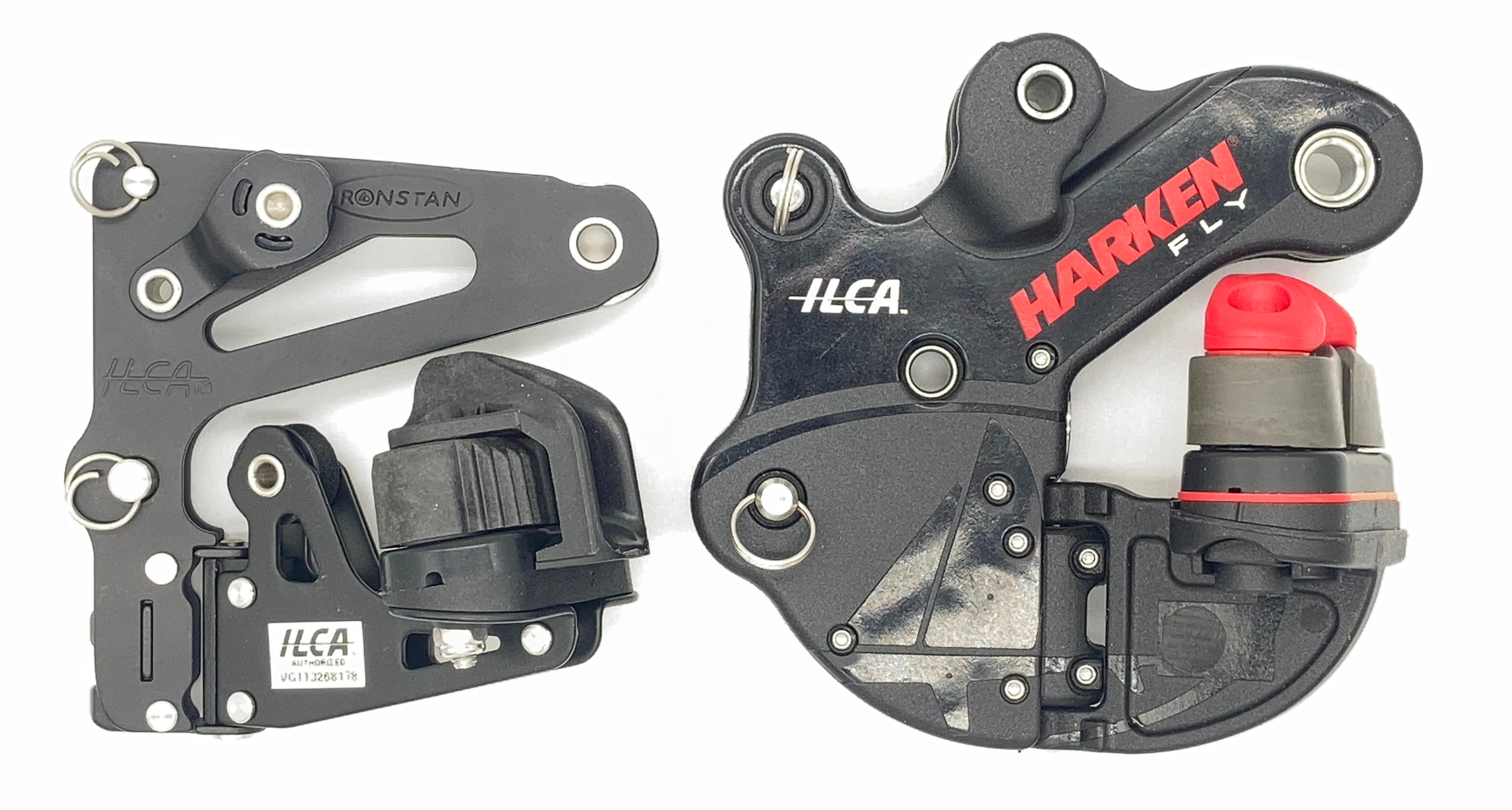
Harken, by using a larger assembly than the Ronstan, have kept the control line turning blocks further away from the mast. The weakest part of the Ronstan system in my opinion, is that the turning blocks are too close to the mast, causing the outhaul/downhaul control lines to occasionally snag on blocks on the side of the assembly, or very occasionally even on the ‘nose’ of the assembly. By keeping the turning blocks further away from the mast, Harken have reduced if not eliminated snagging.
The control line turning blocks have been increased in size from 16mm to 18mm, but the biggest enhancement in terms of improving ease of use is the 25mm high load block used for the primary line. This large block really reduces system friction compared with the old Harken assembly.
The plastic fairlead on the ‘old’ assembly that was subject to wear has been replaced by a stainless steel ferrule. Whilst ‘bullet proof’ the use of the ferrule compared with the block used on the Ronstan assembly would seem to increase friction slightly. However this seems to be offset by the fact that the new Harken uses fractionally larger blocks for all the turning points, and from subjective tests there seems to be very little difference in friction between the new Harken and the Ronstan lower assemblies.
The final aspect of note is the way in which the swinging cleat arm ‘flips’ from side to side. I think this is really neat. It only takes a gentle pull and the cleat is immediately facing you. Click on the video below to see this feature in opeartion.
The cleat is sat on a wedge which allows you to lower the cleating angle if you want to, but I doubt many will do this. If you do want to lower the cleating angle, Harken have engineered this very well with a specially designed nut assembly that (unlike the Ronstan assembly) properly compensates for the changing bolt angle relative to the cleat mounting plate.
Middle Block
This new 1251 double block is a stroke of genius from Harken. The two blocks are twisted at an angle to each other (when I visited Harken last year I called it a ‘twiddle’ block – short for twisted fiddle).
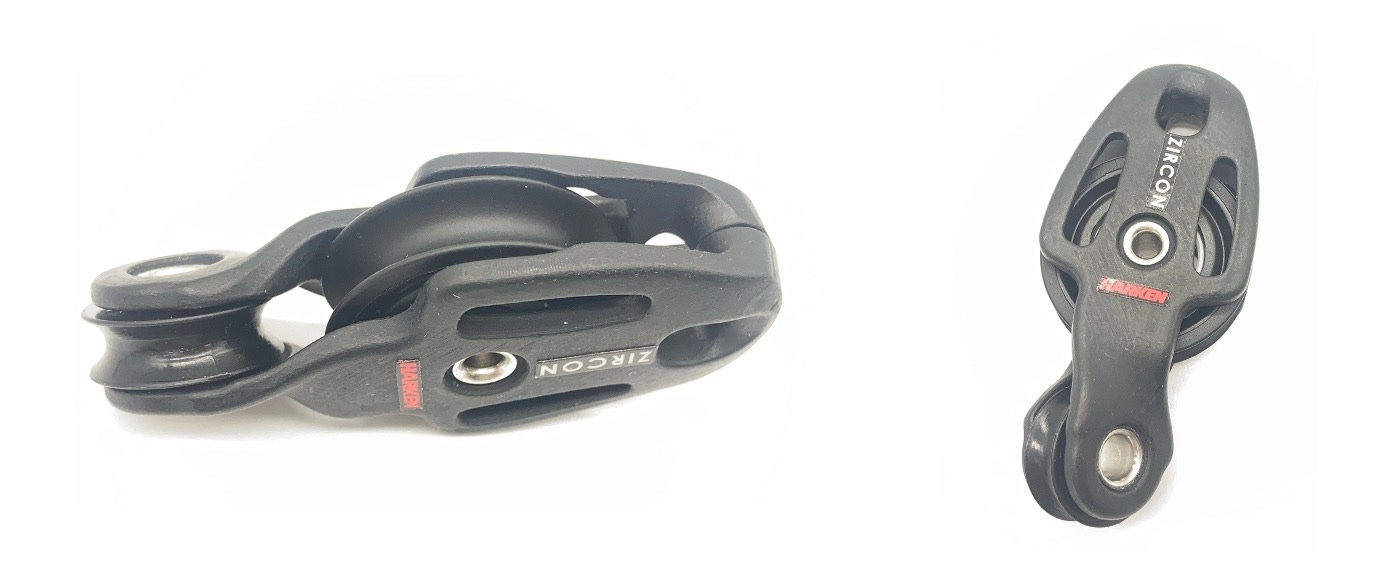
This twist optimises the alignment of the control lines as they are pulled on. The larger of the two blocks is a super free running 29mm ZIRCON, and the smaller the normal sheave as used in the 18mm FLY block.
Top Block
I have been using prototypes of the Harken 1250 25mm FLY top block for almost 2 years, and in fact our sponsored sailor Micky Beckett actually used one at the Paris 2024 Olympics.
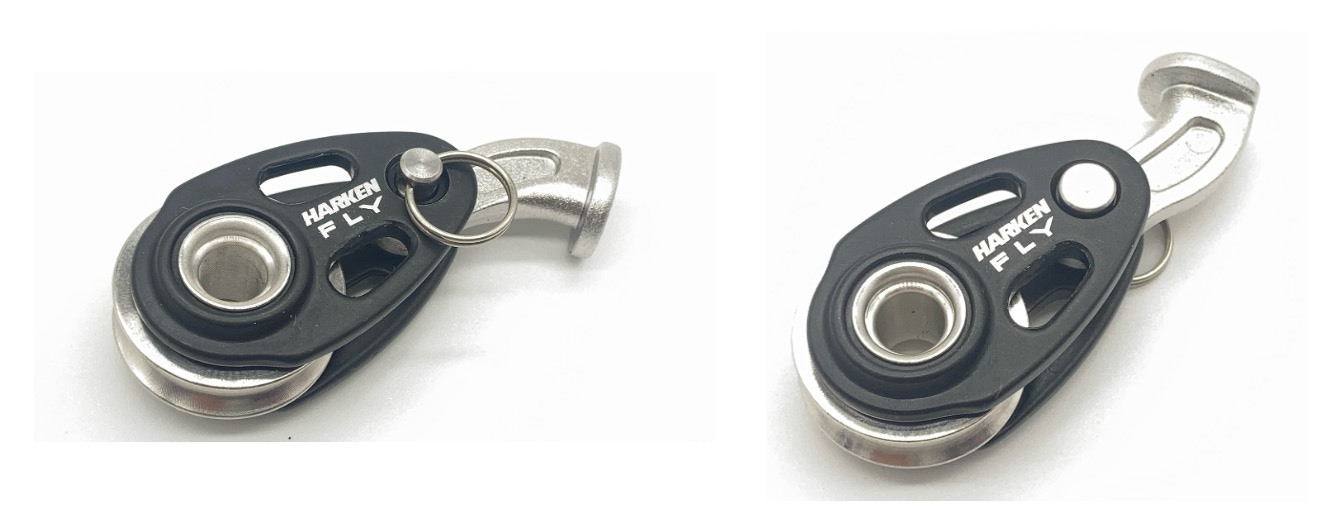
It is a really smooth running block and highly recommended. It also features a super strong forged stainless steel key with a unique shape to it. It won’t fall out, but removing it after sailing is a bit trickier especially with the sail still attached/vang under tension.
I have used the new Harken system now for 6 days of competition and 2 days of training and have found it easy to use. The standard cleating angle seems to be perfect (about the same as the original Harken assembly or the Ronstan assembly with the standard wedge fitted), and the new Harken lower assembly is much easier to uncleat than the ‘old’ Harken system. Plus, in 8 days of sailing I had no control line snagging.
The cleat ‘flip’ from side to side I something that I found I liked – as shown in the video previously, a very gentle pull on the control line and the cleat angle pops around to face you.
Geometry:
Unlike the Ronstan lower assembly which is more compact/sits closer to the mast, as illustrated below, the Harken lower assembly is very similar to the previous one. The position of the primary line sheave relative to the mast attachment point is identical, meaning that primary line lengths are the same for this new Harken assembly as the older one.
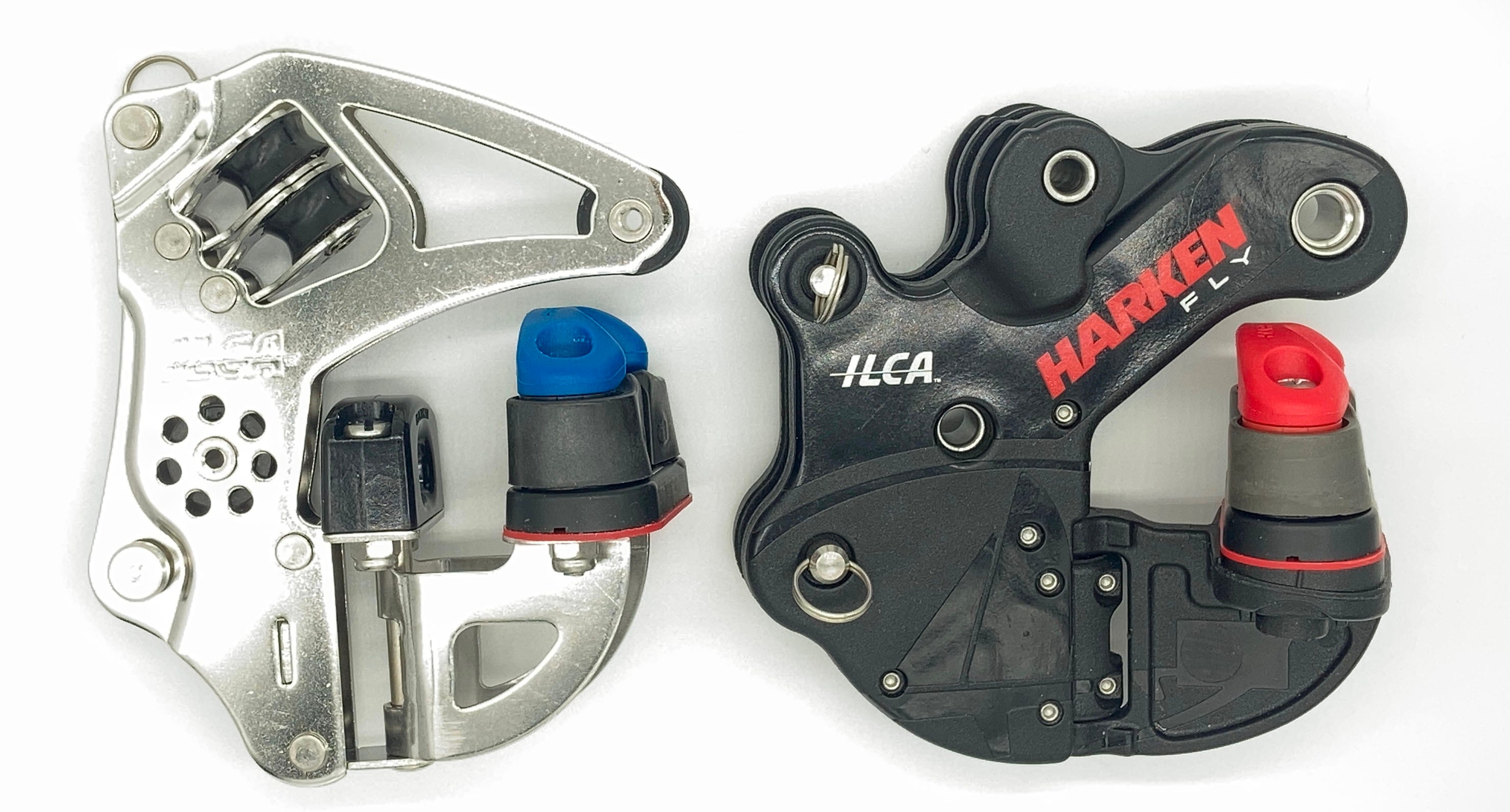
The downhaul/Cunningham attachment point is slightly lower than the old version, and is in approximately the same position as on the Ronstan. For those of you, like me, who like to attach their system to the mast using a ‘quick pin’, you will need a longer one (3/4 inch grip length). One of my minor points of feedback to Harken was to ask that the length of the pins required consider standard lengths of the popular quick pins. For the mast attachment the 1/4” diameter x 3/4” length pin such as the WDS 954-2014075 pin is needed. The downhaul/Cunningham pin length and diameter remains the same as the previous Harken assembly (3/16” diameter x 3/4” length).
Control Line Routing:
As with the Ronstan system, there are many ways that you can route the control line, with no one way being absolutely right or wrong. With the twiddle block differing sheave sizes and orientations this is now even more complex and was the subject of various iterations before Harken advised the following as the best way of routing (the correct term is reeving) your control line. Below is for a normal 15:1 purchase system with the control line attached through the centre of the lower middle block.
Step 1: pass control line through the lower assembly port side block from bow to stern direction;
Step 2: pass control line through the middle large block from stern to bow direction;
Step 3: pass control line through the lower assembly starboard side block from stern to bow direction;
Step 4: pass control line through the middle small block from bow to stern direction;
Step 5: route the line down through the lower assembly and cleat.
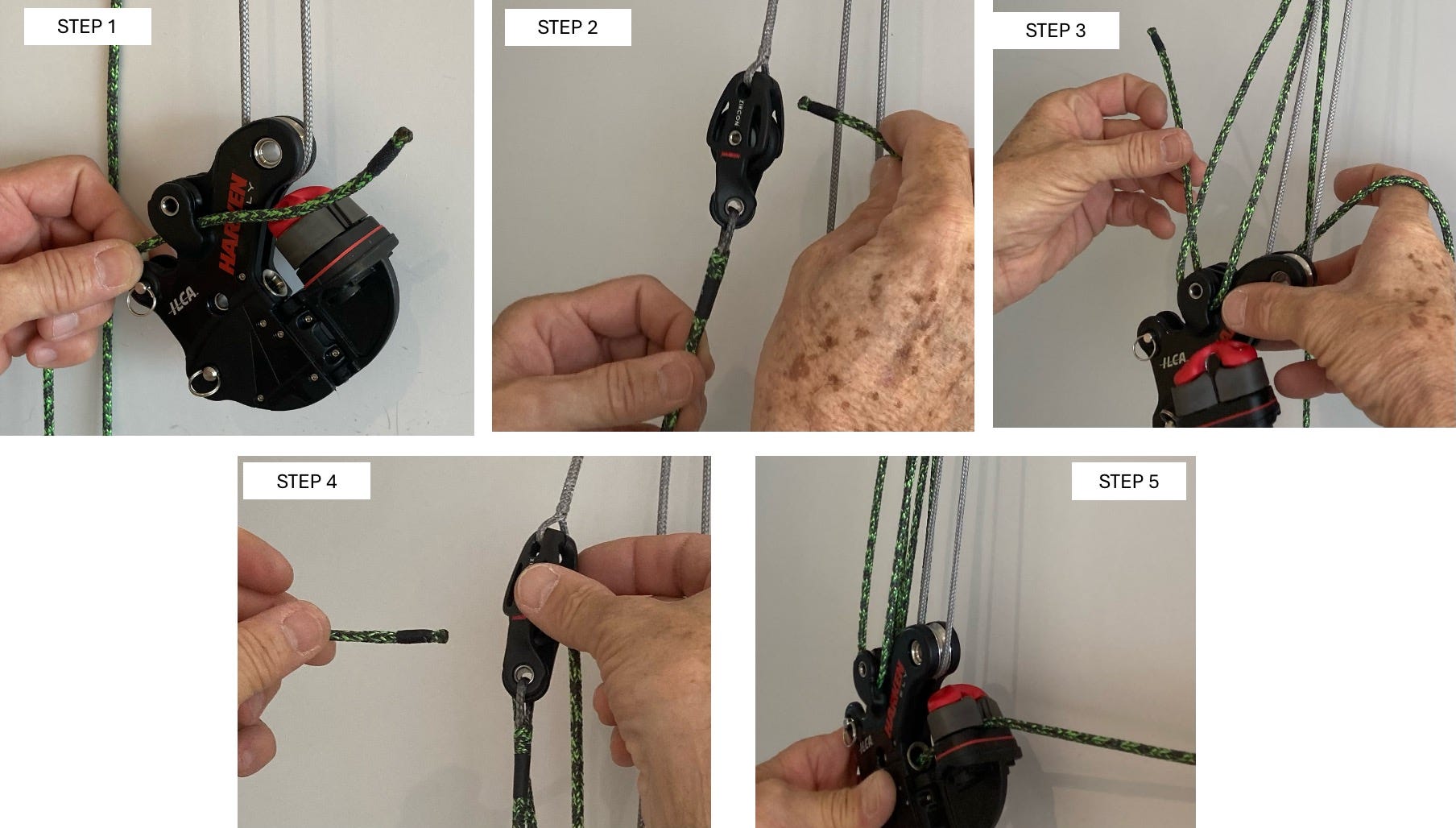
I will try and do a video sometime soon!
It’s clear that the new Harken system is a big step forward from the ‘old’ Harken system.
A complete kicker/vang system is comprised of the lower assembly, middle and top blocks, and appropriate lines. Assuming that you are already using a good top block (by which I mean a high load top block such as the Allen XHL, Harken 25mm FLY or the Ronstan), overall kicker/vang system performance will be dominated by the lower assembly that you use, so I will focus on that element.
In my opinion there are three factors involved in assessing which lower assembly is the ‘right’ one for you, and it is important to understand that sailors will assess each of the factors differently in making their decision. The factors are:
Ease of uncleating - I found that the old Harken lower assembly was really difficult to uncleat when it was under heavy load, and can remember some pretty frightening moments coming in to the windward mark on port desperately trying to uncleat it! The new Harken seems much easier than the old Harken, but maybe not as easy as the Ronstan.
Friction - the new Harken is much better than the old Harken, and from subjective testing seems very similar to the Ronstan.
Control Line Snagging - the biggest downside of the Ronstan is the continual snagging described previously. The new Harken is much better than the Ronstan. In 8 days sailing I haven’t had any snags yet.
For myself, I am going to be using the new Harken system. Although the Ronstan lower assembly may be slightly easier to uncleat, I am fed up with the continual snagging which although not catastrophic, is a distraction that you don’t need when racing.
As Southeast Sailboats has been involved in a very small way over the past 18 months, I will ‘come out of retirement’ for a few days and build up a very limited number of these new Harken kicker/vang systems featuring our unique ‘go-round’ primary line and Polytech control lines as featured on the Harken video with Micky and Matilda. If you are interested please e-mail me at max@southeastsailboats.co.uk for more information on pricing/delivery and how to order.
Worth looking at if you haven’t already seen it is the Harken promotional video - click on the image below.
Comments
Nothing yet. Say the first thing.
Sign in to join the conversation.