
“LLMs are chmod a+w artifacts yay.” Andrej Karpathy, May 24 2025 X (formerly Twitter)
When Andrej Karpathy quipped “LLMs are chmod a+w artifacts”, he meant: AI models are becoming universally writable and hackable (chmod a+w is Unix-style shorthand for “add write permission for all users”). But at the same time, as AI progresses, the focus will shift from making information understandable for humans to making it more understandable for machines.
The major music labels will be crossing this historic neural threshold soon — from analog archives and digital downloads to neural-network pipelines. They will be building dual-purpose, end-to-end AI stacks, both discriminative (analytical) use-cases (rights protection, neural fingerprinting) and generative (creative) ones (ethical music creation, personalized stems, tailored datasets for models). In other words, they will convert their catalogs into machine-accessible data and will re-encode millions of master recordings thereby positioning their IP as machine-readable fuel for future products.
This will be as pivotal as Bob Dylan’s switch from acoustic guitar to electrical.
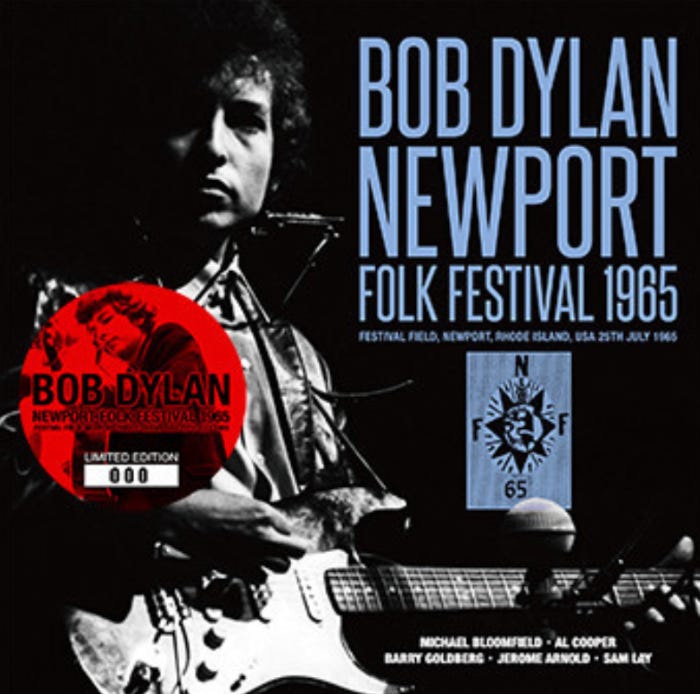
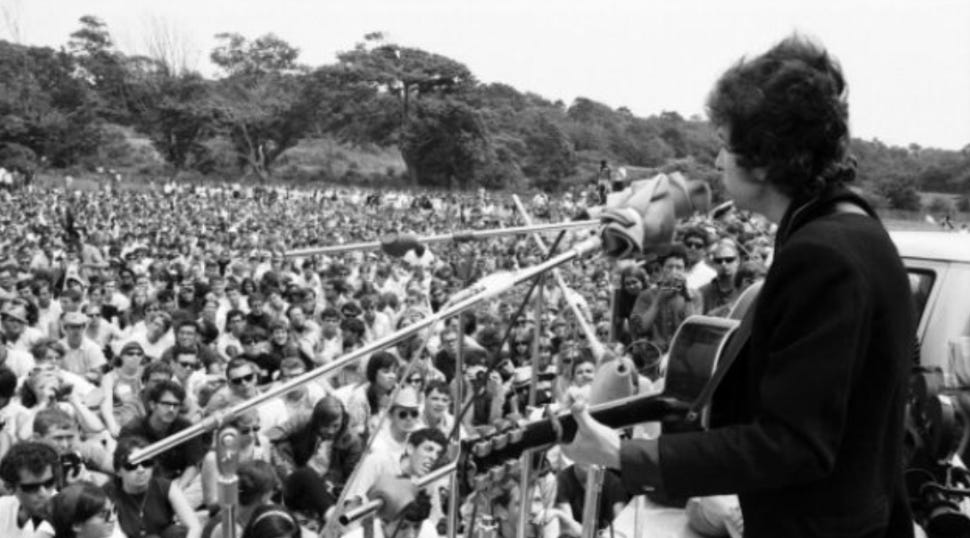
In 1965 Bob Dylan arrived onstage at the Newport Folk Festival as the acoustic voice of social conscience with a Fender Stratocaster and a pickup band that had rehearsed only once. They opened with “Maggie’s Farm,” blasting through poor festival P-A systems.
A section of the crowd booed—partly audio mix issues, partly feeling short-changed by a 15-minute electric set, but mostly a sense of betrayal: electricity symbolised commercial rock, the very thing folk revivalists defined themselves against. Headlines framed it as “Folk’s Judas moment.” Dylan doubled-down with Highway 61 Revisited and a world tour backed by The Hawks (later The Band); by 1966, folk-rock was mainstream.
Dylan didn’t abandon folk; he re-wired it. Likewise, a ‘neural major (label)’ isn’t a label that stops making music—it’s one that routes songs through silicon to reach ears it could never reach before. Just as Dylan rewired folk, labels must rewire music for a neural era.
History suggests that today’s boos will be tomorrow’s box-office. But what does going neural for music publishers and labels actually mean?
A neural major is simply a label that embeds its catalog into machine-readable vectors called embeddings. Embeddings are numeric fingerprints that capture timbre, rhythm, harmony and melody in a compact form. This will jumpstart a new generation of large music models.
And it will solve an old problem. Traditionally, encoding media—audio, video, images—has involved irreversible processes. Lossy compression algorithms discard information deemed insignificant, optimizing file size at the expense of permanent fidelity loss. Such irreversibility constrains our creative possibilities, limiting the depth of future editing, reinterpretation, or reuse of digital assets.
Today’s lossy codecs force artists to choose between size and fidelity. But AI-driven neural autoencoders will fundamentally solve this trade-off. Neural autoencoders explicitly pair encoders (for compression) and decoders (for precise, lossless reconstruction), mapping data into highly abstracted latent spaces. Unlike conventional compression methods, this neural approach enables perfect, fully reversible reconstruction, offering unprecedented creative flexibility. Creators will no longer be constrained by permanent edits or fidelity compromises; neural compression allows lossless editing, infinite remixing, and endless reinterpretation of content. They key benefits are obvious:
Reversibility: perfect, lossless reconstruction
Flexibility: infinite remixing, isolated stems on demand
Adaptability: codecs can be fine-tuned as audio standards evolve
But it may take longer than we think. Although the long‐term trend is toward neural representations, analog and traditional digital (e.g., wav/FLAC) won’t vanish overnight. For the foreseeable future, we’ll see hybrid pipelines “analog → lossless digital → ML preprocessing → neural embeddings” rather than skipping the lossless stage entirely.
Analog masters are first digitized into high‐resolution PCM (Pulse Code Modulation audio which is uncompressed); then neural restoration and enhancement occurs on those files. Even if majors “leapfrog” to neural archives, a massive installed base of legacy tools (DAWs, mastering suites, streaming pipelines) means transition will be gradual. but one day all music may be kept (storage) in embeddings instead of wav files and will have to be regularly refreshed, just like software updates. Periodic re-embedding will be required.
Embeddings excel at search, similarity, clustering, and real‐time transformations, but they are not a lossless substitute for an audio master. To reconstruct a high‐fidelity WAV simply from a 512-dimensional “audio DNA” vector—you need a full “neural codec” paradigm (autoencoder‐based).
Advanced neural codecs (1) (e.g., WaveNet-inspired autoencoders) are coming that can reconstruct audio from a compact latent space. In that scenario, “refresh” means periodically re-training/fine-tuning the codec to preserve fidelity as bit-depth, sample rates, and listening environments change.
Data drift is unavoidable. Embedding spaces can drift over time as newer models are trained. If we want consistent similarity search or remix workflows, we'll need to “re-embed” the entire catalog whenever the underlying network architecture changes significantly. But it will not be such a big deal anymore. The future is moving in this direction and the economics will follow.
The implications of reversible neural compression extend far beyond creative convenience (2). It opens entirely new avenues for interactive and personalized media experiences. Users could dynamically decompress and explore specific dimensions of content—isolating vocals, instrumentals, emotional nuances, or visual elements in real time.
The line between creator and consumer will become fluid, as audiences actively navigate and reshape media according to personal preferences, emotional states, or biometric feedback. Imagine a fan dialing down drums in a track at workout pace, or an AR headset isolating vocals during a live show.
In essence, this paradigm shift—from irreversible to reversible compression—marks a profound evolution: digital media becomes dynamic, perpetually editable, and profoundly adaptive, echoing our broader journey toward fluid, deeply personalized, and infinitely creative human experiences.
Once music goes neural, there is no going back 😀
(1) In addition to Google’s Soundstream and Meta’s Encodec, new architectures are emerging, such as Hilcodec (https://arxiv.org/abs/2405.04752), FlowMac (https://arxiv.org/abs/2409.17635), and MuCodec (https://xuyaoxun.github.io/MuCodec_demo/).
(2) The same shift is happening in quantum information. Unlike classical computing’s irreversible information loss (Landauer’s Principle), quantum computing emphasizes reversible computations, maintaining quantum coherence and information fidelity — a shift that mirrors the move toward reversible neural autoencoders in media.
No posts
Comments
Nothing yet. Say the first thing.
Sign in to join the conversation.