
Hey all! I’m kicking off another round of Draft // Echo, my program for musicians looking to create some momentum on their music. It’s basically a five week accountability and feedback group. If you feel like you’ve got some musical goals that keep receding ahead of you, I hope you’ll consider joining. Five spots left. Sign up here with the code soundflyweekly for 20% off.
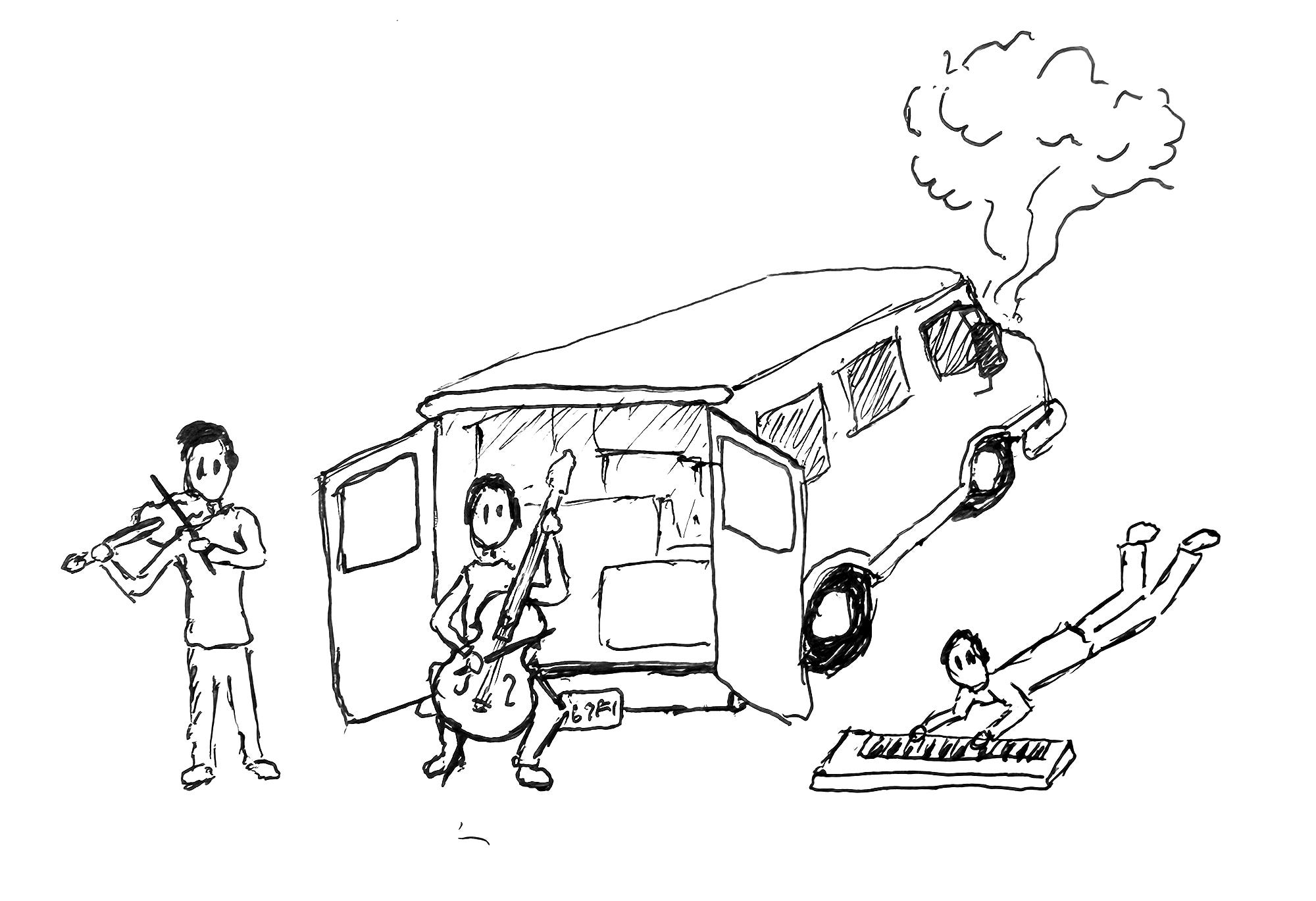
Some 15 years ago, I was in a post-rock band called (the) slowest runner (in all the world) with five of my best friends. It gave me some of the best times in my life, and then blew up spectacularly in a smoking van on the highway outside of Nashville.
This past week, in revisiting some of our old records for a possible re-issue (fingers crossed), I stumbled across an EP I made with just the piano, violin, and cello from the original band and never released. I haven’t listened to these recordings in years, so it was really fun and nostalgic to dive in. And to my surprise, they’re better than they were in my memory. I suppose time has a way of blunting the bite of perfectionism.
Listening back also made me wonder what I’ve forgotten that I used to know about making music, because I don’t really write like this anymore. I’m not sure if I can. What can I learn by trying to talk to the person who wrote and played this stuff? What wisdom does he have to share with me for my creative process now?
I enter the room for our interview. It’s warm and cozy, maybe a little blurry at the edges. The color is faded from the foot traffic of events. A lot’s happened.
The guy sitting across from me is a stranger I once knew, though maybe never as well as I wanted. He’s surprisingly shifty at first — at least until we start talking about something concrete. I remember now how much he used to enjoy being in the background and off-stage. There was this one club in Montréal where I swear he was playing in a closet on the side while the rest of the band filled the stage.
But today, I’m here to talk to him, so talk he must. And he’s excited to talk about this particular music.
“These songs took so long to come into being,” he says. “Like dust settling. They never really had a final shape, not even after we recorded them. Every time we played them it felt like they were still up for grabs — every melody could still be tweaked, every section amended or re-concocted in a slightly new form.”
You can hear it in the music. I wouldn’t call them Franken-songs — it’s not as dramatic as all that — but there is a soap box derby nature to them. It’s as if they’ve been lovingly cobbled together by some kids in the neighborhood from bits and pieces found lying around their dad’s workshop. There’s coherence to them, but it’s a loose one.
In practice, this means the ideas are fast and free-flowing. They’ve got the exuberance and playfulness of people doing something without the full knowledge of how to do it: Why not throw this idea here? What about holding that note for a bit too long? How about a different time signature right here, and then we pass the melody back and forth a few times, and then we play this part faster for some reason? They’re bursting with innocent, unearned confidence.
“All of these songs are written for piano (me), violin (Hunter Jack), and cello (Gillian Jackson). Partly that’s because we’re all friends and those are the instruments we play, partly because we were all in a post-rock band together and regularly found ourselves alone in rehearsals while the others were off f$^&*ing around somewhere.
Musically though, the biggest influence for me was this band Rachel’s, especially their album Music for Egon Schiele. I really wanted to do something like that. I think that’s why I started writing for this set up specifically.”
I haven’t listened to Rachel’s for a long time. They sit in this weird place, somewhere between the minimalist music of Philip Glass and Steve Reich and the neoclassical music of Nils Frahm and Ólafur Arnalds, at least chronologically — and yet, they’re not as known or popular as those artists.
They came up in the alt-rock golden age of the early ‘90s, a time when the market for recorded music was at its peak, when indie labels were seen as cauldrons for musical innovation, and when everyone was looking for the next Nirvana. Despite being a totally different genre, Rachel’s was very much in that vein — the product of colliding art students and classically-trained musicians from Louisville, KY, many of whom played in rock bands at night. They were signed to an imprint of indie label Touch and Go Records, the label that gave us Slint, the Butthole Surfers, and early Yeah Yeah Yeahs. And as part of the whole “bringing classical music into rock venues” thing, they were forerunners of the hugely successful modern neoclassical movement, even if largely unacknowledged.
I used to love Rachel’s. They’re more intricate and complex than lots of the other neoclassical music I listen to, but with moments of modern harmony and a punk ethos to boot. There’s no fancy production to it. There are too many notes and changes in it for heavy reverb tails or washy pads.
I can’t believe I’ve barely listened to them for 15 years. It’s funny how that happens, a band you love so much at one time and place just stay there and don’t travel with you to the next one.
Back to the EP I’m here to talk about. I ask my former self how these songs came about:
“Each of these songs has its own story. “August 1st” we wrote for a friend’s wedding. “Red 14” was a song for the full band we adapted for the trio. “Mouse” was a slog — we couldn’t get it right but kept trying.
“Five Violins” was the first one I think. Hunter and I wrote the structure of it after a band rehearsal. I loved combining the waltz-like melody, which felt sweet and circular, with an aggressive math-rock section in the middle. I believe it’s in 13/8.
When we came up with that pattern, I remember being really psyched because it’s a weird time signature but the rhythmic pattern is such that it doesn’t sound that weird. It sounds fairly normal, maybe even a little martial, but like a marching army that does a little skip following every 3rd step. And then Hunter wails out on the violin to end the section, and it’s really loose and fiddle-y. I love that aspect of his playing, the looseness.”
Listening to this, it feels like something I would never do now, and I’m not sure why. There’s something about writing in odd time signatures that feels naïve, one of those things that novice composers do to show off how complex they can be. It’s a classic symptom of a common beginner’s mistake: privileging technique over musicality.
But there’s also an ebullience and cockiness to it that I now miss. It’s antsy and impatient and searching — qualities that here on my interviewer’s couch 15 years in the future feel a little distant. And it’s so confident in itself, despite having seemingly no right to be. It doesn’t spare a thought for the judgment of others.
“I feel like this music is an untrained person’s idea of what classical music sounds like. That’s not to say we don’t know some classical music, but none of us went to music school or studied this stuff. Mostly we’ve played in rock bands. So for this, we don’t really have any preconceived notions of how to do it.
At the same time, none of us ever wants to play a boring part, so we’re probably over-writing a bit. Sometimes I will come to a writing session with a suggested part for, say, the cello marking the root note of the harmony or for the strings outlining some chords, but invariably we all want to play something more active, more interesting than that.
The idea of fitting melodies in between and against each other is just more exciting. It can also go wrong so much more easily. And I think it’s led to some more idiosyncratic ideas that would have been hard to come up with if one person had written this stuff alone.”
One thing you don’t realize when you’re young is which of your routines won’t last forever. For me now, in my 40s with a family and lots of responsibilities, one of the routines that’s mostly gone is hanging casually with friends making music together. Many of my friends have moved away. Others have families. We all have a little less time. When we get together, it’s usually planned activities. It’s different.
But those casual bored moments messing around with instruments are how much of this music came together. At one point when I was 24 or so, we had 2-3 late night band practices a week, on top of my full-time 9 to whenever job at a consulting firm.
It’s kind of hard to imagine now: What do you do with that much practice time? The answer was so easy back then: We hung out. We jammed and joked and messed around and drank more than was good for us. It’s amazing how valuable wasting time can be for your creativity.
At this point in the interview, I felt the need to text my former bandmate and cellist Gillian to make sure I wasn’t getting taken in here, that my interviewee wasn’t overly romanticizing things. But she mostly agreed with him. I asked her what lessons she would take from her former self, and she replied:
“I think I had more confidence in my creative ideas. I don’t think I was so overwhelmed by the feeling that everything’s been done before. Like, everything was new and exciting and interesting. We cared about moments of discovery instead of striving to be noticed or recognized or make f^&*ing money. I feel like I get stuck in analysis paralysis with everything now.
Music made me feel cool and quieted my chaotic brain and got me laid lol.”
Sex, drugs, friends, and indie chamber music. It’s so simple to say now, but this music was overwhelmingly a byproduct of friends that enjoyed spending time together and playing music with each other and challenging each other to write intricate stuff and sometimes playing it live for other people. One thing I’m curious about is whether that doesn’t happen as much anymore because I’m older and have a family now, or whether it doesn’t happen for anyone anymore because we’re all on our phones and isolated from each other more than ever. I sincerely hope it’s the former.
It also meant this music didn’t have any place to go.
“We’ve always been a little unsure where this music belongs. We started playing it in interludes for our post-rock band slowest runner, a little change of pace from some of our louder, more heavy stuff.
Then it came into its own during this summer tour we were on when the former sheriff’s van we were living in broke down outside of Nashville. We were idiots and forgot to check the oil. We still had a week of shows left, so we decided to split up. Half the band stayed with friends in Nashville waiting for the van to be fixed (didn’t happen) and hoping to re-join the tour (also didn’t happen). Gillian, Hunter, and I kept going, hopping on with another band and opening for them playing these songs as a trio.
There were some really nice moments at those shows. We were able to take audiences by surprise, and I liked offering this quiet chamber-ish palette cleanser before the post-rock excesses of the band that followed us.
Our full band didn’t survive that debacle, but the trio kept going for a bit. We played a couple weddings. I actually proposed to my wife on a drive up to Montréal to play this music at a friend of a friend’s wedding ceremony.
We also started playing these songs at dinner parties and game nights for our friends, and advertised ourselves as an outfit called “Concerts in the Kitchen,” where we’d show up at your house and play quietly in the background for your event. Loved that because the music becomes part of a lovely moment that’s about more than just the music. That was a great feeling.
Truthfully, I haven’t thought about this music in years. I’d almost forgot we’d recorded it. I can’t really remember why we did it, but I’m glad we did. If nothing else, it’s a wonderful keepsake of an amazing time.
And this week, I’m trying to take some lessons from it into my creativity: to be more confident and willing to try unorthodox things, to explore intricate melodies in a way I haven’t for a while, to do stuff I don’t know how to do and compose more outside of the DAW, to have more of a f%&* it attitude, etc.
At the end of our interview, I got up to leave. Obviously, my friend can’t. He’s stuck there, in the past where he belongs, but it’s been nice talking to him. He’s left me all nostalgic and in my feelings so I kept texting with Gillian a bit, and she summed the whole thing up really nicely for me:
“I just had a sweet thought on your original question (“Is there anything your former self could teach us now about creativity and music?”).
It’s love. We all loved each other so f%&*ing much back then. I mean still do, but we spent ALL our time together. We were so in sync like music was a second language for us. Like siblings or something.”
Damn. That’s a lesson worth tapping into: Make music from a place of love. The rest is just notes and noise.
Do you have any old recordings you haven’t revisited in a while? What do you think you could learn from the person who made them? Post them in the comments. I’d love to hear it.
Yours,
Ian
—
Ian Temple
Founder, Soundfly
ian@soundfly.com
Set a goal each week. Share it with a group of supportive musicians. Meet up to chat through challenges. Share what you create. Give and receive feedback.
That’s basically how my Draft // Echo program works. The idea is simply that it’s really hard to stay on top of your musical goals when you’re working on your own with no structure. So join some other musicians, focus on your music, and make some serious progress.
You can join with the code soundflyweekly here.
“These are all ways to put yourself on the hook. Is there any better place to be?” One of the central ideas behind Draft // Echo is to be “on the hook.” This is an idea from Seth Godin, the idea being that you increase your chances of success by committing to something. I’ve always found this to be true.
“I am happiest while pursuing not just a hobby, but a hobby I can get better at.” <— resonates. I was reminded of the “on the hook” idea from Austin Kleon’s typewriter interview with violinist Vijay Gupta here. There’s something about answering questions on the typewriter that makes the answers more poetic.
“Everything can be taken from a man but one thing: the last of the human freedoms - to choose one’s attitude in any given set of circumstances.” — Viktor Frankl, as taken from Grant David Crawford, PhD’s beautiful reflection on making art in the face of ***all this***. Read the whole thing here.
“if you want to see something interesting, you have to see things that you might dislike.” Taken from experimental psychologist Adam Mastroianni’s part 2 to his popular article the Decline of Deviance. In part 1, he documented that we’ve gotten less weird and edgy in general. In part 2, he tried to tease out why a bit more and replied to some critics.
I’m giving Qobuz a spin this month. It’s a streaming service (like Spotify) that makes a big deal about being human-curated (unlike Spotify) and having better artist payouts (unlike Spotify). What I really want from a streaming service these days is a) the ability to keep a library with my favorites, and b) good recommendations for things I might like. So far, I feel like Qobuz is doing a good job at both, but I’ll let you know as I keep going! (This is not an ad, I was not paid for this take, I was recommended Qobuz by a friend and am trying it out).
There are no video recordings of the trio I reference in this article (that I know of), but here’s one of the full band for kicks. Weren’t we young?
Comments
Nothing yet. Say the first thing.
Sign in to join the conversation.