
“It’s lovely. It’s the sort of music that doesn’t really go anywhere. Your grandfather would have found it frustrating, but I really enjoy it.”
That was my Granny’s response to a tape (yes, cassette tape) I made her of me playing some songs I’d written on the piano in college.
It stuck with me because, well, first of all, “I like it but others wouldn’t” is such a funny backhanded compliment, and I love a backhanded compliment. They feel a little out of style these days, and I feel they’re worth preserving.
But also I didn’t expect that specific comment. I didn’t think of my music as “not going anywhere.” I also didn’t really think of it as going somewhere either. I suppose I hadn’t really considered its whereabouts at all or whether it was going or staying put.
But once she said it, I immediately heard what she was saying. Back then, I was obsessed with Yann Tiersen’s Amélie score, like every other piano-inclined 18 year old in 2003. I loved the way those songs had a simple melody over a looped progression that repeated and grew, and then he’d add new voices in the piano arrangement over time, increasing the intensity until it felt like you were playing the equivalent of five different instruments with your two hands.
So my songs were like that: looped progressions with simple melodies that escalate and evolve a bit. They did “go somewhere” in terms of notes leading to other, different notes and whatnot, but there wasn’t a huge sense of progression, especially harmonically.
And what they definitely didn’t have was a lot of V to I resolutions, which for a certain audience is the only somewhere worth going to, if you know what I mean. When you listen to Bach or Mozart, there are those moments when the harmony seems to tumble downhill like a stream. The IV chord bounces up to the VII, then falls down to the iii, then up to the VI, then down to the ii, then up to the V, and home.
I understand the allure. What a delightfully organized rivulet. What a pleasing babble for this brook to have. It all feels so ordered and mathematical and elegant.
But does a song have to go somewhere like that? I’m not always in the mood for the direct path, and sometimes I don’t even want to go downhill at all. Maybe I want to clamber up some rocks instead, or sit comfortably on a hillock looking up at the sky.
In other words, I want a wider set of options here: Where are all the places a song can go? How? And what journey am I trying to take my audience on, if one at all?
If you think about it for a moment, there are tons of ways for songs to travel. Bach does it through harmonic structure. Bob Dylan does it through lyrical sagas, tales, and love stories. Jazz musicians often do it through improvisation and dissonance. Electronic musicians do it through drops and builds. Phish does it through 45 minute improvised jams. John Cage does it by changing a note every year or two for 600+ years (at least in the case of the organ at Halberstadt).
One of the most obvious ways for a song to go somewhere is through a narrative arc — the building of drama via escalating ladder rungs of tension and escalation that leaves you changed at the end.
When I chatted with Charlie Harding for my podcast episode on epic pop songs, he talked about the “epic” structure of pop music — the way it starts with a verse, then builds through a pre-chorus, then hits the chorus, then maybe repeats but with new elements added as the drama builds, then goes to a bridge which is somewhat unexpected and maybe adds a new twist, before erupting into a final climactic chorus or post-chorus. It’s storytelling gold — a template with natural peaks and valleys, tension and resolution built in. The structure has a ready-made, customizable journey within it that helps you know where to go.
But “songs as stories” can also feel a little too on the nose to me sometimes. Not every song needs to narrate a struggle through rising tension to cathartic resolution. I remember seeing ambient group A Winged Victory for the Sullen performing in a cathedral with a string section in Brooklyn once, and I’m not sure those songs told concrete stories or went anywhere — but I certainly did. My emancipated spirit was bouncing around the rafters among the echoes of the bowed drones in transcendent bliss. Sometimes the journey is a mental one.
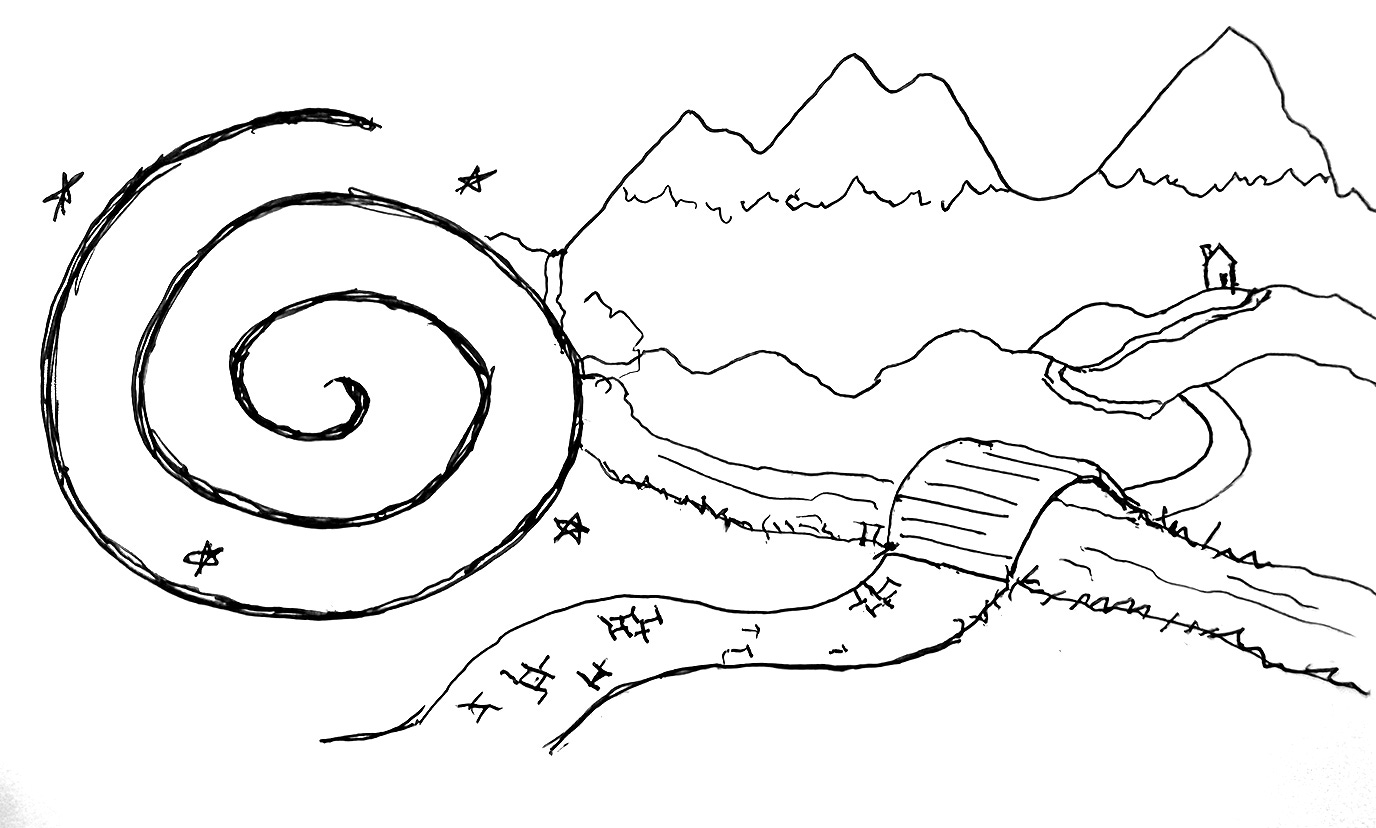
There are plenty of other examples of music that seems to not “go anywhere.” In the Jad Abumrad podcast Fela Kuti: Fear No Man, members of Fela’s band talk about what it was like to play the same couple notes on repeat for an hour, with no changes whatsoever — and members of the audience talk about getting lost in a kind of hypnotic trance to the repetitions in the music. One listener calls it “the spiral,” Fela calls it a “swirl.” Both imply a circular journey as opposed to a linear one. There’s still some change happening. It’s not static. Just circular.
My friend Dr. Ethan Hein has written a lot on how groove-based music is often built on different structural elements than narrative music — particularly rhythm and meter, timbre and mood, syncopation and call-and-response. Not coincidentally, I know he often likes illustrating modern music theory using circles, such as his incredible Groove Pizza or his chord chart circles. It makes sense.
And then, of course, there’s music that combines elements of both: hip-hop tracks with looping samples that still have a chorus, a narrative, and a build to them, or pop songs built on repetitive beats and loops, or minimalist pieces like Steve Reich’s “Music for 18 Musicians” that is somehow both endlessly repetitive and circular while also taking you on a fairly epic narrative journey through a slowly evolving series of chord changes.
The reason I’m thinking about all this is because I’m working on a song right now, and I’m not quite sure what it is yet or where it’s going. I’m still unwrapping it, trying to discover what it wants to be and if it should go anywhere. Like Amélie herself, the song is an eccentric little number trying to figure out how to be in the world, and I’m trying to shepherd it through its adolescence. It’s a messy time.
This article in essence is me asking myself: Where should it go? I could try to force it into a certain structure — a verse-chorus structure, or an AABA structure, or more of a theme-and-variation-style motivic development. There are so many wonderful models for what a grownup song can be in this world, from musical theater performer (through-composed) to tenured professor (math rock). I often find it helpful to adapt an idea for a song into a template.
But I could also build it in escalating circles, like Fela’s swirls. I can compose looping patterns, adding stuff and taking it away as needed to keep the energy high — let the orchestration and arrangement drive it forward. Music is so fractal in this way. You can zoom out, adding in a variety of new parts and voices to create something big and sweeping, and that can increase a song’s emotional footprint. Or you can do the opposite and zoom in, taking everything else away except for a single voice full of texture and dynamics. In each case, the sonic potential fans out before you with incredible depth.
And then there are also little micro-journeys you can go on along the way, arranging decisions you can make that can bring the landscape of your travels into starker relief. When you repeat something many times in a row, the smallest change can unleash a torrent of energy, like a slight change in the current. Contrasts can hit like a thunderstorm, completely remaking the scene from one of stability to instability.
I think I have an idea now of what I want to do with this piece. I do want to take you on a journey with it. I want us to start somewhere very different from where we end up, so there’s going to be a radical change of some sort within it. Emotionally, I want to move from a place that’s darker to one that’s more hopeful. I want to use repetition to my advantage, but also intersperse elements of surprise that make the path feel unexpected and a little windy. I want one big crashing push that knocks you off course. And I want it to not feel too long — more like a haphazard leap and run through the woods into a clearing than a slow march uphill to the light.
Now, I just need to figure out how to do all that through music.
What’s the point of all this? For one thing, I find it endlessly useful to have analogies that can help guide my composition work, and a “journey” might be a good one. For another, I love the reminder that music can and perhaps should take us somewhere emotionally, even if that looks different for different audiences and with different focal points. And finally, it’s helpful to consider that there are templates I can follow to help move my music along — or abandon if I’d rather do something different. It’s all possible.
In the immortal words of my buddy Kiefer, “It’s music, dude. Do whatever you want.”
As you think about your songs and where they’re going, the most important thing is that it’s a somewhere that matters to you, that makes you feel something meaningful and powerful. Wherever that place is and however you get there, take us with you because it sounds awesome.
After all, my Granny didn’t care where my songs were going, and my Granny knew what she was talking about.
So where are your songs going this week? Do you know? Do you care?
Happy travels,
Ian
Ian Temple
Founder, Soundfly
ian@soundfly.com

It’s almost back to school time, so I thought I’d kick off my Fall sale a little early this year. Have I told you about Soundfly in a while? Basically, we have 60+ pre-recorded video courses, made with awesome distinctive artists like Kimbra, Com Truise, Son Lux, and others, as well as top educators like Dr. Ethan Hein or even Carnegie Hall.
Sign up this month with the code “BACKTOSCHOOL” for 30% off an annual or monthly subscription.
Comments
Nothing yet. Say the first thing.
Sign in to join the conversation.