
Most of us are making music for a room full of people who aren’t in it.
The playlist curator.
The close friend whose opinion carries more weight than it should.
The audience we’ve imagined in our head out of comments, streams, and whatever we saw doing well last week.
None of them are in the studio, yet all of them are influencing our creative decisions.
The thing is you did it on their behalf, in advance and without being asked (partly because of our biological need to feel a sense of belonging, and to not be exiled from the tribe).
I spent years like this and didn’t know it.
I thought I was being strategic, but for the most part I was really just asking permission from people who had no idea I existed.
That’s the Approval Trap. When we’re optimizing for acceptance before the work even exists.
Don’t get me wrong, the trap isn’t caring what people think, it’s letting that care operate during the making when the only thing that should be in the room is your taste and your likes.
Here’s today’s reframe:
Making music for yourself is not self-indulgence, it’s the only condition under which your actual taste can show up.
Your taste is the one thing you have that nobody else can reproduce. It was built by a decade of songs you listened to, records your parents played, a scene you fell into by accident, a chord progression that made you sit down and deconstruct it.
That’s your Sonic Genealogy.
That musical inheritance is your signal, everything else in between that and your finished songs is just tools.
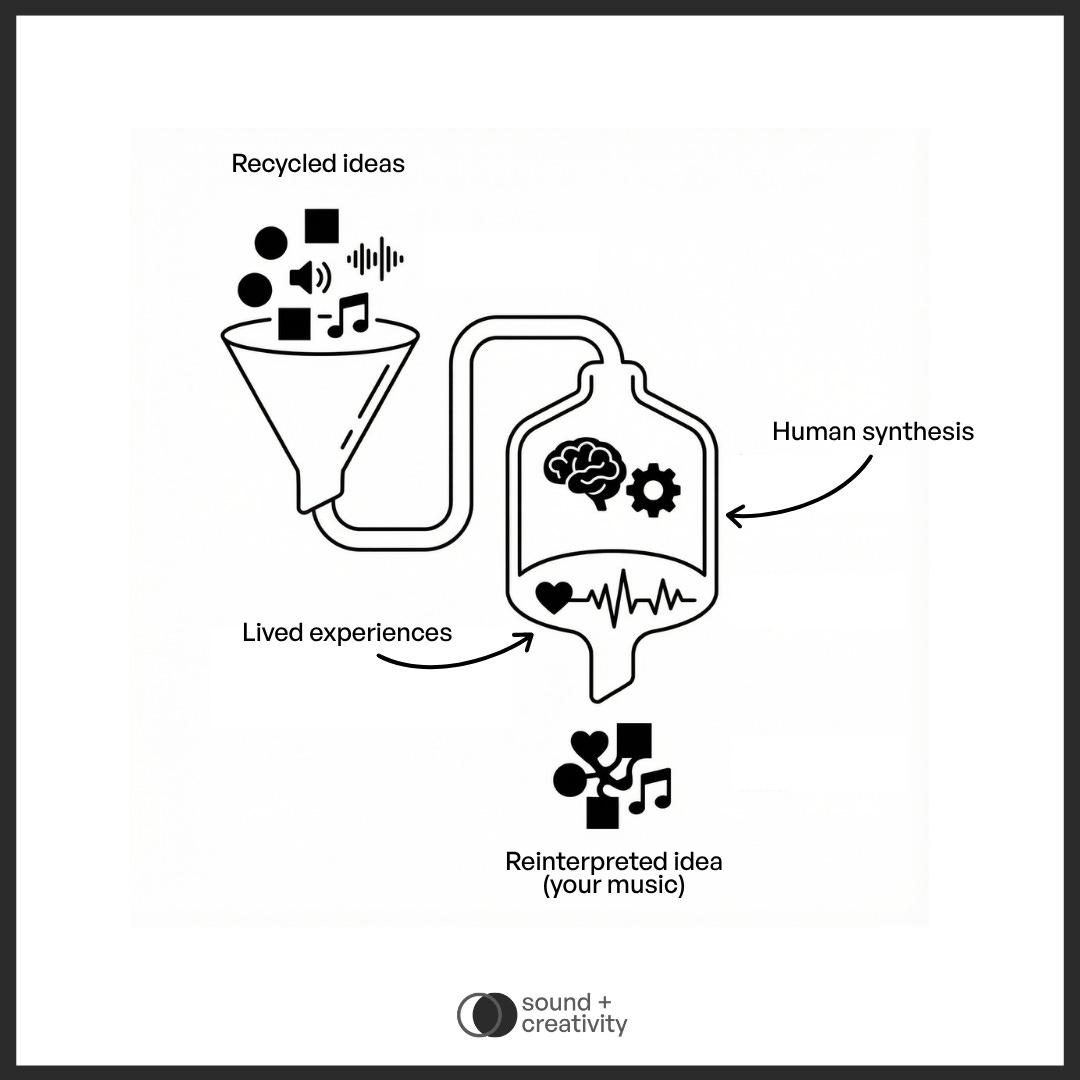
Because when you make for the imaginary room, you filter that signal through a guess. And the guess is always about the past, because it’s assembled from what already worked for someone else.
So the lesson here is simple…
The work has to be true to you before it can be useful to anyone.
Truth first, audience second. Most songs you love were made in that order whether the artist could articulate it or not.
In practice, this looks like three practices.
Make the first decision on instinct. The first ten minutes of a session are the most honest ones you get. Move fast enough that the imaginary audience doesn’t have time to convene. You can evaluate later, you cannot judge and create at the same time.
Notice the moment you lose your say. There is a specific moment where you stop asking “do I like this” and start asking “will they like this.” Learn what it feels like. It usually feels like hesitation, sometimes it’s just the literal thought. When you catch it, name it out loud, and go back to the first question.
Keep a record of what you actually liked. This is not about capturing what performed, it’s about collecting what you liked. Ideas, snippets, mixes, moments. Over a year that becomes a map of your own taste, and it’s more reliable than any trend report you’ll ever read.
Finish one song this month with nobody in mind. Don’t send the bounce, don’t post the clip, let it exist solely for you first. Do you like it?
Lastly don’t forget that the audience is real and they matter, they just come once you’re a fan of your own music.
— Hermes
P.S. Keeping a record of what you actually liked is the whole reason I built the Inspiration Vault inside Song Ritual. It’s a mobile app where you can collect the moments that inspire you without turning it into another folder you never open.
Song Ritual is currently in beta and being used by 40+ artists.
Subscribing to the app is also the most direct way to support the work I put out here.
If you’d like to learn more about Song Ritual and see if it can serve your creative process read all about it here —> Song Ritual website.
Comments
Nothing yet. Say the first thing.
Sign in to join the conversation.