
You sit down, open your DAW but something feels off.
The energy isn’t there, you’re not in the right headspace and you scroll for a bit, looking for something to spark it.
You reorganize your sample folders. You tell yourself you’ll start when the conditions feel right, when the mood arrives, when that elusive feeling of inspiration overwhelms you again.
And then the day passes and you carry on as usual.
This is one of the most common patterns in creative life, and it’s particularly insidious because it doesn’t feel like avoidance. It feels like self-awareness.
You believe you know yourself well enough to recognize when you’re not in the right state to create, like you’re respecting the process rather than forcing it.
And there’s a version of that which is true…
But there’s another version, a quieter and more comfortable one, that isn’t self-awareness at all.
It’s avoidance with a creative excuse attached to it.
The difference between the two is subtle, and most artists never examine it closely enough to tell them apart, because they feel the same from within. Both involve not starting, both come with a story about why not starting is the right call, but one is genuine discernment and the other is Resistance.
Here’s the thing most artists don’t want to hear:
The feeling you’re waiting for rarely arrives before the work, it almost always arrives because of it.
Creatives know this pattern intimately, even if they’ve never named it.
The project that stays in the folder for weeks.
The session that never opens.
The day that passes without a single sound made.
Not from laziness or distraction but from waiting. Waiting for the mood for the spark or the conditions to align in a way that feels right enough to begin.
The cost is obvious:
Time.
Hours, days, sometimes months of potential creative work that never happens.

But the deeper cost is harder to see, and in my opinion it’s the one that actually matters.
The real cost is the gap between where you are and where you think you need to be to start gets a little wider. The imagined version of “the right conditions” gets a little more specific, a more demanding.
Your confidence in your ability to create without those conditions, to just sit down and make something begins to wither away.
This is how creative blocks begin.
Not in a single moment of failure but in the accumulated weight of days spent waiting for a feeling that never arrived.
I’ve watched this pattern repeat across every kind of creative.
The producer who has a studio full of gear and hasn’t finished a track in six months.
The songwriter who has notebooks full of ideas and hasn’t recorded a single one.
The beatmaker who spends more time curating samples than making music with them.
And the common thread isn’t a lack of talent or ideas or time, it’s the belief that the feeling has to come first.
However for me the shift that changes everything comes from a simple and uncomfortable realization:
The state you’re trying to access through inspiration is usually the state that making something puts you in, not the other way around.
You sit down uninspired, open a session and start moving things around not because you feel it, but because you made a commitment to your craft and showed up.
And somewhere in that process something begins to shift…
A sound catches your ear and the work starts pulling you forward instead of you having to push it. It begins to take on a life of its own, developing its own gravitational pull.
That’s not magic, that’s just how creative flow works.
The discomfort you feel right before you start is not a signal that you should wait, it’s almost always a signal that you’re exactly at the threshold.
The moment where showing up matters most.
Resistance doesn’t announce itself as fear or avoidance. It arrives dressed as patience, self-knowledge or respect for the process (at least that’s how it did for me).
It says:
Wait until you feel it.
Don’t force it.
You’ll know when the time is right.
And because those things sound wise, because they rhyme with genuine creative discernment, most artists believe them.
They frame the waiting as respecting the process, then they wonder why the music isn’t getting finished.
Here’s the pattern that keeps reappearing across every creative discipline and every level of experience:
Resistance is always loudest right before you begin.
Not after you’ve been working for an hour.
Not in the middle of a session.
Right before. At the threshold. At the exact moment when the decision to start or not start is being made.
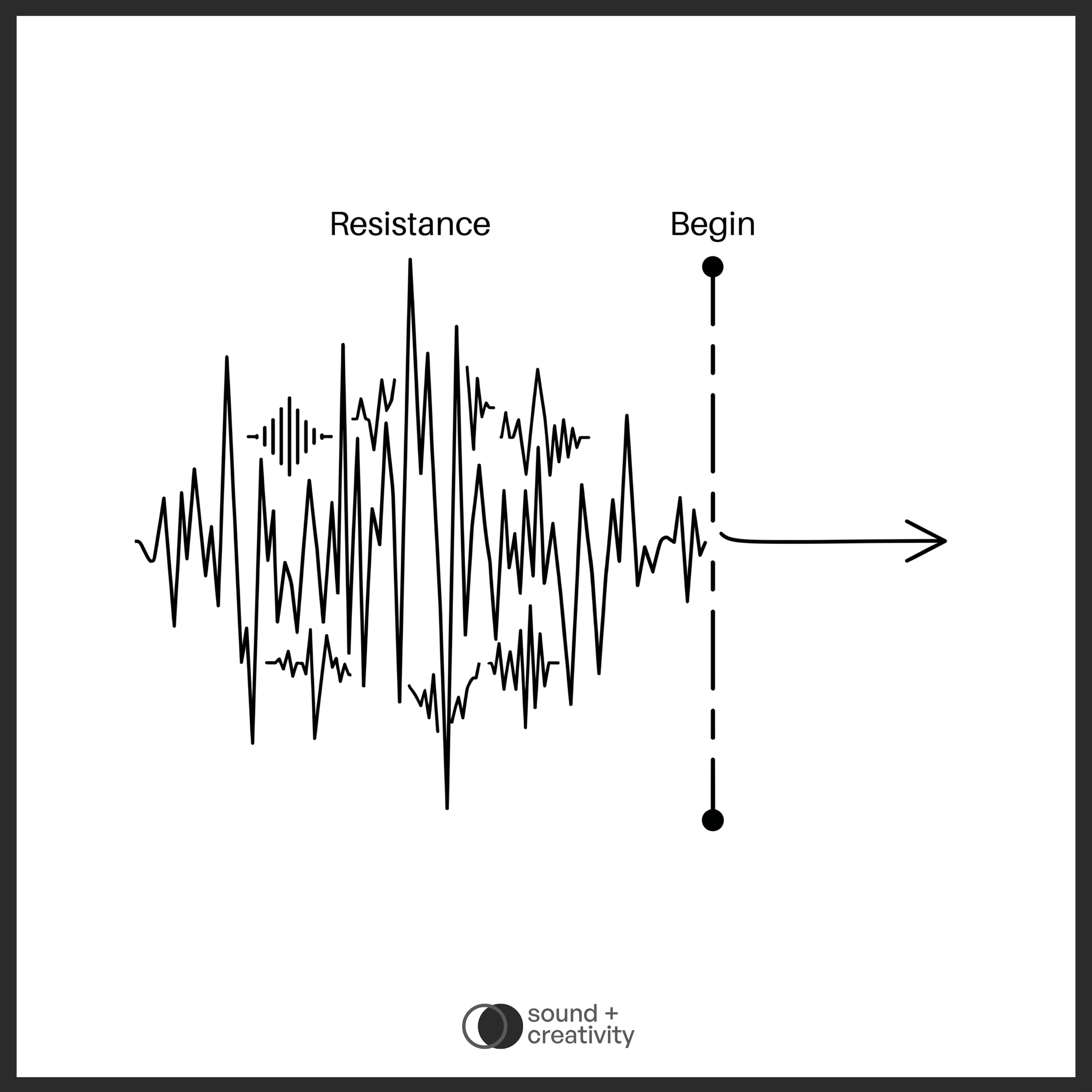
This is not a coincidence, Resistance concentrates its force at the point of maximum leverage because that’s where it can do the most damage.
If it can keep you from starting, it doesn’t have to fight you through the whole session.
The artists who build consistent creative practices understand this. They don’t wait for inspiration to bypass Resistance, they start moving, and they let Resistance dissolve along the way.
Because here’s what Resistance doesn’t tell you:
It almost always dissolves once you begin.
Not immediately, sometimes it takes ten or fifteen minutes of uncomfortable, uninspired movement through a session before something shifts, but it shifts. And to me this is the only real distinction between a consistent creative practice and an inconsistent one.
Not talent, better ideas or more free time, just the willingness and discipline to begin before the feeling arrives.
From experience I know starting can be the hardest part, so how do we even begin to develop that consistency required to stay locked in on our work?
This is where we get practical.
Next up are three practices, each designed to lower the threshold of beginning and rebuild your relationship with the starting from the ground up.
Most artists have an unconscious standard for what “starting a song” means.
It involves having some sense of direction, a sound in mind, a mood to chase, a reference to work towards perhaps. Starting, in this framing, requires readiness, and readiness requires inspiration.
My advice:
Break that definition.
Instead try redefining starting as opening a project with a single element and having no concrete expectation of what it’s supposed to be (or where it goes).
Simply define starting as committing to:
A sound.
A tempo.
A chord progression.
A sample pulled at random from a folder.
That’s it, that’s the start of a song. Declare it, you’ve started.
This works because the pressure of needing a grand vision before you begin is one of the primary reasons sessions never open. When the bar for starting is “I need to know where this is going,” most days won’t qualify.
When the bar is “I need to open a project and place one element,” almost every day qualifies because it’s an easy ask.
The blank canvas is paralyzing but a canvas with a single brushstroke is a starting point.
In practice:
Next time you sit down and the feeling isn’t there, don’t try to summon it.
Open a project, place one element, anything, a kick drum, a pad, a sample you’ve never used, a tempo that feels wrong. That’s the session, everything that happens next is a bonus.
Because remember that the goal isn’t to produce something polished, the goal is to show up in the place where inspiration can actually find you.

Once you’re inside the session, even with nothing, even with one element that feels completely uninspiring, start moving things forward.
Adjust the sound.
Change the tempo.
Layer something unexpected on top of the one element you placed.
Move a sample to a different position in the arrangement.
Add something that doesn’t belong, remove something that does.
The specific action matters less than the act of moving.
Creative flow is not a state you arrive in and then create from, it’s a state the work puts you in. The engagement precedes the flow, not the other way around.
This is one the lessons I’ve learned in my own creative practice, and it runs counter to almost everything the current culture tells us about inspiration.
We’re told that inspired artists sit down and the music pours out of them and that the great sessions happen when everything aligns. That you can feel when it’s going to be a good day in the studio.
I’ll be the first to admit that sometimes that’s true, but more often the great sessions start exactly like the bad ones, with resistance, reluctance, and the sense that nothing is working until something finally clicks.
Suddenly you’re not pushing the work forward, it begins pulling you.
In practice:
Give yourself permission to make things that are bad. Move through the session without judgment for the first 10 minutes.
Don’t evaluate, don’t compare, just move forward.
Notice when something catches your attention even slightly, and follow that thread. The feeling will come, it will feel unmistakable.
Trust the process enough to stay in the room until that happens.
This is the practice that makes the other two sustainable.
Separate the session from the outcome.
Most artists wether consciously or not, evaluate their sessions by what they produce.
A good session is one where something finished emerged. A bad session is one where nothing keepable happened, and this constant evaluation of output is one of the main reasons starting feels so heavy.
If every session has to produce something great then every session becomes a test, and tests are hard to pass when you’re not feeling ready or prepared.
The reframe here is that the goal of a session is not to produce something polished, the goal is to engage with the process and show up in the place where creative work happens and spends time there.
Some sessions will yield nothing worth keeping but I believe we must learn to not see that as failure, simply see it as part of the work.
When the session is a creative spark rather than a deliverable, the stakes of beginning lower. You’re not trying to produce a finished track. You’re trying to spend time in the creative space.
I’m convinced that over time, this practice builds something more valuable than any individual song:
A deeper relationship with the process itself but most importantly a consistent creative practice that doesn’t depend on the unpredictable feeling of inspiration.
In practice:
Before each session, set a single intention.
At the end of the session, evaluate not by what you made, but by whether you showed up and moved. Keep a simple log of what you explored and learned not what you finished.
Over time, you’ll notice that the sessions where you showed up without inspiration are often the ones that surprise you most. But most importantly you’ll learn that when each session is an experiment there is no way to lose, because the purpose of an experiment is not to succeed or fail it’s simply to learn.
Inspiration is real and it’s worth paying attention to when it arrives, it’s part of why we make music. But in my worldview inspiration is a byproduct of engagement not always a prerequisite for it.
I’ve noticed that the artists who wait for it or treat it as something that either shows up or doesn’t, are outsourcing their creative practice to a force they can’t control. They’re basing their ability to create consistently on a feeling that by nature unpredictable.
But time and time again I realize that the artists who build something lasting don’t do this, they simply show up day after day.
They lower the bar, start moving and they let Resistance dissolve in the doing.
And they tend to trust from experience and the accumulated evidence of sessions that started badly and ended somewhere unexpected.
All it required was beginning to finally unlock it.
Sitting down to create is almost always the hardest part, but once you’re in, the work takes over.
Start anyway, inspiration is already waiting there.
— Hermes
P.S. One of the reasons I built Song Ritual is because I kept noticing how much creative energy gets lost in the space between inspiration and execution.
Ideas scattered across voice notes.
Half-finished projects buried in folders.
Sessions that never begin because starting from scratch feels too heavy.
Song Ritual was designed to reduce that friction. It helps you collect inspiration, organize creative fragments and use structured creative prompts + personalized rituals to begin making music.
If you want to learn more you can see what’s it’s all about here.
No posts
Comments
Nothing yet. Say the first thing.
Sign in to join the conversation.