
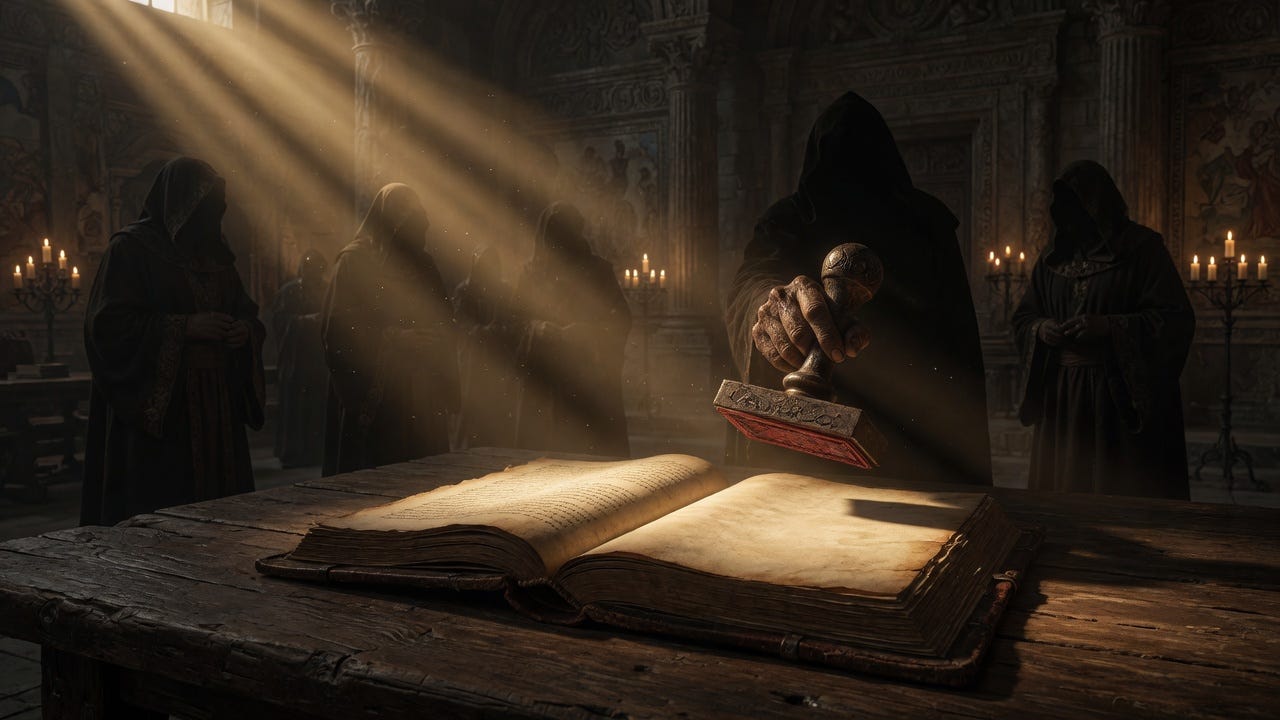
There is a story making its way around spiritual circles.
It usually goes something like this:
Early Christians believed in reincarnation for the first five hundred years. Then, in the year 553, the church held a council, condemned the teaching, and removed every trace of it from Christianity.
Now, that is one mighty interesting story.
It is also a little too neat.
History rarely behaves itself well enough to fit inside one clean paragraph. The truth is more complicated—but I believe it is also more interesting.
Some early Christians did entertain ideas that resembled reincarnation or the transmigration of souls. Other Christians strongly rejected those ideas. Still others believed the soul existed before birth without necessarily believing it returned through repeated earthly lives.
Those are three different things, and folks have a habit of tossing them all into the same theological sack.
So let’s slow down and examine this a little deeper.
Before asking whether early Christians believed in reincarnation, we need to decide what that word means.
Reincarnation usually describes an individual soul living more than one earthly life by entering a succession of human—or sometimes animal—bodies.
Ancient Greek writers often discussed a related idea called metempsychosis or the transmigration of souls. The basic idea was that the soul survived bodily death and could pass into another embodied life.
But reincarnation is not the same thing as either resurrection or the pre-existence of the soul.
Resurrection usually describes the restoration or transformation of a person after death. The same life continues into a renewed form; the soul does not simply begin another ordinary childhood as somebody else.
Pre-existence means that a soul existed before its present bodily life. That belief does not automatically require the soul to have lived as another human being before.
A soul could theoretically exist before birth only once.
So when an early Christian writer speaks about souls existing before bodies, we cannot automatically declare:
“There it is. They believed in reincarnation.”
Maybe they did.
Maybe they didn’t.
We have to keep reading.
Most people were taught to imagine early Christianity as one united church with one Bible, one set of doctrines, and everybody sitting in agreement until troublemakers came along.
That picture does not hold up very well.
The first centuries of Christianity included many communities, teachers, scriptures, interpretations, and arguments about the nature of Yeshua, the material world, salvation, resurrection, and the human soul. Alexandria alone became home to several competing Christian movements and theological schools.
Some groups later labelled heretical appear to have accepted some form of repeated embodiment.
Irenaeus, writing against groups he opposed during the second century, reported that followers of Carpocrates believed souls moved from one body to another and experienced different kinds of earthly lives.
That is clearly much closer to what we now call reincarnation.
But there are two things we must remember.
First, the Carpocratians did not represent every Christian.
Second, much of what we know about them comes from opponents who were trying to discredit them. Irenaeus was not writing as a neutral historian. He was writing a theological prosecution.
His report still tells us that transmigration was being discussed—but it does not prove that the majority of early Christians accepted it.
Matter of fact, Irenaeus spent considerable effort arguing against the transmigration of souls. His opposition shows that the idea existed in the religious world around him, but also that other Christians rejected it.
So the honest statement is not:
“The early Christians believed in reincarnation.”
It is:
“Some early Christians appear to have believed in forms of reincarnation, while others strongly opposed them.”
That may not fit on a bumper sticker, but it is a whole lot closer to the truth.
This is where the conversation usually gets tangled.
Origen of Alexandria lived during the late second and early third centuries. He became one of Christianity’s most influential early biblical scholars and philosophical theologians. He speculated about the origin and pre-existence of souls and explored the possibility that rational beings existed before their present embodied condition.
Because Origen believed in the pre-existence of souls, many modern writers call him a teacher of reincarnation.
But that conclusion is heavily disputed.
In his Commentary on Matthew, Origen directly called the doctrine of transmigration foreign to the church and argued against the same soul repeatedly entering earthly bodies.
That sounds fairly plain.
Origen believed the soul’s story may have begun before the present body. But repeated earthly incarnations are another matter.
Scholars still debate parts of Origen’s thought because some of his writings survive only through later translations, fragments, or hostile descriptions. Even so, the safest conclusion is that Origen’s pre-existence of souls should not simply be treated as ordinary reincarnation.
This distinction matters.
Imagine a man saying:
“I lived in another country before moving here.”
That is not the same as him saying:
“I have repeatedly died and been born into new families for thousands of years.”
Both statements describe existence before his present location.
They do not describe the same journey.
Now we come to the famous church council.
The Second Council of Constantinople took place in 553 during the reign of Emperor Justinian. Origen and teachings associated with later Origenism were involved in the larger controversy surrounding that period.
A collection of fifteen condemnations associated with this controversy rejected teachings involving the pre-existence of souls and their eventual restoration to an original spiritual condition.
But modern scholarship generally does not treat those fifteen statements as formal canons issued during the official sessions of the council itself. The scholarly consensus described by patristics specialist Peter Martens is that Justinian issued them and bishops approved them shortly before the council formally convened.
That may sound like splitting hairs, but it matters when somebody claims:
“The council gathered in 553 for the purpose of removing reincarnation from Christianity.”
That is not an accurate description of what happened.
The primary business of the council concerned a Christological dispute known as the Three Chapters controversy. Origen’s name appears in a condemnation associated with the council, but the relationship between the official proceedings and the separate anti-Origenist statements has long been debated.
Even more importantly, those condemnations speak directly about pre-existent souls and particular forms of restoration. They do not provide evidence that reincarnation had been the universal belief of Christianity until that moment.
The year 553 did not mark one sudden afternoon when everybody believed in reincarnation before lunch and nobody believed in it by supper.
The institutional church had been arguing against transmigration for centuries before that council. Irenaeus opposed it in the second century, and Origen himself later rejected repeated migration of the same soul through earthly bodies.
What happened over time was more gradual.
Certain ideas became accepted as orthodox.
Others were pushed outside the boundaries.
Institutions gained power to decide which teachers would be preserved, which writings would be copied, and which beliefs would be condemned.
That is significant.
But it is not the same as proving that reincarnation was Christianity’s original universal teaching.
There is also a popular claim that church leaders removed biblical passages teaching reincarnation.
I have not found reliable historical evidence that the Council of Constantinople—or another early council—went through the biblical manuscripts and deleted clear reincarnation teachings.
That does not mean the biblical canon developed without politics, authority, controversy, or human agendas.
It certainly did not.
But we should not replace one oversimplified church story with another oversimplified alternative story.
There are passages that cause people to wonder whether ideas about pre-existence or returning souls were part of the conversation.
Yeshua says that John the Baptist is, in some sense, the Elijah who was expected to come.
Some readers take this as evidence that Elijah reincarnated as John.
Others understand it symbolically: John carried Elijah’s prophetic role, spirit, or mission rather than Elijah’s individual soul occupying John’s body. Origen himself used this passage to reject transmigration and argued that John continued Elijah’s prophetic ministry without literally being Elijah reincarnated.
In John’s Gospel, the disciples meet a man who had been blind from birth and ask whether the man himself had sinned or whether his parents had sinned.
That is an unusual question.
How could the man have sinned in a way that caused a condition present at birth?
Some see the question as evidence that the disciples knew about pre-existence or reincarnation. Others connect it with ancient ideas about prenatal sin, inherited consequences, or simply the disciples proposing a confused explanation that Yeshua then rejects.
The passage raises a question.
It does not provide a complete doctrine.
On the other side, Hebrews says people die once and then face judgment. That passage has long been used to argue against repeated earthly lives.
The texts leave us with material to examine—but not with a clear statement from Yeshua saying:
“Every soul repeatedly returns to Earth in another body.”
Nor do they give us a clear statement from him declaring:
“The idea of reincarnation is forbidden, and you must never consider it.”
As with many spiritual subjects, later institutions often became much more confident than the texts themselves.
We should be careful not to invent conspiracies where evidence is lacking.
Still, we can ask why a belief in repeated lives might sit uncomfortably beside an institution built around one earthly lifetime, one authorised path of salvation, and one final judgment.
If a soul receives many opportunities to grow, learn, and awaken, then fear loses some of its urgency.
The institution can no longer say quite as easily:
“You have this one brief chance, and your eternal fate depends upon accepting our answer before time runs out.”
That does not prove reincarnation is true.
It does help explain why the idea could become threatening within a system whose authority depends partly upon controlling the terms of salvation.
At the same time, reincarnation can create problems of its own.
It can be misused to blame suffering people by claiming they must deserve their pain because of something they did in a previous life.
It can cause people to neglect injustice by saying every victim simply chose their circumstances before birth.
And it can become just as rigid and manipulative as the doctrine it replaces.
No spiritual teaching should be accepted merely because it frightens an institution.
It should also not be accepted merely because it irritates one.
Here is where I land.
Some early Christian movements believed in ideas resembling reincarnation or transmigration.
Many other early Christians rejected those ideas.
Origen believed in the pre-existence of souls, but that should not automatically be confused with repeated earthly reincarnation—and his surviving commentary explicitly opposes transmigration.
The church’s boundaries narrowed over time, and beliefs about the soul that did not fit the developing orthodox system were condemned or marginalised.
But there is no solid basis for saying all Christians believed in reincarnation for five hundred years until one council suddenly removed it.
The truth is neither:
“Reincarnation was always the central teaching of Christianity.”
Nor:
“No Christian ever considered reincarnation until modern times.”
The truth lives in the uncomfortable space between those two claims.
And that space is usually where history gets interesting.
You do not have to decide today whether reincarnation is true.
You can examine accounts of past-life memories.
You can study the ancient texts.
You can compare resurrection, pre-existence, transmigration, and spiritual rebirth.
You can listen to people whose experiences do not fit neatly inside your current worldview.
And you can still say:
“I do not know.”
That is not spiritual failure.
Sometimes “I don’t know yet” is the most honest doorway into deeper understanding.
The purpose of examining early Christian history is not to replace one unquestionable doctrine with another.
It is to recover the questions we were told had already been settled.
Perhaps consciousness experiences one earthly life.
Perhaps it experiences many.
Perhaps the truth is stranger than either system has imagined.
But whatever the answer may be, fear should not make the decision for us—and neither should our desire for a particular answer to be true.
Real integrity means being willing to follow the evidence, even when it leads somewhere we did not expect.
Were you taught that reincarnation was completely incompatible with Christianity?
And if your beliefs have changed, what caused you to reconsider the possibility?
Share your experience in the comments. Your question may become the subject of a future From the Comments article or podcast.
Remember, the Kingdom is a lot closer than you think.
Comments
Nothing yet. Say the first thing.
Sign in to join the conversation.