
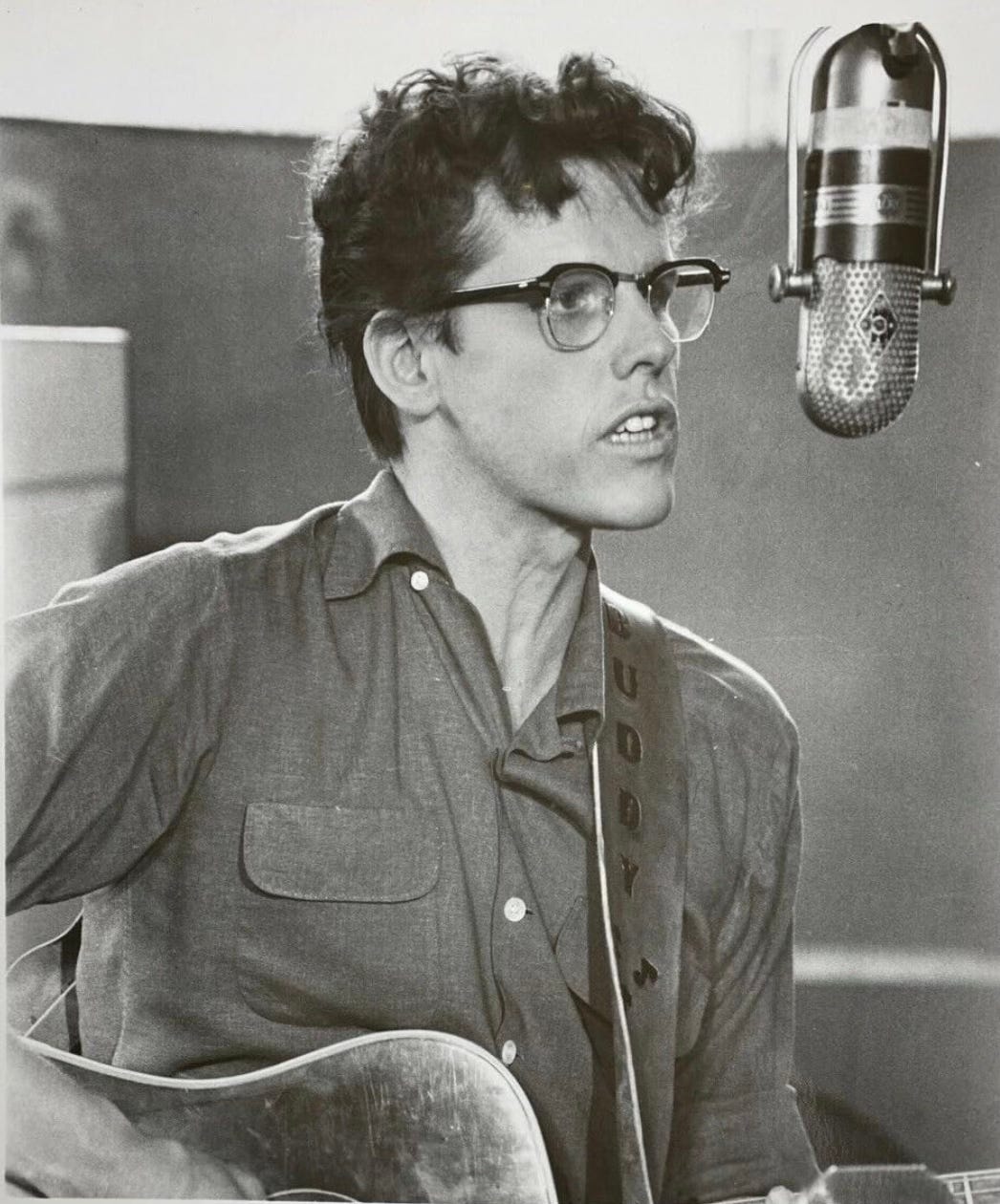
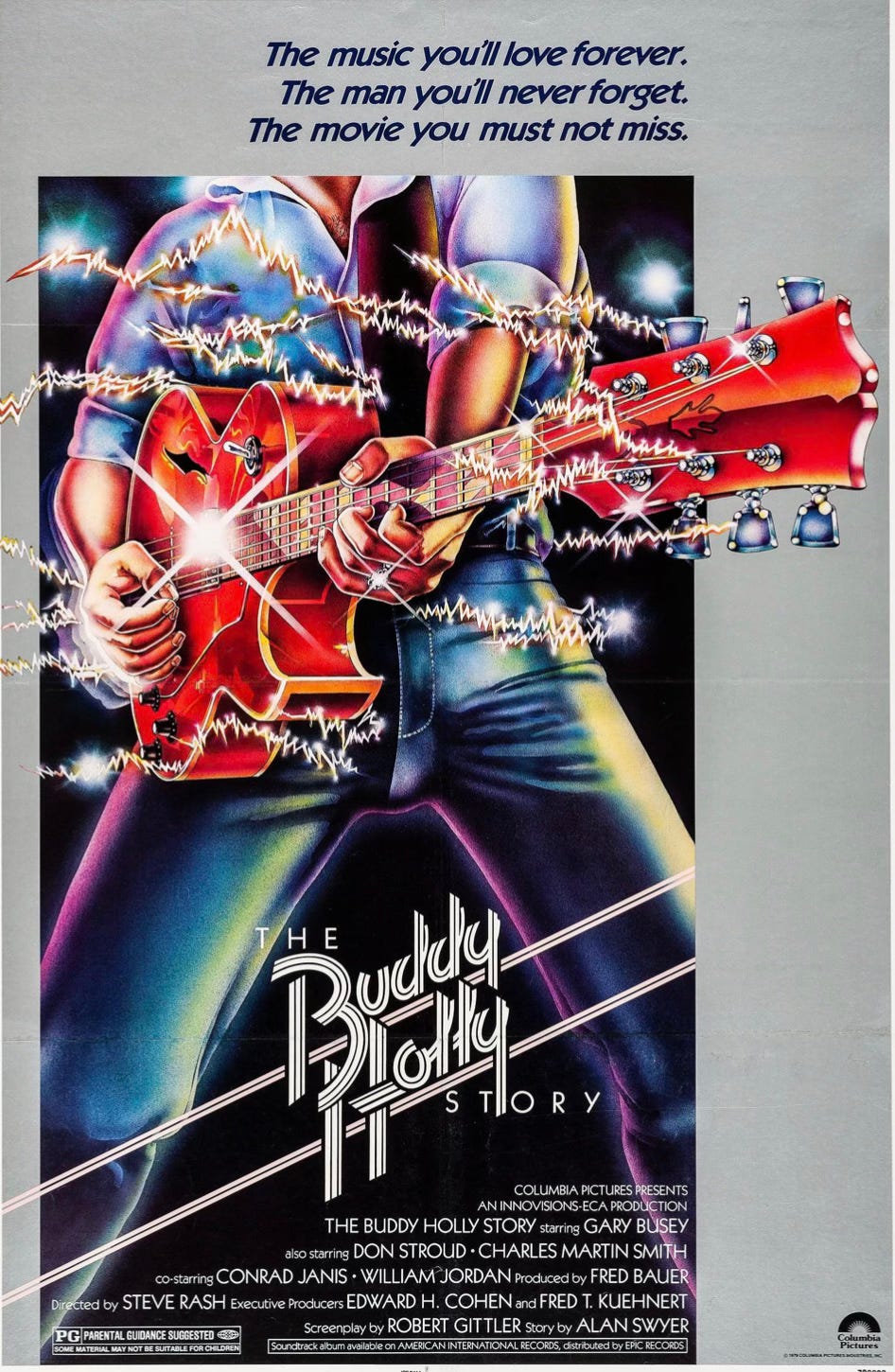
There I was channel surfing the free content when Gary Busey delivered a powerhouse, Oscar-nominated performance in the 1978 biographical film The Buddy Holly Story. Interestingly, the movie brings up many topics in the present Americana world. Charles Hardin “Buddy” Holly (1936-59) stands as a titan in Soul Country as he fused country, rock, rockabilly, R&B, pop, gospel, New Orleans and even Latin sounds. The icon forged one of rock and roll’s most enduring songbooks before his tragic demise at 22. I found this film rewarding, especially after the overblown Queen, Elvis and Michael biopics. It felt like the budget was similar to other 50s retro going around from Happy Days to American Graffiti, meaning minimal and character driven, not laden with special effects or staged mega performances. In the end the realism included things like Busey’s guitar cord getting wrapped around his calf, and the director leaving it in the final cut.
But Busey’s journey to that role started long before Hollywood with genuine musical roots. Before he became a recognizable character actor, Busey worked as a drummer playing for country-western legends including Willie Nelson, Kris Kristofferson, and Leon Russell. He also performed on a local Tulsa, Oklahoma television show under the character name Teddy Jack Eddy, building real credibility in the music world before transitioning to film.
The rabbit hole widened as I learned about the original production. The Buddy Holly Story project actually emerged from the ashes of an earlier, aborted biographical film titled Three-Sided Coin, which 20th Century Fox was developing before it collapsed mid-production due to pressure and rights disputes with the Holly estate. In that original ill-fated adaptation, Busey was cast to play the band’s drummer, Jerry Allison. During his time on Three-Sided Coin, he spent six months hanging out with Allison, then serving as a musical advisor. Through the screenplay and countless personal conversations with Allison, Busey absorbed an extensive, intimate knowledge of Buddy Holly’s personality, quirks, and life story. When that original project failed, the casting director remembered Busey’s intense energy and offered him a fresh audition for the lead role when the new film project was green lit.
Busey’s deep musical background and versatility proved essential for the final production. He famously showcased his real-life talent on the drums during a memorable studio rehearsal scene before switching back to the front of the stage. Busey was able to use his musicality to push for raw authenticity, insisting that he and his co-stars record all of their musical numbers completely live on set rather than lip-syncing to pre-recorded tracks.
The narrative arc of the film builds toward the historic and tragic event famously known as the Day the Music Died. The movie concludes on a poignant note, showing Holly’s final, electrifying performance at the Surf Ballroom in Clear Lake, Iowa, and ends right before the fateful February 1959 plane crash that claimed his life. The film reinforced how Holly changed the face of music in his brief career. No Crickets - No Beatles - it’s that simple.
The Buddy Holly Story premiered in the United States on May 18, 1978, with a special opening in Lubbock, Texas. The film subsequently premiered in the United Kingdom on September 6, 1978, when film-backer Paul McCartney hosted a midnight screening at the Odeon, Leicester Square in London. Keith Moon, drummer of The Who, attended as McCartney’s guest. Hours after leaving the theater, Moon returned to his flat and died of a sedative overdose. It was his last night out, forever linking the film to another devastating loss in music history.
The Crickets themselves became a blueprint for how rock bands could function as creative units rather than solo vehicles, influencing countless artists who followed. The impact rippled through country-rock circles for decades, particularly shaping artists like Waylon Jennings, who was touring with Holly in 1959 and never forgot that brief window of collaboration. When Busey spent those six months with Allison preparing for the role, he was absorbing decades of accumulated knowledge from someone who had lived inside the actual creative machine that revolutionized American music.
Busey’s later career trajectory did not reflect the promise of this Oscar-nominated role, and he often found himself cast in reality television appearances in subsequent. Back in Soul Country a tip of the ten gallon hat to both Texans one who made the music and one who through perseverance brought it to the screen.
A decade later Paul put this doc letting his former bandmates tell their version of the real story updating the biopic myth.
No posts
Comments
Nothing yet. Say the first thing.
Sign in to join the conversation.