
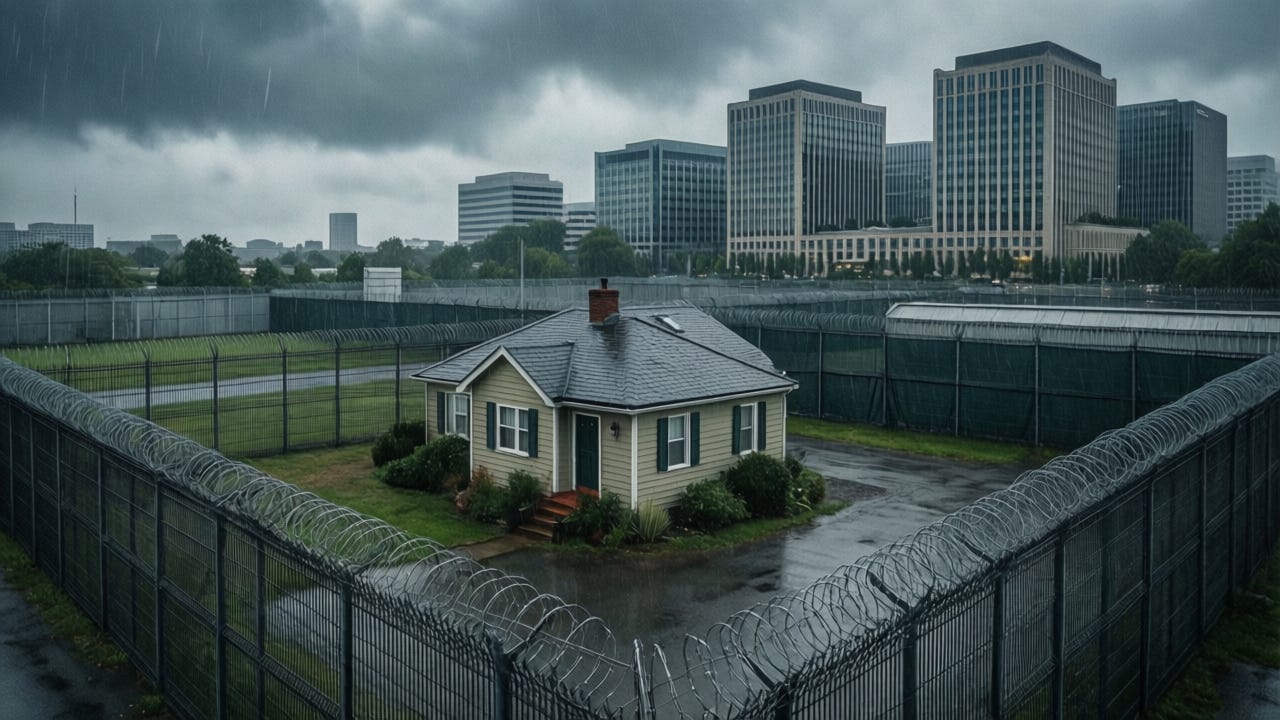
I’ve always said that every single argument against statelessness applies to the state even more. And by statelessness, I don’t mean the absence of governance; I mean the decentralised self-governance as opposed to the state’s centralised, threat-based government.
So, the “objection” goes like this:
“In a stateless, decentralised-governance model, what if someone buys all the property around yours and then charges you insane amounts of resources every time you want to leave your house to go to work, to shop, to meet people, or to visit another property of yours? What happens then, huh?”
State apologists love this argument, missing the irony that this argument is self-defeating, as it applies to statism even more.
You see, in the state’s centralised government paradigm, which humanity has, unfortunately, had since the inception of the alpha-male tribal leader, you get this enclosure phenomenon all the time.
Have you ever heard of an embargo, the precursor to war, which is the state’s inalienable trait and lifeblood? This is the exact same scenario; someone or some interest group enclosing a whole country, no less.
Have you ever heard of curfews and lockdowns? This is the purest form of this example: the state owning the property around your house (the streets) and, on a whim, disallowing any travel. Hell, even without curfews and lockdowns, the state doesn’t let you use its property (the roads) to do anything, unless you pay the vast majority of your labour in taxes, which you do. Yes, income tax is but a fraction of what you pay in taxes. Most taxes are hidden and indirect, making up the majority of the price tag of everything you buy.
Have you ever heard of landlocked countries? Have you ever heard of enclave countries, completely surrounded by other countries, like Lesotho, San Marino, and Vatican City?
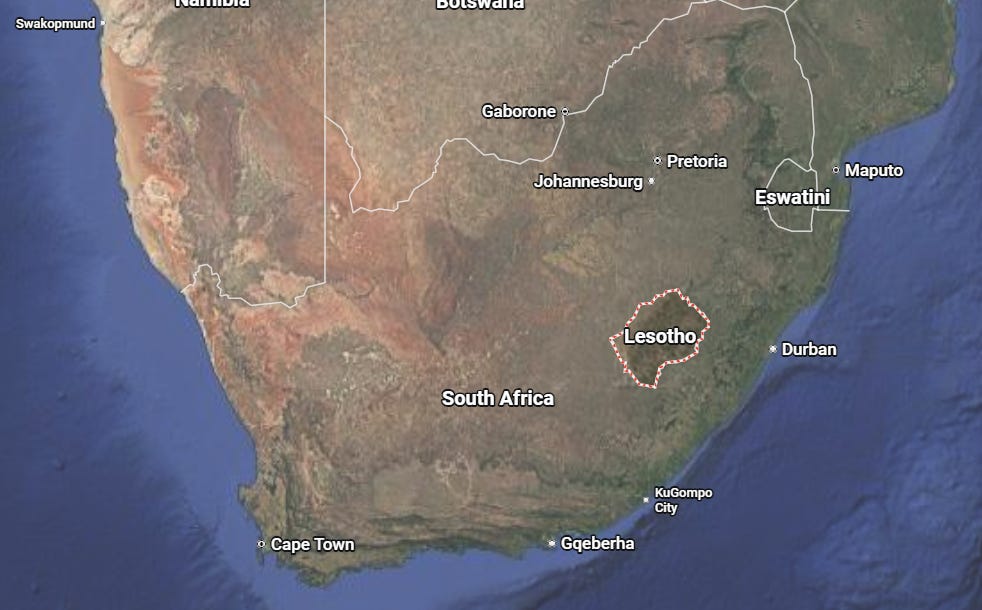
So what happens then, especially when those doing the enclosing are unaccountable, unopposed monopolies of violence with every incentive to use violence to solidify their power — states?
You see, this ridiculous objection to statelessness is an even greater objection against the state: What happens if a state surrounds your property, or your city, or your country and disallows all movement? Have you been paying any attention to history or to the recent troubles in the Strait of Hormuz? Embargoes and wars are the state’s doing, and those in power have every incentive and little disincentive to wage war when others are paying and bleeding.
In free-market competition, there are no incentives, and there is no centralised power to impose such restrictions on a whim. If anything, the centralisation of power of the state and the unaccountability of state leaders mean that such instances are more likely to occur under the state than in statelessness.
But let’s take the example of landlocked states. What’s to deter the surrounding countries from imposing total lockdowns on the countries they surround? They can close their borders to these countries, close their airspace, and close off all communications with them. It’s within their “rights”, right? And often, this happens in the form of an embargo, which leads to war. As Bastiat said, when goods don’t cross borders, soldiers will. And this is demonstrably true: the antidote to war is trade. If you hinder trade, you incentivise war.
And this is the takeaway here: Even if in a stateless paradigm someone buys all the property around your house or neighbourhood and encloses everyone in there on a whim, then they incentivise war, not only with the enclosed people, but also with the people on the outside who wish to trade with the enclosed people. Even if the outsiders have nothing to trade with the enclosed, the outsiders will still resent this enclosure practice in fear that it might one day happen to them. And they will seek to be insured against this, which is how lawmaking is done without the state (with the state, too, if you think about it, since the state is just one big risk management service — miserable because it’s an artificial monopoly).
If you find your house enclosed, then you’ll become belligerent, regardless of arbitrary “laws”. You’ll defy your captor’s property. You’ll dig tunnels in the disputed area beneath. You’ll build bridges, or helicopters, or slingshots to escape. Or you’ll simply become totally independent in your prison.
I don’t see how the state safeguards you from such an eventuality when the state is the most likely candidate to do this to you.
And this is the problem with state apologists: they think that the monster will protect them because the monster is powerful. But they don’t connect the dots to see that they can’t control the monster, despite deluding themselves that they do through the scam of voting.
The fact remains that your house is already surrounded by the property of someone else: the state. The roads belong to the state. And you have very little control over the state other than public sentiment, which the state controls more through propaganda than you do. If you think voting is a way to control the state, then you must agree that “voting” through where you choose to spend your money is a more powerful control mechanism than choosing between identical, prechosen candidates who are unaccountable when it comes to their generic and legally unbinding promises.
If you believe voting works (meaning that those in power care about our opinions), then you must concede that lawmaking through the free markets is more organic, fair, and efficient than lawmaking through a disincentivised, corruptible monopoly (the state).
If the monopoly of the state cares about what we think, then private individuals and businesses competing with each other care even more.
If you don’t quite yet realise how laws without the state emerge, even now under the state, then you should catch up on the literature here: Reading list on Voluntaryism, Consentism, and Voluntary, Stateless, Decentralised, Laissez-Faire Systems of Self-Governance in the Style of Rothbardian Austro-Anarchism.
The fact remains that houses, neighbourhoods, and whole countries are already surrounded by someone else’s property. And if the state — this unopposed, unaccountable monopoly of violence — still has some incentive to allow somewhat “free” travel, then imagine private individuals who are accountable to everyone in their community, which is the greatest strength of free-market competition.
The greatest deterrent preventing an abuser is not the reaction of the victim but the reaction of everyone else. This is why we take care of rapists, thieves, and murderers, even if they never raped, robbed, or murdered us specifically. This need of ours to feel safe in our community, we misguidedly outsource to the state to satisfy. But without a state, it’s up to competing suppliers of lawmaking and justice dispensing.
Until you can show me how I can protect myself from the state preventing me from leaving my house, or asking insane concessions on my part for letting me do so (which it does daily), then this argument is void; especially so when the null hypothesis is statelessness, and thus, the burden of proof lies with the state.
Comments
Nothing yet. Say the first thing.
Sign in to join the conversation.