

Your abusers have an interest in appeasing and pacifying you because anger isn’t always self-destructive; it’s actually vital if you want to change your life for the better. That’s the difference between unhinged rage and controlled anger. And you need anger before you stand up to your abusers.
Anger can be a useful emotion when it helps you understand what you need to do to escape abusive relationships, to break free from rigid, debilitating mindsets, to set healthy boundaries, to stand up for yourself, and to stop tolerating indignities.
Yes, when anger becomes uncontrollable rage, it can make you lose your shit, with negative consequences for yourself and others. But anger turns into rage when you bottle your frustration, suppress it, internalise it, force it to build pressure, and twist and explode out of control.
Whenever people tell you that “others have it worse”, they actually try to make you feel guilty for wanting better for yourself. They invalidate your pain, deny you recognition for your struggles, recognition that would otherwise motivate you to endure. They brush your pain off as if it’s nothing. They make light of it, and then you start wondering whether you should be feeling bad about your circumstances because “others have it worse”, right?
And then you conclude that you should be feeling grateful for not having it worse, which leaves you complacent in squalor, and tolerant of abuse.
Guilt-tripping is textbook manipulation, and it works more on principled people, on people with empathy, on people who are willing to punish themselves for not adhering to the high standards they chose to hold themself against.
I grew up with the generation when parents used to shame and guilt-trip us over “the children in Africa”: “You don’t eat all your food? Then, you should be ashamed of yourself because children in Africa have nothing to eat, and you should also somehow feel responsible for them, too.”
This shaming and guilt-tripping ended up making us submissive, obedient, and tolerant of force-feeding, which is a form of child abuse. And when you tolerate one form of abuse, you condition yourself to be tolerant of any and all abuse.
I remember losing sleep over the guilt I felt for the children in Africa, unable to fall asleep because thoughts of starving children — and the over-responsibility I felt for them — haunted me. I felt guilty for not wanting to eat more, not wanting to be force-fed.
Shaming and guilt-tripping weren’t limited to the African children; these innocent children whose name this mass-scale abuse was being conducted in. My shame- and guilt-based upbringing involved varied manifestations: “You keep demanding what other kids have at school, and you don’t think about poor children who have nothing.”
I was made to feel guilty, and even responsible, for children I’d never met. Sure, spoiling children is just another form of abuse. But if you force me to be around children at school I never chose to be around, and their parents give them respectable sports shoes, proper clothes that help them define their individuality and self-ownership, and options of extracurricular activities, then I’m not asking to be spoiled: I’m asking just to keep up with the other kids, so that I don’t conclude that I’m less deserving as a child.
Even the most basic of parents wouldn’t even dream of not giving these things to their children, especially when their children are forced to be compared to other children who got those things. Of course I’m going to demand something better. I shouldn’t have to be made to feel guilty for doing so. I didn’t live with children in Africa. You force me to live in a community with high expectations, yet you deny me the means to adhere to those standards. I’m not forced to compare myself against the poorer children. I am forced to hold myself against a higher benchmark, which you keep me from meeting, thus condemning me to develop a lack of self-esteem.
“Others have worse than you” translates to “shut the fuck up and take every indignity I dish out”.
Yes, sometimes it’s important to appreciate what you have and avoid the trap of a victimhood mindset, always self-debilitated and entitled to people’s sympathy from pity. But this is not what I’m talking about here.
If there is nothing to protest, nothing to complain about, then there is nothing to improve.
If you feel gratitude for your chains just because they’re dressed with velvet, then you stand no hope in ever breaking them.
If there is nothing to hold people accountable for, then they can do anything they want to anyone, and get away with it.
People do hurt people. And blaming the victim all the time for supposedly “complaining” isn’t helpful. Sure, you can show the victim where they were responsible for being abused, but not to blame them and foster self-loathing; rather, to empower them by showing them where they can improve their circumstances.
When your abusers gaslight you into feeling guilty for protesting your abuses, they win.
Abusers preach pretentious “gratitude” for “not having it worse”, which diffuses your anger and your sense of urgency, and thus disempowers you because you feel guilty just for wanting to free yourself from abuse.
Yes, you should appreciate what you have, but the bare necessities, the meeting of needs that your nature burdened you with — needs not of your choosing — are nothing to be “grateful” about, nothing to dance around for like a merry fool for having. Nobody feels overjoyed every second for having air to breathe. It’s not an over-and-above achievement and nothing to be grateful about. It’s a bare necessity, a need not of your choosing. And you don’t owe “God” anything; quite the opposite.
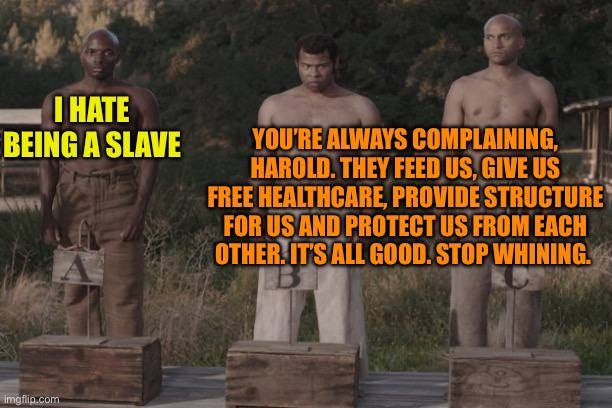


I’ve noticed how the people who always jump to invalidate your troubles by comparing you to “people who have it worse” are either selling something — toxic motivators who want you disempowered and a perpetual buyer of their false-hope bullshit products — or it’s people who are actually responsible for your misfortune, or at least responsible for helping you get out of your misfortune. And thus, by telling you that others have it worse, they deflect your protest against their abuse, or nullify your requests for help.
Those who invalidate your pain rob you of your dignity of protesting an injustice. Treat them accordingly.
Condescending positivity gurus and motivational speakers deliberately keep you down by denying you your right to feel angry, and anger can be a helpful sentiment when you use it to change yourself for the better. But they don’t want you to improve, because that means they lose a customer, just like the modern medicine business model: treat the symptom, never the cause; focus on perpetual treatment, never a final cure, and keep the money rolling.
This backhanded demotivation disguised as motivation uses short-term, feel-good faux-positivity, as televangelists do, to diffuse your energy, the passion you need to finally make changes, to burn bridges, to escape toxic attachments, to unburden yourself of toxic shame that makes you manipulable.
Be aware of the things that pacify you, that keep you complacent in squalor, and thus inert. Religions do that, ideologies do that, cults do that, and idols do that.
Scene from the film ‘Network’ (1976): “You’ve got to get mad!”
Your abusers, or the people responsible for supporting you, will always downplay your pain to waive themselves of accountability.
“Others have it worse” is toxic positivity because it invalidates our pain. Gratitude? More like masked guilt and manipulable inertia from deluded complacency.
The Problem With Rocky's "Inspirational" Speech
·
Apr 9

The famous inspirational speech from Rocky Balboa (2006) represents the epitome of toxic motivation, and everything that’s wrong with those demanding over-accountability in you to deflect their own.
Comments
Nothing yet. Say the first thing.
Sign in to join the conversation.