
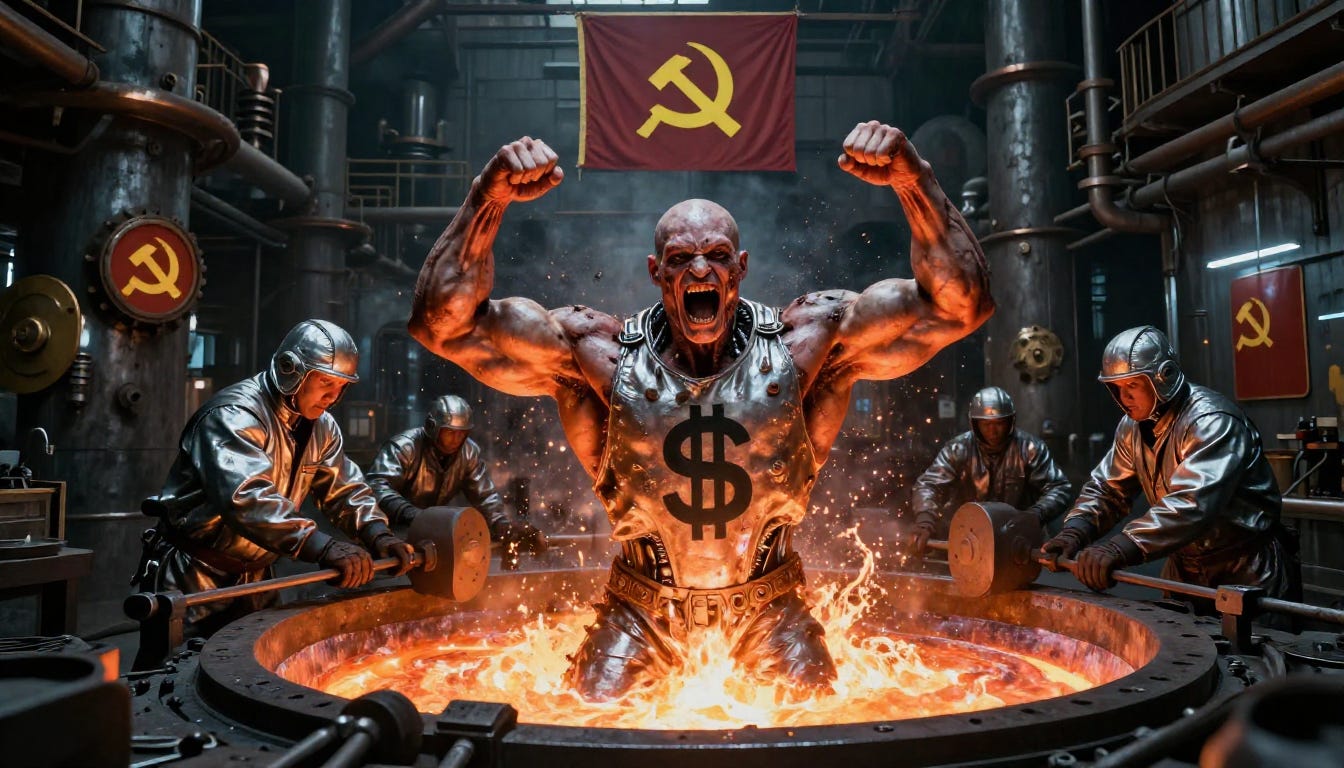
A socialist’s definition of “capitalism” is as socialist as socialism gets: central banking, centrally planned economies, arbitrary and forced wealth redistribution, merger of state and means of production, and thus, inevitable classism…
I know, I know. I keep telling people not to use loaded terms like “capitalism”, since they carry vastly different meanings to different groups, which makes arguing over them impossible.
For example, the libertarian definition of “capitalism” is simply the right to own property, and any denial of property rights is slavery. Yes, socialism denies property rights, the rights slaves were denied, since slaves were used as property themselves. And the fact that your wealth and property are subject to taxes means you don’t really own them, but rather, you’re allowed to keep enough of them to survive and keep producing more, you know, like a proper slave. The only difference is self-awareness: you are a slave who deludes himself he’s free.
“Capitalism”, in the socialist’s mind, is in fact corporatism, which is the state forcibly redistributing wealth from the many to the few: corporate welfare, regulatory favouritism, selective enforcement, tax exemptions for the select party-member few. Yet, this is what socialism in practice always does. Be it the USSR, Cuba, Venezuela, Yugoslavia, China, North Korea, or the United Socialist States with its protectorate, the European Socialist Union (EU); they all apply socialist policies to the max: centralised power in the hands of a few who will inevitably abuse it to favour themselves and their own, thus resulting in elitist classism. All power structures (the most authoritarian being socialism) inevitably lead to elitist abuse.
There is no mechanism by which the masses — the deluded people who relinquished their freedoms to the socialist state — nothing they can do to prevent power abuses by those in power. Once you unleash the centralised state, there is no putting the leash back on. If you think voting pre-selected candidates somehow has any sway over those in power, then keep voting. Apparently, it’s “working”…
There is nothing more socialist than Wall Street bailouts and corporate welfare (and all kinds of welfare, for that matter). Corporate welfare is arbitrary and forced wealth redistribution, a practice that is at the core of demented Marxist ideology.
Corporate bailouts, often used to describe “capitalism”, are the definition of wealth redistribution; a fundamental socialist policy. In overtly socialist states like the Soviet Union, productive departments subsidised the underproductive: no accountability, no incentive to improve, no mechanism for fairness. The exact same happens now in “Western capitalist democracies”. Wait, you thought your government wasn’t socialist? You thought your definition of “capitalism” wasn’t just socialism in disguise?
Central banking is a quintessential Marxist ideal. Socialists complain about banks, about central bank monopoly of money supply, and about the global banking cartel funding both sides of every war since Napoleon, at least. And socialists are right to complain about these evils. What socialists don’t understand is that central banking is a basic non-negotiable of Marxism/socialism.
Instead of severing their attachment to the sick ideology of socialism, their cognitive dissonance creates deflections and scapegoats: They now call the inevitable symptoms of socialism “capitalism”, so that they don’t have to challenge their cherished belief systems. They’ll blame all the evils of socialist central banking and socialist central planning on the right of the lower classes to own property and wealth. Insane.
Look around you: the fact that in traditionally “capitalist” economies you can’t open any business unless you get a permit from government, or your business model isn’t feasible anymore unless it secures funding from government (meaning, forcing the working taxpayers to subsidise it), goes to show that we live under a textbook socialist system where wealth is redistributed on a whim, forcibly, preferentially, unfairly.
And don’t get me started on the migrant crisis: this forced movement of populations, with governments around the world paying nomadic people to migrate into their countries so that they can abuse welfare and preferential treatment. Why wouldn’t they?
This migration problem is not organic migration: it’s forced redistribution of population, what the USSR did with its conquered regions. This is what Genghis Khan also did, redistributing populations to minimise the chances of revolt, since revolt requires homogenised populations that foster solidarity and high-trust societies.
Inorganic migration is textbook imperialism. And imperialism is textbook socialism. Just look at China and how it treats its conquered regions of non-Chinese ethnicities.
The problem of corporatism is not the lobbying corporations; that’s the symptom. The underlying problem is our deluded need for the monopoly of violence of the state that is bound to be hijacked by the highest bidder. When we focus on symptoms only, we blind ourselves to the cause.
The opposite of socialism isn’t “capitalism”. Capitalism or corporatism are clever words to disguise socialism in practice.
The opposite of socialism isn’t fascism either, or national socialism. Fascism and socialism are identical in central planning policies and totalitarianism, save for different branding, insignificant differences, like comparing Pepsi to Coca-Cola: Both antagonise each other, not because they are antithetical, but because they are so similar, and thus compete for the same unhinged followers.
All these sick, demented ideologies fall in the category of statism: the twisted, low-IQ idea that humans are evil and dumb, so we must somehow grant a small group of evil, dumb humans absolute power and justification for using arbitrary violence… and thus, somehow, we get order. Ludicrous.
Socialists complain about the things their ideology brings. It’s the same as Christians complaining about the passive, subvertive, sucker-for-punishment nature of “degenerate liberals” who promote subservience and allow every abuse from their condescended noble savages. Christians forget that “degenerate liberals” are exactly what mainstream Christianity treats as ideal: hanging out with prostitutes, turning the other cheek, giving unto Caesar what is Caesar’s, ennobling Samaritan savages, and all kinds of subversive state-worship, especially in Romans 13.
Statism, whether democracy, monarchy, tyranny, socialism, fascism, or theocracy, is in fact centralised government, and is antithetical only to decentralised self-governance, by which the only regulator needed is the most powerful and organic regulator of all: free-market competition.
Some people resort to the vapid incredulity fallacy: “I just don’t see how statelessness can work; what would stop businesses, unregulated by the force of the state, from achieving power and then abusing it?”
Ridiculous. What would, in fact, stop people in government from abusing their power, which they do daily? Every argument against statelessness applies to the state even more. Wars that no one wants, taxes no one wants, corporate welfare that no one wants, pedophiles running free and protected by the “justice” systems that are supposed to maintain order and earn our trust…
Their answer? Voting, which never, ever works, demonstrably. So, you believe casting an insignificant, weightless suggestion for pre-selected, unaccountable candidates every few years has power swaying the artificial monopoly of the state? And by the same mechanics, you don’t think that your daily boycotting or buycotting of businesses subject to relentless free-market competition — unhindered by the state’s regulatory favouritism — can have even more of an influence than meaningless voting?
If you think voting works, then congratulations: you make a case for free-market competition, which is practically voting every single day, organically, with your wealth, your skin in the game, something that actually bears weight and consideration. Just look at how quality standards and self-regulation emerge in the free market spontaneously, without any government intervention (especially so without it). Just look at how even the biggest corporations try to gauge public opinion and adapt to it. The state does not value public opinion as much because it enjoys an artificial monopoly of governance services, with our naive blessings.
Then again, most voters sell their vote in exchange for privileges at the expense of their neighbour, so corruption always starts from the voter. Corrupt politicians simply supply the demand for corruption.
Again, if you believe your vote somehow pressures politicians to submit to your will, then you must also believe that your purchasing choices in a free-market, decentralised self-governance can work even better than “democratic” voting. Take all the time you want to connect the dots. All the time in the world.
P.S. As an appeal to my authority, I have an MSc in Economics, so don’t presume to waste my time with nonsense you read in a socialist pamphlet, or shaming language you learned from your demented mother or closeted father. Give thoughtful counterarguments, or stay silent.
Comments
Nothing yet. Say the first thing.
Sign in to join the conversation.