
Dear SoTA,
For years, conversations about digital sovereignty focused on a relatively simple question: where is my data?
Today, that question has become much broader, and much more consequential.
As AI moves from research labs into critical national infrastructure, governments, enterprises and investors are increasingly asking a different question: who controls the infrastructure that makes AI possible?
That infrastructure extends far beyond data. It includes compute, networking, semiconductors, energy, cooling, software orchestration and operational control. In other words, the physical and digital foundations that determine whether AI can be deployed, scaled and sustained over the long term.
This changing conversation is driving the growing focus on AI sovereignty.
Importantly, AI sovereignty is not about isolation, protectionism or turning away from trusted global partners. The United States has built an extraordinary AI ecosystem, from hyperscale cloud providers and frontier model developers to semiconductor innovators and world-leading investors. Countries such as the UK, along with partners across Europe and Asia, benefit enormously from that ecosystem and will continue to do so.
But strong partnerships are strongest when all parties bring meaningful capability to the table.
AI sovereignty therefore should be understood as the ability of nations, organizations and allied ecosystems to build, operate and evolve AI systems with resilience, choice and strategic control.
Five years ago, many sovereignty discussions focused on where data was stored and which jurisdiction governed it. Those concerns remain valid, but AI has fundamentally changed the equation. Today, access to data alone is not enough. Organizations also need access to the infrastructure required to process, move and act on that data at unprecedented scale.
That means sovereignty now depends on a much wider set of capabilities: AI compute, GPU clusters, optical interconnects, networking fabrics, power distribution, cooling systems, storage architectures, semiconductor supply chains, cybersecurity and operational resilience. In short, sovereignty is increasingly becoming an infrastructure challenge.
This reflects a broader shift in how AI is viewed. AI is no longer just another software category. It is increasingly being treated as critical infrastructure, much like energy grids, telecommunications networks, transportation systems and other strategic national assets. That changes everything, because the infrastructure layer itself is becoming strategic.
Much of the public conversation around AI focuses on models. Which country has the largest models? Which model performs best on the latest benchmark? These are important questions, but they overlook a fundamental reality: owning or accessing models alone is no longer sufficient.
A model can only create value if it can be deployed effectively. Infrastructure determines what can be run, where it can be run, at what cost, at what performance level and with what degree of control. That is why the next phase of sovereign AI will be shaped not only by models, but by compute, networking, power, semiconductors and systems architecture.
In many respects, infrastructure capability is becoming more strategically durable than model capability. Models can change rapidly. Infrastructure decisions often shape competitiveness for years.
This is perhaps the most important concept in the sovereign AI discussion. Historically, AI performance has been discussed primarily in terms of compute. More GPUs generally meant more capability.
Modern AI systems are revealing a different reality. AI capability is not compute alone. AI capability is Compute × Networking × Power.
As AI clusters scale from thousands to tens of thousands, and eventually hundreds of thousands, of accelerators, networking becomes a first-order problem. Adding more GPUs delivers diminishing returns if data cannot move efficiently between them.
This is where Oriole’s technology becomes particularly relevant. Traditional AI infrastructure relies heavily on electrical packet-switching architectures that introduce latency, consume significant power and become increasingly difficult to scale as cluster sizes grow.
Oriole’s PRISM architecture takes a fundamentally different approach.
By using photonic networking to create a unified AI fabric, PRISM enables ultra-low-latency communication, deterministic performance and significantly higher bandwidth efficiency than conventional approaches.
Rather than treating networking as “plumbing,” PRISM treats it as a core architectural element of AI infrastructure. This matters because sovereign AI is not built on compute alone, it is built on the ability to connect compute efficiently.
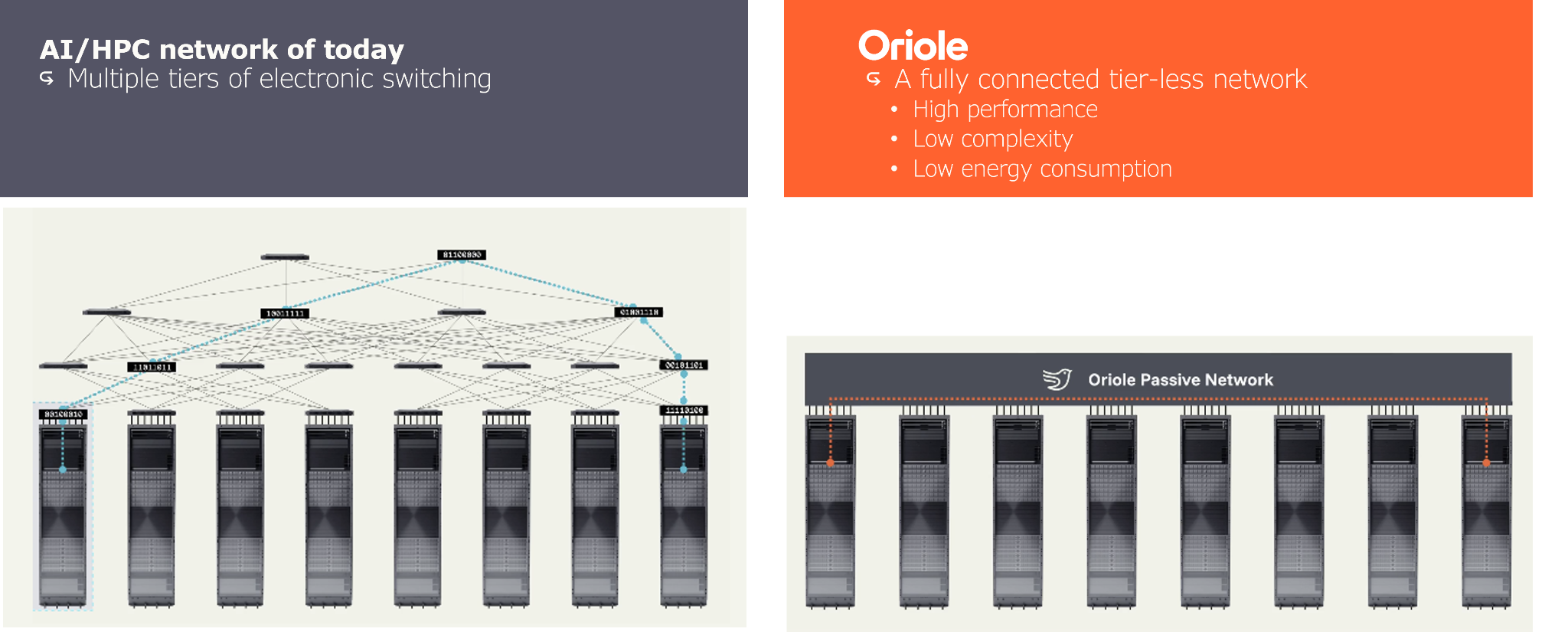
When policymakers discuss sovereign AI, networking is often overlooked. Yet networking increasingly determines AI system performance, infrastructure economics, energy consumption, scalability and operational resilience. Large AI clusters simply cannot operate effectively without robust interconnects.
This is especially true as the industry shifts from training-focused infrastructure toward inference-focused infrastructure. Inference workloads place different demands on the system: lower latency, greater efficiency, more distributed architectures, higher utilization rates and lower operating costs. These requirements elevate the importance of networking even further.
If networking is essential to deploying and operating sovereign AI infrastructure, then photonic networking is not merely a technical optimization. It is a strategic enabler of sovereign AI. This is particularly relevant for countries seeking to build meaningful capability in critical layers of the AI stack without attempting to recreate every aspect of the global ecosystem.
Another major shift is the increasing link between AI policy and energy policy. Around the world, discussions about AI infrastructure now regularly include grid capacity sovereignty, power generation, nuclear energy, renewable energy, cooling systems and transmission infrastructure.
This reflects a growing recognition that power availability may become one of the biggest constraints on AI growth. A nation may have access to frontier models. It may have access to GPU supply. It may have plans for new data centers. But if it cannot operate those systems efficiently within available power budgets, sovereignty remains theoretical.
This is where Oriole’s technology story extends beyond performance and into viability. PRISM was designed not simply to improve networking performance, but to dramatically reduce the power overhead associated with moving data through large-scale AI systems.
At a time when networks are becoming a growing portion of overall AI power consumption, reducing networking energy requirements can have a significant impact on the overall economics of AI deployment. Sovereign AI should therefore be viewed not only through the lens of control, but also through the lens of feasibility. The countries and organizations that can run AI infrastructure more efficiently will have greater freedom to scale it.
One of the most important lessons from previous technology waves is that innovation alone is not enough. Capability is built through deployment.
Governments that want sovereign AI infrastructure cannot limit their support to research grants and policy statements. They must also help create the conditions that allow promising technologies to be tested, validated and scaled.
That means creating real-world deployment opportunities, national testbeds, procurement pathways, reference customers and scale-up investment. The objective is not protectionism. The objective is capability.
Deep-tech infrastructure companies often require years of development before their technologies reach commercial maturity. Early deployments help bridge that gap, creating confidence for customers, investors and ecosystem partners.
For companies like Oriole, sovereign AI initiatives represent an opportunity not because of nationalism, but because they encourage:
Infrastructure diversity
Architectural innovation
Ecosystem resilience
Second-source options
Long-term competitiveness
The AI sovereignty debate is evolving rapidly. What began as a discussion about data is becoming a discussion about infrastructure. What began as a software conversation is becoming a systems conversation. And what began as a geopolitical issue is increasingly becoming an engineering issue.
The conclusion is maybe straightforward: sovereign AI starts with sovereign infrastructure.
Nations do not need to build every model. They do not need to recreate every part of the global AI ecosystem. But they do need sufficient capability in the critical layers of the AI stack to ensure resilience, economic value and long-term strategic choice.
As AI continues to scale, those critical layers increasingly include networking. Because AI capability is not simply about compute. It is about Compute × Networking × Power. If the network cannot scale, sovereign AI cannot scale either.
Yours,
James Regan
Chairman & Co-Founder, Oriole
Author biography:
James Regan is a seasoned technology executive and physicist with over 40 years in optical communications. As Chairman and co-founder of Oriole, he is pioneering the next radical breakthrough in advanced optical networking systems for AI. James has a proven track record of transforming university research into globally impactful companies. He is a frequent contributor to discussions on climate-conscious innovation, deep-tech commercialization, and the intersection of AI and photonics.
Write to the Society for Technological Advancement on letters@ilikethefuture.com.
Comments
Nothing yet. Say the first thing.
Sign in to join the conversation.