
Dear SoTA,
The next era of manufacturing may be won not by the countries that make the most, but by those that learn the fastest. That creates a significant opportunity for the UK.
The UK has deep manufacturing capability across a broad and diverse industrial base, from aerospace and automotive to pharmaceuticals, food and drink, chemicals and beyond. Despite differences in scale, products and production models, manufacturers face common challenges: how to raise productivity and make better use of scarce technical expertise while high energy and operating costs continue to weigh on competitiveness and investment.
Physical AI offers a way to get more from existing factories, equipment and expertise by helping manufacturers capture, interpret and act on what happens in production.
Manufacturers have always improved by making. The more they produced, the more problems they encountered, and the more opportunities they had to refine their processes. Historically, that gave the largest manufacturers an inherent learning advantage.
AI makes it possible to compete not just through scale, but through the speed and quality of industrial learning.
Much of manufacturing’s most valuable knowledge has traditionally been difficult to capture. Some sits in the judgement of experienced people: recognising subtle changes, understanding how a process behaves in practice and knowing which intervention is likely to work. Some sits in the production process itself, in visual, contextual and other unstructured signals that conventional systems have struggled to interpret at scale. In both cases, useful knowledge can remain fragmented, informal and confined to particular people, shifts or sites.
New AI systems can increasingly learn from the production process itself. Alongside conventional sensor and quality data, they can interpret sources such as production video, recognise unfamiliar faults, combine observations with engineering knowledge and suggest likely causes and responses.
In a paper from my group at Cambridge, we explored how AI can combine what it observes in production with engineering knowledge to respond to unfamiliar situations. The broader opportunity is to help manufacturers learn across their own lines, shifts and sites, turning individual observations and interventions into knowledge that can be reused throughout the business. Over time, that could create an internal industrial memory: a record of what happened, how people responded and what worked.
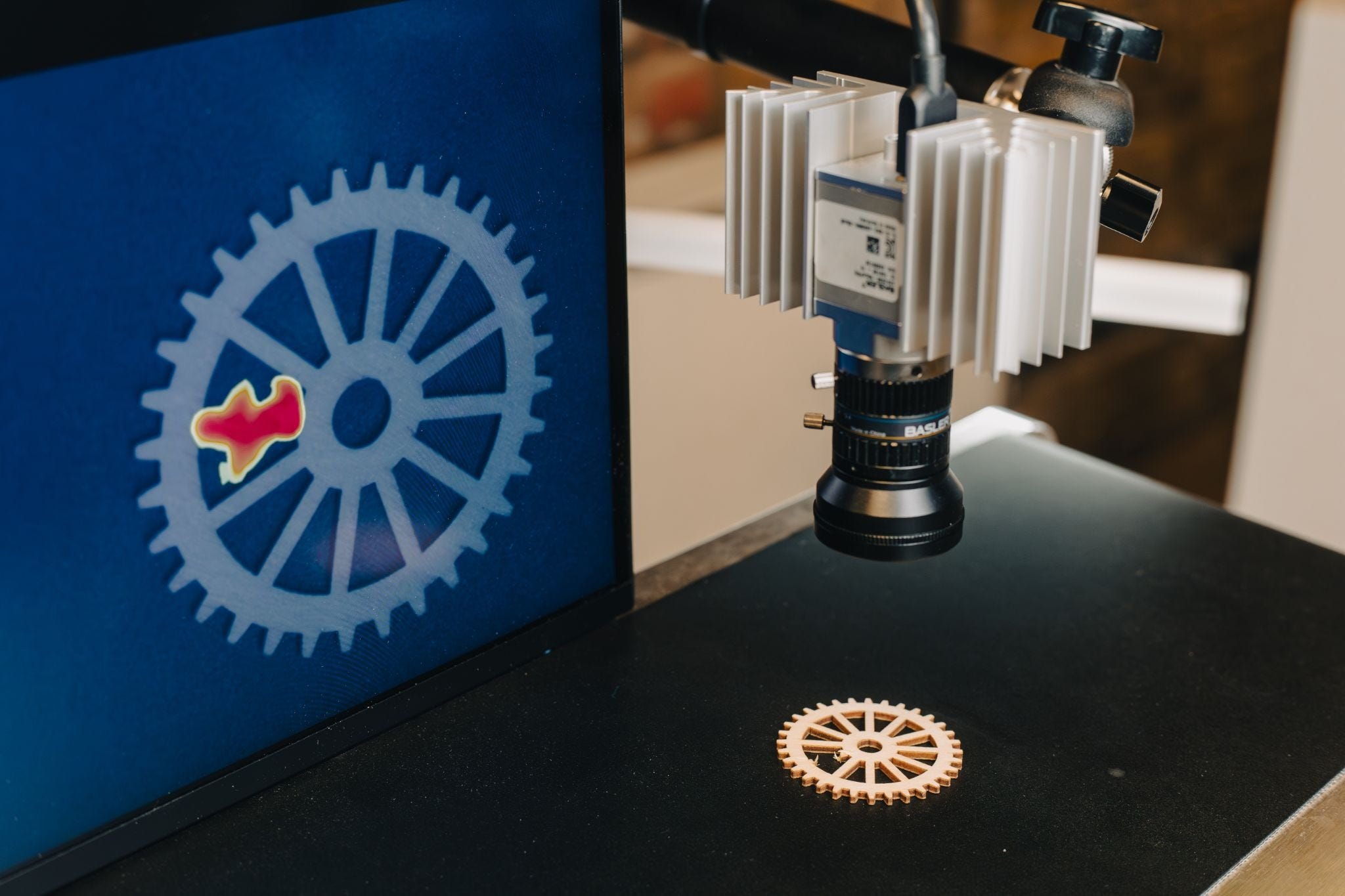
Matta’s Sentry system captures video data to identify and localise defects
That matters particularly for the UK. In aerospace and other high-mix, low-volume industries, every production run can contain valuable information. AI can make each run more informative and reduce the cost of relearning. In high-throughput sectors such as food and drink, it can help teams react faster to variation, protect quality and increase output.
There is also a strategic dimension. When production moved overseas, some of the practical knowledge generated by manufacturing moved with it. Engineers and operators learned where the work happened, and those lessons accumulated in the companies and countries holding the volume. Industrial AI offers Britain a way to capture more of that knowledge, apply it faster and compound it.
Physical AI should therefore have a core place in the UK’s modern industrial strategy, as a way to strengthen the capabilities and productivity of its existing manufacturing base. The UK may not win by making the most. It can compete by learning more from what it makes, and turning that learning into better production faster.
Yours,
Sebastian Pattinson
Cofounder & Chief Scientist, Matta
Author biography:
Sebastian Pattinson is co-founder and Chief Scientist of Matta, building industrial AI for factory sentience, enabling factories to sense, understand, and adapt in real time. He is also an Associate Professor in the Department of Engineering at the University of Cambridge, where his group works on AI for industrial processes.
Write to the Society for Technological Advancement on letters@ilikethefuture.com.
Comments
Nothing yet. Say the first thing.
Sign in to join the conversation.