
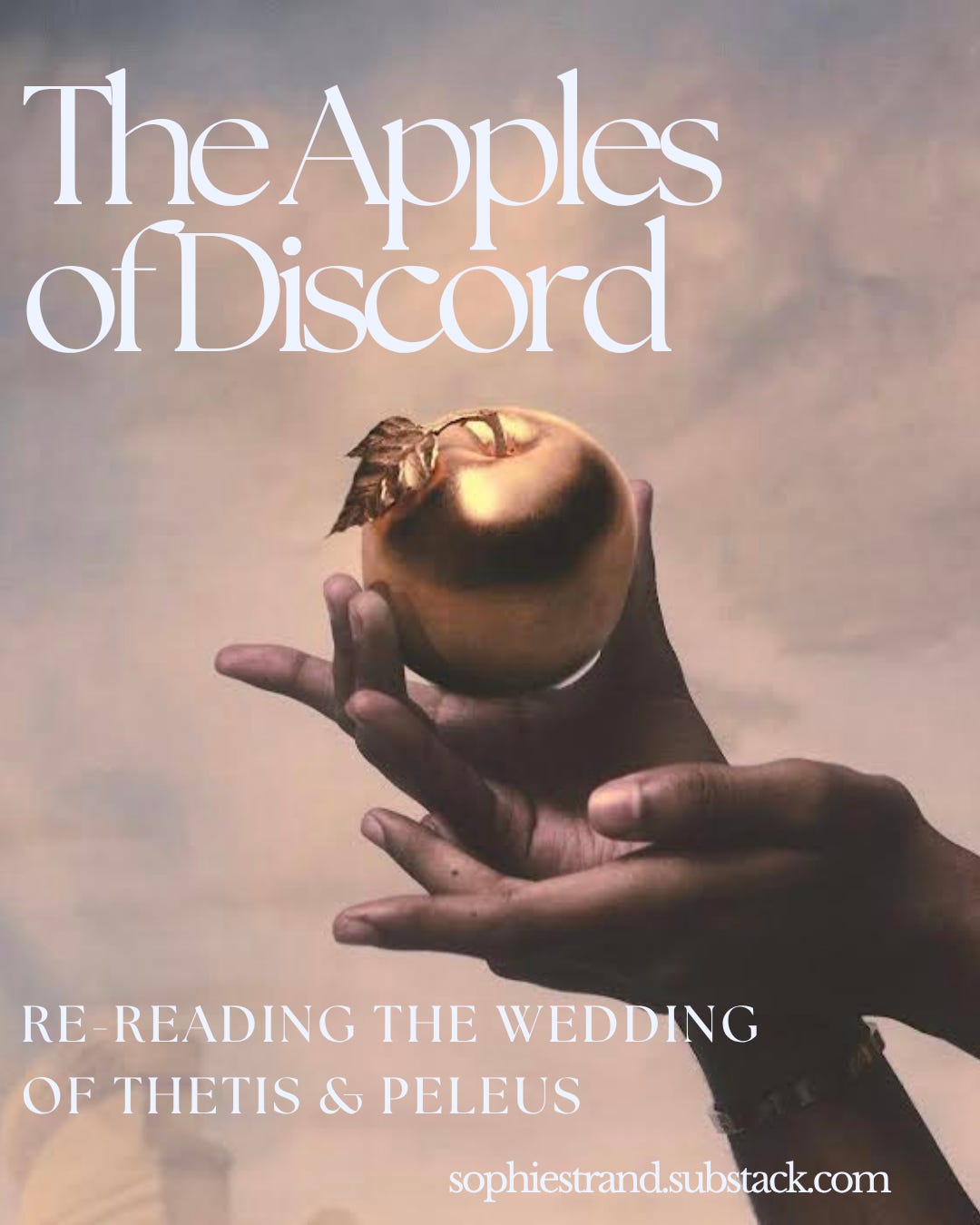
(detail from a photo by A. J Hamilton)
The Apples of Discord: Re-reading the Wedding of Thetis and Peleus
TW: assault. This is Part 1 in a series of essays rewilding the character of Paris for Confessions of a Romantic Animist.
A beautiful water nymph and a handsome King of Phthia are getting married. The wedding feast attendance is a who’s who of Mount Olympus. Zeus is flirting with all the bridesmaids while Hera fumes. A pair of giant immortal horses almost upset the wine jugs when Poseidon leads them into the celebration, presenting them to the bridegroom Peleus. Everyone has a present for the handsome king who is already deep in his cups, ruddy-faced, trying to keep pace with his divine in-laws. Aphrodite gives him a sly wink when she hands over a crystal bowl inscribed with the word Eros. Hephaestus gifts him a finely wrought knife. Athena has fashioned him a flute.
His new wife Thetis is pale, and she is not drunk. She has eaten nothing. She has said nothing. She sits back in the shadows below the olive trees, eyes eerily blank. No one gives her a gift until Zeus shoots up a bolt of lightning into the purple dusk to signal a pause. All the immortals and humans alike grow still and look towards Zeus.
“I would like to present a gift to this most….” Here the burly storm god leers, his eyes moving down the length of the young bride, hovering on her chest. “This most beautiful bride. A gift that befits her manifold charms.”
Thetis says nothing but her face visibly tightens.
“We are most honored.” Peleus slurs. “Most…most honored…”
Zeus waves a hand and out of thin air blooms two giant wings made of feathers that glisten opalescent, sending out a radiant multi-hued glow. A collective gasp travels the wedding revelers.
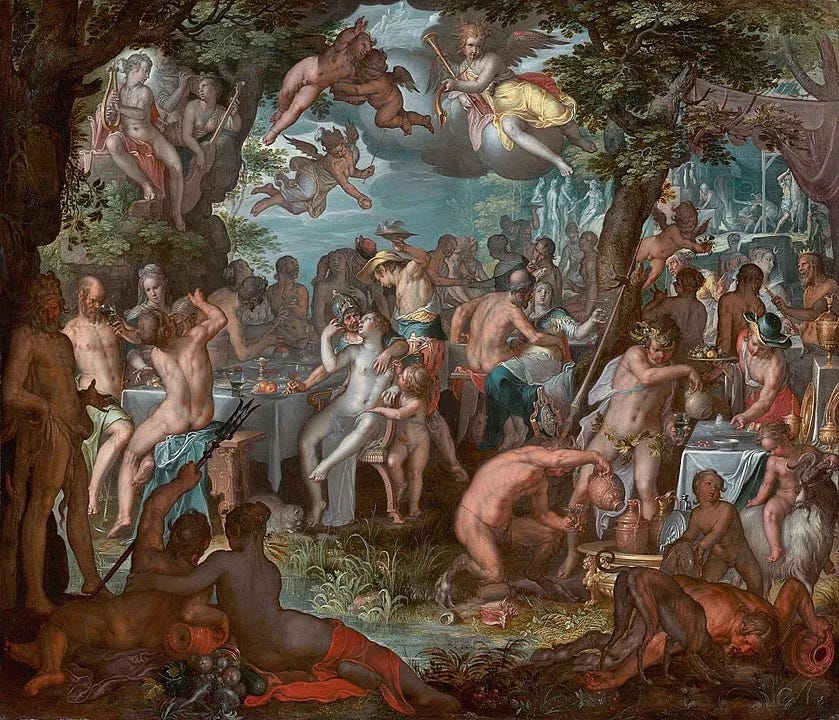
The Wedding of Peleus and Thetis by Joachim Wtewael
Only the bride Thetis is not transfixed by the stunning beauty of the wings. Instead, she is staring at the place where the wings should connect to a body. Frayed sinew and bone poke through. Below the wings a puddle of oily blood forms.
“I have conquered Arke, that loathsome Titan sister of Rainbows. I have punished her and have brought you her wings. They will suit you better than that hag,” Zeus booms.
The collective applause drowns out the screams.
Thetis has slid from her bench and is hunched over her knees. She is clawing her face, screaming and screaming. It is only now that you can see the slight swell of her belly under her silken sheath. The bride is already pregnant.
“No…No….no!”
At first it sounds as if her screaming has cleaved in two, two sonic snakes twisting above and below the guests. But as Thetis falls silent, the second scream differentiates from beyond the trees that circle the wedding feast.
“How dare you! How dare you not invite me!”
The speaker is invisible although her piercing scream is heard by all.
And then something appears. The golden orb momentarily suspended in the sky, doubles the full moon: two lunar eyes glaring down upon the shocked revelers.
Aphrodite who was the only one other than Thetis to hold her applause at the appearance of the bloody wings seizes the moment to run forward, easily plucking the apple from its fall. But she is quickly flanked by Hera and Athena.
“Damned Eris!” Zeus is fuming, obviously ready to stalk through the forest to punish the goddess of discord.
“I said that you should invite her….” Aphrodite murmurs sweetly as she turns the apple over in her hand.
“What does it say?” Hera prompts.
Aphrodite tosses one of her long red braids over her graceful shoulder, grinning as she holds the golden fruit out for all to see.
“Kallisti! To the fairest!”
~~
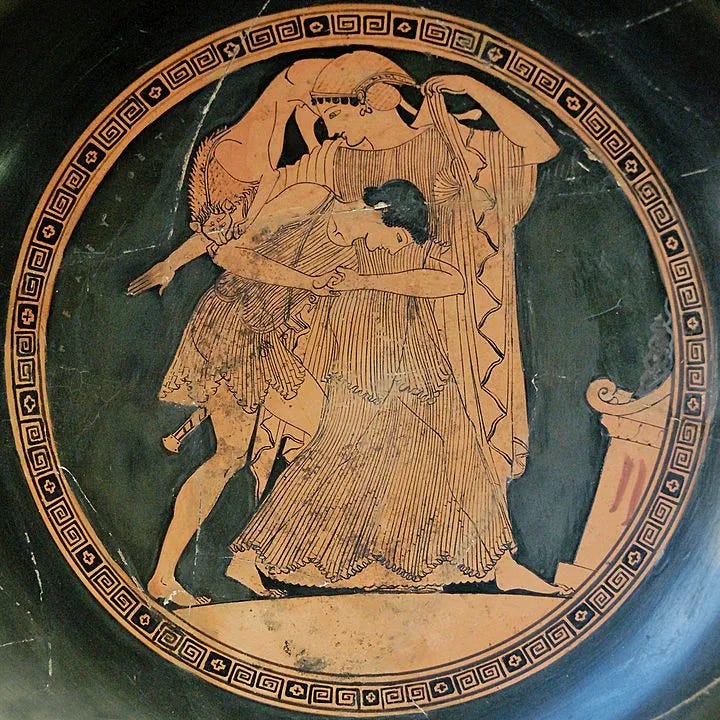
Thetis trying to escape capture.
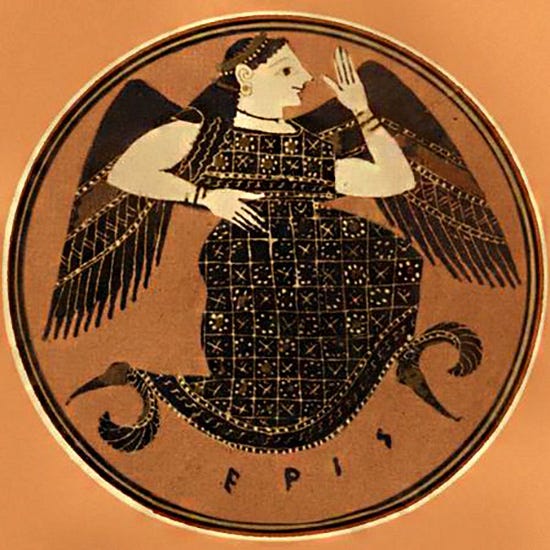
The Wedding of Peleus and Thetis is a footnote to the event that many argue is the origin of the Trojan War and its many tragedies. The goddess of discord Eris - a goddess of misty origins whose first divine role seems to occur in the legends surrounding the Iliad - is the only divinity consciously excluded from the wedding festivities. The daughter of Nyx (night) is angered and seeks retribution by throwing discord right into the middle of the celebrations in the form of a divine trap: an apple addressed to the fairest goddess. Athena, Hera, and Aphrodite all assume this title belongs to them and to settle the dispute Zeus seeks a mortal prince of Troy. The young prince who at the time still believes himself a humble shepherd chooses Aphrodite and her offer of the love of the most beautiful woman. And so begins the cascade of events that will lead to Prince Paris stealing Helen from Menelaus, the fall of Troy, and the death of thousands.
The fault lies with Eris. The fault lies with Paris. The capricious goddess who adds fuel to the fire is vain Aphrodite.
But I want to offer that the origins of the Trojan War merits a much closer reading. Wherever we encounter easy heroes and villains, seductresses and pliant virgins, it is important to remember that every story – even epic stories with mythical and historical claims - is a story written by an author with a bias. A story of a violent hero is expertly constructed to render a victorious murderer a hero, justifying his actions while demonizing his victim’s behaviors.
The Iliad begins with the wrath of Achilles, son of Thetis. Is Achilles really our hero? Is Paris really our villain? Is Eris really the bad-fairy Maleficent she will morph into in Perrault’s Sleeping Beauty thousands of years later?
As masterful as the stories of the Trojan War are from Ovid to Catullus to Homer, they are still outgrowths of Greek and then Roman propaganda justifying the violence of men and the treatment of women as chattel. And the killing of children. But I’ll get to that in a later essay.
Let us follow the thread of wrath back up the umbilical cord to Achilles’ mother Thetis, the water nymph bride.
Across accounts, the most famous from Ovid and Catullus, we learn that Thetis was an extremely beautiful water nymph and that both Zeus and Poseidon lusted after her. There was the small issue that she was the subject of Prometheus’ prophecy that the son she bore would be powerful enough to overthrow his father, echoing the exact circumstances of Zeus’s own ascent to divine dominance when he overthrew the Titans and his father Cronus. Seeking to neutralize the fertile threat of the water nymph, unable to bed her but looking for someone else to act as their proxy, Poseidon and Zeus schemed to set the immortal nymph up with a mortal man.
The mortal man the two lecherous gods found was their worthy proxy indeed in that he came trailing a history of having killed his brother, killed a scorned lover, and forced a former wife to suicide. Peleus the bridegroom was a brother killer, a woman killer, and an accused rapist. So we should not be surprised that once the gods told him that Thetis was his to wed, he did little to secure her affections or win her consent.
Instead, he aggressively gives chase. Thetis is unwilling and evades capture by repeatedly changing shape into a fire, a serpent, twisting water, a lion, a bird. Finally, another male god Proteus intervenes and gives Peleus instructions on how to capture and rape a sea nymph:
“Son of Aeacus, you can have the lovemaking you’re after. All you have to do is wait until Thetis is relaxed, asleep in her stony cave. Then tie her up, unawares, with cords and tight bindings. Don’t be fooled by the hundred false shapes she makes, but hold her close whatever she is, until she resumes her original shape.’ When Proteus had said this, he hid his face in the sea and cast waves over his final words.” (Ovid)
Peleus succeeds in kidnapping, raping, and impregnating Thetis against her will. Then Zeus, happy that the prophecy has been neutralized and his dominance protected and acted out through Peleus as his sexual surrogate, sets up a wedding.
At this point we have to ask if we can really call this a wedding when the bride has been kidnapped and assaulted? It is a celebration of male violence and dominance.And to this celebration, the Eris, goddess of discord and the daughter of night, is explicitly barred entrance.
Discord is exiled from the wedding. But when we realize this isn’t really a wedding but the celebration of a rape and forced pregnancy, we wonder where the true discord really lives.
When Zeus gifts Thetis the wings of Arke, he is gifting her a trophy from his latest female torture victim and the message is clear.: “I may not have been able to personally rape you. But I own you. I can kill you and destroy you whenever I want. You think this is bad? It can get so much worse.”
If order is a rape dressed up as a wedding is that really the order you seek and the party you want to attend? I think I’d rather be out in the orchards of disorder and discord with Eris. Order is a slippery word often assumed to be a universal: but the conception of the harmonious operation of society is quite often a term that masks hierarchical power paradigms and classifies anything that threatens them as “disorderly”.
Luke Kemp in his fantastic book Goliath’s Curse: The History and Shape of Societal Collapse works through dozens of case examples where the “collapse” of a city or a civilization is enshrined as a negative event by the surviving elite in narrative but that these early collapses are almost always followed by a period where archeological evidence shows common people growing taller, living longer with better teeth, bones, and nutritional profiles and less signs of both infectious disease and violence. We live in fear of collapse because that is what the richest and most powerful among us want us to fear. Zeus tells us not to invite Eris. And then he goes and orchestrates the rape of another sea nymph. But the truth is that moment when systems of orderly domination and hierarchy collapse, over a period of decades people tend to get taller and wilder and happier and healthier. People leave cities and nodes of infectious disease collapse. People walk away from systems that benefit the few while bleeding out the many.
Good stories are compelling. And so are stories that are built to covertly ensure our own submission to systems of oppression. All stories – good and bad alike - always bare the trace of an author’s bias and an author’s attempt to create justification for the system that most benefits them.
The origins of the Trojan war lie in the moment a water nymph is raped. It is little surprise that Thetis gives birth to a man who will slay many and will himself father a son renown for slaughtering children. At that wedding, the seeds of discord were not in Eris’s apple but in Thetis’s womb.
Hiding behind the hitjob on Aphrodite and Paris and Eris are two divine patriarchs seeking to protect their power while also raping a woman who might threaten their dominion.
And there is the rainbow goddess Arke bleeding out in Tartarus, her wings stolen by Zeus.
Rainbow stealers. Rapists. Abusers. Is this the order you want to protect? Are these really our heroes?
But there is an antidote hiding in this story. Behind the heroes and villains lurks a bear-suckled lover ready to serve love at all costs, ready to bring down the cities of men with wildness.
Eris winks at Aphrodite, clearly the fairest of them all, and whispers, “Isn’t discord the twin of passion?”
Eris. Eros. Paris.
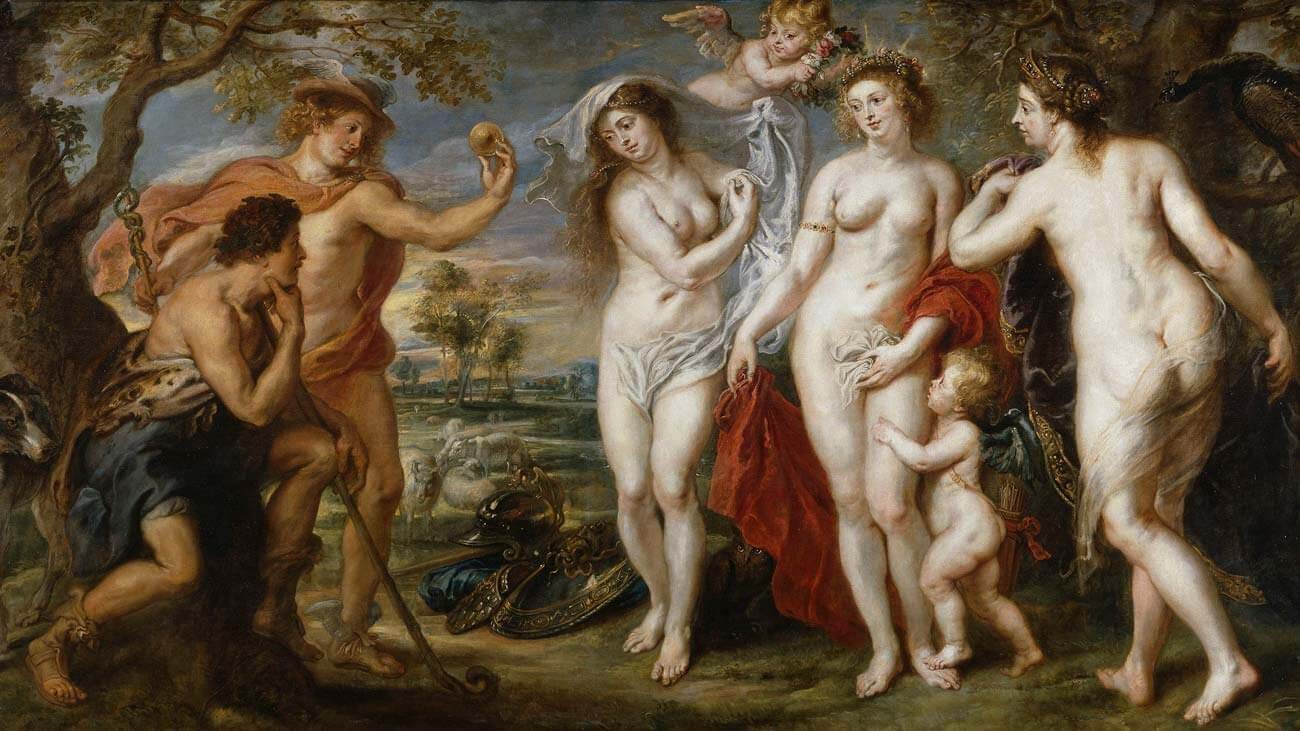
Apple of Discord by Ruben
Resources:
The Iliad
Book 11 of Ovid’s Metamorphosis
Goliath’s Curse by Luke Kemp
This is the fifth installment in my ongoing series Confessions of a Romantic Animist.
I want to reclaim romance as a celebration that includes the entire earth. I want to throw another party. A love party. And I want to invite you along.
I’m going to take the same approach to love stories as I took to myths of the masculine in The Flowering Wand. I will reroot, rewild, and retell classical love stories within an ecological framework. I’m also going to write about my fascination with contemporary romance, animal courtship rituals, and fantasy. I have questions about how romance is a powerful tool in combatting and dismantling empire and I’m going to think and write through them in real time in conversation with you.
Most of the essays in this series will be offered for free. I want to think and love and dance with you. But alongside this series on courtship, ecology, fantasy, and eros, I’m also going to offer reading lists and excerpts for of my upcoming fantasy series: one inspired by Joan of Arc and the other a queer retelling of Tristan & Isolde for my paid subscribers as well as occasional personal essays on romance.
No posts
Comments
Nothing yet. Say the first thing.
Sign in to join the conversation.