
Imagine you are sitting in front of a psychic at a summer fair. Her tarot cards are sun-faded and finger-smudged such that only she can decode their symbols. She asks you to pick three and lay them face up.
“Ah. A choice.” She cants her chin, eyes squinting not at the cards but at the noon sun itself, warming both your heads; you can imagine it kindling your spines to wicks, lighting your bodies like candles.
You study the cards. On one a throne. On the next a sword. On the last a heart.
“What do you want most? Power over all. Domination over all. The intellect and status to force all others to your will.” She presses her thumb to the throne and then slowly moves onto the sword. “Or perhaps you would like to be the strongest and most lethal? A warrior able to cut down any enemy and strike fear into the hearts of all?”
You say nothing.
She finally plucks the heart. “Or love. Beauty and love. You will not gain power over others. In fact, you will be powerless before your lover, before the pull of your own heart towards another.”
The wildfire haze burns your throat. The heat strains your veins trying to pump blood from your feet to your head.
Do you want to be a tyrant? A warrior? Or a lover?
“Love.” It’s the only answer when the world is burning.
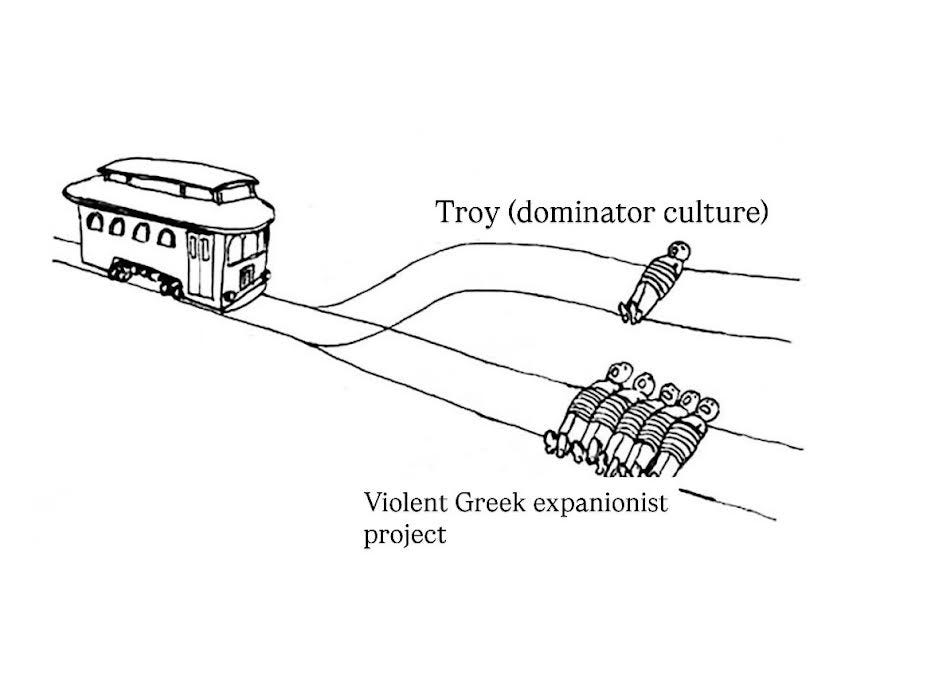
In the famous ethical thought experiment of the trolly problem that demands you choose between saving one life or many lives, the answer I’ve always desired is the complete refusal of a binaristic dilemma. When faced with two tragedies, I think we must imagine and choose a third rail, a third way.
Between violence and domination there is another road: the lover’s foot path where we must walk with our own two feet, depending on no horse or manpower to accelerate our progress.
The answer seems clear to me which is why it has always perplexed me that Paris, prince of Troy, is painted as frivolous when he forgoes Athena and Hera’s promises of domination and violent power to choose Aphrodite’s promise of love.
If you ask a contemporary schoolchild who the hero of the Iliad is they will usually give you one of the Greeks who ultimately stormed Troy raping women and throwing babies from the walls: Achilles, Ajax, the cunning Odysseus. When identifying a villain, Paris is often summoned as the instigator of the violent conflict. The interloper. The coward. The adulterer.
As a woman, it is to my benefit to read stories cynically. Is this a hero? Or an abusive man creating a narrative to justify his bad behavior? Is that a monstrous villain or is it really the snake goddess of the earth-centered egalitarian society you just decimated? Myths are very often rewrites of older stories, retold to serve as a violent victor’s propaganda.
And lest we forget history does not come to us unbiased. Luke Kemp, senior research associate at the Centre for the Study of Existential Risk at the University of Cambridge explains in his excellent analysis of societal collapse Goliath’s Curse that history is almost always written by the one percent. History tells us domination is necessary, cities are nodes of cosmopolitan creativity, bigger is better, and collapse is bad. But just as we must question whether Medusa is monster or an old subjugated mother goddess, so must we question the conflation of civilization with hierarchy and domination. Kemp draws attention to these largely invisible biases with another interesting observation that bronze was mainly used for ornamentation and weaponry only afforded to the very wealthy. Calling the Bronze Age the Bronze Age is a subtle wink to the bias of historical accounts both archeological and anthropological that prizes the 1 percent’s well-being over the 99 percents. Bronze lasts. Leather and grass and wood decay. We are interested in the funeral hordes of bronze weapons and jewelry, the huge monuments, and the individuals who gained enough power over others to leave their material stamp on the geological record. Kemp tells us mostly, for millennia, it was the Wood Age. For most of human history, 99 percent of people have been along some continuum of peasant, farmer, and hunter gatherer, not the bronze-weapon wielding minority amassing wealth and prestige, leaving behind funerary monuments and stone stele.
When I look at the Iliad I see a trolley problem. There is no good choice between the Trojans and the Achaeans (The Greeks). Hector and Achilles alike always choose the gifts of Hera and Athena, ready to sacrifice the NPC peasant populus to defend their prestige and place on the pinnacle of a hierarchy. The end of the Bronze Age was characterized by highly stratified city-states and the movements from egalitarian earth-reverent cultures to dominator cultures (see Riane Eisler’s case study of this in The Chalice and The Blade). We see a rise in mass casualty events, human sacrifice, infectious disease, patriarchy, and corvee labor. Both the Trojans and the Greeks alike are tied into a game of violence, resource accumulation, and status jockeying where only the one percent ever have a chance of winning although the chess pieces they use are the disposable 99 percent.
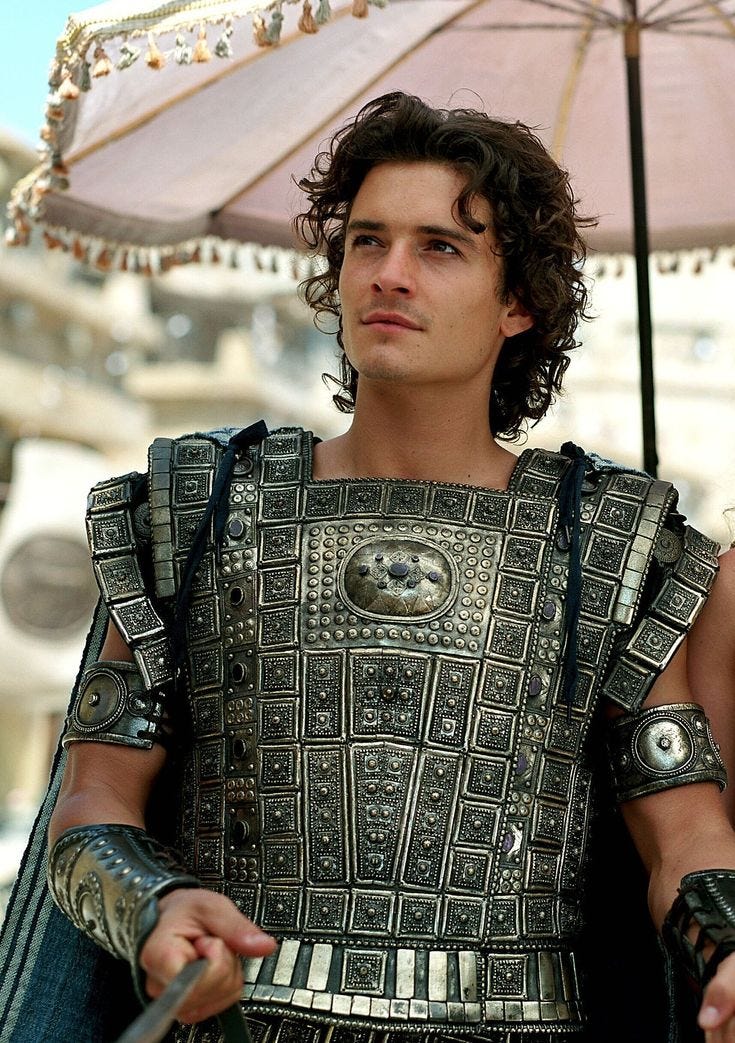
And then comes Paris. A son of Troy – a son of domination – who is paradoxically not raised in the city as a prince. As a lover of medieval romances and the troubadours, I always saw Paris as an early proto-hero of the romantic tradition, on a direct rhizomatic continuity with other interloping lovers like Tristan and Lancelot. But looking into the mist behind Paris I saw something older and even more dangerous.
I saw the gods of vegetation and social upheaval who, like Paris, always arrive as a newcomer to a city, ready to topple dominant paradigms with their seductive appeal, empowering women and slaves alike to don animal skins and revolt. I am speaking of Dionysus who when he arrives is the epitome of the interloping and empire-toppling lover except that the Helen he steals is not a single woman, but the entire population of women and other marginalized communities.
Paris, a son of Troy, is a Trojan Horse for a way of life already quickly disappearing towards the end of the Bronze Age: nature-reverent, animist egalitarianism. Populaces who still had a strong “counter dominance intuition”, choosing to walk away from cities and situations that demanded their subjugation. We see countless examples of this counter dominance intuition across the archeological record. People, time and time again, choose to experiment with dominance and social stratification and then quickly shrug it off when it impacts their well-being.
Given the past two thousand years of empire and domination and highly biased historical accounts, it is easy to forget that for most of human existence, we have been choosing love and beauty and leisure, creating social structures that ridicule and ostracize those who try to hoard resources or create dominance systems.
We have walked away from cities leaving them as ghostly warnings to those who seek to gain power over each other and over the earth. Unlike Troy, many of these examples are quiet and without violet collapse. The archeological record suggests that people actually just got up and walked back into the fields and forests and mountains.
Paris, although he is born to Troy’s King Priam, comes with a foreboding prediction that he will cause the downfall of his home city. Priam is instructed to kill the infant but cannot bring himself to carry out the murder of his son, refusing the trolley problem of saving one child or saving an entire city, choosing instead to gift the decision to the shepherd Agelaus. In some accounts, the infant Paris is left exposed on Mount Ida where he is found and suckled by a mother bear.
Paris the prince is not suckled at patriarchy but by the very symbol of wildness itself: the bear. The enemy of the city and its system of domination is suckled at the teat of the wilderness and claimed by the animals. And it will be another animal long associated with Dionysus and vegetation gods that Paris will love so much that he follows it back into Troy: the bull.
Paris is not raised in a city but on a mountain long believed to be a holy spot for the earth goddess. He is raised as a shepherd, tending to animals and attuned to the give and take of nature’s cycles. As is often the case in stories about prophecy, Priam ensures the prophecy’s outcome by trying to outsmart it. When he sends baby Paris out of Troy, he ensures that the boy will become a Trojan Horse for bears, bulls, mother goddess, mountains, and love itself.
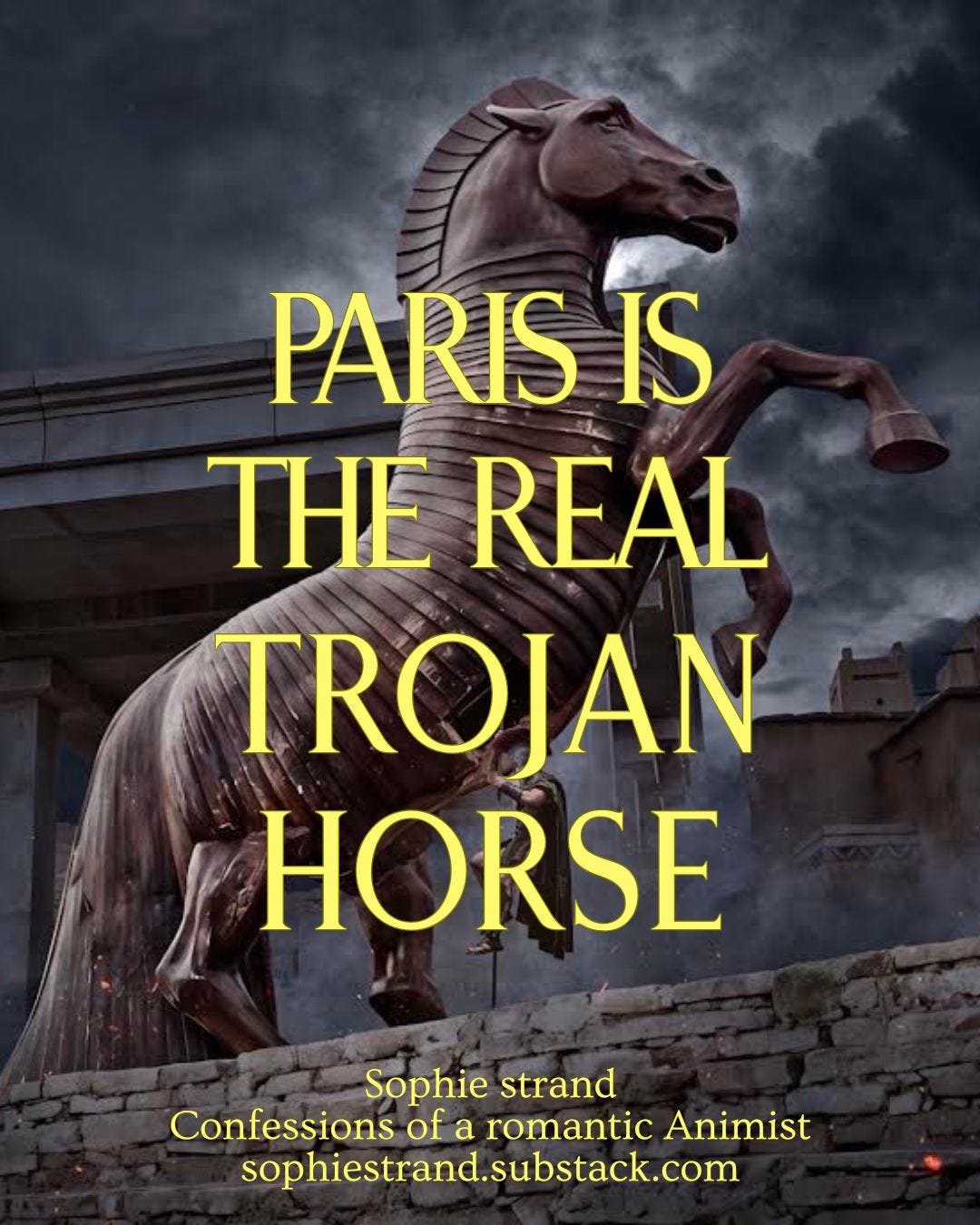
The real Trojan Horse is not a wooden instrument designed by the cunning Odysseus.
The real Trojan Horse is Paris. And he enters Troy long before war begins. He is not carrying warriors inside of him. He is carrying that anarchic counter dominance intuition that wants us walk away from systems of oppression and fortified cities, returning to nature reverence and collective effervescence.
There are no warriors inside of Paris. There are lovers.
This is the eighth installment in my ongoing series Confessions of a Romantic Animist.
I want to reclaim romance as a celebration that includes the entire earth. I want to throw another party. A love party. And I want to invite you along.
I’m going to take the same approach to love stories as I took to myths of the masculine in The Flowering Wand. I will reroot, rewild, and retell classical love stories within an ecological framework. I’m also going to write about my fascination with contemporary romance, animal courtship rituals, and fantasy. I have questions about how romance is a powerful tool in combatting and dismantling empire and I’m going to think and write through them in real time in conversation with you.
Most of the essays in this series will be offered for free. I want to think and love and dance with you. But alongside this series on courtship, ecology, fantasy, and eros, I’m also going to offer reading lists and excerpts for of my upcoming fantasy series: one inspired by Joan of Arc and the other a queer retelling of Tristan & Isolde for my paid subscribers as well as occasional personal essays on romance.
No posts
Comments
Nothing yet. Say the first thing.
Sign in to join the conversation.