
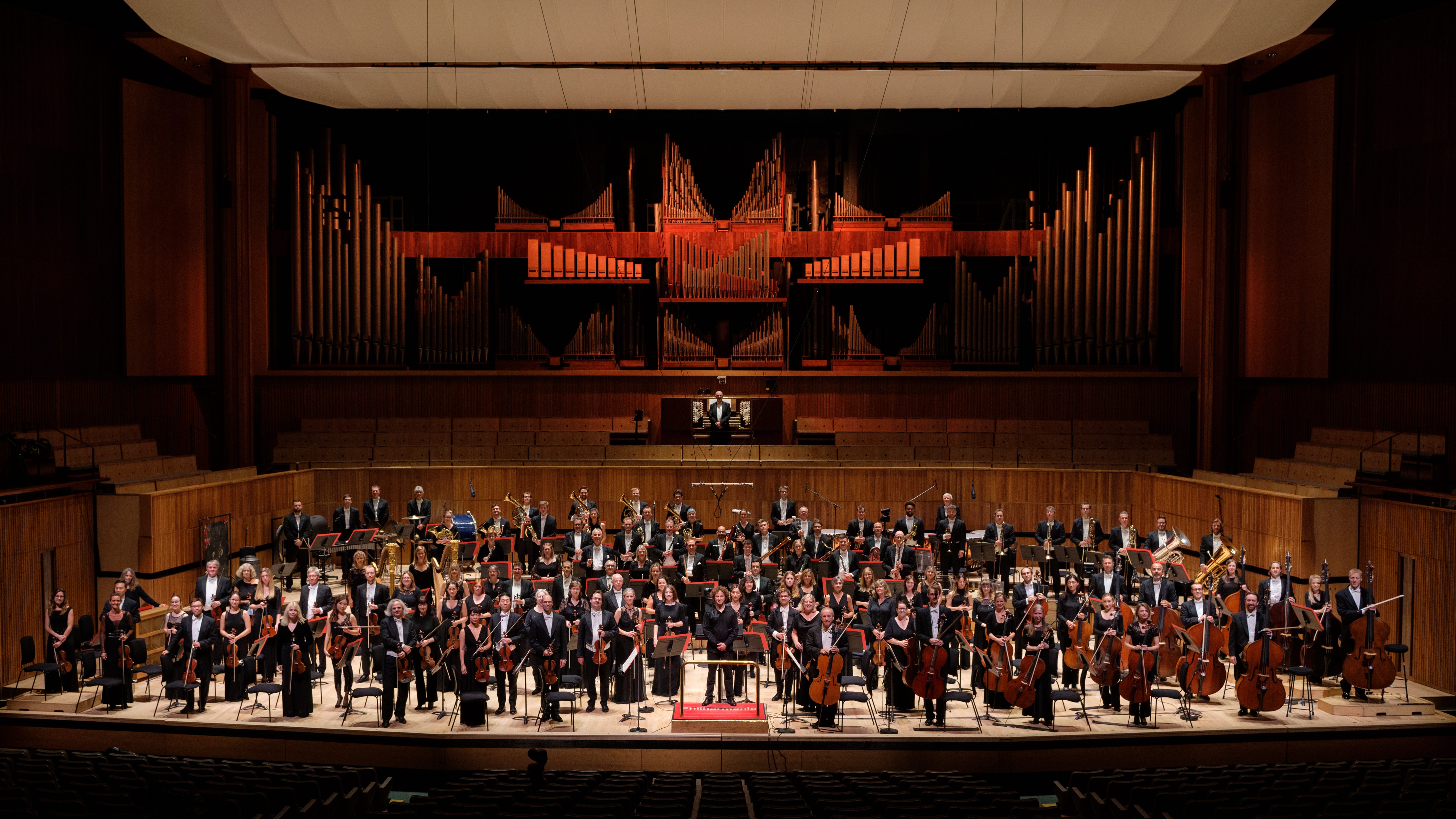
The Philharmonia takes its bows. Credit: Luca Migliore
Eluding deluges of gloom, the ‘Liebestod’ of Wagner’s Tristan und Isolde holds its lovers in a trance. Before nirvana devastation spares the star-crossed.
Cradling the enamoured girl with sleepy cellos, maestro Thomas Søndergård unwrapped a placid orchestra last night at Royal Festival Hall. The Prelude of the opera’s opening dispersed its woodwind themes in spatter. As crescendos seemed suspended, volume was upended. Horns lagged in their first attack: a long and laboured birth. Strings climbed pedantically but with a quick vibrato – coming fashionably late and leaving time to pose.
In plodding doses they interpreted ‘Nicht eilen!’ (‘Do not hurry!’) with excessive reverence. The solo on bass clarinet discorded with the score – transforming its assigned shy p into a proud mf. Horns soared in soured tones while tremolos took modest strolls. Although endearing imitation took place when the oboes caught a dolce motif from the clarinets, the arpeggiated chords on harp took muted shelter. Triplets on the violins slipped timidly into elation.
At the cusp of effervescent awe soprano Masabane Cecilia Rangwanasha drank in nature to unravel Richard Strauss’s Four Last Songs. Torrential runs and twinkling summits glided on legato. ‘Vogelsang’ (‘birdsong’) emerged in a hypnotic onomatopoeia at the start of ‘Frühling’; ‘selige’ (‘blessed’) flew celestially through four tied notes. A reference to how summer ‘lingers for a long time still by roses, yearns for rest’ (‘Lange noch bei den Rosen / Bleibt er stehen, sehnt sich nach Ruh’) sparked sympathy for the spent season of ‘September.’
Lending death acceptance, Rangwanasha illustrated slumber with a humble resignation at the closure of ‘Beim Schlafengehen.’ ‘Meine Sinne nun / Wollen sich in Schlummer senken’ (‘Now my senses long to sink to sleep,’), she contemplated in complacence. Triplets over ‘freien flügen’ (‘wings of freedom’) glimmered liberally. In Strauss’s gleeful paean to life’s end ‘Im Abendrot,’ the vocalist serenely limned a crepuscule. ‘Wie sind wir wandermüde — ist dies etwa der Tod?’ (‘How tired are we of our travels – is this really death?’) relied on a refined vibrato in a tight diminuendo of relief and fear.
Expressive peaks of characterisation are a challenge in the songs. At certain moments Rangwanasha struggled to keep pace: the ‘sehnliches’ of ‘sehnliches Verlangen’ (‘yearning urges’) in ‘Beim Schlafengehen’ had rushed arpeggios; ‘Wie ein Wunder von mir’ (‘like a miracle for me’) incurred an extra breath in ‘Frühling.’ Yet a hybrid of unbridled rapture and frayed life was palpable.
Flutes crooned indelicately under Søndergård’s direction of the first song but bewitching pizzicati mimicked chirps. ‘September’ introduced a diffident bassoon. Staccato triplets on the woodwind dwindled out of earshot. Horns blew raspberries and instruments delayed distinctly behind strings.
Trills on the flutes tipped piquant pleasure at ‘Im Abendrot’s euphoriant onset yet impeding horns defeated. At best this rendering of Strauss’s Four Last Songs enjoyed a languid guile.
Violas’ lacquer crackled at the start of ‘Pathétique’: Tchaikovsky’s sixth and final symphony. A cornucopia of life’s inconstant loves, the masterpiece paints aches of different measures; treasures of lost peace. Coincidentally it premiered only nine days after the composer’s death.
Here subtlety was swept away. At Søndergård’s undiplomatic helm strings sang full throttle. Flutes trod lethargically and oboes took slow bows. Yet when the score instructed cellos to play ‘molto cantabile, con espansione’ (‘very songfully and with effusion’), warmth abstained. Between the opposites of ‘incalzando’ (‘getting warmer’) and ‘ritenuto’ (‘held back’), violins lingered like a waiter near a table.
Horn chords marked ‘pesante’ (‘heavily’) were lost amidst a scuffle in hot protest. Though Rebecca Gilliver’s ‘Adagio non mosso’ clarinet solo bore melancholy longing, trumpets and trombones blared in cacophony. Strings overpowered even timpani toward the ‘Adagio – Allegro non troppo’ movement’s end.
Pristineness teemed across strings’ rhythms in ‘Allegro con grazia’; woodwind and brass limped in the distance. Convivial triplets on the violins implied a ballroom’s ambience and pizzicati sprung in dexterous thunder. But the imitations between solo instrumentalists on strings and woodwind fell asunder, shunning nuance.
Trombones and tubas roamed in search of resolution in third movement ‘Allegro molto vivace.’ As violent violins’ septuplets tumbled cleanly, colleagues had to shuffle through. Triplets intended to be played ff along bassoon, oboe and horn chords stopped at p. Bars hardened both dynamics and their speed to spearhead a bombastic march of squawking brass and stumbling trumpets.
Legato darted with no elegy in the ‘Adagio lamentoso.’ Though tenuto notes on strings were forceful, incohesion was heard more. Trombones droned clumsily but the last blast on tam-tam crammed in the grim reaper’s supercilious sneer. A passage designated varying selections of p, pp, ppp, pppp and ppppp unsealed in brash panache on brass. The muted double basses’ final chords were boorish.
Lording over Søndergård’s recital was an absence of surrender. When the strings singed other timbres, demonstration could be heard. ‘Death wouldn’t last!’ they cried.
A veneration for its victory was lacking in this incarnation.
Comments
Nothing yet. Say the first thing.
Sign in to join the conversation.