
Last year, I started a small project: drawing custom-made Parisian street signs. I’ve always been fascinated by the stories places tell, AND by how much you can learn about a city simply by paying attention to its street names.
This project quickly showed me how many of us carry a favourite Paris street - a place tied to memory, routine, or a particular moment in time. I loved drawing these signs for you, and even more, learning about each street along the way. Through their histories, I found myself learning the city all over again.
So here I’m sharing one of those streets - one I personally love, and/or one that many of you have asked for. I also drew (and animated) a map of this street, marking a few of my favourite places along it and in the surrounding neighbourhood.
You can explore other streets I’ve written about - and illustrated - here. You can order this street sign and map - together or separately - or commission a custom-made version of your favourite Paris street in my online shop.

Before I tell you the whole story of rue des Rosiers, one important note: the vernissage of my exhibition here in Paris is next Thursday, May 21. Your invitation is here.
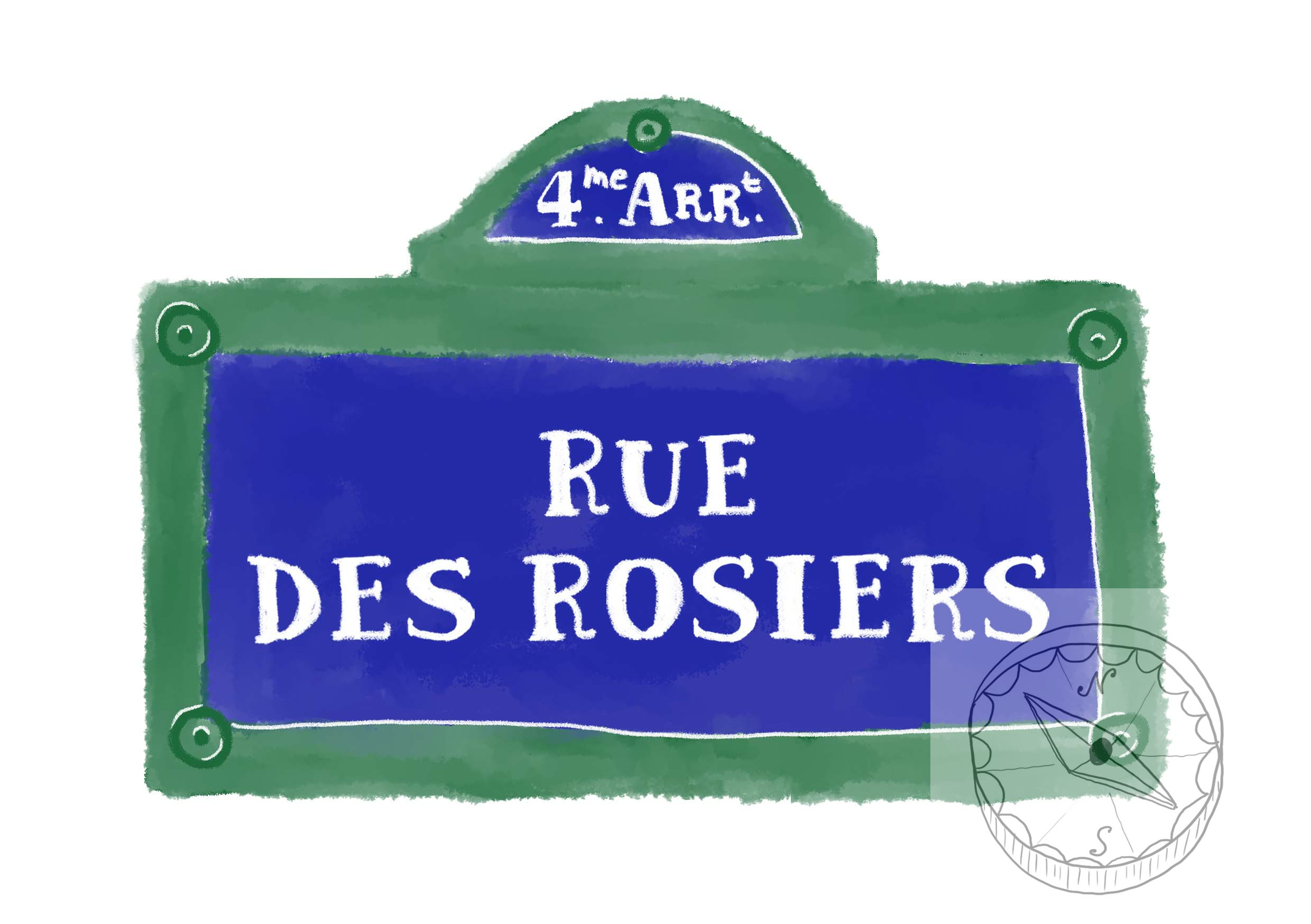
While I was doing my research - walking up and down Rue des Rosiers, sketching and re‑sketching places, trying to understand what I still don’t know about the street - I realised I have more memories tied to it than I first thought. Those memories are mundane ones: small, precious, and unimportant to anyone but me. They’re linked to sharing moments of life with friends (I counted at least three who have lived on this street), to our intertwined histories in cities (not only this city), and to those rare, unexpected pockets of peace when I sat and did nothing at all, which I almost never do. A big part of my life is drawing other people’s stories through maps, so this time I let my brain entertain itself with mine while I drew this one.
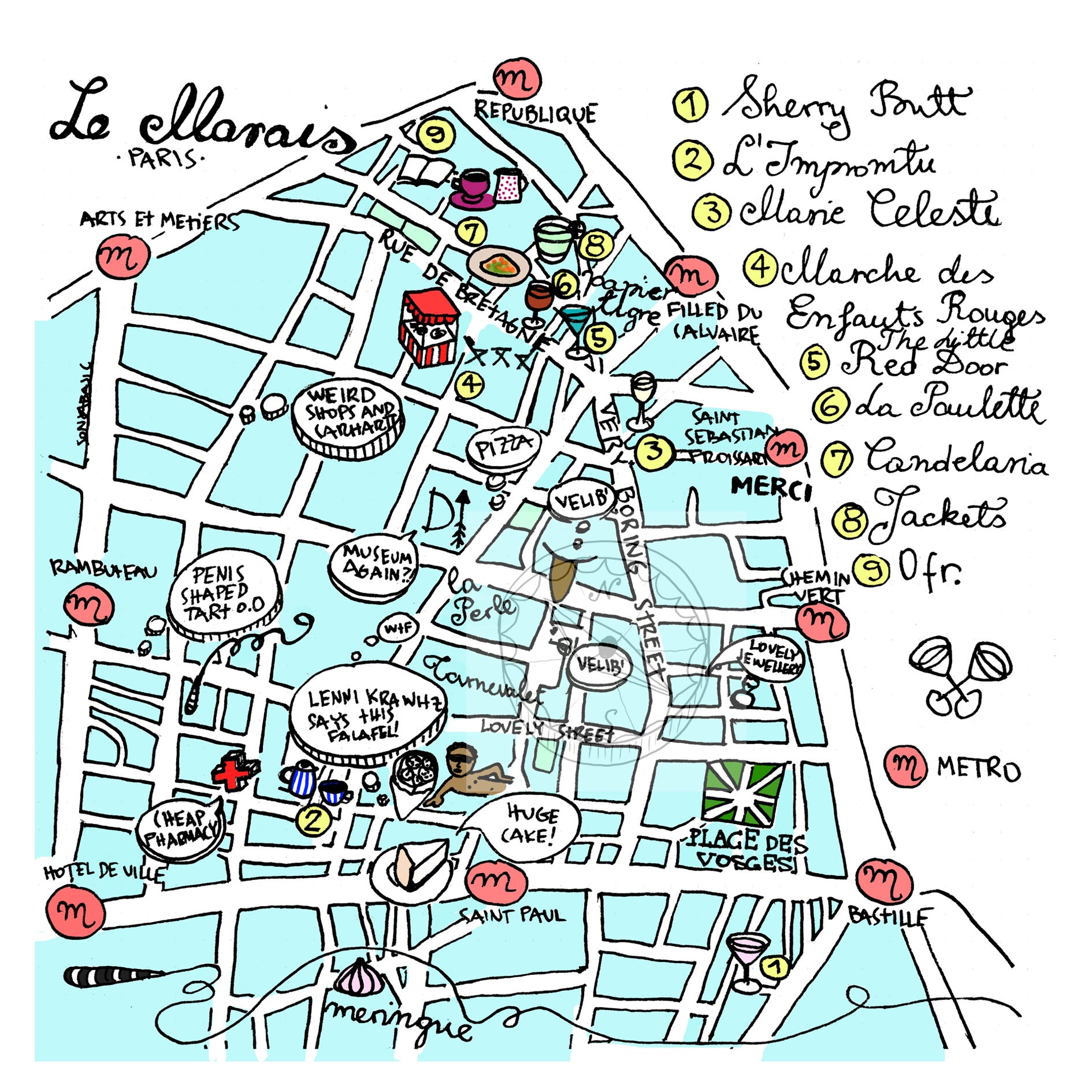
In 2015 I did a project called 100 Days of Paris (which I will never stop mentioning, sorry), and one of the maps I drew for it was a map of the Marais. Those maps launched my whole business - mapmaking and illustration - and, in particular, this business of storytelling through drawings. On that map you can find a drawing of Picasso’s bull, rue de Turenne labelled as a very boring street, and the location of a patisserie selling a penis‑shaped tart. As for Rue des Rosiers itself, there are drawings of falafel and a huge cake. Interestingly, both of those have found their way onto this new map, eleven years later - minus the shirtless Lenny Kravitz who appears on the 2015 version. I was younger, and he was more popular. It is what it is.
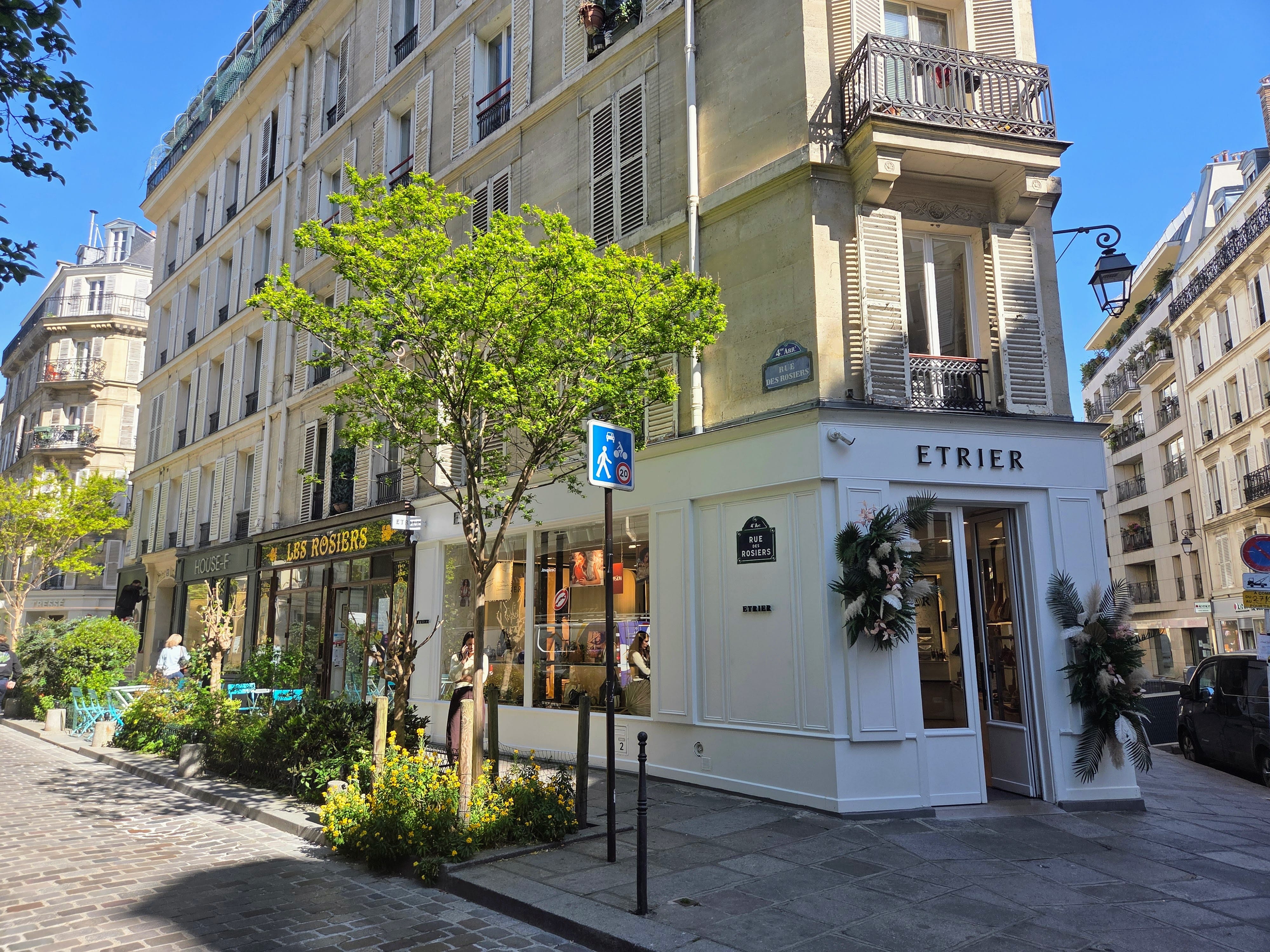
Rue des Rosiers is one of the centres of Jewish life in Paris. The area around it is called the Pletzl (“small square” in Yiddish). It’s a vibrant, beautiful street that largely escaped Haussmannisation, and in the early mornings or in low season it truly feels like a small place. This is where you can also find layers and layers of history about Paris, its communities, its food, and yes, its tourism.
Back home, when I was a kid, my father would always ask, with a kind of gravity in his voice, whether I’d remembered to call my Catholic, Protestant, and Muslim friends on their religious holidays to give them my best wishes. It was his way of explaining to me the idea of longer tables, not higher walls, and I’m grateful for that. I come from a complex place, where knowing your neighbours - their traditions and their rules - can lead to longer periods of peace (one can hope), and I try to follow the same pattern of getting to know people wherever I live.
The wall I mentioned in the neighbouring street I recently drew played an important part in the formation of this one. When Philippe Auguste built his wall in the late 12ᵗʰ and early 13ᵗʰ century, this was the edge of the city, a narrow service path pressed up against the ramparts. Locals of the time, wanting to make this little road prettier, planted small gardens along the wall where rosebushes softened the defensive landscape and eventually lent their name to the street: la rue des Rosiers, “street of the rosebushes.”
By around 1230 the street was firmly established in documents, and you can find it under this name even on old, OLD, maps of the city. Cannot recommend enough looking at those. Jewish families lived here from the 13ᵗʰ century onward, but were expelled at the end of the 14ᵗʰ century from a France whose borders looked very different from today. Their presence in this area then fluctuated with the changing rules on religious freedoms under different kings, until the French Revolution.
After 1791, this area became home to several waves of Jewish communities. First came Ashkenazi families from Alsace-Lorraine; later, Eastern European families arrived, fleeing misfortunes in their homelands. In the 1960s and 70s, after newly independent countries emerged around the Mediterranean, Jews from North Africa and the Middle East also settled here.
Many residents of the Marais disappeared in the concentration camps of the Second World War - around half of the Jewish population - and if you pay attention you will see plaques on buildings in the area that tell that sad story, commemorating their lives and quietly reminding us to be kinder, better neighbours, and to celebrate our differences instead of fearing them.
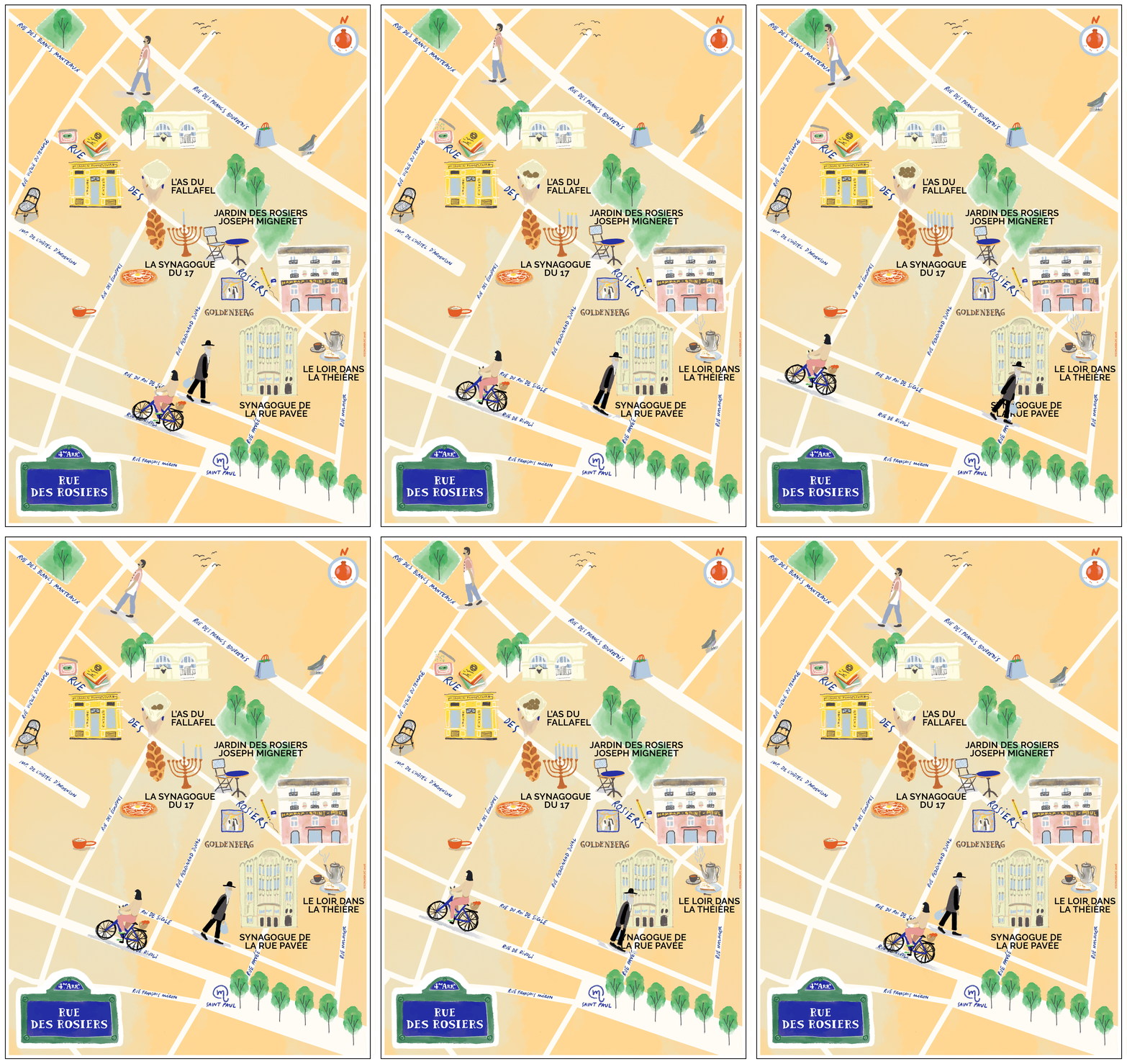
I drew and animated a map and put together a short list of things worth noticing along the street. Should you ever find yourself here, this small selection - almost a pocket guide - should tell you exactly what you're looking at, and why it matters.
If you ever need someone to show you around Paris - I’m always happy to do so.
Sometimes I enter the street from the eastern side (where the cake and teapot are on my map), sometimes from the western side (closer to the yellow shop). The street numbers run from east to west, and we’ll begin - at the beginning.
Comments
Nothing yet. Say the first thing.
Sign in to join the conversation.