
The EHRC draft Code of Practice for service providers on single-sex spaces has been finally laid before Parliament. It happened after long government delays, on the last Commons sitting day before the half-term recess, and the last day it could have been laid so that it comes into force before Parliament breaks up before the summer.
Much of the original draft code sent to the government last September was leaked, so we know there have only been two meaningful changes relating to single-sex facilities and services. The first is that the Code now says you can have an association for people with two unrelated protected characteristics. This interpretation of the Equality Act is yet to be tested in the courts, and subject to some debate from specialist lawyers. The second relates to whether sex constitutes ‘special category’ data. The Code now asserts it does, which Sex Matters says is straightforwardly wrong in law.
Otherwise this version of the Code is substantially identical to the original draft produced many months ago. No surprises there, because it simply translates the Equality Act as interpreted by the Supreme Court in For Women Scotland into guidance for businesses and charities providing services to the public. Parliament makes the law, the courts interpret the law including by resolving ambiguities on the face of statute, and an independent regulator like the Equality and Human Rights Commission simply provides advice on how to comply with the law.
The EHRC cannot rewrite primary legislation through its guidance. If you don’t like what the law says, you need to advocate for changes to the law to enable single-sex facilities and services to operate instead as single-gender-identity facilities and services. The fate of former first minister of Scotland Nicola Sturgeon offers a clue as to how that might go down.
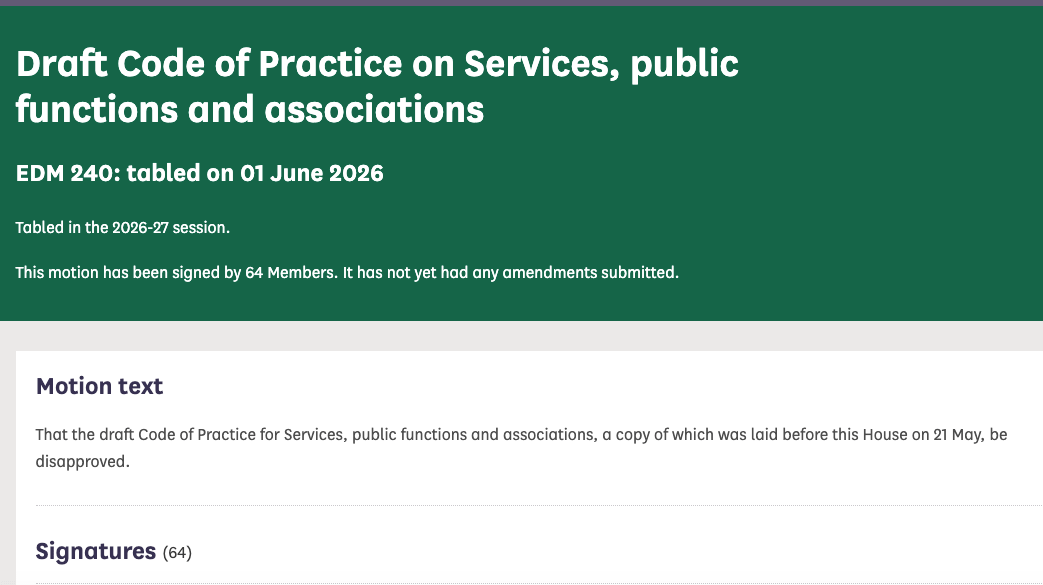
But the last couple of weeks have made painfully clear that there are MPs who are either not bright enough to understand this, or too dishonest to say they disagree with the law as it stands, and so who resort to attacking the EHRC instead. On Monday we were treated to a Commons ministerial statement on the draft Code. A group of MPs have also put down an Early Day Motion calling for the Code to be disapproved. It’s a depressing window into some legislators’ lack of understanding of the law, how it gets made, and their role in relation to it. There were a number of arguments that have been advanced by the Code’s parliamentary opponents.
Not at the beginning of Pride month!
Yes, several MPs were unserious enough to find a bone of contention in the fact that the government dared make a statement on the Code on Monday 1 June - the next Commons sitting day after the day the Code was laid - the first day of Pride month. Those whinges aside, many gay men and lesbians I know have welcomed the Supreme Court judgment, and its clarity that sex as a protected characteristic relates to someone’s biological sex, precisely because this also maintains the protected characteristic of being same-sex attracted. One of the astonishing brain-muddling symptoms of gender-identity ideology is that its followers feel empowered to tell lesbians they are transphobic for being clear that men who identify as women and are attracted to women are not lesbians: they are straight men who are not welcome in lesbian spaces. Straight men who demand rights of access to lesbian spaces raise all kinds of red flag, but the Supreme Court judgment affirmed that demand has zero legal basis. So those MPs who present the judgment and the Code as being antithetical to LGBT rights are ignoring a lot of gay men and lesbian women.
The Code is trans-exclusionary.
What MPs claiming this really mean is that they think the law is trans-exclusionary. The Code just translates the law into guidance, after all. Nadia Whittome even made the claim that the law’s effect will be to ‘push trans people out of public life’.
As I’ve argued before, part of being a grown-up is realising that not every one of your demands can be realised by society where they would have a negative impact on others. We have a long-standing social norm in the UK that shared facilities and services that involve toileting, undressing, or that make people vulnerable in other ways, tend to be provided on a single-sex basis. This is for reasons of privacy and dignity, and in the case of women, safety. For example, many men and women would not want to share communal changing facilities at the gym with people of the opposite sex, an entirely reasonable position.
MPs like Whittome conversely seem to believe that people should be able to self-identify into facilities like gym changing rooms, or services like rape crisis support groups, reserved for those of the opposite sex. There may be some men who want to do this in relation to female services for reasons that invoke sympathy - for example, they feel genuine distress at the reality of their sexed bodies. (There are others who acknowledge that for them, identifying as a woman is associated with sexual gratification). But this notion of ‘trans inclusiveness’ is not a reasonable expectation of women. It excludes the majority women who don’t want to share their intimate spaces with men.
The law - and therefore, the Code - strikes the right balance. Service providers have an obligation to provide facilities that meet the needs of trans people. This does not mean allowing people to identify into facilities for those of the opposite sex, but might include, for example, the provision of some gender-neutral facilities (or, for example, in the case of toilets and changing rooms, providing only gender-neutral but individually-lockable rooms rather than cubicles).
If Whittome and other MPs want to impose their version of ‘trans inclusion’ on society, they need to advocate for a change in the law to over-ride sex with gender identity in relation to the Equality Act’s single-sex exceptions.
The Code is unworkable.
MPs made two types of argument against the Code on practical grounds. First, they argued it would be too expensive for businesses providing services to implement. The minister, Seema Malhotra, made short shrift of this, pointing out most businesses will already be compliant with most parts of the Code. But even if there were some additional costs for some businesses in complying with the Code, surely that is the price of living in an ‘inclusive’ society? It’s hard to imagine the same MPs making the same arguments in relation to disabled access - ‘it’s just too expensive’.
Second, there are the enforcement arguments, AKA ‘you want there to be TOILET POLICE?!’ No, nobody sane thinks that. There are lots of laws and policies in society that are not enforced in an everyday context. The Equality Act sets out the obligations of service providers in relation to single-sex spaces. We can work on the basis that most adults will have enough regard for their fellow citizens to comply with policies on the usage of single-sex facilities and services. Service providers would probably have good grounds for barring someone who consistently tries to flout these policies to the detriment of other users.
Activists have also ingeniously tried to argue that operating facilities and services on a single-sex basis is detrimental to gender non-conforming women. Nice try. The gender non-conforming lesbians I know say it is much more important to them to have single-sex facilities available, and that they are more than capable of dealing with the odd woman asking them if they are in the right space, a confusion usually cleared up as soon as they start speaking.
The very good news is that at the time of writing, only 62 MPs have signed the EDM. This is progress: had this been a few years ago, the number would have surely been much higher. They will not be able to prevent this draft Code from being brought into force by a government commencement order.
Finally, an honourable mention for Tracy Gilbert MP, who towards the end of the debate asked
I welcome the clarity that the code brings for service providers, and I note, too, that Women’s Aid is just one of the organisations that has welcomed it. Can my hon. Friend confirm that the Supreme Court judgment and the code have not revoked any rights for anyone, but have confirmed single-sex rights that protect women and girls?
What a relief that at least some MPs get it.
No posts
Comments
Nothing yet. Say the first thing.
Sign in to join the conversation.