
Read Part 1 here.
In the first chapter of J.R.R. Tolkien’s The Silmarillion the world is created through song. Eru (‘the One, who is called Iluvatar’) says to his offspring the Ainur:
‘…I will now that ye make in harmony together a Great Music. And since I have kindled you with the Flame Imperishable, ye shall show forth your powers in adorning this theme, each with his own thoughts and devices, if he will. But I will sit and hearken, and be glad that through you great beauty has been awakened into song.
Then the voices of the Ainur, like unto harps and lutes, and pipes and trumpets, and viols and organs, and like unto countless choirs singing with words, began to fashion the theme of Iluvatar to great music; and a sound arose of endless interchanging melodies woven in harmony that passed beyond hearing into the depths and into the heights, and the places of the dwelling of Iluvatar were filled to overflowing, and the music and the echo of the music went out into the Void, and it was not void.’
Only recently have I dipped my toes back into Tolkien’s overflowing world. Embarking at the beginning of the trilogy this time around, The Fellowship of the Ring struck me as a kind of spring, not only in its being such an evident point of origin for much of the fantasy that came after it, but returning to it I was impressed by the freshness of its language, seldom showy but always vivid, as if Tolkien brought to us his visions of Middle-earth in clear pails, careful not to trip over his words and distort the reflection. It’s a verdant novel bursting with the promise of things to come.
But at the same time, the tale told in The Lord of the Rings feels like something that has always existed. The epic, timeless register was something Tolkien consciously strove for – though his Middle-earth was not strictly analogous to his native England, he envisioned his novels as a sort of mythic rendering of the spirit of his homeland, in the tradition of something like the Icelandic Sagas or the Finnish Kalevala. And despite its fictionality Tolkien’s worshipful documenting of the land he imagined puts him too in the lineage of evocators of the English landscape like Wordsworth or Thomas Hardy. Nourished on the same land, the trees and hills he described, once written, were no less real than theirs.
Still, many of his books’ most enduring moments come not from descriptions of landscape but from the mouths of its characters, who are almost as likely to sing as they are to speak. The last time I read The Lord of the Rings I was eleven years old, and I skipped over the ‘songs’, wanting only the continuation of the story. But is there a better way to come to know a world than by its music? In fairness to my younger self, books don’t sing, but words turned to the mode of incantation invite the recitation (and invocation) of whatever it is their song embodies. The substance of the worlds of the great fantasists is made up of nothing but words, and yet their ethereal matter coalesces through shared recital until we all agree that Middle-earth, or Narnia, or Earthsea, are worlds real enough at the very least to be studied. Beyond this point, once we’ve dreamed them together, they may become visible, and even visitable, like the film set of The Shire, which is now a huge tourist attraction in New Zealand. Anything constructed must first be imagined. And any worlds tangible enough to give rise to song must exist in some fashion.
The earlier great works of fantasy came to us in the form of epic poetry. These were worlds housed in song, that were to be remembered, detail by detail, through the act of singing them into being, and the epic nature of the poems was not just in their length but in the highwire act of animating and sustaining a world across that length. The grace of musical creation carves and caresses the folds of Homer’s valleys and sharpens the peaks of Milton’s paradise. There is a kind of holy spirit animating these worlds, acting as a beautifying veil through which we see them, and that spirit is the melodious language in which the worlds are given to us. ‘I know it’s epic poetry that keeps the cosmos orbiting,’ says rapper R.A.P. Ferreira in Fighting Back.
In Christian mythology the Word is given precedence: ‘In the beginning was the Word’. The holy spirit is the communicant of the word of God; the divine coagulant that makes possible the imminentising of the Word and the subsequent enchanting of the world in the light of the story of Christ – instantiating God as author and Jesus as word-made-flesh. The story walking among us. Summarised like this it almost sounds like the kind of vertiginous metaphysical trick Borges (another great fantasist) tries to pull off in his fictions, but then Borges was of course influenced by many religions and philosophies, and all fantasy shares the seed of religiosity, because religion is the retelling of the world, usually by means of a kind of palimpsesting of another.
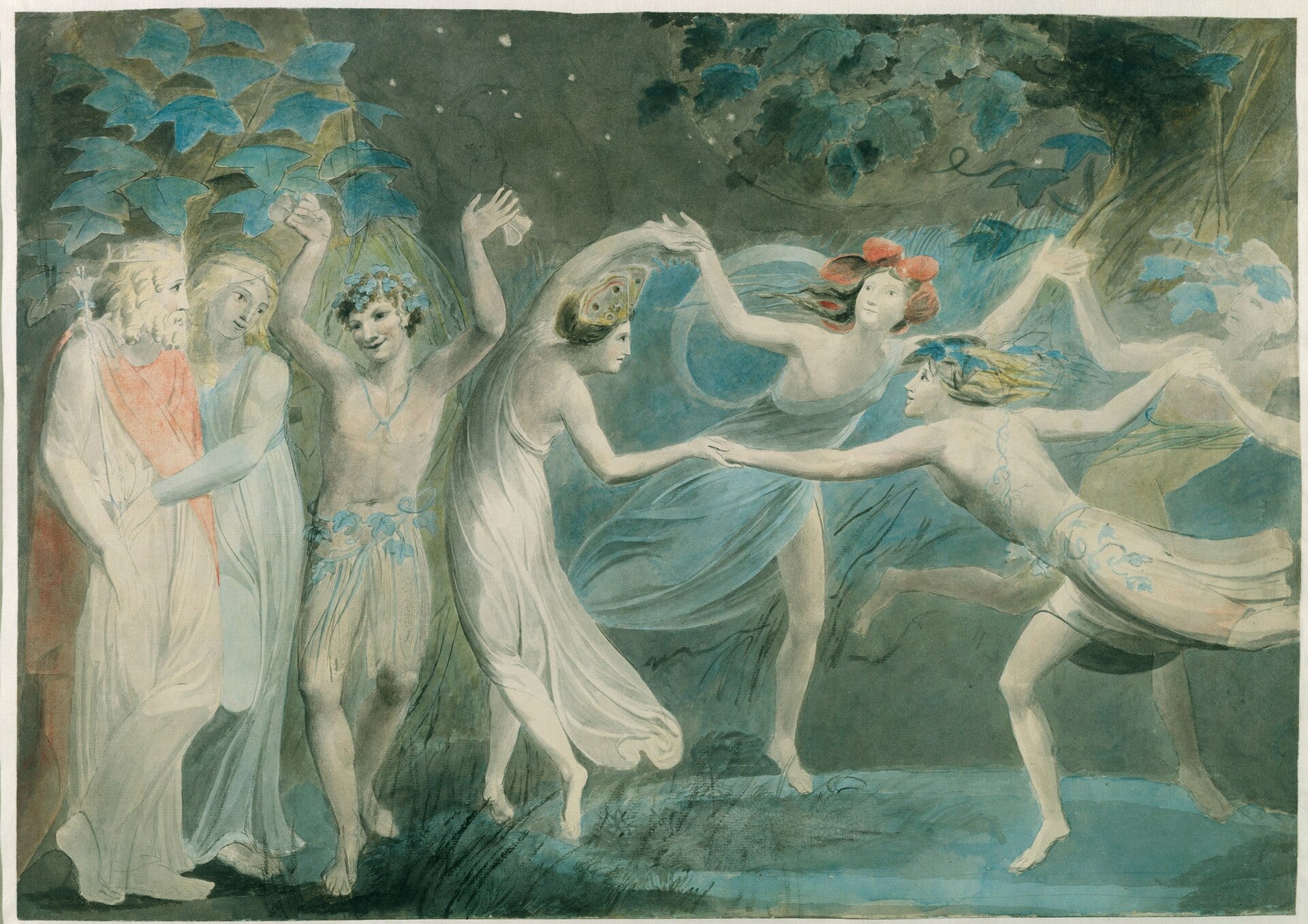
William Blake – one of the most renowned fantasists, visionaries and, by his own estimation, bards in all of literature – believed that everyone needed their own religion, founded and fostered in their imagination. ‘All religions are one’ he famously claimed, meaning that all religions sprang from the same imaginative intuition. And the dogmatic fractioning that follows on from the formal establishment of any religion is because ‘…all sects of Philosophy are… adapted to the weaknesses of every individual [through whom they are expressed]’.
In his own prayerful poetry, in which he is at once chronicler, commander and inquisitor of the cosmos, he is never far from calling heaven, in whichever form, down to earth. In his poem To Summer he invites the season to come and sit beside a clear river, promising that the mossy valleys will love and welcome it, and, to sweeten the invitation, he gives special mention to the musicians:
‘…Our bards are fam’d who strike the silver wire…
We lack not songs, nor instruments of joy,
Nor echoes sweet, nor waters clear as heaven,
Nor laurel wreaths against the sultry heat.’
He places songs first in his list because the songs are the purifying force which make the waters clear as heaven; they clear the way for the arrival of the summoned summer, which is a summer that exists only in song.
It’s this kind of intimacy and trust between world and imagination that Blake wants us all to enjoy. But it can only be gained through experience. Gnosis acts in us at a sub-lingual level that knowledge can’t reach. But, though Blake would say that we all by our birthright have access to it, not all of us reach the same imaginal wellspring he did. Religions disseminate the visions of those influential individuals who have reached the wellspring, but the danger of this dissemination is one that Blake understood: it is the ones who can’t see it for themselves that fight most violently for their truth. No wonder then that the main way in which religions try to bring their gods down to earth is through song; music is the great unifying art, and – like with the plantation slaves and ship labourers mentioned in part 1 – through song we are invited to dream, and in dreaming see.
When we hear music that is supposed to come from another world – even if we are only entertaining a fantasy in believing it so – there is a strange charm that comes attached to it. Because out of what history, and out of what landscapes, has it emerged? Within a film, for example, the soundtrack is composed to be of that world, to be in some sense its texture, or atmosphere – its environment. But the effect is even starker when we hear a song in a film which is set in a world apart from our own that we are invited to imagine originated in the world of that film. What musical lineage can we place it in? The fantastical register that the composers of this kind of film music work within gives them an imaginal window out of history.
But then history itself is already a dream. Not only do we see through a glass darkly, we also stake our sense of worldly stability on the dream of collective memory. Music, though, always has one foot outside of history. Each performance of a song is a resummoning, an attempt to dream a dream again. ‘Bring it back’, ‘Do it again’, ‘One more time’… all phrases that ask the musicians to repeat what has come before. And the trancelike effect of music that plays with repetition has its power in the looping of a moment back into itself again and again. Music doesn’t only play in time but with time, and the effect that this has on the spatial imagination can be borderline psychedelic.
When I was 17 I discovered the band maudlin of the Well (lowercase ‘m’ intended). I’d just been to see Insidious, a horror film very much of the early 2010s – which forever warped the impression that Tiptoe Through the Tulips makes on me – presenting its horrors as intrusions from the astral plane, and putting into my mind a fascination with what kinds of places and presences might exist there. I hadn’t yet developed the hallucinatory insomnia that I’ve been living with since my mid-twenties, otherwise that fascination might have looked a little different. While looking up astral projection I spotted maudlin of the Well referenced as a band who had allegedly used it, as well as lucid dreaming, to compose their music.
I had to listen to them of course. I had a vision of the astral plane as a sort of haunted attic (maybe not different from the place invoked by motW frontman Toby Driver’s album In the L…L…Library Loft) whose bare floorboards creaked and whose windows looked out onto a world too alien to actually consider, more like a tantalising direction I wasn’t yet ready to extend my fantasy into. This is where I imagined maudlin of the Well’s music being composed. The interludes and acoustic-centric tracks especially suited my vision. And the music fascinated me; the odd, somehow balletic metal passages interwove with serene, chamber-like orchestration and the ugliness and the beauty did not dispel each other but blended into a whole that still to this day casts its own idiosyncratic spell on me. But some of it also sent a shiver up my spine, like the wordless babbling that suddenly emerges in the middle of Rose Quartz Turning to Glass, or the end of The Ferryman, which I couldn’t help hearing (or wanting to hear) as the actual voice of an astral demon, or the distant and distressed shouting at the beginning of Riseth He, the Numberless, Pt.2 which sounded like someone trapped in the dreamworld of the music. It was these wordless moments of vocal expression that were most chilling because they were the most evocative of the world I was hoping the music would bring to me. Unlike the words of the songs, Toby Driver’s wordless babbling seemed to me – kitschy as it might sound – a direct transmission from an otherworldly being, and therefore a window into its world. It was expression unhindered by language.
We’ve now crossed a border from the epic poets who built their worlds word upon word; the building blocks of maudlin of the Well’s astral evocations are far more fluid and ghostly. What does the voice express when it shakes itself free of language? It’s not simply emotion, though emotion is one of the things it encompasses. The voice is an instrument of imaginative transportation. Toby Driver’s croaking and babbling took me somewhere unsettling and demonic, but at other times his almost childlike singing seemed to fill the dream-attic space with banishing light.
This kind of transportive effect doesn’t demand a voice – I would say texture and melody together are its core ingredients – but the presence of a voice is like the figure in a landscape painting onto whom we can project ourselves. There is something so enlivening when a voice appears even in music which is largely instrumental; its presence carries over into the moments of its absence. Silence, once broken by even a single voice, can never again be absolute. As for the envisioning of the landscape itself, though, Joscelyn Godwin, in Harmonies of Heaven and Earth relates this anecdote from Mozart:
‘Great thinkers have vast premonitory glimpses of schemes of relation between terms, which hardly even as verbal images enter the mind, so rapid is the whole process. Mozart describes thus his manner of composing: First bits and crumbs of the piece come and gradually join together in his mind; then the soul getting warmed to the work, the thing grows more and more, “and I spread it out broader and clearer, and at last it gets almost finished in my head, even when it is a long piece, so that I can see the whole of it at a single glance in my mind, as if it were a beautiful painting… in which way I do not hear it in my imagination at all as a succession – the way it must come later – but all at once, as it were. It is a rare feast. All the inventing and making goes on in me as in a beautiful strong dream. But the best of all is the hearing of it all at once.’
Here, the hearing and the seeing are one. In THERE’S NO DOOR INTO THE MANSION I wrote about how a better understanding of our emotions might be a pictorial one, in which we locate them within an inner topography. We instinctively close our eyes when we sing, and I think to some extent we do so to enter into this inner terrain. Schopenhauer describes the straying and returning of a melody to and from the dominant note as a kind of sublimated map charting an adventure of the will, and to have an adventure there must be a landscape. We might better understand what’s going on here if we turn to dolphins. Godwin tells us:
‘Normally the dolphin sends out periodic sonic and supersonic clicks in bursts of up to 800 per second. Their echoes bring all the spatial information the dolphin needs… It is difficult to imagine such a mode of perception, and one can only guess at the acoustical elements that carry the messages, but according to all accepted definitions the animal’s experience must be a musical one. If the dolphin is in motion, the echo will be heard with the pitch-change characteristic of a Doppler effect (as with the siren of a fast-moving ambulance: the pitch is heard to rise as it approaches, and fall as it leaves). All distances will be perceived as different rhythmic intervals. An echo heard as the next sound is emitted will give rise to beats or to a chord.’
Is it possible that our proclivity for singing is some kind of evolutionary hangover from our shared ancestry with mammals who use sonar? Humans can learn to echolocate, and whales are known to sing – whatever it is that drives them to do so may well be something we both gained from our common ancestors. In the most practical terms singing is of little use to us in the external world when speech already exists, but because of this it is something of a mysterium fascinans of the inner world for every human being with ears to hear. Is melody itself a siren song in that it beguiles us towards a mystery which is bottomless because we have evolved beyond its meaning? Maybe so, if we are searching for meaning.
But we do not sing to find meaning. We sing to exalt in being alive. We sing to fulfil a vision in song. Whether our capacity for exalting in this fashion is an evolutionary vestige of something once more practical or not doesn’t change our delight in the exaltation. Evolution does not usually equip animals with a tool merely for the purpose of their own pleasure, but creative use of our tools is where recreation comes into play, and everything is capable of change when passed through the filter of the human mind; the intellect is a multipurpose tool for making multipurpose tools. The difference between the echolocation of dolphins and our own singing is that for the dolphin the music comes back to it as the echo of its surroundings, whereas for us the music itself is the thing being expressed by our voice. We do not sing to hear back a report of a landscape; in singing we create a landscape. And in doing so we impress upon all who hear it a more direct and immediate window into our inner world than would be capable by any more prosaic fashion. As Agnes Varda claims in The Beaches of Agnes, ‘If we cut a human open we will find a landscape.’ And Godwin quotes The Brethren of Purity, saying:
‘In effect, melodies which are composed of notes and rhythms leave an impression on the soul similar to that made by the artisan’s work on the material which is the substratum of his art.’
Melody, in this interpretation, moulds a topography of the soul. This topography is the same one that Blake implores us to explore for ourselves, but Blake’s own visionary world is one that he painstakingly made sure to leave open to visitors. Through song we are invited to enter the landscape of another, and through shared song inner landscapes can become communal. As discussed in part 1, some of the earliest known and still ongoing traditions of song exist as a sort of mental register of their surroundings, but there are places of deep cultural significance that are only accessible in the imagination. Godwin writes:
‘The Celtic Otherworld has a constant quality peculiar to itself… Its landmarks are as unmistakeable, its atmosphere as marked as that of the Muslim Paradise with its greenery and houris, or of the Renaissance alchemical engravings with their formal gardens and fabulous beasts…Of course, Irish saints may have been blown off course and ended up in the Bahamas, but this in itself is not sufficient reason for the tales they told… There is a characteristic passport to the Celtic Otherworld… It is a silver branch with golden fruits, three or nine in number, which – and here is the typical Celtic touch – strike together to make an enchanting melody.’
And:
‘The Celtic legends1 leave an unforgettable impression of a dreamlike existence suffused with music: an Elysium of musical trees, fruits, fountains, stones, nets, choirs, and birds upon birds. Taken as discrete symbols, one could analyse and explain them, but this would be to lose the environing atmosphere of a world with its own nature and its own inner consistency. To ask what the crystal pillar ‘means’ is as pointless as for a visitor in Paris to ask the meaning of the Eiffel Tower.’
We can ask for no better illustration than this of how the imagination does not stay housed in the minds of each individual, but demands to be given expression. Shared dream-worlds form the substratum of entire cultures. And the imagination is in fact likely to become malign if not allowed passage into the world through creativity. And so our world is teeming with the dreams of others, living and dead, at every stage of actualisation, from a sketch drawn in sand to the Taj Mahal to the tales of the Norse gods. This perspective might not be a logical negation of Solipsism, but it is a reversal of its worldview: not only are we not the only conscious subject, but the subjectivity of others actively shapes the world around us. Each subject is a singularity equivalent to a universe. This, again, calls back to the Christian mythos, in which God is the creator of the universe, and we are each created in his image. To be created in the image of the world’s creator means to be yourself capable of creating a world. To be, in fact, already the creator of a world, simply by existing.
Once this gate is opened the borders between dream and waking, and self and other, are apt to blur, and our conception of the world becomes porous with a virtual infinity of others. And the universal love that is preached at the heart of every religion needs no more explanation. Love thy neighbour as the one who dreams you. But again, this is something that must be felt instead of merely known. Sometimes I feel it after a bottle and a half of wine, or a long conversation with a friend. Sometimes I feel it during the harp interludes of Cosmia by Joanna Newsom. Sometimes I feel it for no reason at all, except that I’ve felt it before.
There are dreams within dreams within dreams within dreams. When listening to the elven music in the House of Elrond, Frodo – dreamed up by Tolkien – dreams his way to the edge of his own world:
‘At first the beauty of the melodies and of the interwoven words in elven-tongues, even though he understood them little, held him in a spell, as soon as he began to attend to them. Almost it seemed that the words took shape, and visions of far lands and bright things that he had never yet imagined opened out before him; and the firelit hall became like a golden mist above seas of foam that sighed upon the margins of the world.’
The ‘far lands’ and the ‘golden mist’ visit him exactly where he sits, in the firelit hall. The imagination is like a kaleidoscope of many windows always looking into its own centre, where anything capable of being imagined resides. The kingdom is the dream of the kingdom. And music, so often, is the key.
If any generous souls feel like making a small donation, I’ve set up a buymeacoffee account: https://buymeacoffee.com/somethingishappening. I’ll probably use it to buy food, but I might occasionally buy a coffee for form’s sake.
The Voyage of St Brendan, The Voyage of the Hui Corra, The Sickbed of Cuchulain etc.
No posts
Comments
Nothing yet. Say the first thing.
Sign in to join the conversation.