
The quintessential British colour palette – greys and greens – rushes past the train window on my way to Stockport. All day a humid air has hung under the clouds, and the lack of air conditioning on this 21st century locomotive has me breaking a sweat even while sitting still. Summers in Britain are hot, and getting hotter, as any number of social media posts are eager to make apparent to the rest of the world. ‘We’re not built for this!’ the cry goes.
I’m travelling to Stockport from Liverpool to see the exhibition Ends are for Yesterdays (Not Tomorrows), a show displaying the work of (and affably hosted by) Will Farmer, Lucy Roberts and Keziah Thomas-Mellor. The venue is PINK – by name if not by colour – a small arts space smuggled inside of a repurposed and admittedly rather ugly 1960s office building, which in itself feels like a minor act of reclamation from the calcified claws of capitalism, something pertinent to the concerns of each of the featured artists.
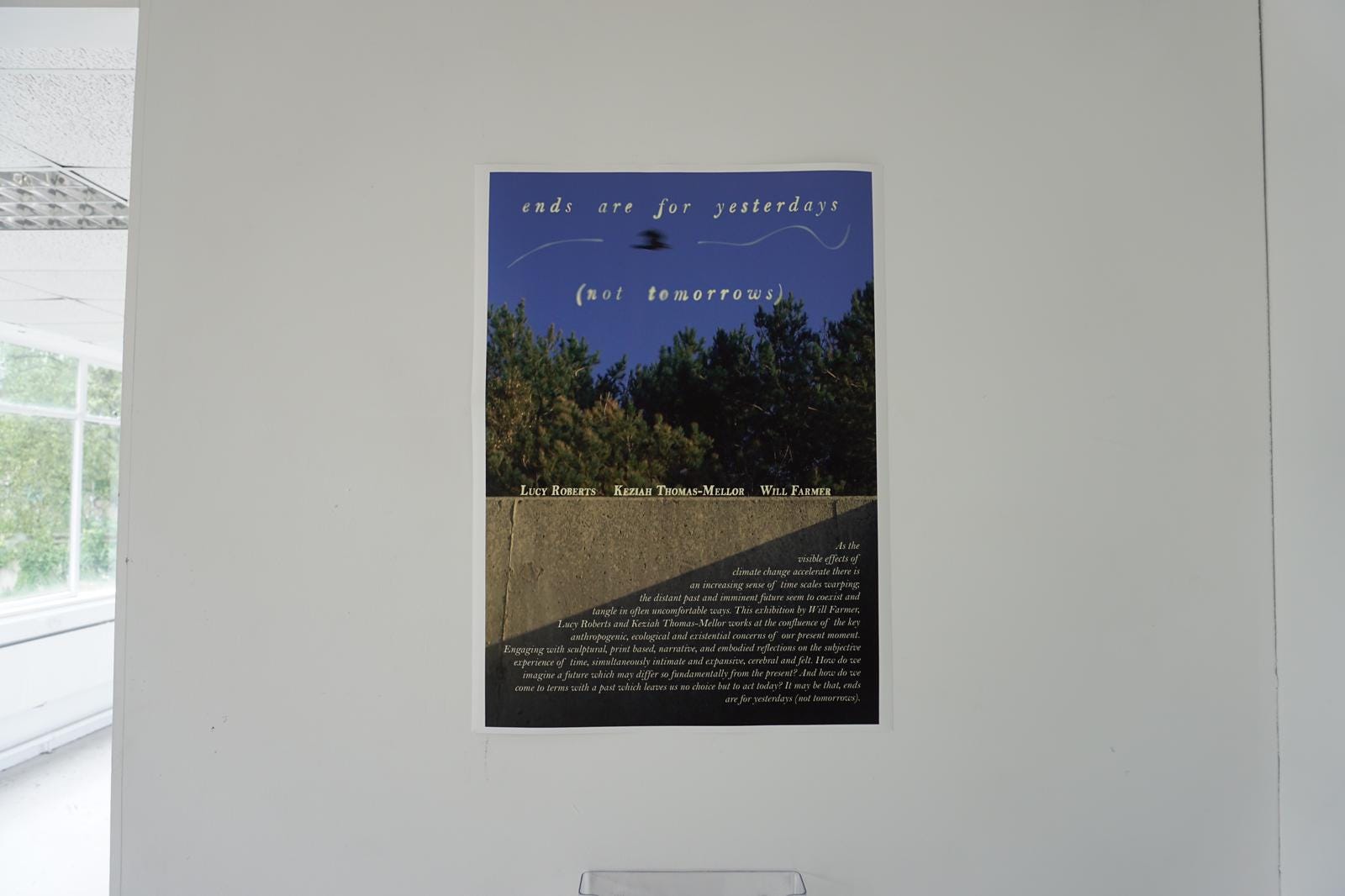
The exhibition booklet unfolds in a non-linear, puzzle-like presentation, but whichever page first catches your eye certain themes are made unavoidably clear: time, the natural world, and the ways that we humans have marked it. ‘As the visible effects of climate change accelerate,’ it reads, ‘there is an increasing sense of time scales warping; the distant past and imminent future seem to coexist and tangle in often uncomfortable ways.’
There is mention also of land art, of ‘spiritual engagement with the land’, and an implicit lament for how we treat it; how we dig and gouge it for resources, how we build unceremoniously upon it, how we divide it up and name its territories, how even our language distils materiality into conceptual matter only ever referent but not equal to the earthly matter itself. We too easily forget that our bodies – and therefore our minds – are also of the earth, and that we should welcome the fact that the world exceeds our capacity to know it as an invitation to wonder, instead of suffering in vain to exhaust our inevitably imperfect mappings of it. Farmer reminds us of this in the pocket guide: ‘The wondrous unknowns of the self and the material world are sites of potential, rather than gaps in knowledge.’
Art is built upon that very site of potential, it delves into the wondrous unknown. It is a path of discovery different to that of science, one which leads us not away from the self and the world, into laboratories of cool observance, but draws us deeper into our mutually incalculable depths – however playful and circumambulatory might be its course. Art shows us the world and teaches us to see ourselves. To quote Farmer again: ‘The observer… watches through a lens which is actually a mirror.’
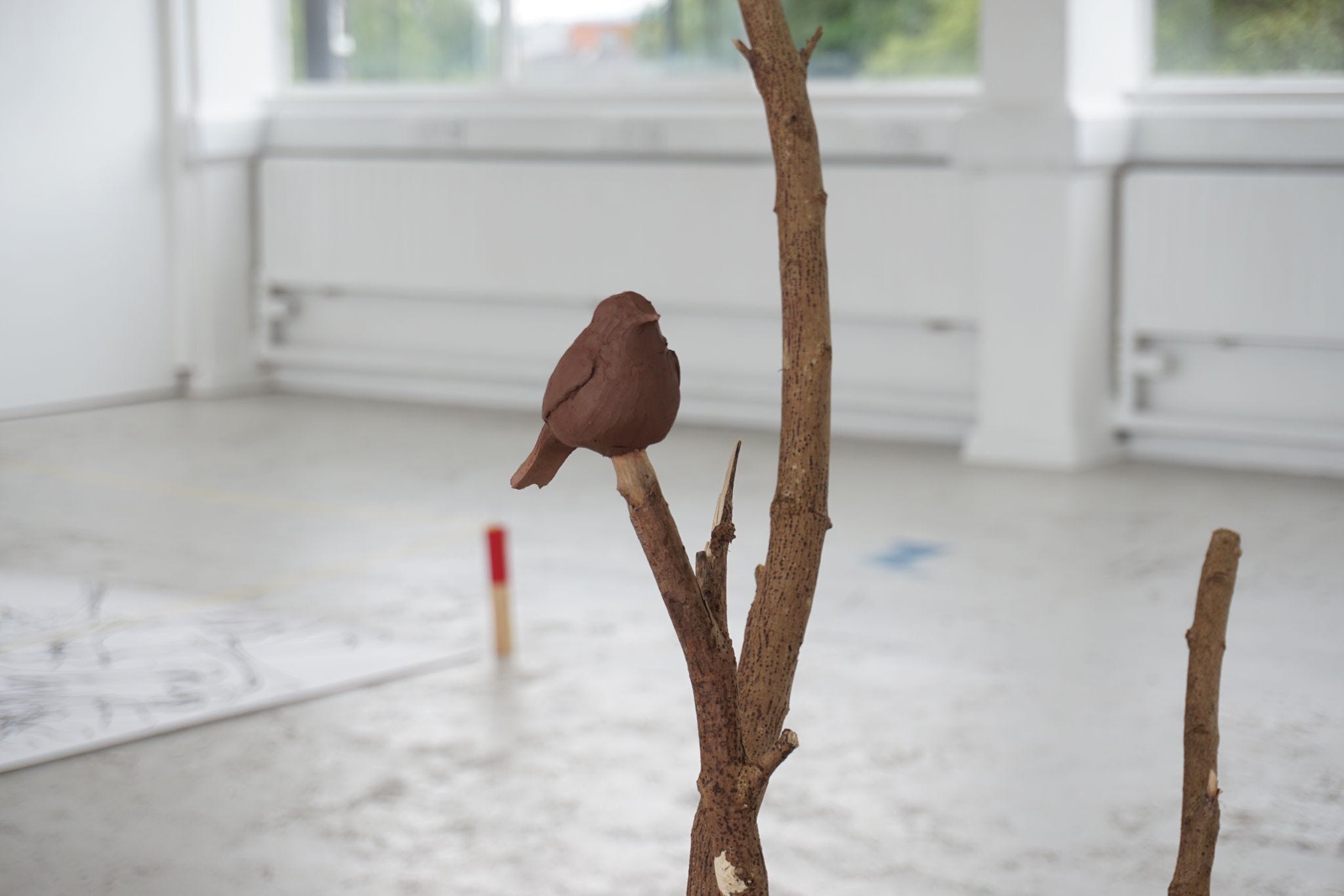
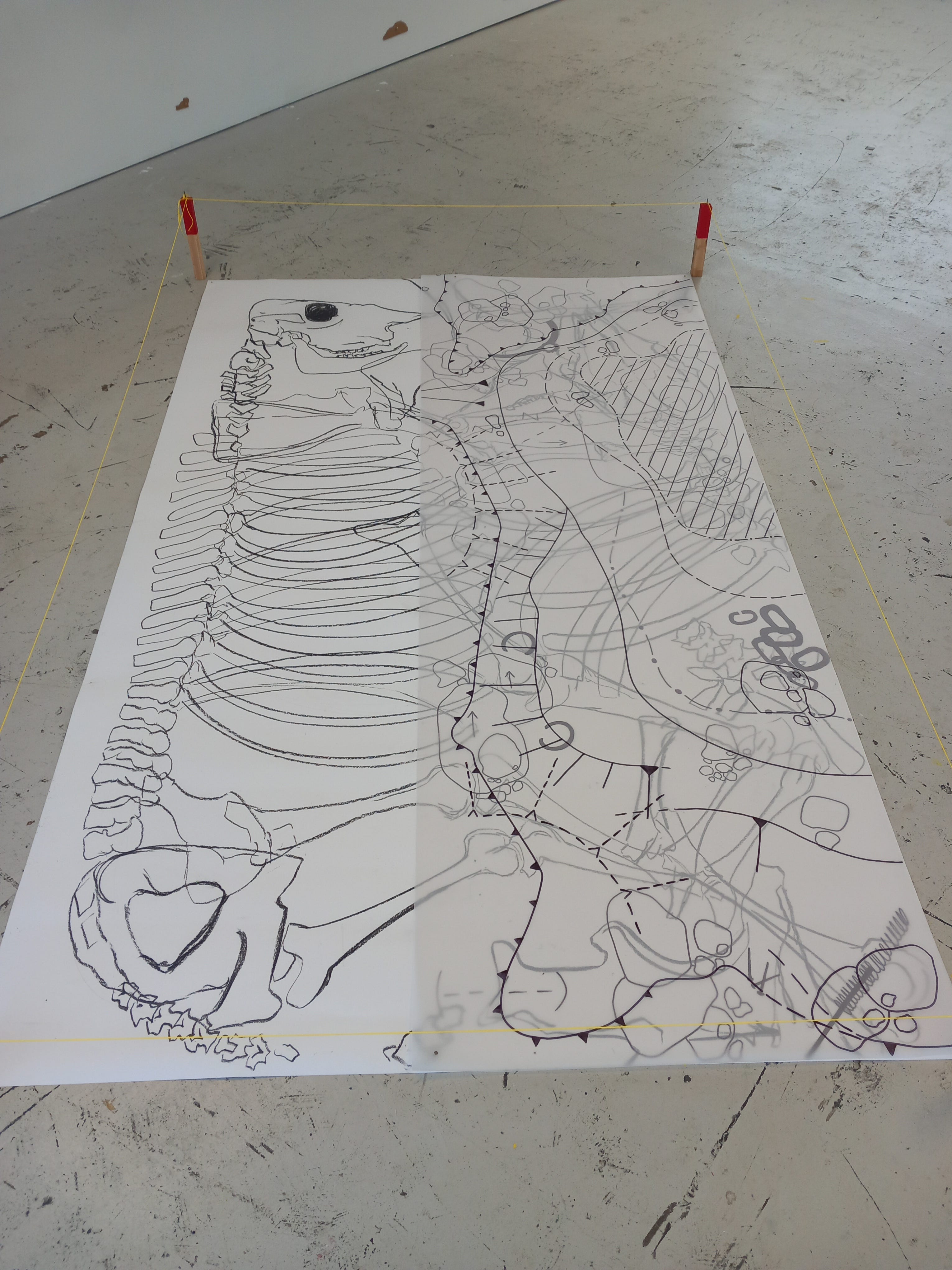
So, onto the art on display here. Both the floor and the walls in the little white room have been utilised by the artists. The floor is taken up on the left by three huge drawings of the skeletons of cows by Roberts, two of which are overlaid with translucent topographical diagrams, while a sculpture by Thomas-Mellor dominates the right side of the room, in which a twin-pronged branch topped with two clay birds sprouts from a spiral of bricks harvested from the debris of Liverpool’s Blitz Beach and carefully selected for their sea-weathered roundedness, the rounder ones occupying the centre of the spiral, the more rectangular ones forming its border, as if its curve charted a timeline along which the bricks were shedding the influence of human hands and reverting back to humble stones. There are no straight lines in nature, and no stone wants to remain rectangular.
But though it’s these floor installations that first catch my eye, it’s clear that their full significance will only become apparent after absorbing the rest of the work. On the walls there is a clear left-to-right alignment which makes reading the room, so to speak, easy, and ensures that everything encountered carries with it the context of the previous piece.
Firstly, Roberts offers two short stories which proffer up the kind of world we are being invited to interpret these artworks in light of, or to set them against. The first of these stories, What Happened to the Cows?, fittingly hangs beside a window looking out onto a car park. The protagonist is a nameless ‘they’ identified only as ‘the worker’, employed at a factory in which the workers at their assigned stations are shielded from the sight of the cows whose skin they unknowingly use to make leather bags.
Roberts states in the booklet her interest in how ‘Tenseless language and absence of physicality create a space where you can warp your existence across space and time.’ What she is aiming to evoke in language is what the environment of a factory or a slaughterhouse aims to establish in practice – a mechanistic absence of physicality in which the existence of living beings is – in the case of workers – minimised, and – in the case of animals – annulled. The story critiques the industrial work model which divides manufacture into discrete roles carried out by workers whose comprehension of the production process in its entirety is tacitly discouraged. The cog-in-the-machine anonymity of industrial labour bottoms out in a perverse kind of innocence almost touching on non-existence. Humanity reduced to the function of a lever or a button, a simultaneous presence and absence.
Roberts’ second story, ‘Recent Excavation of the Archaeological Site of an Undefined Region: An Exploratory Account’ is a short tale somewhat reminiscent of the Strugastsky brothers’ sci-fi classic Roadside Picnic, about an unexplained sinkhole that opens up on the path between two settlements, which is subsequently investigated and quarantined under suspicion of alien activity, before eventually being paved over and mostly forgotten about. Mystery erased by the blank weight of concrete.
At one point in the story someone lowers a lamp by rope into the hole. Here – in the real world – a rope-threaded lamp also hangs from the wall. This feels like a Borgesian trick (Jorge Luis Borges is one of the writers cited as an influence on the exhibition). The Argentine was always trying to find a way to breach his fictions into reality. The boundary between page and world is porous in Borges, and it is something these artists are toying with too.
From Roberts’ stories we carry a sentiment of industrial loss, and a slight residue of the science fictional, over to Will Farmer’s corner of the room. Here we find a shelf of old books on birdwatching, a folder, labelled ‘Sightings’, of playful bird drawings and a radio tuned (presumably by chance and not intent) to Jonathan Ross’ Music at the Movies hour. But the centrepiece of Farmer’s display is a series of blurred and indistinct photographs whose objects are just about discernible, captioned with the faux-Latinate names of birds and yet absent of any traces of avian life besides certain sites – a balustrade, a window ledge, an antenna – on which they might have alighted.
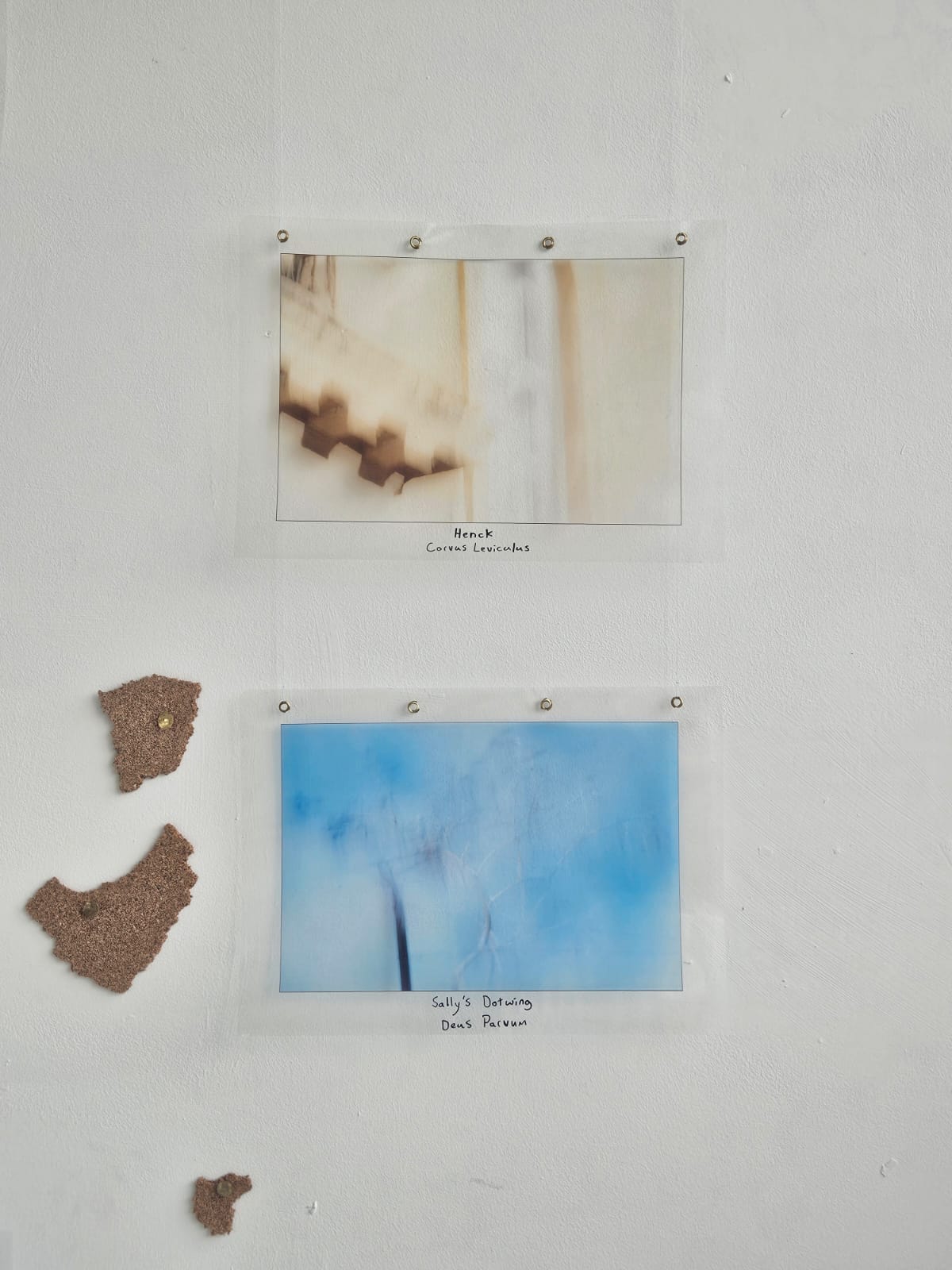
The exhibition booklet constantly draws our attention to the future, not least to ask us ‘What will we leave behind?’, and Farmer’s photographs play with that archival instinct in us to preserve and pass down old names and categories for things that may change or disappear by the time future generations arrive. The blurring of the images acts as a kind of confusion like the fog of time, as if we were looking back from some distant future on these documents of the past, and in our ignorance confusing the bird for its perch – is the Latin ‘Penna Intonsus’ referring to the bearded brake named but not shown, or the antenna which is in fact the subject of the photograph? Again the simultaneity of presence and absence is being evoked.
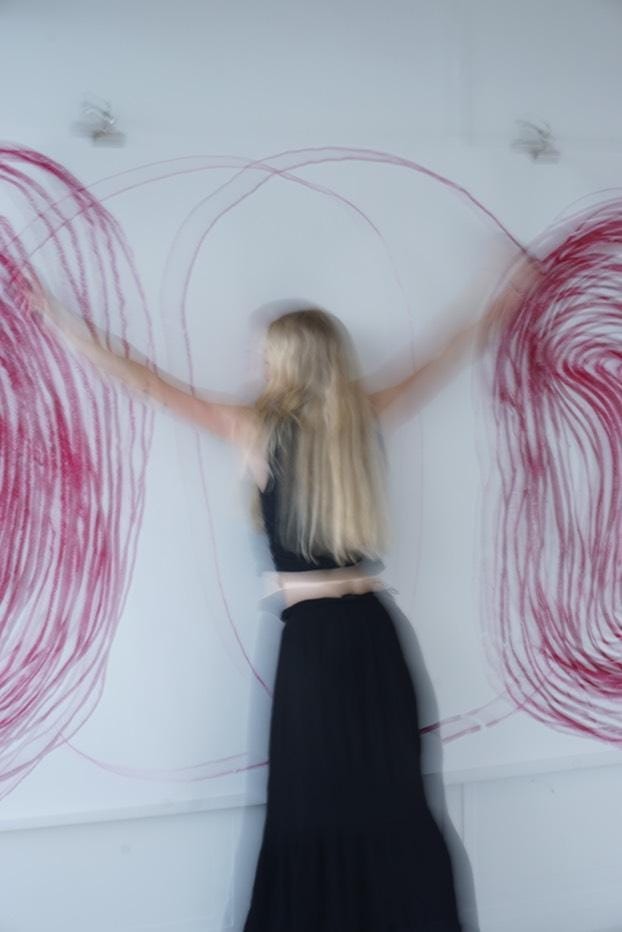
Moving on from this corner of the room Thomas-Mellor’s sculpture of brick, branch and bird leads us at last off the page and into the real world of objects, just in time for the main event of the night – a live drawing from Thomas-Mellor in deep-pink oil crayon of spirals on a huge canvas hung on the far wall. The drawing is an expansion of a similar performance at Manchester Art Gallery in January, this time ending in a two-handed double spiral, during which the artist’s arms rise and dip and twist in an almost flight-like motion. Again the bird motif haunts the show; the missing birds in Farmer’s photographs, the clay birds atop the branches in Thomas-Mellor’s sculpture, the blurred bird captured mid-flight on the exhibition poster… these birds are all frozen or absent, which then contrasts with Thomas-Mellor’s performance, which can best be described as an act of presence.
Everyone in attendance pauses to watch the twenty-or-so minute live drawing, to see the spirals take shape with the inevitability of the concentric rings of a tree, the motion of the artist’s body leaving traces which will then themselves become the lasting artwork in her absence – though only by this performance of presence were they able to take form. Which is the artwork here, the performance, or the traces of the performance?
This is what the three artists are asking us: what will we leave behind? And how should we live now so that we can be content with the story our traces will tell? Would we recognise ourselves in the relics that outlive us, or would we seem something entirely other? In the same way that a balustrade adopts the name of a missing bird in Farmer’s photography, when humans are gone humanity will reside only in objects, and perhaps also in the destruction we have caused. We remember the dinosaurs in the same breath as we remember the asteroid that wiped them out. Will humanity be remembered as its own asteroid, as a self-destructing species?
This question becomes more urgent with every passing year, with every flood that sweeps through our towns, every fire that burns through our forests, every bomb that takes the lives of blameless children and every technological advancement that sharpens the simulacrum of the spectacle while detaching us from ourselves. The self is emerging as the great other of 21st century life.
The forfeiting of agency is understandably alluring in a society that seems bent on collapse and yet keeps going and going and going, as if even god’s thumb is trapped in the scroll of an endless news cycle. So it’s no surprise that it has been made easier than ever to reduce yourself to a lever, to abscond into the algorithm, to seek the innocence of the absentee – but sooner or later the mirror gets held up to us all.
The question of what we will leave behind is one for the future. The legacy of humanity is not for humans to know. Right now what we need to decide is: what are we going to do? As long as we are on this earth, we can each choose how to act. The Mitch Alborn quotation that gives the exhibition its name prods us with this notion. The use of ‘tomorrows’ in plural instead of simply ‘tomorrow’ implies that the future is still open to influence. Which tomorrow will we choose?
No posts
Comments
Nothing yet. Say the first thing.
Sign in to join the conversation.