
FIRST THINGS FIRST — I am launching a mail club! Eeeeep!
Something for Sundays is entering the physical realm — and I’m so excited!
This past year or so, I’ve felt a pull toward being attentive to physical life. In this screen-filled world, with information-overload, I wanted to create something that encourages a slower, creative way to engage with my readers.
So I’m launching the Something for Sundays Mail Club. A monthly zine — fully hand-illustrated by me — about wisdom traditions, religion, and spiritual practices from around the world. It’s a small zine about big things, made for anyone: devoutly religious, fully atheist, or somewhere in between.
Each issue is 8 pages of illustrations, insights, and anonymous reader questions (you can submit yours here, by the way). Every single copy is created, bound, sealed, and sent by yours truly!
The club has limited availability for now — and because you’re already here, I’m opening the waitlist to my Substack readers first. 🧡
Join the waitlist to be the first to know when subscriptions open next week. I am so grateful you’re here!!!


Aaaaannnddd in other news, today we are going to talk about a scary word… cults.
Several years ago, I wrote this line in my journal:
I am caught between faithfully serving each Sunday, and obsessively watching cult documentaries, trying to figure out if I am in one.
At the time of writing, I was really active in my LDS ward — I was the kind of person who attended ward council, had two callings, and drove someone new to church each week. I was very much in it. AND, I’d spend my evenings during the week watching cult documentaries about Scientology, Gloriavale, NVIXM, and FLDS — anything I could. I’d gawk at the believers, thinking, “How could they ever believe that?” (meanwhile feeling a little twinge in my heart at some similarities)
One documentary I watched during my time of searching was about a TikTok dance cult, called Dancing for the Devil. The church targeted Koreans, and later TikTok dancers. A young girl got wrapped up in the group when she moved to L.A., and the documentary follows her parents’ attempts to help her “escape” the cult.

They show the family insulting the leaders, explaining to her she is brainwashed, showing up to the house to forcibly try to get her out, and further creating a deeper and deeper chasm between their family and her. Her parents are visibly hurt by her choices and are worried they will never get their daughter back. It’s heartbreaking for them.
When I was watching, I couldn’t help shake my head and think, “they’re doing it all wrong.” Even though, at the time, I couldn’t totally turn a critical eye to my own beliefs, I recognized that force and anger only drives people away.
If the goal is to set someone free of the kind of mindset it takes to be a part of a cult — insults, accusations, and forcible attempts don’t quite cut it. Leaders of every cult ever warn of the outsiders and people who will “never understand.” It’s part of the indoctrination that makes people stay there in the first place.
Once, a really angry woman (who was, unfortunately, a Christian pastor) snatched a pass-along card from my hand. “Perfect!” she spat, “I’m giving a sermon this Sunday on cults.”
I remember that interaction so clearly. My prevailing thought at the time was, “If I am actually in a cult, wouldn’t she want to help me? Why would she be so mean?”
In a twisted way, all that pastor did was reinforce the lifelong messaging I had received that I would be persecuted for my beliefs because my beliefs were correct. Since the church was true, people would try to attack it because satan didn’t want the truth to prevail on earth. The rejection I faced and names I was called were welcomed (and expected) by me. Since Jesus suffered, I was willing to suffer, too.

Uhhhh… it’s complicated.
Last year, I decided to get brave and read Steve Hassan’s Combatting Cult Mind Control.
The book brought up interesting emotions for me. I didn’t like the idea that normal, smart people could be subject to mind control. I felt unsettled and disturbed by some of the ways that Hassan classified a cult because suddenly, it seemed like everything was a cult (!!!)
If you’re unfamiliar with Hassan’s work, he is someone who was recruited into the Moonie group as a college student. The Moonies who recruited him were cute girls who used the classic “flirt to convert” tactic, and took advantage of Hassan’s idealistic hopes for the world and his desire to make society a better place.
Within two years, Hassan had dropped out of college, gave up everything he owned, cut off his family, and became a successful leader and recruiter within the organization. One day, sleep deprived and driving, he got into a big car accident and broke his leg. His family saw that as an opportunity to reconnect with him and hired cult deprogrammers (yes, that’s a thing) to reason with him and attempt to “snap” him out of it.
Since that time, he has become one of the leading experts on cults, and has created the BITE model, which describes different methods destructive cults use to recruit and maintain control over people.
BITE stands for Behavior Control, Information Control, Thought Control, and Emotional Control.
Steve Hassan doesn’t discourage joining organizations entirely, but advocates for people to research groups they are a part of, and ask questions thoroughly before joining a new group. Interestingly, reading that book helped me feel more confident in being able to join new groups and organizations in the future because I knew what to look out for.
Full disclosure: Steve Hassan classifies Mormonism as a destructive cult. Interestingly, he wrote about this recently here.
When it comes to my own experience with Mormonism, I struggle to definitively classify it as a cult. Maybe it’s because it’s the only religion I have fully been a part of. Maybe because compared to Steve Hassan’s involvement with the Moonies, my “cult-y” experiences seem to pale in comparison. Maybe it’s because I love family members and friends who are active in Mormonism. Maybe it’s because the more I learn about other religions and practices, the more I’m realizing that overall, human organizations can just be… kind of… weird.
Whether or not I was raised in a cult — it has all already happened, and defining Mormonism as a cult wouldn’t change anything for me. And also, the definition is not really the point.
As the years have gone by, my questions have evolved. I’ve stopped asking myself, “Am I/was I in a cult?” and have began asking myself, “Am I operating out of an internal-locus of control?”
An internal locus of control is the psychological belief that you are the primary architect of your own destiny.
According to Hassan, destructive cults systematically strip individuals of their internal locus of control and replace it with an external one—where the member's sense of reality, morality, and identity is dictated by the leader or the group.
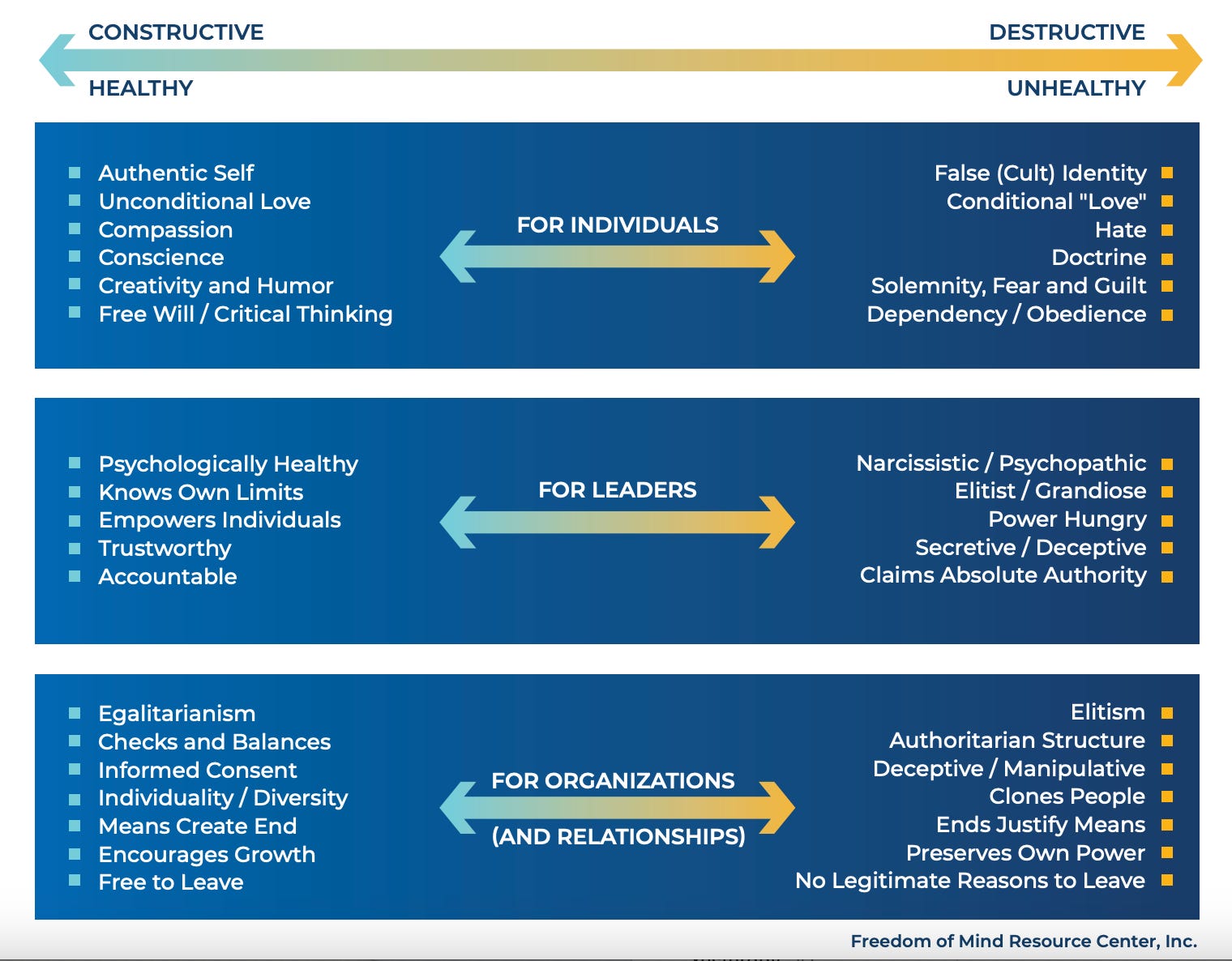
Organizations and relationships are unhealthy and destructive when they discourage people to think for themselves, are restrictive in the information people are able to receive, and discourage criticism and individuality.
This can happen in Mormonism (it happened for me), but it goes way beyond that. It can happen in emotionally abusive relationships, multi-level marketing businesses, wellness and self-improvement organizations, and religions across the board. It happens when people are told to not trust themselves and outsource their conscience instead.
So, learning to operate out of an internal locus of control is what I’m focusing on — feeling like I have the ability to think for myself and make my own decisions. This is more important to me than definitively labeling Mormonism as a cult. People can come to their own conclusions about that.
Below is a model from Hassan’s book that visually shows things to look for in yourself, in leaders, and organizations to maintain a healthy inner-locus of control:
When people get out of these unhealthy organizations, you see them look back on their times in that mindset and say “That wasn’t me.” Or they’ll say, “Everything inside was telling me this was wrong and something wasn’t right.”
What all these cult documentaries have in common is people acting against their own conscience because they were told somebody outside of themselves had absolute authority.
They turn over their bodies, their families, their rationalities, their logic, and their agency over to a leader or a philosophy that claims absolute truth.
People often comply not because they are gullible or dumb, but because most of the time, they have a sincere desire to please their leaders, which to them is synonymous with pleasing God.
I think a lot of people critiquing these organizations skip over this part — this desire people have to please God.
Their desires are sincere while their trust is misplaced. It hurts my heart when someone’s sincere desire to connect with God and their personal search for meaning in life is exploited.
Gaining a strong internal locus of control and building self-trust is not mutually exclusive with a belief in God or even belonging to a religion. I’ve often thought about how people’s view of God often impacts how they view others and themselves.
As their view of the world expands, their view of God can, too.
When I asked myself, “Am I in a cult?” I was really asking myself, “Am I free?”
I stopped myself from questioning my beliefs for so long because I was afraid to step away from the organization that I loved and was loyal to — one that was so embedded into my blood and into my social life — but most of all, I was afraid to lose my tender faith.
I went slowly for this reason. Questioning things a piece at a time, and understanding what I value and how I want to live my life. That tender faith is still an important part of who I am.
If you find yourself in a situation where your head is spinning, decisions are hard, you struggle to locate that inner-locus of control, and you feel choked with fear, I understand where you are. I’ve been there, too.
If I could tell myself anything while I was caught between faithfully serving on Sundays and trying to figure out if I was in a cult, I would say this:
Take everything as data. Note your feelings as data. Note inconsistencies as data. View church history as data. See everything for what it is: information. You do not need to be afraid of information. Information leads to a more informed path of worship.
As you collect your data, and you see patterns, trust what you see. Welcome thoughts and emotions as they come. Try new things. Demystify your fears. Notice how your connection to God doesn’t go away — it just expands.
“And ye shall know the truth, and the truth shall make you free.” — John 8:32
I’m right there with you,


Below, you will find this week’s Sunday Somethings. This is where I share my recommendations, insights, and favorites for the week. Have something you’d like to share, too? I’d love to hear from you in the comments and in the community chat!


“There is no gate, no lock, no bolt that you can set upon the freedom of my mind.”
― Virginia Woolf, A Room of One’s Own

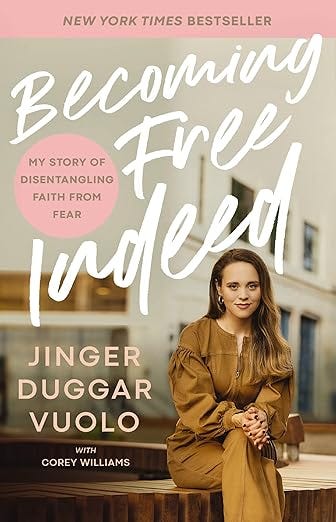
Becoming Free Indeed by Jinger Duggar Vuolo — this is a book that I read near the beginning of my faith journey that made a big impact on me. Jinger is one of the kids from the hit show 19 Kids and Counting. This book isn’t necessarily a “tell-all” — it’s not as much about her experience on the show (though that is a very interesting aspect) as it is about her journey shifting from a rigid belief system to a more merciful version of Christianity.

In honor of writing about cults today… I want to share some of my favorite cult documentaries:
Trust Me: The False Prophet — this is my favorite docuseries about the FLDS I’ve ever seen, and maybe the best docuseries period. The footage they have from the insider-view of the FLDS is incredible. It’s a heartbreaking story that I think showed very clearly the way cults can begin.
Dancing With the Devil — this is the docuseries I mentioned in my newsletter today. It definitely took some twists and turns I didn’t expect, and I found it to be very compelling. Definitely worth a watch!
Leah Remini: Scientology and the Aftermath — This is a docuseries that is so fascinating to watch because of how high-profile its creators are. They go deep into the way Scientology works. It was previously on Netflix, but I guess it was removed (my honest guess is threats from Scientology sponsors). Anyway! You can watch it on Tubi for free.
Kumare — this is a documentary that I watched recently. It was really interesting because it almost is a critique of spiritual leaders as a whole. An Indian-American man adopts a persona of Kumare, and he essentially fools people into thinking that he is a meditation Guru. It is an indie film, and can be watched entirely on Youtube! Give it a go!
Thank you, THANK YOU for reading Something for Sundays! If you enjoyed this post, please share with someone you know who might enjoy it too! ♥
Why some things will never be the same post faith deconstruction
On wanting to hope during IVF
Why I’m not trying to change the church
My experiences with church hopping
Reintegrating: melding together of Mormon me and current me
My current stance on the Book of Mormon
No posts
Comments
Nothing yet. Say the first thing.
Sign in to join the conversation.