
Seventy-five years ago, in the summer of 1951, millions of people took part in the Festival of Britain. Planned as a celebration of national renewal after the war, events took place around the UK. There were six exhibitions in London; the most famous was at the South Bank, where a new public space on the Thames was built in a boldly modernist style. Notable features were the large aluminium Dome of Discovery and the Skylon, a floating vertical steel spire. The architect Le Corbusier, who visited London in August 1951, described both admiringly in an interview for BBC radio:
Poetry was one of the arts encouraged by the Festival organisers, although the less-than-boldly-modernist verse it promoted, via a Penguin anthology of competition winners — excitingly titled Poems 1951 — was, as Roy Fuller wrote, “not… a volume that made the whiskers rise up”. A nineteen-year-old George Macbeth, meanwhile, gave the South Bank site itself a disillusioned review in verse. It began
That striking last line suggests the talent that would see Macbeth become a successful published poet. His South Bank poem, however, written during his last year at school, was placed third in the North-East Regional Festival of Britain Competition, which makes me wonder if the first and second prize-winners enjoyed their visit a bit more.
One poet who did relish the South Bank experience — if not so much the exhibition itself — was Dylan Thomas, who was commissioned by the BBC Welsh Home Service to deliver a fifteen-minute radio postcard. Thomas was a broadcaster of genius, and composed a prose rhapsody far more verbally vivid and inventive than it needed to be. His friend, Vernon Watkins, thought it was “the most dazzling” of all Thomas’s work for radio, and it may not be a coincidence that it marked the beginning of what his biographer, Constantine Fitzgibbon, called “his last true flowering as a poet”.
Following the recording and broadcast of his Festival talk in June 1951, Thomas would, over the summer and autumn, complete his final masterpieces: “Lament”, “Poem on His Birthday”, “Prologue”, and “Do Not Go Gentle into that Good Night”, as well as half of his radio drama Under Milk Wood (1954). It is Under Milk Wood’s exuberant pastoral of Llareggub life in particular that is audibly foreshadowed in the “magical and parochial” comic surrealism of “The Festival Exhibition, 1951”.
After a perfunctory overview of the exhibition space at the start of the broadcast, Thomas plunges into a long Dickensian paragraph describing all the people who are going round the wrong way. The visitor guide to the South Bank site was full of maps titled “THE WAY TO GO ROUND”, because
But Thomas was not especially interested in making sense of what he had seen — the “real eccentrics”, as he saw it, were those who though they could actually follow the story — and more in the poetic possibilities of recalling it all in tumbling crowds of words (some of the more ingenious puns here, such as the Skylon “rearing to be off”, and the riff on Shakespeare’s Mechanicals — “midsummer moonshine all fluting, snug, and copper-bottomed” — suggest he had absorbed the language of Finnegans Wake (1939)). Unfortunately, no recording survives, but here is “the whole bright boiling” of the script, from Quite Early One Morning: Broadcasts by Dylan Thomas (1954).
THE FESTIVAL EXHIBITION, 1951
The extent of the site of the exhibition on the South Bank of the Thames in the heart of London is four and a half acres. There are twenty-two pavilions in the exhibition, and thirteen restaurants, cafes, bars, and buffets.
Some people visit the twenty-two pavilions first, then glazed and crippled, windless, rudderless, and a little out of their minds, teeter, weeping, to one of the thirteen restaurants, cafes, bars, and buffets to find it packed to the dazzlingly painted and, possibly, levitating doors.
Other people visit all thirteen restaurants, cafes, bars, and buffets before attacking the pavilions, and rarely get further than the Dome of Discovery, which they find confusing, full, as it is, of totem poles, real dogs in snow, locusts, stars, the sun, the moon, things bubbling, thunder and lightning machines, chemical and physical surprises. And some never return.
Most people who wish, at the beginning, anyway, to make sense of the exhibition, follow the course indicated in the official guide-book — a series of conflicting arrows which lead many visitors who cannot understand these things slap-splash into the Thames — and work their way dutifully right through the land of Britain, the glaciers of twenty thousand years ago, and the inferno of blown desert sand which is now Birmingham, out at last into the Pavilion of Health — where, perhaps, they stop for an envious moment at the sign that says “Euthanasia” —and on to the netted and capstaned, bollarded, buoyed, sea-shelled, pebbly beautiful seaside of summer childhood gone.
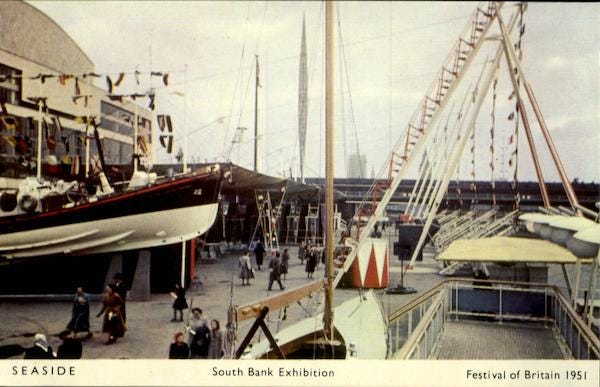
And other visitors begin, of course, at the end. They are the people without whom the exhibition could not exist, nor the country it trombones and floats in with its lions and unicorns made of ears of wheat, its birds that sing to the push of a button, its flaming water, and its raspberry fountains. They are the suspicious people over whose eyes no coloured Festival wool can possibly be pulled, the great undiddleable; they are the women who “will not queue on any account” and who smuggle in dyspeptic dogs; the strangely calculating men who think that the last pavilion must be first because it is number twenty-two; the people who believe they are somewhere else, and never find out they are not; sharp people who have been there before, who know the ropes, who chuckle to their country cousins: “You get double your money’s worth this way”; vaguely persecuted people, always losing their gloves, who know that the only way they could ever get around would be to begin at the end, which they do not want to; people of militant individuality who proclaim their right, as Englishmen, to look at the damfool place however they willynilly will; people nervously affected by all such occasions, who want to know only, “Where’s the place?”; timid people who want to be as far from the skylon as possible, because “you never know”; foreigners, who have been directed this way by a school of irresponsible wits; glassy benighted men who are trying to remember they must see something of the exhibition to remember before they go home and try to describe it to their families; young people, hand-in-love, who will giggle at whatever they see, at a goldfish in a pond, a model of the Queen Elizabeth, or a flint hammer; people too bored to yawn, long and rich as borzois, who, before they have seen it, have seen better shows in Copenhagen and San Francisco; eccentric people: men with their deerstalker caps tied with rope to their lapels, who carry dried nut sandwiches and little containers of yoghurt in hairy green knapsacks labelled “glass with care”; fat, flustered women in as many layers of coats as an onion or a cab-driver, hunting in a fever through fifty fluffed pockets to find a lost packet of bird-seed they are going to give to the parrots who are not there; old scaly sneezing men, born of lizards in a snuff-bin, who read, wherever they go, from books in tiny print, and who never look up, even at the tureen-lid of the just-tethered dome or the shining skylon, the skygoing nylon, the cylindrical leg-of-the future jetting, almost, to the exhibition of stars; real eccentrics: people who have come to the South Bank to study the growth and development of Britain from the Iron Age till now.
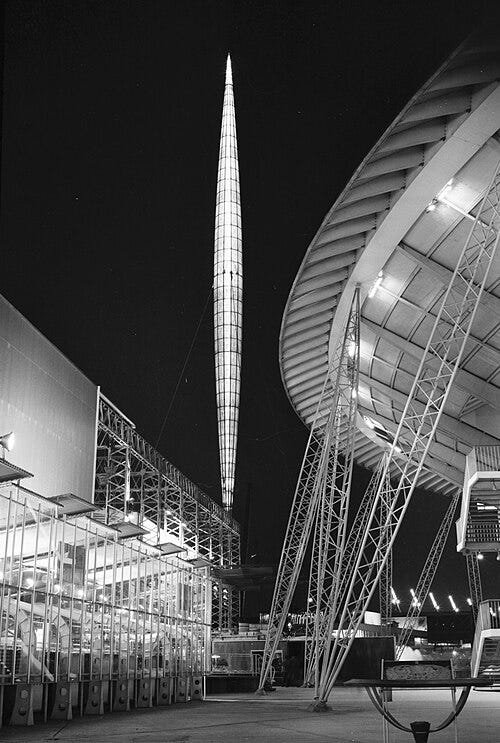
Here they will find no braying pageantry, no taxidermal museum of Culture, no cold and echoing inhuman hygienic barracks of technical information, no shoddily cajoling emporium of tasteless Empire wares, but something very odd indeed, magical and parochial: a parish-pump made of flying glass and thistledown gauze-thin steel, a rolypoly pudding full of luminous, melodious bells, wheels, coils, engines and organs, alembics and jorums in a palace in thunderland sizzling with scientific witches’ brews, a place of trains, bones, planes, ships, sheep, shapes, snipe, mobiles, marbles, brass bands, and cheese, a place painted regardless, and by hand.
Perhaps you’ll think I’m shovelling the colour on too thickly; that I am, as it were, speaking under the influence of strong pink. (And what a lot of pink —rose, raspberry, strawberry, peach, flesh, blush, lobster, salmon, tally-ho — there is, plastered and doodled all over this four-acre gay and soon-to-be-gone Festival City in sprawling London.) London: to many of us who live in the country, the Capital punishment. Perhaps you will go on a cool, dull day, sane as a biscuit, and find that the exhibition does, indeed, tell the story “of British contributions to world civilization in the arts of peace”; that, and nothing else. But I’m pleased to doubt it. Of course it is instructive; of course there is behind it an articulate and comprehensive plan; it can show you, unless you are an expert, more about, say, mineralogy or the ionosphere than you may want to know. It’s bursting its buttons, in an orderly manner, with knowledge. But what everyone I know, and have observed, seems to like most in it is the gay, absurd, irrelevant, delighting imagination that flies and booms and spurts and trickles out of the whole bright boiling; the small stone oddity that squints at you round a sharp, daubed comer; the sexless abstract sculptures serenely and secretly existing out of time in old cold worlds of their own in places that appear, but only for one struck second, inappropriate; the linked terra-cotta man and woman fly-defying gravity and elegantly hurrying up a w.c. wall; the sudden design of hands on another wall, as though the painter had said: “Oh, to the daft devil with what I’m doing,” and just slap-slap-slapped all over the ochre his spread out fingers and thumbs, ten blunt arrows, or as though large convict-birds, if there are any such, had waddled up the wall and webbed it as they went. You see people go along briskly down the wide white avenues towards the pavilion of their fancy — “Our Humbert’s dead keen on seeing the milk-separators” — and suddenly stop: another fancy swings or bubbles in front of their eyes. What is it they see? Indigo water waltzing to music. Row after row of rosy rolling balls spread on tall screens like the counting beads of Wellsian children fed on the food of the gods.

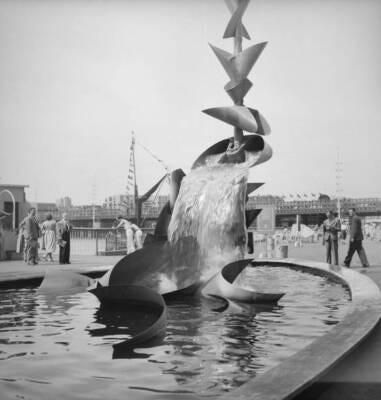
Sheets of asbestos tied on to nowhere, by nothing, for nothing is anchored here and at the clap of hands the whole gallimaufry could take off to Sousa and zoom up the flagged sky. Small childbook-painted mobiles along the bridges that, at a flick of wind, become windmills and thrum round at night like rainbows with arms. Or the steel-and-platinum figure — created by the Welsh engineer and architect, Richard Huws — of maybe a mer-woman standing, if that is the word for one who grows out of it, in arc-light water; she weeps as she is wept on; first her glinting breast, then another plane of her, tips, slides, shoots, shelves, swings, and sidles out to take, from the lake of her birth, one ton of water at a time to Handel’s Water Music, absorbs it, inhales it through dripping steel, then casts and cascades it off and out again. Or even the hundreds of little vivid steel chairs that look like hundreds of little vivid steel people sitting down.
In the pavilion called “The Natural Scene,” see the seals and eagles, the foxes and wild cats, of these still wild islands, and the natural history of owled and cuckooed, ottered, unlikely London. A great naked tree climbs in the middle of all, with prodigious butterflies and beetles on it. A blackbird lights up, and the aviary’s full of his singing; a thrush, a curlew, a skylark.
And, in the “Country,” see all the sculpted and woven loaves, in the shape of sheaves of wheat, in curls, plaits, and whirls. And men are thatching the roofs of cottages; and — what could be more natural? — the men are made of straw. And what a pleasure of baskets! Trugs, creels, pottles and punnets, heppers, dorsers and mounds, wiskets and whiskets. And if these are not the proper words, they should be.
In “The Lion and the Unicom” is celebrated, under flights of birds, the “British Character,” that stubborn, stupid, seabound, lyrical, paradoxical dark farrago of uppishness, derring-do, and midsummer moonshine all fluting, snug, and copper-bottomed. Justice, for some reason, looms in the midst of the Hall, its two big wigs back to back, its black and scarlet robes falling below. The body of justice is shelves of law books. The black spaces beneath the white wigs looks like the profiles of eagles. The white knight rides there too, too much a Don Quixote for my looking-glass land, and very potless and panless. A bravo-ing hand pats his plaster back, and tells him good night. There is a machine for, I believe, grinding smoke. And a tea-set, I failed to see, of salmon bones. But, in all this authentically eccentric exhibition, it is the Eccentrics’ Corner that is the most insipid. Some of the dullest exhibits in the pavilion are relieved by surrounding extravagance; but the department devoted to the rhapsodic inspirations of extravagance is by far the dullest. Why was not the exquisite talent utilized of the warlock who, offering his services to the Festival authorities, assured them he would, to order, throw a rainbow over the Thames? I wish he would throw a rainbow over me as I walk through the grey days. “Yes, we can tell it’s him coming,” the envious neighbours would murmur, “we recognize his rainbow.” And, on the balcony, there is a row of tiny theatres; in each, the stage is set for a Shakespearian play; and out of the theatres come the words of the players. If you’re in luck, something may go wrong with the works and Hamlet rant from Dunsinane.
In “Homes and Gardens”, blink at the grievous furniture, ugly as sin and less comfy. In the “Transport Pavilions”, goggle at the wizard diesels and the smashing, unpuffing streamlines and the miracle model railway for dwarf nabobs. Then, if there are by this time no spots in front of your eyes, go to the Telecinema and see them astonishingly all around you: spots with scarlet tadpole tails, and spottedly sinuous tintacks dancing with dissolving zebra heads, and blobs and nubbins and rubbery squirls receding, to zig-zag blasts of brass, down nasty polychrome corridors, a St Vitus’s gala of abstract shapes and shades in a St Swithin’s day of torrential dazzling darning needles. Sit still in the startling cinema and be kissed by a giraffe, who stretches his neck right out of the screen for you. Follow the deliberately coloured course of the Thames, the Royal River; the whispering water’s more like water than water ever was; closer, closer, comes the slow kingfisher-blue water and suddenly it ripples all over you: that’ll be the day when film stars do the same.
Go to the South Bank first by day; the rest of your times at night. Sit at a cafe table in the night of musical lights, by the radiant river, the glittering skylon above you rearing to be off, the lit pavilion, white, black, and silver in sweeps of stone and feathery steel, transplendent round you as you sip and think:
This is the first time I have ever truly seen that London whose sweet Thames runs softly; that minstrel mermaid of a town, the water-streeted eight-million headed village in a blaze. This is London, not the huge petty misshaped nightmare I used to know as I humdrummed along its graceless streets through fog and smoke and past the anonymous unhappy bodies lively as wet brollies. This Festival is London. The arches of the bridges leap into light; the moon clocks glow; the river sings; the harmonious pavilions are happy. And this is what London should always be like, till St Paul’s falls down and the sea slides over the Strand.
“The linked terra-cotta man and woman fly-defying gravity and elegantly hurrying up a w.c. wall” was Peter Laszlo Peri’s sculpture The Sunbathers — lost for decades after the Festival, but now on public display at Waterloo Station:
To mark the 75th anniversary of the Festival of Britain, the Southbank Centre has collected more visitor memories here:
Comments
Nothing yet. Say the first thing.
Sign in to join the conversation.