
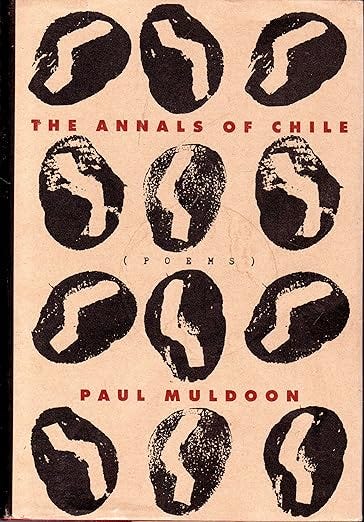
Thinking about Paul Muldoon’s anthology of sonnets last week sent me back to the one book of his own poetry which, for me, stands above all the rest. I’ve said before that I think The Annals of Chile (1994) is one of a handful of winners of the T.S. Eliot Prize for Poetry which can compare with the originality and ambition of Eliot in The Waste Land and Four Quartets. Like those works, it is not so much a collection of poems as a single multi-part composition with an intricate underlying structure which, when apprehended, increases the reader’s appreciation of each part.
The Annals of Chile begins with a series of shorter poems, but ends with a single long poem: “Yarrow”. I re-read “Yarrow” every year, never grasping everything I am reading, but carried along by an experience that reminds me of E.M. Forster’s description, in Aspects of the Novel (1927), of listening to Beethoven’s Fifth Symphony:
When the orchestra stops, we hear something that has never actually been played […] The opening movement, the andante, and the trio-scherzo-trio-finale-trio-finale that composes the third block, all enter into the mind at once, and extend one another into a common entity [...] the symphony as a whole.
Each section of “Yarrow” is a single sentence occupying a single page. None of them, read in isolation, would have anything like the effect they have when read together. This makes it a remarkably difficult poem to write about. So with Forster’s observation in mind, I am going to focus on the final section, and specifically what happens when I reach it and “hear something that has never actually been played”.
Before that, though, it may help to read the first section of “Yarrow” for orientation. In 1992, Paul Muldoon revisited his childhood family home — a farm in County Armagh, Northern Ireland — and found that the house and garden had changed almost beyond recognition. In the opening poem of “Yarrow”, this becomes an apocalyptic vision of floral wilderness overrunning cultivated land:
Little by little it dawned on us that the row
of kale would shortly be overwhelmed by these pink
and cream blooms, that all of uswould be overwhelmed, that even if my da
were to lose an arm
or a leg to the fly-wheelof a combine and be laid out on a tarp
in a pool of blood and oil
and my ma were to make one of her increasingly rareappeals to some higher power, some Deo
this or that, all would be swept away by the stream
that fanned across the land.
These twelve lines are the start of a poem of 1,193 lines in which ninety different end-sounds are recycled in an echoing pattern of repetition, rhyme and pararhyme (where the consonants remain stable but the vowels shift e.g. clock / click). Complex as this is, the poem is also constructed with an overall sense of symmetry that is intermittently audible, so — for example — the half-way point is marked by another twelve-line poem which echoes the end-sounds of the first (Pizarro / prink / alas etc.)
I’ll say more about how this works later, but now I want to jump forward to the final poem, in which all ninety end-sounds are repeated and made to rhyme loosely with each other in a single sentence of terza rima — the interlinking three-line stanza of Dante’s Divine Comedy (which rhymes aba bcb cdc etc). To give you some sense of how ingenious this in practice, here are the first lines of Muldoon’s envoi annotated with the recurring end-sounds they contain, as tabulated by David-Antoine Williams:
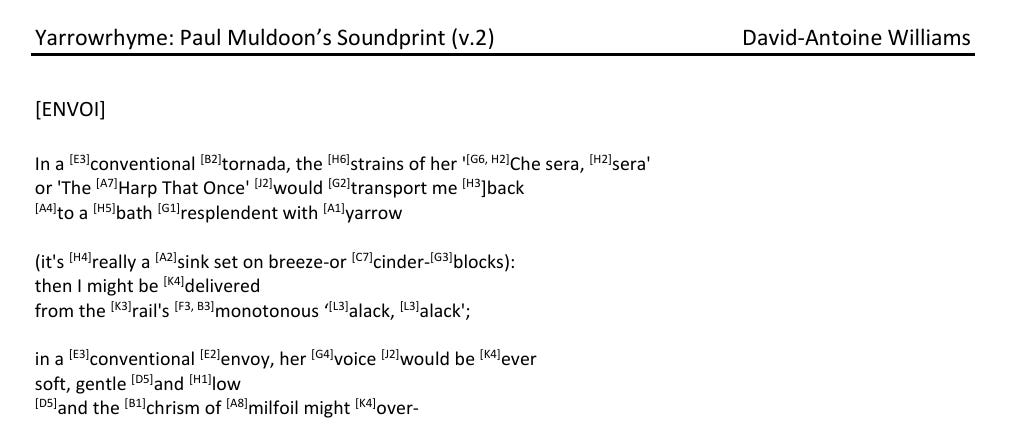
It’s a formally remarkable way to conclude a poem, tying up ninety loose ends. Read for sense, however, the final section of “Yarrow” is about failing to conclude. The speaker begins by meditating on the possibility of return, resolution and coming “full circle”:
In a conventional tornada, the strains of her “Che sera, sera”
or “The Harp That Once” would transport me back
to a bath resplendent with yarrow(it’s really a sink set on breeze- or cinder-blocks):
then I might be delivered
from the rail’s monotonous “alack, alack”;in a conventional envoy, her voice would be ever
soft, gentle and low
and the chrism of milfoil might over-flow
as the great wheel
came full circle
But the poem ends by confessing that mechanism of its “great cog” is faulty, as its train of thought gets lost at sea:
though it slips, the great cog,
there’s something about the quail’s “Wet-my-foot”
and the sink full of hart’s-tongue, borage and common kedlockthat I’ve either forgotten or disavowed;
it has to do with a trireme, laden with ravensara,
that was lost with all hands between Ireland and Montevideo.
These lines leave the speaker poised between a “conventional tornada” or “envoy” — that is, the formal conclusion of a troubadour lyric, reiterating its theme — and something more unfinished and mysterious: something to do with a trireme (an ancient galley ship), laden with ravensara (another word for clove nutmeg), lost along an unlikely North-South Atlantic trade route for a cargo of spice native to Madagascar.
The terms “tornada” and “envoy” (or envoi) alert us to the extraordinary structure of the whole poem, which is based on the sestina: a lyric form of seven stanzas which repeats the same six end-words in six different ways, and then again in a three-line envoi. One definition of its circling yet mercurial poetic character comes from the Comte de Gramont, as quoted in the New Princeton Encyclopaedia of Poetry and Poetics:
[A sestina is] a reverie in which the same ideas, the same objects, occur to the mind in a succession of different aspects, which nonetheless resemble one another, fluid and changing shape like the clouds in the sky.
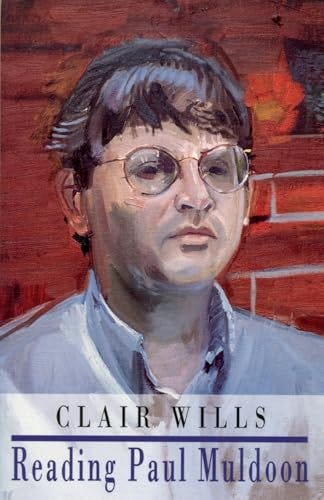
Muldoon has described “Yarrow” as being made of “twelve, intercut, exploded sestinas”. But as Claire Wills notes in her critical study Reading Paul Muldoon (1998), “this is, in fact, a little misleading for the twelve rhymed poems which form the template are not strictly sestinas, since they contain twelve, nine or six lines”.
One meaning of “the great wheel” which comes full circle in Muldoon’s envoi, then, is the poem’s form. For not only does “Yarrow” revolve its obsessions section by section, it also returns upon itself in an elaborate formal chiasmus — or palindrome — by which the rhyme-combinations of the first seventy-four sections are reflected in reverse order by the last seventy-four. Thus, the final 12-line poem before the envoi repeats, again, the end-sounds of the first poem: -row, -ink, us, -da, -arm, wheel, -arp, oil, rare, deo, -ream, -and.
And yet, as Muldoon’s envoi indicates, although the poem comes full circle, the emotional circle it describes is — like its rhymes — imperfect. The poet wants to be delivered from his lament by the “soft gentle and low” voice of a loved woman. But this is, ironically, a literary allusion with tragic resonance, a line originally spoken by King Lear as he mourns his daughter Cordelia, lying dead in his arms (“Her voice was ever soft / Gentle and low” — the last of several allusions to Lear in the poem). Similarly, “the chrism of milfoil” that the poet imagines “might overflow” and relieve his grief would be a healing ointment made from common yarrow, also known as milfoil (thousand-leaved) or Achillea millefolium — because, according to folklore, Achilles used it to stanch his wounds after the battle of Troy. But Achilles, of course, eventually died of a wound nevertheless.
The wishful poet seems to imply that his grief would be healed in a “conventional” envoi. But there is nothing unconventional about an emotionally unresolved sestina. The envoi is not, necessarily, a happy ending — rather, it reiterates with condensed force the emotions that precipitated the poem (e.g. Elizabeth Bishop’s “Sestina”). In order to understand what is less “conventional” about the end of “Yarrow” as a poem of grief, we need to circle back to the longest poem in the first part of The Annals of Chile, “Incantata”, a 360-line elegy for Muldoon’s lover, the artist Mary Farl Powers.
Comments
Nothing yet. Say the first thing.
Sign in to join the conversation.