
By Luke Burgis
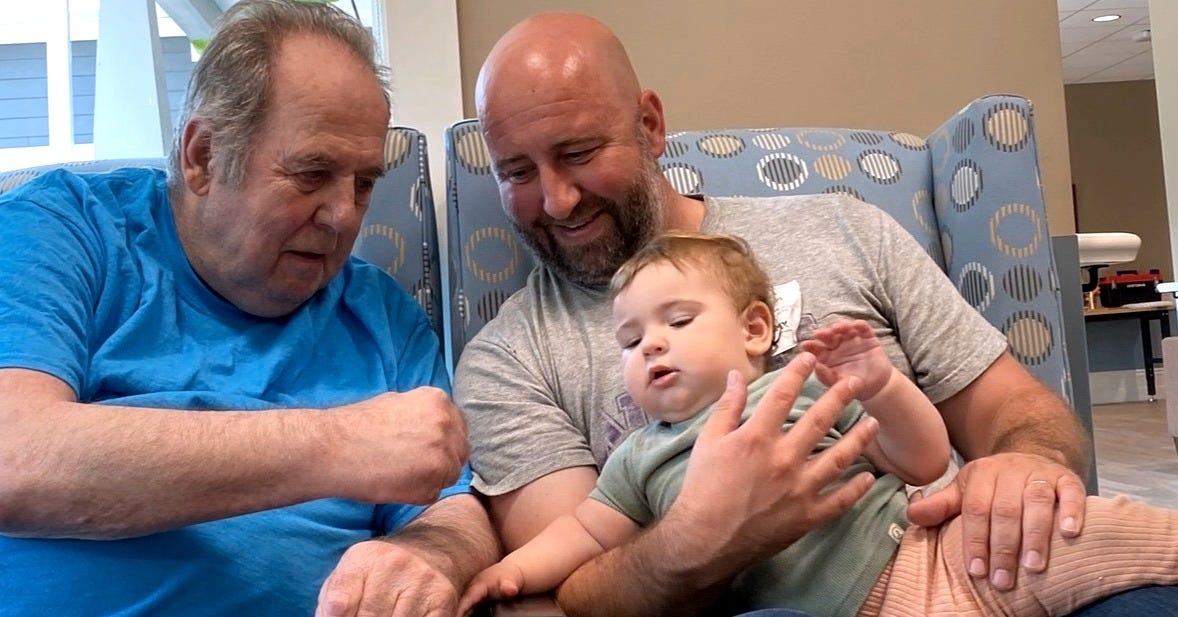
When I was 39, I was traveling out of state and grew concerned when my mother stopped responding to texts and calls. My aunt and uncle went to her house and discovered a nightmare that would change my life forever. They found my mother catatonic in bed, and my father puttering around as if nothing was wrong. He thought she was taking a nap. In reality, my mother had suffered a sudden, catastrophic health decline—and my father was disappearing into the fog of undiagnosed Alzheimer’s disease.
I returned home in shock to peel back the layers of a miserable onion. My mother had been my father’s sole caregiver for five years, since the disease had become debilitating—but there had been signs going back almost a decade. Her fear of confronting Alzheimer’s was too great, so she ignored it as his faculties slipped away. Then when she needed him most, when urgent medical attention could have saved her life, he didn’t have the presence of mind to respond. By the time I arrived, it was too late. She was dead in a week.
As an only child, confronting my own abrupt transition to caregiver was jarring but transformative. I quickly learned everything I could about Alzheimer’s disease—what causes it, what happens to people who develop it, what I could do to help—and I was left with more questions than answers. It is a complex, mysterious disease of the mind, the dissolution of memory and meaning even as the soul burns bright. There are treatments, given early, that can slow it down and in rare cases even restore cognitive function. But doctors soon confirmed that for my father that window had closed.
In the throes of this tragedy, I discovered an unlikely gift: though it was too late to save my father’s mind, there was still time to save my own.
We live in an atomized society where there is little social fabric lying between the self and the crowd, the person and State, an individual and the broader community of which they are a part. I call this the problem of The One and the Ninety-Nine. One hundred represents the whole, and each person must increasingly fend for themselves within it.
Without a world to think about, without other people to activate ideas, and without other people who take the time to deeply know us, we ourselves forget who we are because we can’t properly exercise our minds and our memories. Social isolation starves the mind of the very thing it needs to survive.
While my dad’s mind failed, the things he never ceased remembering were the things most deeply embedded within him: his time as a paratrooper in the 101st Airborne division with a band of brothers, his parachuting friends, his Teamsters Union leaders, his golfing buddies and the regular customers at the store that he bought and worked for the last fifteen years of his life, before his memory faded. It was those close associations of small groups of people which faded last, and many of them he still remembers today.
We don’t get a lot of things to care about in this life—and the ones that we do get deserve sustained attention, not distracted minds. Nowhere is that more important than in our own families, and the close circles of friends and other people who are near enough to us to actually notice when we’re gone. My parents were isolated after they retired, and I noticed a very clear and direct correlation between that isolation and the acceleration of their health problems. A mind that loses the opportunity to interact and contend with other living, embodies, active minds quickly loses its ability to function well. It begins a rapid decline.
My dad’s dementia diagnoses was an impetus for me not simply to exercise and take better care of my “brain health”, but to invest in that dance of minds with a group of five to seven people outside of my family who would miss my own when it’s gone someday. I have had to intentionally seek them out, but it has been the most rewarding journey that I’ve taken so far. I owe it to my daughters, as a new father. I owe it to my dad. I owe it to myself.
The suffering that millions of Americans shoulder every year—dementia, disease, and loss—presents a rare opportunity to move beyond prevention and into intention: in the space between the one and the ninety-nine, finding two, three, four, five, six, or seven. They are the ones who will be there to think about—and to think about you—even if someday your own brain should fail. They are remainders that the mind, unlike the brain, is not an individual thing but a social one.
And if you don’t know where to begin, just think about one person right now whose minds you would like to begin dancing with.
Luke Burgis is Founder and Director of the Cluny Institute, and author of The One and the Ninety-Nine: Forging Identity in the Age of Social Contagion.
No posts
Comments
Nothing yet. Say the first thing.
Sign in to join the conversation.